Tag: score improvement

  • Simple Probability: Basic Concepts & Real-Life Applications | ACT Math Guide

    Simple Probability: Basic Concepts & Real-Life Applications | ACT Math Guide

    Probability is one of the most practical and frequently tested concepts in the ACT Math section. Whether you’re calculating the chances of rolling a specific number on a die, drawing a particular card from a deck, or predicting weather patterns, probability helps us understand and quantify uncertainty. This fundamental pre-algebra topic appears regularly on the ACT, and mastering it can significantly boost your math score while building critical thinking skills you’ll use throughout life. For more comprehensive ACT preparation strategies, explore our complete collection of study resources.

    🎯

    ACT SCORE BOOSTER: Master This Topic for 2-3 Extra Points!

    Probability questions appear in most ACT Math tests (typically 2-4 questions per test). Understanding basic probability thoroughly can add 2-3 points to your composite score. Let’s break it down with proven strategies that work!

    🚀 Jump to ACT Strategy →

    ⚡ Quick Answer: What is Probability?

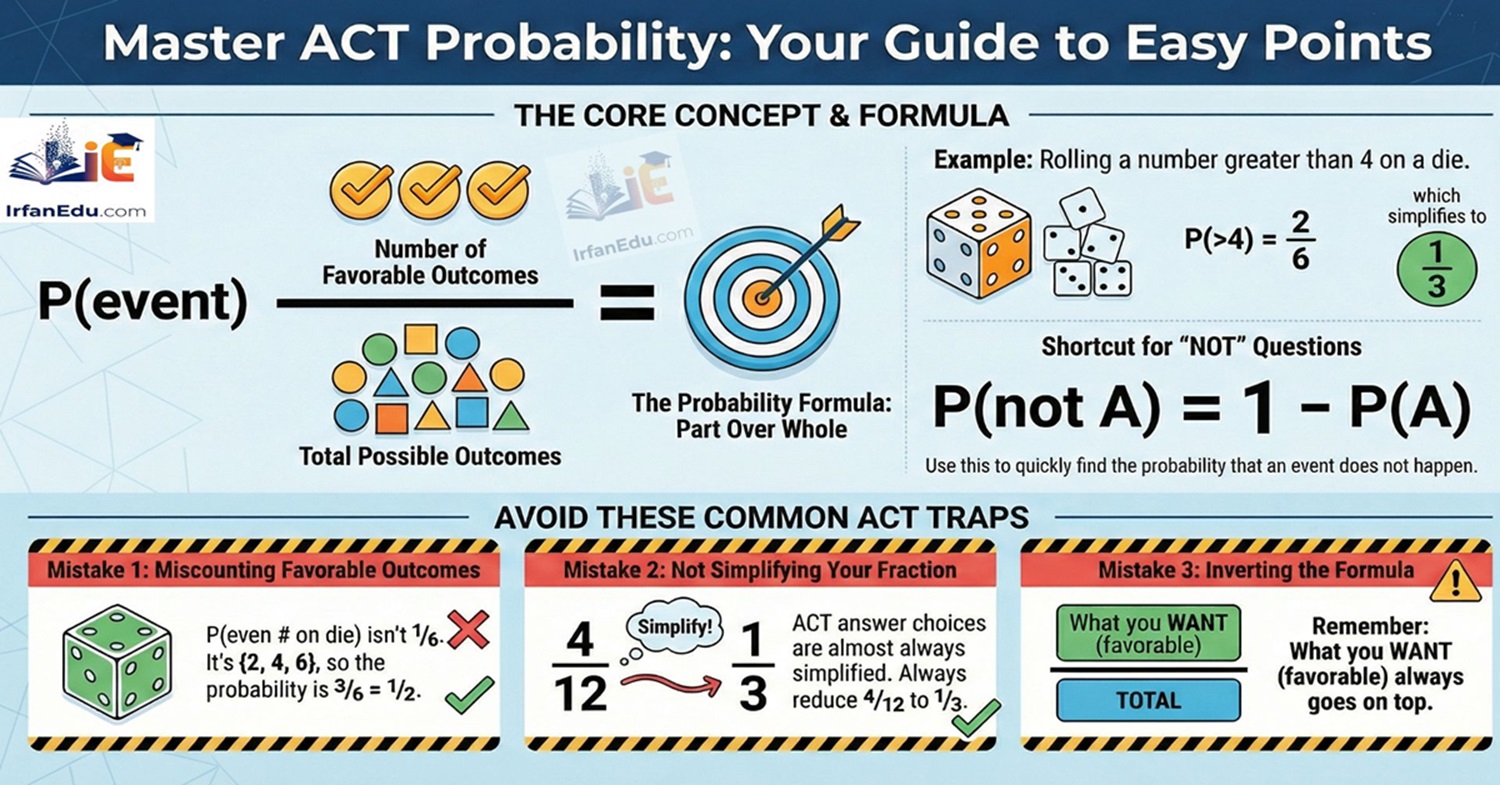
    Probability is a measure of how likely an event is to occur. It’s expressed as a number between 0 and 1 (or 0% to 100%), where 0 means impossible and 1 means certain. The basic formula is:

    $$P(\text{event}) = \frac{\text{Number of favorable outcomes}}{\text{Total number of possible outcomes}}$$

    Example: The probability of rolling a 4 on a standard die is $$\frac{1}{6}$$ because there’s 1 favorable outcome (rolling a 4) out of 6 possible outcomes (1, 2, 3, 4, 5, 6).

    📚 Understanding Simple Probability

    Probability is the mathematical study of chance and uncertainty. In everyday life, we use probability constantly—from checking weather forecasts (70% chance of rain) to making decisions based on likely outcomes. On the ACT, probability questions test your ability to calculate the likelihood of events occurring, often in contexts involving coins, dice, cards, spinners, or real-world scenarios.

    Why is probability important for the ACT? According to the official ACT website, probability questions appear regularly on the ACT Math section, typically 2-4 questions per test. These questions are often straightforward if you understand the basic concepts, making them excellent opportunities to secure quick points. Additionally, probability connects to other math topics like fractions, ratios, and percentages—skills that appear throughout the test.

    Key concepts you’ll master:

    • Basic probability formula and calculations
    • Understanding favorable vs. total outcomes
    • Converting between fractions, decimals, and percentages
    • Complementary probability (finding “not” probabilities)
    • Real-life applications and word problems

    📐 Key Formulas & Rules

    1. Basic Probability Formula

    $$P(\text{event}) = \frac{\text{Number of favorable outcomes}}{\text{Total number of possible outcomes}}$$

    When to use: For any single event probability calculation

    2. Probability Range

    $$0 \leq P(\text{event}) \leq 1$$

    Remember: Probability is always between 0 (impossible) and 1 (certain)

    3. Complementary Probability

    $$P(\text{not A}) = 1 – P(\text{A})$$

    When to use: To find the probability that an event does NOT occur

    4. Probability as Percentage

    $$P(\text{event as %}) = P(\text{event}) \times 100\%$$

    Example: $$\frac{1}{4} = 0.25 = 25\%$$

    💡 Memory Tip: Think of probability as “part over whole” – just like fractions! The favorable outcomes are the “part” you want, and total outcomes are the “whole” of all possibilities.

    ✅ Step-by-Step Examples

    Example 1: Coin Flip Probability

    Problem:

    What is the probability of flipping a fair coin and getting heads?

    Step 1: Identify what’s given and what’s asked

    • We’re flipping a fair coin (2 sides: heads and tails)
    • We want to find: P(heads)

    Step 2: Determine the total number of possible outcomes

    A coin has 2 sides, so there are 2 possible outcomes: heads or tails

    Step 3: Determine the number of favorable outcomes

    We want heads, and there is 1 way to get heads

    Step 4: Apply the probability formula

    $$P(\text{heads}) = \frac{\text{Number of favorable outcomes}}{\text{Total number of outcomes}} = \frac{1}{2}$$

    Step 5: Convert to decimal or percentage (if needed)

    $$\frac{1}{2} = 0.5 = 50\%$$

    ✓ Final Answer: $$\frac{1}{2}$$ or 0.5 or 50%

    ⏱️ Time estimate: 30-45 seconds on the ACT

    Example 2: Rolling a Die

    Problem:

    What is the probability of rolling a number greater than 4 on a standard six-sided die?

    Step 1: Identify what’s given and what’s asked

    • Standard die with 6 faces (numbered 1, 2, 3, 4, 5, 6)
    • We want: P(number > 4)

    Step 2: Determine the total number of possible outcomes

    A die has 6 faces, so there are 6 possible outcomes

    Step 3: Determine the number of favorable outcomes

    Numbers greater than 4 are: 5 and 6
    That’s 2 favorable outcomes

    Step 4: Apply the probability formula

    $$P(\text{number} > 4) = \frac{2}{6} = \frac{1}{3}$$

    Step 5: Simplify and verify

    $$\frac{1}{3} \approx 0.333 \approx 33.3\%$$

    ✓ Final Answer: $$\frac{1}{3}$$ or approximately 0.333 or 33.3%

    ⏱️ Time estimate: 45-60 seconds on the ACT

    ⚠️ Common Pitfall: Students sometimes forget to simplify fractions. Always reduce to lowest terms: $$\frac{2}{6} = \frac{1}{3}$$

    Example 3: Complementary Probability

    Problem:

    A bag contains 5 red marbles and 3 blue marbles. If you randomly select one marble, what is the probability that it is NOT red?

    Step 1: Identify what’s given and what’s asked

    • 5 red marbles + 3 blue marbles = 8 total marbles
    • We want: P(NOT red)

    Step 2: Method 1 – Direct calculation

    “NOT red” means blue
    Number of blue marbles: 3
    Total marbles: 8
    $$P(\text{NOT red}) = \frac{3}{8}$$

    Step 3: Method 2 – Using complementary probability

    First find P(red): $$P(\text{red}) = \frac{5}{8}$$
    Then use complement formula: $$P(\text{NOT red}) = 1 – P(\text{red}) = 1 – \frac{5}{8} = \frac{3}{8}$$

    Step 4: Convert to decimal/percentage

    $$\frac{3}{8} = 0.375 = 37.5\%$$

    ✓ Final Answer: $$\frac{3}{8}$$ or 0.375 or 37.5%

    ⏱️ Time estimate: 60-75 seconds on the ACT

    💡 ACT Tip: The complement method is especially useful when it’s easier to calculate what you DON’T want than what you DO want!

    📝

    Ready to Test Your Knowledge?

    Take our full-length ACT practice test and see how well you’ve mastered this topic. Get instant scoring, detailed explanations, and personalized recommendations!

    🚀 Start ACT Practice Test Now →
    Full-Length Tests
    Instant Scoring
    Detailed Solutions

    🌍 Real-World Applications

    Probability isn’t just an abstract math concept—it’s everywhere in daily life and professional fields:

    🌦️ Weather Forecasting

    Meteorologists use probability to predict rain chances, helping you decide whether to bring an umbrella.

    🏥 Medical Diagnosis

    Doctors use probability to assess disease risk and determine the most effective treatments based on success rates.

    📊 Business & Finance

    Companies use probability for risk assessment, market analysis, and predicting customer behavior.

    🎮 Game Design

    Video game developers use probability to create balanced gameplay mechanics and reward systems.

    College courses that build on probability: Statistics, Data Science, Economics, Psychology Research Methods, Engineering, Computer Science (algorithms and AI), and Business Analytics.

    Why the ACT tests probability: It’s a fundamental skill for data literacy in the modern world. Understanding probability helps you make informed decisions, evaluate claims critically, and interpret data—essential skills for college success and beyond.

    ⚠️ Common Mistakes to Avoid

    ❌ Mistake #1: Forgetting to Count All Outcomes

    Wrong: “What’s the probability of rolling an even number on a die?” → $$\frac{1}{6}$$
    Right: Even numbers are 2, 4, and 6 (3 outcomes) → $$\frac{3}{6} = \frac{1}{2}$$
    Fix: Always list out all favorable outcomes before counting!

    ❌ Mistake #2: Not Simplifying Fractions

    Wrong: Leaving answer as $$\frac{4}{12}$$
    Right: Simplify to $$\frac{1}{3}$$
    Fix: Always reduce fractions to lowest terms. ACT answer choices are typically simplified!

    ❌ Mistake #3: Confusing “And” vs. “Or” Probabilities

    Problem: For basic ACT probability, focus on single events. If you see “and” or “or,” read carefully!
    Fix: “Or” usually means add favorable outcomes; “and” for independent events means multiply (covered in advanced probability).

    ❌ Mistake #4: Getting Probability Greater Than 1

    Red Flag: If your answer is greater than 1 (or 100%), you made an error!
    Fix: Double-check that favorable outcomes ≤ total outcomes. Probability can never exceed 1.

    ❌ Mistake #5: Mixing Up Numerator and Denominator

    Wrong: $$P = \frac{\text{total outcomes}}{\text{favorable outcomes}}$$
    Right: $$P = \frac{\text{favorable outcomes}}{\text{total outcomes}}$$
    Memory Trick: “What you WANT over what’s POSSIBLE” (favorable/total)

    📝 ACT-Style Practice Questions

    Test your understanding with these ACT-style probability problems. Try solving them on your own before checking the solutions!

    Practice Question 1 BASIC

    A spinner is divided into 8 equal sections numbered 1 through 8. What is the probability of spinning a number less than 4?

    A) $$\frac{1}{8}$$
    B) $$\frac{1}{4}$$
    C) $$\frac{3}{8}$$
    D) $$\frac{1}{2}$$
    E) $$\frac{5}{8}$$
    Show Solution

    ✓ Correct Answer: C) $$\frac{3}{8}$$

    Solution:

    • Numbers less than 4: 1, 2, and 3 (that’s 3 favorable outcomes)
    • Total sections: 8
    • $$P(\text{number} < 4) = \frac{3}{8}$$

    ⏱️ Target time: 30-40 seconds

    Practice Question 2 INTERMEDIATE

    A jar contains 12 red balls, 8 blue balls, and 5 green balls. If one ball is randomly selected, what is the probability that it is NOT blue?

    A) $$\frac{8}{25}$$
    B) $$\frac{12}{25}$$
    C) $$\frac{17}{25}$$
    D) $$\frac{3}{5}$$
    E) $$\frac{4}{5}$$
    Show Solution

    ✓ Correct Answer: C) $$\frac{17}{25}$$

    Solution:

    • Total balls: 12 + 8 + 5 = 25
    • NOT blue means red OR green: 12 + 5 = 17 favorable outcomes
    • $$P(\text{NOT blue}) = \frac{17}{25}$$

    Alternative method (complement):

    • $$P(\text{blue}) = \frac{8}{25}$$
    • $$P(\text{NOT blue}) = 1 – \frac{8}{25} = \frac{25}{25} – \frac{8}{25} = \frac{17}{25}$$

    ⏱️ Target time: 60-75 seconds

    Practice Question 3 INTERMEDIATE

    A standard deck of 52 playing cards contains 4 suits (hearts, diamonds, clubs, spades) with 13 cards in each suit. What is the probability of randomly drawing a heart from the deck?

    A) $$\frac{1}{13}$$
    B) $$\frac{1}{4}$$
    C) $$\frac{4}{13}$$
    D) $$\frac{1}{3}$$
    E) $$\frac{1}{2}$$
    Show Solution

    ✓ Correct Answer: B) $$\frac{1}{4}$$

    Solution:

    • Total cards in deck: 52
    • Number of hearts: 13 (one full suit)
    • $$P(\text{heart}) = \frac{13}{52} = \frac{1}{4}$$

    💡 ACT Tip: Know standard deck facts: 52 cards total, 4 suits of 13 cards each. This appears frequently!

    ⏱️ Target time: 45-60 seconds

    Practice Question 4 ADVANCED

    In a class of 30 students, 18 play basketball, and 12 do not play basketball. If a student is randomly selected, what is the probability, expressed as a percent, that the student plays basketball?

    A) 18%
    B) 40%
    C) 50%
    D) 60%
    E) 66%
    Show Solution

    ✓ Correct Answer: D) 60%

    Solution:

    • Total students: 30
    • Students who play basketball: 18
    • $$P(\text{plays basketball}) = \frac{18}{30} = \frac{3}{5}$$
    • Convert to percent: $$\frac{3}{5} = 0.6 = 60\%$$

    💡 Key Point: When the question asks for a percent, don’t forget the final conversion step! $$\frac{3}{5} \times 100\% = 60\%$$

    ⏱️ Target time: 60-75 seconds

    💡 ACT Pro Tips & Tricks

    ✨ Tip #1: The “Part Over Whole” Memory Trick

    Think of probability as a fraction where the numerator is the “part you want” and the denominator is the “whole of all possibilities.” This simple mental model prevents mix-ups!

    ⚡ Tip #2: List It Out for Complex Problems

    When favorable outcomes aren’t obvious, write them down! For “rolling greater than 4 on a die,” list: {5, 6}. This takes 5 seconds but prevents counting errors.

    🎯 Tip #3: Use Complement for “NOT” Questions

    When you see “NOT,” “at least one,” or “none,” consider using $$P(\text{NOT A}) = 1 – P(\text{A})$$. It’s often faster than counting all the “not” outcomes!

    🔍 Tip #4: Check Answer Reasonableness

    Ask yourself: “Does this make sense?” If you get $$\frac{5}{3}$$ or 150%, you made an error. Probability must be between 0 and 1 (or 0% and 100%).

    📊 Tip #5: Know Common Probability Scenarios

    Memorize these: Coin flip = $$\frac{1}{2}$$, Single die number = $$\frac{1}{6}$$, Card suit = $$\frac{1}{4}$$, Specific card = $$\frac{1}{52}$$. Knowing these saves time!

    ⏱️ Tip #6: Time Management Strategy

    Basic probability questions should take 45-90 seconds. If you’re stuck after 90 seconds, make your best guess, mark it for review, and move on. You can always return!

    🎯 ACT Test-Taking Strategy for Probability

    ⏰ Time Allocation

    Allocate 45-90 seconds for basic probability questions. These are typically straightforward once you identify the favorable and total outcomes. If a problem involves multiple steps or complementary probability, allow up to 2 minutes. Don’t spend more than 2 minutes on any single probability question—mark it and return if needed.

    🎲 When to Skip and Return

    Skip if: (1) You can’t identify what the “favorable outcomes” are after 30 seconds, (2) The problem involves unfamiliar terminology, or (3) It requires multiple probability concepts you’re unsure about. Mark it, move on, and return with fresh eyes. Sometimes later questions trigger insights!

    🎯 Strategic Guessing

    If you must guess, eliminate impossible answers first. Remember: probability must be between 0 and 1. Eliminate any answer greater than 1 or less than 0. Also eliminate answers that don’t make intuitive sense (e.g., if more than half the outcomes are favorable, the probability should be greater than $$\frac{1}{2}$$).

    ✅ Quick Check Method

    After solving, spend 5-10 seconds checking: (1) Is your answer between 0 and 1? (2) Did you simplify the fraction? (3) Does it match the answer format requested (fraction, decimal, or percent)? (4) Does it make logical sense? This quick check catches 90% of errors!

    ⚠️ Common Trap Answers

    Watch for these ACT traps: (1) Unsimplified fractions ($$\frac{2}{6}$$ instead of $$\frac{1}{3}$$) – usually wrong, (2) Inverted fractions (total/favorable instead of favorable/total), (3) Wrong format (giving 0.25 when they asked for a percent), (4) Counting errors (missing one favorable outcome). The ACT designs wrong answers based on common mistakes!

    🏆 Score Boost Strategy: Probability questions are among the most “gettable” points on the ACT Math section. Master the basic formula and practice 10-15 problems, and you can reliably score points on every probability question you encounter. This alone can add 2-3 points to your Math score!

    🎥 Video Explanation

    Watch this detailed video explanation to understand the concept better with visual demonstrations and step-by-step guidance.

    ❓ Frequently Asked Questions

    Q1: Can probability ever be greater than 1 or less than 0?

    No, never! Probability always falls between 0 and 1 (inclusive). A probability of 0 means the event is impossible, 1 means it’s certain, and any value in between represents the likelihood. If you calculate a probability greater than 1 or less than 0, you’ve made an error—likely mixing up the numerator and denominator or counting outcomes incorrectly.

    Q2: What’s the difference between theoretical and experimental probability?

    Theoretical probability is what we calculate using the formula $$\frac{\text{favorable}}{\text{total}}$$ based on the possible outcomes (e.g., probability of heads = $$\frac{1}{2}$$). Experimental probability is based on actual trials (e.g., if you flip a coin 100 times and get 47 heads, experimental probability = $$\frac{47}{100}$$). The ACT primarily tests theoretical probability, though you should understand both concepts.

    Q3: How do I convert between fractions, decimals, and percentages for probability?

    Fraction to decimal: Divide the numerator by denominator ($$\frac{3}{4} = 3 \div 4 = 0.75$$). Decimal to percent: Multiply by 100 ($$0.75 \times 100 = 75\%$$). Percent to decimal: Divide by 100 ($$75\% \div 100 = 0.75$$). Percent to fraction: Put over 100 and simplify ($$75\% = \frac{75}{100} = \frac{3}{4}$$). Always read the question carefully to see which format is requested!

    Q4: What does “mutually exclusive” mean in probability?

    Events are mutually exclusive if they cannot happen at the same time. For example, when rolling a die, getting a 3 and getting a 5 are mutually exclusive—you can’t roll both on a single roll. However, “rolling an even number” and “rolling a number greater than 3” are NOT mutually exclusive because you could roll a 4 or 6 (which satisfy both conditions). For basic ACT probability, you mainly need to recognize when outcomes can’t overlap.

    Q5: How often does probability appear on the ACT Math section?

    Probability typically appears in 2-4 questions per ACT Math test (out of 60 total questions). While that might seem small, these questions are often straightforward and represent “easy points” if you understand the basic concepts. Additionally, probability connects to statistics questions, which appear another 4-6 times per test. Together, probability and statistics make up about 10-15% of the Math section—making it definitely worth your study time!

    Dr. Irfan Mansuri

    ✍️ Written by Dr. Irfan Mansuri

    Educational Content Creator & Competitive Exam Specialist

    IrfanEdu.com • United States

    Dr. Irfan Mansuri is a distinguished educational content creator and competitive exam specialist with over 15 years of experience spanning high school, undergraduate, and postgraduate levels. As the founder of IrfanEdu.com, he has successfully guided thousands of students through various competitive examinations, helping them achieve exceptional results and gain admission to their dream institutions.

    15+ years in competitive exam preparation Certified Instructor LinkedIn Profile

    📚 Continue Your ACT Math Journey

    Now that you’ve mastered simple probability, explore more ACT prep resources to build a complete foundation:

    • Statistics and Data Analysis (mean, median, mode)
    • Ratios and Proportions
    • Percentages and Percent Change
    • Fractions and Decimals Operations
    • Advanced Probability (compound events)

    💪 Practice Makes Perfect: Solve at least 10-15 probability problems from official ACT practice tests to solidify these concepts. The more you practice, the faster and more accurate you’ll become on test day!

    🎯 Ready to Boost Your ACT Score?

    You’ve learned the fundamentals of probability—now it’s time to practice and apply these strategies on real ACT questions. Remember: every probability question you master is 2-3 potential points added to your score!

    Keep practicing, stay confident, and watch your ACT Math score soar! 🚀

    Simple Probability: Basic Concepts & Real-Life Applications | ACT Math Guide for Grades 9-12

    [pdf_viewer id=”138″]

  • Understanding and Solving Absolute Value Equations | ACT Math Guide

    Understanding and Solving Absolute Value Equations | ACT Math Guide

    Understanding and Solving Absolute Value Equations | ACT Math Guide

    Absolute value equations can seem intimidating at first, but once you understand the core concept, they become one of the most straightforward topics in Pre-Algebra and ACT Math. Whether you’re in 9th grade just learning the basics or a 12th grader preparing for the ACT, mastering absolute value equations is essential for building a strong mathematical foundation and boosting your test scores. For more ACT prep resources, explore our comprehensive study materials.

    🎯

    ACT SCORE BOOSTER: Master This Topic for 2-3 Extra Points!

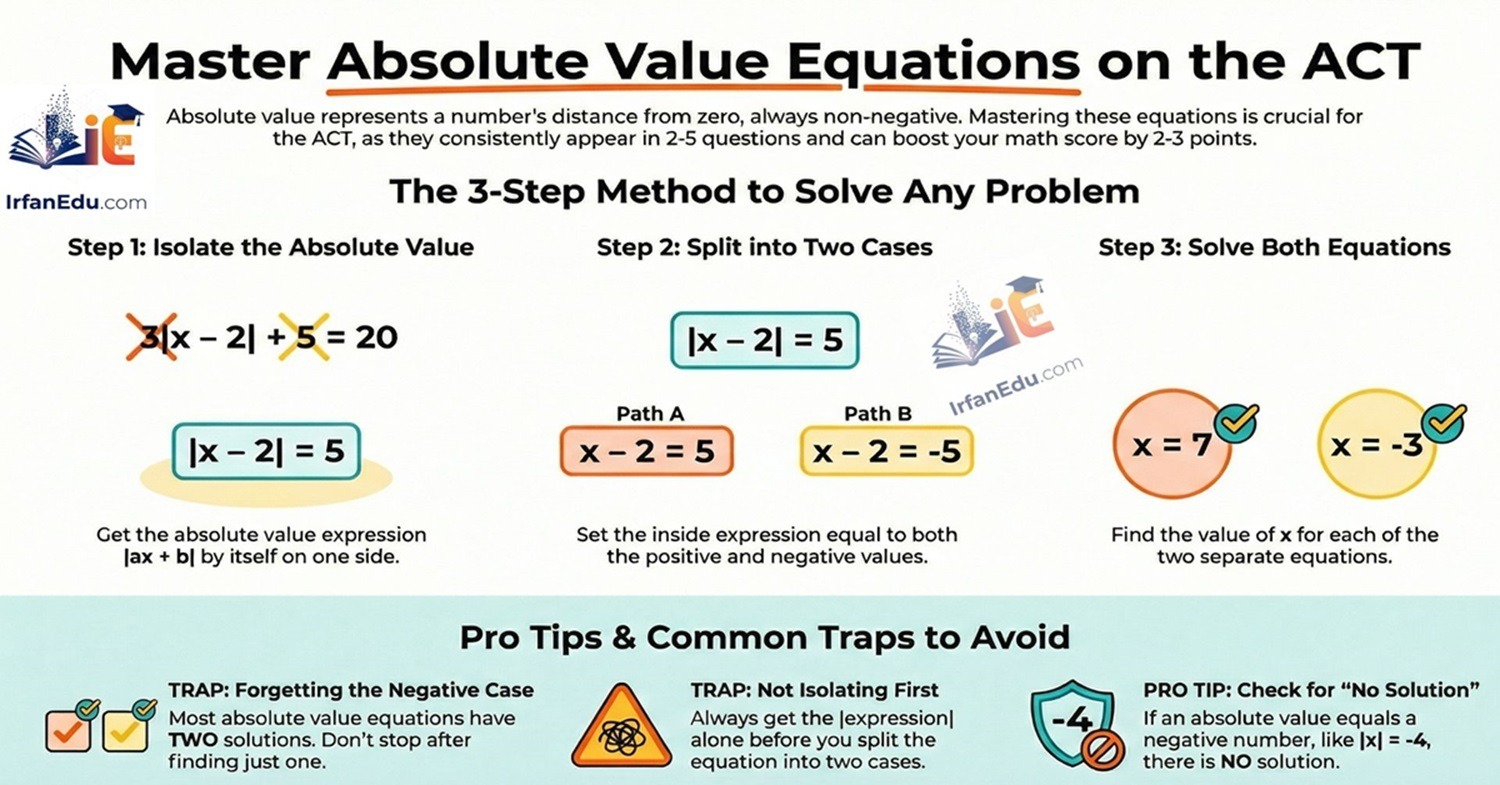
    Absolute value equations appear in 2-5 questions on the ACT Mathematics section. Understanding them thoroughly can add 2-3 points to your composite score. Let’s break it down with proven strategies that work!

    🚀 Jump to ACT Strategy →

    ⚡ Quick Answer (TL;DR)

    Absolute value represents the distance of a number from zero, always positive or zero. To solve absolute value equations like $$|x| = 5$$, create two cases: $$x = 5$$ or $$x = -5$$. For equations like $$|2x + 3| = 7$$, isolate the absolute value first, then split into two equations: $$2x + 3 = 7$$ and $$2x + 3 = -7$$. Solve both to find all solutions.

    💡 Memory Trick: “Absolute value splits into TWO paths—positive and negative!”

    📚 What is Absolute Value?

    The absolute value of a number is its distance from zero on the number line, regardless of direction. Distance is always positive (or zero), so absolute value is never negative. We denote absolute value using vertical bars: $$|x|$$. According to the official ACT website, understanding this concept is fundamental for success on the mathematics section.

    For example:

    • $$|5| = 5$$ (5 is 5 units from zero)
    • $$|-5| = 5$$ (-5 is also 5 units from zero)
    • $$|0| = 0$$ (0 is 0 units from zero)

    Why is this important for the ACT? Absolute value questions test your understanding of this fundamental concept and your ability to solve equations that involve it. These questions appear regularly on the ACT Math section, and mastering them builds confidence for more advanced algebra topics like inequalities and functions.

    Frequency on ACT: You’ll typically see 2-5 questions involving absolute value concepts on each ACT Math test. They range from simple evaluation ($$|-3| = ?$$) to solving equations ($$|2x – 1| = 9$$) to more complex applications.

    Score Impact: Understanding absolute value thoroughly can add 2-3 points to your ACT Math score, as it’s foundational for many other topics including inequalities, functions, and even coordinate geometry.

    📐 Key Concepts & Rules

    1. Definition of Absolute Value

    $$|x| = \begin{cases} x & \text{if } x \geq 0 \\ -x & \text{if } x < 0 \end{cases}$$

    2. Basic Absolute Value Equation

    If $$|x| = a$$ where $$a \geq 0$$, then:

    $$x = a$$ or $$x = -a$$

    3. General Absolute Value Equation

    If $$|ax + b| = c$$ where $$c \geq 0$$, then:

    $$ax + b = c$$ or $$ax + b = -c$$

    4. Important Properties

    • $$|x| \geq 0$$ for all real numbers $$x$$
    • $$|x| = 0$$ only when $$x = 0$$
    • $$|-x| = |x|$$ (absolute values of opposites are equal)
    • If $$|x| = a$$ and $$a < 0$$, there is no solution

    ⚠️ Critical Rule: Before solving, always check if the right side is non-negative. Equations like $$|x| = -5$$ have NO SOLUTION because absolute value cannot be negative!

    🎨 Visual Understanding: Number Line Representation

    Understanding absolute value visually helps tremendously. Let’s visualize $$|x| = 4$$:

        Distance = 4        Distance = 4
        ←─────────────┐   ┌─────────────→
                      │   │
        ──────┼───────┼───┼───────┼───────┼──────
             -6      -4   0       4       6
                      ↑           ↑
                  Solution 1  Solution 2
                  x = -4      x = 4
        
        Both -4 and 4 are exactly 4 units away from 0!
        

    This visual representation shows why absolute value equations have two solutions—one on each side of zero at equal distances.

    ✅ Step-by-Step Examples

    Example 1: Basic Absolute Value Equation

    Solve: $$|x| = 7$$

    Step 1: Identify what’s given and what’s asked

    We need to find all values of $$x$$ whose absolute value equals 7.

    Step 2: Apply the absolute value rule

    If $$|x| = 7$$, then $$x = 7$$ or $$x = -7$$

    Step 3: Verify both solutions

    Check $$x = 7$$: $$|7| = 7$$ ✓
    Check $$x = -7$$: $$|-7| = 7$$ ✓

    Final Answer: $$x = 7$$ or $$x = -7$$

    ⏱️ ACT Time: This should take 15-20 seconds on the test.

    Example 2: Absolute Value with Linear Expression

    Solve: $$|2x + 3| = 11$$

    Step 1: Set up two separate equations

    The expression inside the absolute value can equal 11 or -11:
    Case 1: $$2x + 3 = 11$$
    Case 2: $$2x + 3 = -11$$

    Step 2: Solve Case 1

    $$2x + 3 = 11$$
    $$2x = 11 – 3$$
    $$2x = 8$$
    $$x = 4$$

    Step 3: Solve Case 2

    $$2x + 3 = -11$$
    $$2x = -11 – 3$$
    $$2x = -14$$
    $$x = -7$$

    Step 4: Verify both solutions

    Check $$x = 4$$: $$|2(4) + 3| = |8 + 3| = |11| = 11$$ ✓
    Check $$x = -7$$: $$|2(-7) + 3| = |-14 + 3| = |-11| = 11$$ ✓

    Final Answer: $$x = 4$$ or $$x = -7$$

    ⏱️ ACT Time: This should take 45-60 seconds on the test.

    Example 3: Absolute Value with Isolation Needed

    Solve: $$3|x – 2| + 5 = 20$$

    Step 1: Isolate the absolute value expression

    $$3|x – 2| + 5 = 20$$
    $$3|x – 2| = 20 – 5$$
    $$3|x – 2| = 15$$
    $$|x – 2| = 5$$

    Step 2: Set up two cases

    Case 1: $$x – 2 = 5$$
    Case 2: $$x – 2 = -5$$

    Step 3: Solve both cases

    Case 1: $$x – 2 = 5$$ → $$x = 7$$
    Case 2: $$x – 2 = -5$$ → $$x = -3$$

    Step 4: Verify

    Check $$x = 7$$: $$3|7 – 2| + 5 = 3|5| + 5 = 15 + 5 = 20$$ ✓
    Check $$x = -3$$: $$3|-3 – 2| + 5 = 3|-5| + 5 = 15 + 5 = 20$$ ✓

    Final Answer: $$x = 7$$ or $$x = -3$$

    ⏱️ ACT Time: This should take 60-90 seconds on the test.

    📝

    Ready to Test Your Knowledge?

    Take our full-length ACT practice test and see how well you’ve mastered absolute value equations. Get instant scoring, detailed explanations, and personalized recommendations!

    🚀 Start ACT Practice Test Now →
    Full-Length Tests
    Instant Scoring
    Detailed Solutions

    🚫 Common Mistakes to Avoid

    ❌ Mistake #1: Forgetting the Negative Case

    Wrong: Solving $$|x| = 5$$ and only writing $$x = 5$$
    Right: $$x = 5$$ OR $$x = -5$$ (always two solutions unless one is extraneous)

    ❌ Mistake #2: Not Isolating the Absolute Value First

    Wrong: Splitting $$2|x| + 3 = 11$$ into $$2x + 3 = 11$$ and $$2x + 3 = -11$$
    Right: First isolate: $$2|x| = 8$$, then $$|x| = 4$$, then split into $$x = 4$$ or $$x = -4$$

    ❌ Mistake #3: Accepting Negative Absolute Values

    Wrong: Trying to solve $$|x| = -3$$ and getting confused
    Right: Recognize immediately that there is NO SOLUTION because absolute value cannot be negative

    ❌ Mistake #4: Not Checking Your Solutions

    Problem: Sometimes algebraic manipulation can introduce extraneous solutions
    Solution: Always substitute your answers back into the original equation to verify

    🧠 Memory Tricks & Mnemonics

    💡 The “Two Paths” Method

    Think of absolute value as a fork in the road. When you reach $$|expression| = number$$, the road splits into TWO paths:

    • Path 1 (Positive): expression = number
    • Path 2 (Negative): expression = -number

    “Absolute value? Split the road—positive and negative mode!”

    💡 The “Distance” Analogy

    Remember: $$|x – a| = d$$ means “$$x$$ is $$d$$ units away from $$a$$”

    Example: $$|x – 3| = 5$$ means “$$x$$ is 5 units from 3” → $$x = 8$$ or $$x = -2$$

    💡 The “I-S-S” Method

    Isolate the absolute value
    Split into two cases (positive and negative)
    Solve both equations

    📝 Practice Questions with Solutions

    Test your understanding with these ACT-style practice questions. Try solving them on your own before checking the solutions!

    Practice Question 1 Basic

    Solve for $$x$$: $$|x| = 9$$

    A) $$x = 9$$ only
    B) $$x = -9$$ only
    C) $$x = 9$$ or $$x = -9$$
    D) $$x = 0$$
    E) No solution
    Show Solution

    Correct Answer: C

    Solution:
    Using the basic absolute value rule: if $$|x| = 9$$, then $$x = 9$$ or $$x = -9$$

    Verification:
    $$|9| = 9$$ ✓
    $$|-9| = 9$$ ✓

    ⏱️ Time: 15 seconds

    Practice Question 2 Intermediate

    Solve for $$x$$: $$|3x – 6| = 12$$

    A) $$x = 6$$ only
    B) $$x = -2$$ or $$x = 6$$
    C) $$x = 2$$ or $$x = -6$$
    D) $$x = 6$$ or $$x = -6$$
    E) $$x = -2$$ only
    Show Solution

    Correct Answer: B

    Solution:
    Set up two cases:
    Case 1: $$3x – 6 = 12$$
    $$3x = 18$$
    $$x = 6$$

    Case 2: $$3x – 6 = -12$$
    $$3x = -6$$
    $$x = -2$$

    Verification:
    $$x = 6$$: $$|3(6) – 6| = |18 – 6| = |12| = 12$$ ✓
    $$x = -2$$: $$|3(-2) – 6| = |-6 – 6| = |-12| = 12$$ ✓

    ⏱️ Time: 45-60 seconds

    Practice Question 3 Advanced

    Solve for $$x$$: $$5|2x + 1| – 3 = 22$$

    A) $$x = 2$$ or $$x = -3$$
    B) $$x = 3$$ or $$x = -2$$
    C) $$x = 2$$ only
    D) $$x = -3$$ only
    E) No solution
    Show Solution

    Correct Answer: A

    Solution:
    Step 1: Isolate the absolute value
    $$5|2x + 1| – 3 = 22$$
    $$5|2x + 1| = 25$$
    $$|2x + 1| = 5$$

    Step 2: Set up two cases
    Case 1: $$2x + 1 = 5$$
    $$2x = 4$$
    $$x = 2$$

    Case 2: $$2x + 1 = -5$$
    $$2x = -6$$
    $$x = -3$$

    Verification:
    $$x = 2$$: $$5|2(2) + 1| – 3 = 5|5| – 3 = 25 – 3 = 22$$ ✓
    $$x = -3$$: $$5|2(-3) + 1| – 3 = 5|-5| – 3 = 25 – 3 = 22$$ ✓

    ⏱️ Time: 60-90 seconds

    Practice Question 4 Intermediate

    Which equation has NO solution?

    A) $$|x| = 0$$
    B) $$|x + 2| = 5$$
    C) $$|x – 3| = -4$$
    D) $$|2x| = 10$$
    E) $$|x| = 1$$
    Show Solution

    Correct Answer: C

    Explanation:
    Absolute value is always non-negative (zero or positive). It can NEVER equal a negative number.

    Therefore, $$|x – 3| = -4$$ has NO SOLUTION because the absolute value cannot equal -4.

    Why the others have solutions:
    A) $$|x| = 0$$ → $$x = 0$$ (one solution)
    B) $$|x + 2| = 5$$ → $$x = 3$$ or $$x = -7$$ (two solutions)
    D) $$|2x| = 10$$ → $$x = 5$$ or $$x = -5$$ (two solutions)
    E) $$|x| = 1$$ → $$x = 1$$ or $$x = -1$$ (two solutions)

    ⏱️ Time: 20-30 seconds

    💡 ACT Pro Tips & Tricks

    ✨ Tip #1: Check the Right Side First

    Before doing any algebra, look at what the absolute value equals. If it’s negative, you can immediately write “No solution” and save 30+ seconds!

    ✨ Tip #2: Always Isolate First

    Get the absolute value expression by itself before splitting into two cases. This prevents algebraic errors and makes the problem cleaner.

    ✨ Tip #3: Use Process of Elimination

    On multiple choice questions, you can often eliminate wrong answers by testing them. If an answer choice doesn’t satisfy the original equation when you plug it in, cross it out!

    ✨ Tip #4: Remember the “Two Solutions” Rule

    Most absolute value equations have TWO solutions. If you only find one, double-check your work—you probably missed the negative case!

    ✨ Tip #5: Calculator Strategy

    You can use your calculator to verify solutions quickly. Most calculators have an absolute value function (often “abs”). Plug in your solutions to check if they work!

    ✨ Tip #6: Watch for Extraneous Solutions

    Sometimes your algebraic work produces a solution that doesn’t actually work in the original equation. Always verify by substituting back into the original problem!

    🎯 ACT Test-Taking Strategy for Absolute Value

    ⏱️ Time Allocation

    Basic problems: 15-30 seconds
    Intermediate problems: 45-75 seconds
    Advanced problems: 90-120 seconds
    If you’re spending more than 2 minutes on an absolute value question, mark it and move on. You can return to it later.

    🎯 When to Skip and Return

    Skip if you see complex nested absolute values like $$||x – 2| – 3| = 5$$ on your first pass. These are rare and time-consuming. Focus on easier questions first to maximize your score, then return to challenging ones if time permits.

    🎲 Guessing Strategy

    If you must guess on an absolute value equation question:

    • Eliminate any answer that shows only one solution (unless the question asks for a specific value)
    • Eliminate “No solution” unless the right side is negative
    • Look for answer choices with two values that are opposites or symmetric
    • Test the middle value if you have 10-15 seconds—plug it into the original equation

    ✅ Quick Verification Method

    On the ACT, you don’t always have time to verify both solutions completely. Use this quick check:

    1. Verify ONE solution by substitution (takes 10-15 seconds)
    2. Check that the other solution is symmetric or follows the pattern
    3. If one works and the algebra was correct, trust your work

    ⚠️ Common Trap Answers to Watch For

    • Only the positive solution (forgetting the negative case)
    • Solutions before isolating (splitting too early)
    • Wrong signs ($$x = 5$$ and $$x = 5$$ instead of $$x = 5$$ and $$x = -5$$)
    • Extraneous solutions that don’t check out

    📊 Score Maximization Strategy

    Absolute value questions are considered medium difficulty on the ACT. Getting these right consistently can push you from a 24-26 score to a 28-30 range. Practice until you can solve basic absolute value equations in under 30 seconds—this frees up time for harder questions later in the test.

    🎥 Video Explanation

    Watch this detailed video explanation to understand absolute value equations better with visual demonstrations and step-by-step guidance.

    🌍 Real-World Applications

    Absolute value isn’t just an abstract math concept—it has practical applications in everyday life and various career fields:

    📍 GPS & Navigation

    GPS systems use absolute value to calculate distances between coordinates, regardless of direction. Your phone doesn’t care if you’re north or south of a location—only how far away you are.

    💰 Finance & Accounting

    Financial analysts use absolute value to measure variance and deviation from targets. Whether you’re $500 over or under budget, the absolute difference matters for analysis.

    🏗️ Engineering & Manufacturing

    Engineers use absolute value for tolerance calculations. If a part must be 10cm ± 0.2cm, they’re using absolute value: $$|length – 10| \leq 0.2$$

    🌡️ Science & Medicine

    Medical professionals use absolute value when measuring deviations from normal ranges. Body temperature, blood pressure, and lab results all involve absolute differences from healthy baselines.

    Why ACT tests this: The ACT includes absolute value because it’s foundational for higher mathematics (calculus, statistics) and critical thinking in STEM fields. Colleges want to know you can think about distance, magnitude, and deviation—concepts central to scientific reasoning.

    College courses that build on this: Calculus (limits and continuity), Statistics (standard deviation), Physics (vector magnitude), Computer Science (algorithms and optimization), Economics (variance analysis).

    ❓ Frequently Asked Questions (FAQs)

    Q1: Can an absolute value equation have more than two solutions?

    Answer: For basic absolute value equations of the form $$|expression| = number$$, you’ll have at most two solutions. However, in more complex scenarios (like equations with multiple absolute values or higher-degree polynomials inside), you could have more solutions. On the ACT, you’ll primarily see equations with 0, 1, or 2 solutions.

    Q2: What’s the difference between $$|x| = 5$$ and $$|x| < 5$$?

    Answer: $$|x| = 5$$ is an equation with exactly two solutions: $$x = 5$$ or $$x = -5$$. Meanwhile, $$|x| < 5$$ is an inequality with infinitely many solutions: all numbers between -5 and 5 ($$-5 < x < 5$$). Inequalities represent ranges, while equations represent specific values.

    Q3: Why do I need to check my solutions?

    Answer: When solving absolute value equations, sometimes the algebraic process can introduce extraneous solutions—answers that satisfy your work but don’t actually work in the original equation. This is especially common with more complex equations. Checking ensures you’re submitting correct answers. On the ACT, if you’re confident in your algebra, a quick mental check is usually sufficient.

    Q4: Can I use my calculator to solve absolute value equations on the ACT?

    Answer: Yes! Most graphing calculators can help. You can graph $$y = |expression|$$ and $$y = number$$ and find intersection points, or use the “solve” function if your calculator has it. However, for basic absolute value equations, solving by hand is often faster. Save calculator methods for verification or particularly complex problems.

    Q5: What if I get confused about which case is positive and which is negative?

    Answer: Remember: you’re not deciding which case is “positive” or “negative”—you’re considering both possibilities. When you have $$|expression| = number$$, the expression inside could equal the positive number OR the negative number. Set up both: $$expression = number$$ AND $$expression = -number$$. Then solve both equations. Don’t overthink which is which—just solve both!

    🎓 Conclusion: Master Absolute Value for ACT Success

    Absolute value equations are a fundamental building block in Pre-Algebra and ACT Math. By understanding the core concept—that absolute value represents distance from zero—and following the systematic approach of isolating, splitting, and solving, you can tackle any absolute value equation with confidence.

    Remember the key strategies:

    • Always check if the right side is non-negative before solving
    • Isolate the absolute value expression first
    • Split into two cases: positive and negative
    • Solve both equations completely
    • Verify your solutions (especially on complex problems)
    • Use time-saving strategies on the ACT

    With practice, absolute value equations will become one of your strengths on the ACT Math section. These 2-3 points can make the difference between a good score and a great score—potentially opening doors to better college opportunities and scholarships.

    🚀 Ready to Boost Your ACT Math Score?

    Practice these concepts regularly, work through the example problems, and you’ll see improvement in your confidence and speed. Keep pushing forward—you’ve got this!

    💪 Master absolute value → Unlock higher scores → Achieve your college dreams!

    Dr. Irfan Mansuri

    ✍️ Written by Dr. Irfan Mansuri

    Educational Content Creator & Competitive Exam Specialist

    IrfanEdu.com • United States

    Dr. Irfan Mansuri is a distinguished educational content creator and competitive exam specialist with over 15 years of experience spanning high school, undergraduate, and postgraduate levels. As the founder of IrfanEdu.com, he has successfully guided thousands of students through various competitive examinations, helping them achieve exceptional results and gain admission to their dream institutions.

    15+ years in competitive exam preparation Certified Instructor LinkedIn Profile

    📚 Related ACT Math Resources

    Continue your ACT Math preparation with these related topics from our comprehensive ACT prep resources:

    Solving Linear Equations

    Master the fundamentals of solving one and two-step equations

    Absolute Value Inequalities

    Take your absolute value skills to the next level with inequalities

    ACT Math Time Management

    Strategies to complete all 60 questions in 60 minutes

    [pdf_viewer id="121"]