Tag: Polynomials

  • Factoring Methods – Techniques & Examples | IrfanEdu

    Factoring Methods – Techniques & Examples | IrfanEdu

    Factoring Methods – Techniques & Examples | IrfanEdu

    Factoring Methods – Techniques & Examples

    SA
    Study Abroad
    | 📅 13 Jan, 2026 | 📚 Class 8 Maths Chapter 4

    What are Factoring Methods? Factoring methods are algebraic techniques that help you break down complex expressions into a product of simpler expressions called factors. Think of it as the reverse process of multiplication—instead of combining terms, you split them into components that multiply together to give you the original expression. This skill becomes your secret weapon when you solve equations, simplify functions, and tackle higher-level mathematics.

    Student learning factoring methods with mathematical equations x² + 5x + 6 = (x+2)(x+3) 12345 a² – b² π Mastering Factoring Methods

    Why Should You Master Factoring Methods?

    Factoring sits at the heart of algebra. When you learn to factor expressions efficiently, you unlock the ability to solve quadratic equations, simplify rational expressions, and understand polynomial behavior. These techniques appear everywhere—from calculating projectile motion in physics to optimizing profit functions in economics. Students who master factoring find calculus and advanced algebra much easier to navigate.

    The beauty of factoring lies in pattern recognition. Once you train your eyes to spot common structures like the difference of squares or perfect square trinomials, problems that once seemed impossible become straightforward. You develop mathematical intuition that serves you throughout your academic journey.

    Exploring Factoring Methods for Quadratic Equations and Algebra 2

    When you dive into factoring methods in Algebra 2, getting comfortable with different techniques becomes a total game-changer for tackling higher-level problems. One of the most frequent tasks you face involves factoring quadratic equations. Most quadratic expressions follow a standard format: ax² + bx + c. Your goal is to find two linear expressions that multiply back together to give you the original quadratic form.

    Chalkboard showing different factoring patterns and formulas Factoring Patterns & Formulas GCF Method ab + ac = a(b + c) Difference of Squares a² – b² = (a-b)(a+b) Perfect Square a² + 2ab + b² = (a + b)² Trinomial x² + 5x + 6 = (x+2)(x+3) Grouping xy + 2y + 3x + 6 = (x+2)(y+3) Sum of Cubes a³ + b³ = (a+b)(a²-ab+b²)

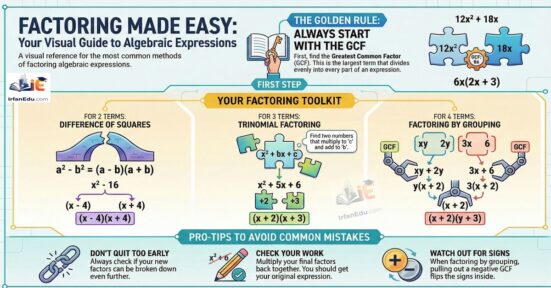
    If you want a reliable approach, the absolute first rule is to scan for a Greatest Common Factor (GCF). This is simply the largest term that divides into every part of the expression without leaving a remainder. For instance, in the expression 3x + 9, the GCF is 3. When you pull that 3 out, you get 3(x + 3). Starting with this simple step makes factoring trinomials much less intimidating because it reduces the numbers you need to manage.

    As you progress through Algebra 2, you often encounter polynomials that require more work. You might start by extracting a GCF, only to discover that what remains is a “difference of squares.” This pattern occurs when you have two perfect squares being subtracted from one another, like a² – b². This specific pattern always breaks down into (a – b)(a + b). Training your eyes to spot these patterns helps you breeze through assignments and exams.

    Step-by-Step Factoring Methods and Practical Examples

    Not every expression yields to the same approach, so you need several different tools in your mathematical toolkit. Based on standard algebraic techniques, here are the main ways to break expressions down into their factors.

    1. Factoring by Greatest Common Factor (GCF)

    This is your “Level 1” method. You examine every term in the expression to identify what they share. It represents the opposite of the distributive property—you “undistribute” a number to reveal the original components.

    Example: Factor 12x² + 18x

    1. Step 1: Find the biggest number that divides both 12 and 18, which is 6.
    2. Step 2: Find the highest power of x they both share, which is x.
    3. Result: 6x(2x + 3)
    12x² + 18x = 6x(2x + 3)

    2. Factoring by Grouping

    Sometimes you see an expression with four terms where no single GCF exists for the whole group. When that happens, try grouping them into pairs. This approach helps you find smaller common factors that eventually reveal a shared binomial.

    Example: Factor xy + 2y + 3x + 6

    1. Step 1: Pair up the first two and the last two: (xy + 2y) + (3x + 6)
    2. Step 2: Pull the GCF out of each pair: y(x + 2) + 3(x + 2)
    3. Step 3: Now that (x + 2) appears in both parts, factor it out: (x + 2)(y + 3)
    xy + 2y + 3x + 6 = (x + 2)(y + 3)

    3. Factoring Methods for Trinomials (The AC Method)

    For trinomials like ax² + bx + c, we often use a technique called “splitting the middle term.” This becomes your go-to move for solving many quadratic equations.

    Example: Factor x² + 5x + 6

    1. Step 1: Look for two numbers that multiply to 6 (the last number) and add up to 5 (the middle coefficient).
    2. Step 2: Those numbers are 2 and 3 (because 2 × 3 = 6 and 2 + 3 = 5).
    3. Step 3: Write it out as (x + 2)(x + 3)
    x² + 5x + 6 = (x + 2)(x + 3)

    4. Difference of Two Squares

    This is a specialized shortcut for binomials where both terms are perfect squares separated by a minus sign. It becomes a very visual pattern once you know what to look for.

    Example: Factor 16x² – 25

    1. Step 1: Find the square root of 16x², which is 4x.
    2. Step 2: Find the square root of 25, which is 5.
    3. Result: (4x – 5)(4x + 5)
    16x² – 25 = (4x – 5)(4x + 5)

    Advanced Application: Factoring Higher Degree Polynomials

    Algebra 2 doesn’t stop at simple squares. You might find yourself staring at cubic expressions or polynomials with a degree of 4 or higher. The secret is that the logic stays exactly the same: keep simplifying until you can’t go any further. A problem that looks like a nightmare often just needs you to pull out a GCF first.

    Example: Factor 2x³ – 8x

    You don’t need a fancy cubic formula right away. Start by pulling out 2x to get 2x(x² – 4). Then you’ll see the difference of squares sitting right there inside the parentheses. Finish it off to get 2x(x – 2)(x + 2).

    2x³ – 8x = 2x(x² – 4) = 2x(x – 2)(x + 2)

    This “peeling back the layers” approach is what really helps you master advanced algebra. Each factorization reveals another opportunity to simplify further.

    Different Types of Factoring: Complete Guide

    5. Factoring Perfect Square Trinomials

    Perfect square trinomials follow the pattern a² + 2ab + b² = (a + b)². When you recognize this pattern, factoring becomes instant.

    Example: Factor x² + 6x + 9

    Notice that x² is a perfect square, 9 is a perfect square (3²), and 6x is exactly 2(x)(3).

    x² + 6x + 9 = (x + 3)²

    6. Factoring Sum or Difference of Cubes

    These special patterns require memorization but become powerful tools once you internalize them.

    Formulas to Remember:
    • Sum of cubes: a³ + b³ = (a + b)(a² – ab + b²)
    • Difference of cubes: a³ – b³ = (a – b)(a² + ab + b²)

    Example: Factor x³ + 8

    Recognize that 8 = 2³, so this is a sum of cubes.

    x³ + 8 = (x + 2)(x² – 2x + 4)

    Factoring Methods Cheat Sheet: Quick Reference Table

    This table provides a quick way to decide which strategy to use based on the number of terms and the pattern you observe.

    Number of Terms Recommended Method Pattern/Formula
    Any number Greatest Common Factor (GCF) ab + ac = a(b + c)
    Two Terms Difference of Squares a² – b² = (a – b)(a + b)
    Two Terms Sum/Difference of Cubes a³ ± b³ = (a ± b)(a² ∓ ab + b²)
    Three Terms Trinomial Factoring x² + (p+q)x + pq = (x+p)(x+q)
    Three Terms Perfect Square Trinomial a² + 2ab + b² = (a + b)²
    Four Terms Grouping Pair terms and factor GCF twice

    Common Pitfalls to Avoid

    Watch Out for These Mistakes:

    • The Sign Trap: When you factor by grouping, keep a close eye on negative signs. If your third term is negative, you factor out a negative number, which flips the sign of the fourth term.
    • Quitting Too Early: Just because you factored once doesn’t mean you’re finished. Always double-check your results to see if they can be broken down even more.
    • Missing the GCF: If you end up with binomials that have large numbers or shared divisors, you probably missed a common factor at the very start.
    • Forgetting to Check Your Work: Always multiply your factors back together using the distributive property to verify you get the original expression.

    Summary: Types of Factoring at a Glance

    Type Example Factored Form
    GCF 6x² + 9x 3x(2x + 3)
    Grouping ax + ay + bx + by (x + y)(a + b)
    Trinomial x² + 5x + 6 (x + 2)(x + 3)
    Difference of Squares x² – 16 (x + 4)(x – 4)
    Perfect Square Trinomial x² + 6x + 9 (x + 3)²
    Sum of Cubes x³ + 8 (x + 2)(x² – 2x + 4)

    Conclusion: Your Path to Factoring Mastery

    Factoring methods form the backbone of algebraic problem-solving. Whether you’re extracting the greatest common factor, recognizing the difference of squares, or tackling complex polynomials through grouping, each technique builds your mathematical confidence and capability.

    Remember that factoring is a skill that improves with practice. Start with simple expressions and gradually work your way up to more complex polynomials. Use the cheat sheet as your quick reference guide, and always verify your answers by multiplying the factors back together.

    As you continue your journey through Algebra 2 and beyond, these factoring methods will become second nature. They’ll serve as essential tools when you encounter calculus, differential equations, and real-world problem-solving scenarios. Keep practicing, stay patient with yourself, and celebrate each factoring victory along the way!

    💡 Pro Tips for Success:

    • Always start by looking for a GCF—it simplifies everything that follows
    • Create flashcards for special patterns like difference of squares and perfect square trinomials
    • Practice factoring for 15 minutes daily to build pattern recognition skills
    • Check your work by multiplying factors back together
    • Don’t hesitate to use online factoring calculators to verify your answers while learning

    Mastering Factoring Techniques | ACT Math Guide for Grades 9-12

    Factoring is one of the most critical skills you’ll need for the ACT Math Elementary Algebra section. Whether you’re breaking down trinomials, recognizing difference of squares patterns, or extracting the greatest common factor (GCF), mastering these factoring techniques can significantly boost your ACT score. This comprehensive guide will walk you through each factoring method with step-by-step examples, proven strategies, and practice problems designed specifically for ACT success.

    🎯

    ACT SCORE BOOSTER: Master This Topic for 3-5 Extra Points!

    Factoring appears in very high frequency on the ACT Mathematics section. Understanding it thoroughly can add 3-5 points to your composite score. Let’s break it down with proven strategies that work!

    🚀 Jump to ACT Strategy →

    ⚡ Quick Answer: Three Essential Factoring Methods

    1. Greatest Common Factor (GCF): Factor out the largest expression common to all terms.

    2. Difference of Squares: Recognize $$a^2 – b^2 = (a+b)(a-b)$$ pattern.

    3. Trinomial Factoring: Factor $$ax^2 + bx + c$$ into two binomials using various techniques.

    Master these three methods and you’ll handle 90% of ACT factoring questions with confidence!

    📚 Understanding Factoring for ACT Success

    Factoring is the reverse process of multiplication—it’s about breaking down algebraic expressions into simpler components (factors) that multiply together to give the original expression. Think of it like finding the building blocks of a mathematical structure.

    On the ACT, factoring questions appear in approximately 5-8 questions per test, making it one of the highest-yield topics you can master. These questions test your ability to:

    • Identify the greatest common factor in polynomial expressions
    • Recognize special factoring patterns like difference of squares
    • Factor quadratic trinomials efficiently
    • Simplify rational expressions using factoring
    • Solve quadratic equations by factoring

    The beauty of factoring is that once you understand the patterns, you can solve problems in seconds—a crucial advantage when you’re racing against the ACT’s strict time limits. For more ACT prep resources covering all math topics, explore our comprehensive collection.

    📐 Essential Factoring Formulas & Patterns

    🔑 Master These Factoring Formulas

    1. Greatest Common Factor (GCF)

    Pattern: $$ab + ac = a(b + c)$$

    When to use: When all terms share a common factor

    Example: $$6x^3 + 9x^2 = 3x^2(2x + 3)$$

    2. Difference of Squares

    Pattern: $$a^2 – b^2 = (a + b)(a – b)$$

    When to use: Two perfect squares separated by subtraction

    Example: $$x^2 – 25 = (x + 5)(x – 5)$$

    ⚠️ Important: Sum of squares ($$a^2 + b^2$$) does NOT factor over real numbers!

    3. Trinomial Factoring ($$x^2 + bx + c$$)

    Pattern: $$x^2 + bx + c = (x + m)(x + n)$$ where $$m \cdot n = c$$ and $$m + n = b$$

    When to use: Quadratic with leading coefficient of 1

    Example: $$x^2 + 7x + 12 = (x + 3)(x + 4)$$

    4. Trinomial Factoring ($$ax^2 + bx + c$$, where $$a \neq 1$$)

    Pattern: Use AC method or trial and error

    AC Method: Find two numbers that multiply to $$a \cdot c$$ and add to $$b$$

    Example: $$2x^2 + 7x + 3 = (2x + 1)(x + 3)$$

    5. Perfect Square Trinomials

    Patterns:

    • $$a^2 + 2ab + b^2 = (a + b)^2$$
    • $$a^2 – 2ab + b^2 = (a – b)^2$$

    Example: $$x^2 + 6x + 9 = (x + 3)^2$$

    🧠 Memory Tricks & Mnemonics

    🎯 “SOAP” for Difference of Squares:

    Same signs in factors (one + and one -)
    Opposite operation in middle (subtraction in original)
    Always two perfect squares
    Perfect pattern: $$(a+b)(a-b)$$

    🎯 “FOIL Backwards” for Trinomials:

    Remember FOIL (First, Outer, Inner, Last) from multiplication? Factoring is just FOIL in reverse! Look for two numbers that multiply to give the last term and add to give the middle coefficient.

    🎯 “GCF First, Always” Rule:

    Before trying any other factoring method, ALWAYS check for a GCF first. This simplifies your work and prevents errors. Think of it as “cleaning up” before you start the real work!

    🎯 Sign Pattern Trick:

    For $$x^2 + bx + c$$:
    • Both signs positive (++) → both factors positive
    • Last sign positive, middle negative (+−) → both factors negative
    • Last sign negative (−) → one positive, one negative factor

    ✅ Step-by-Step Factoring Examples

    Example 1: Greatest Common Factor (GCF)

    Problem: Factor completely: $$12x^3 + 18x^2 – 24x$$

    Step 1: Identify the GCF of all terms

    • Coefficients: GCF(12, 18, 24) = 6
    • Variables: GCF($$x^3$$, $$x^2$$, $$x$$) = $$x$$
    • Combined GCF = $$6x$$

    Step 2: Divide each term by the GCF

    $$12x^3 \div 6x = 2x^2$$

    $$18x^2 \div 6x = 3x$$

    $$24x \div 6x = 4$$

    Step 3: Write the factored form

    $$12x^3 + 18x^2 – 24x = 6x(2x^2 + 3x – 4)$$

    ✓ Final Answer: $$6x(2x^2 + 3x – 4)$$

    ⏱️ ACT Time: 30-45 seconds

    Example 2: Difference of Squares

    Problem: Factor completely: $$49x^2 – 64$$

    Step 1: Recognize the pattern (two perfect squares with subtraction)

    • $$49x^2 = (7x)^2$$ ✓ Perfect square
    • $$64 = 8^2$$ ✓ Perfect square
    • Operation is subtraction ✓

    Step 2: Apply the difference of squares formula: $$a^2 – b^2 = (a+b)(a-b)$$

    Here, $$a = 7x$$ and $$b = 8$$

    Step 3: Write the factored form

    $$49x^2 – 64 = (7x + 8)(7x – 8)$$

    ✓ Final Answer: $$(7x + 8)(7x – 8)$$

    ⏱️ ACT Time: 15-25 seconds

    Example 3: Simple Trinomial (Leading Coefficient = 1)

    Problem: Factor completely: $$x^2 + 9x + 20$$

    Step 1: Identify what we need

    We need two numbers that:

    • Multiply to give $$c = 20$$
    • Add to give $$b = 9$$

    Step 2: List factor pairs of 20

    1 × 20 = 20, and 1 + 20 = 21 ✗

    2 × 10 = 20, and 2 + 10 = 12 ✗

    4 × 5 = 20, and 4 + 5 = 9 ✓

    Step 3: Write the factored form

    $$x^2 + 9x + 20 = (x + 4)(x + 5)$$

    Step 4: Verify using FOIL

    $$(x + 4)(x + 5) = x^2 + 5x + 4x + 20 = x^2 + 9x + 20$$ ✓

    ✓ Final Answer: $$(x + 4)(x + 5)$$

    ⏱️ ACT Time: 30-40 seconds

    Example 4: Complex Trinomial (Leading Coefficient ≠ 1)

    Problem: Factor completely: $$3x^2 + 11x + 6$$

    Step 1: Use the AC Method

    Multiply $$a \times c = 3 \times 6 = 18$$

    Find two numbers that multiply to 18 and add to 11

    Step 2: Find the magic pair

    2 × 9 = 18, and 2 + 9 = 11 ✓

    Step 3: Rewrite the middle term

    $$3x^2 + 11x + 6 = 3x^2 + 2x + 9x + 6$$

    Step 4: Factor by grouping

    $$= (3x^2 + 2x) + (9x + 6)$$

    $$= x(3x + 2) + 3(3x + 2)$$

    $$= (x + 3)(3x + 2)$$

    ✓ Final Answer: $$(x + 3)(3x + 2)$$

    ⏱️ ACT Time: 45-60 seconds

    Example 5: Multi-Step Factoring (GCF + Pattern)

    Problem: Factor completely: $$2x^3 – 50x$$

    Step 1: Always check for GCF first!

    GCF = $$2x$$

    $$2x^3 – 50x = 2x(x^2 – 25)$$

    Step 2: Check if the remaining expression can be factored further

    $$x^2 – 25$$ is a difference of squares! ($$x^2 – 5^2$$)

    Step 3: Apply difference of squares formula

    $$x^2 – 25 = (x + 5)(x – 5)$$

    Step 4: Write the complete factorization

    $$2x^3 – 50x = 2x(x + 5)(x – 5)$$

    ✓ Final Answer: $$2x(x + 5)(x – 5)$$

    ⏱️ ACT Time: 35-50 seconds

    💡 Key Lesson: Always factor completely! Don’t stop after the GCF if more factoring is possible.

    🎨 Visual Factoring Process

    📊 Factoring Decision Tree

    START: Expression to Factor
             |
             v
        [Check for GCF]
             |
        Yes / \ No
           /     \
          v       v
     Factor out  [Count Terms]
        GCF          |
          |      2 / | \ 3+
          |       /  |  \
          |      v   v   v
          |   [Diff  [Trinomial]
          |    of    
          |  Squares]
          |     |
          |     v
          | (a+b)(a-b)
          |     |
          v     v
    [Check remaining] → [Factor further if possible]
          |
          v
      COMPLETE!
          

    Quick Reference:

    • 2 terms: Check for difference of squares or GCF only
    • 3 terms: Likely a trinomial (use factoring methods)
    • 4+ terms: Try factoring by grouping
    📝

    Ready to Test Your Factoring Skills?

    Take our full-length ACT Math practice test and see how well you’ve mastered factoring techniques. Get instant scoring, detailed explanations, and personalized recommendations!

    🚀 Start ACT Practice Test Now →
    Full-Length Tests
    Instant Scoring
    Detailed Solutions

    ⚠️ Common Mistakes to Avoid

    🚫 Don’t Fall Into These Traps!

    ❌ Mistake #1: Forgetting to Check for GCF First

    Wrong: $$2x^2 + 8x + 6 = (2x + 2)(x + 3)$$ ✗

    Right: $$2x^2 + 8x + 6 = 2(x^2 + 4x + 3) = 2(x + 1)(x + 3)$$ ✓

    Why it matters: On the ACT, “factor completely” means ALL factoring, including GCF!

    ❌ Mistake #2: Trying to Factor Sum of Squares

    Wrong: $$x^2 + 25 = (x + 5)(x + 5)$$ ✗

    Right: $$x^2 + 25$$ is prime (cannot be factored over real numbers) ✓

    Remember: Only difference of squares factors, not sum!

    ❌ Mistake #3: Sign Errors in Trinomials

    Wrong: $$x^2 – 5x + 6 = (x + 2)(x + 3)$$ ✗

    Right: $$x^2 – 5x + 6 = (x – 2)(x – 3)$$ ✓

    Check: Middle term negative + last term positive = both factors negative

    ❌ Mistake #4: Not Factoring Completely

    Wrong: $$x^4 – 16 = (x^2 + 4)(x^2 – 4)$$ ✗ (incomplete)

    Right: $$x^4 – 16 = (x^2 + 4)(x^2 – 4) = (x^2 + 4)(x + 2)(x – 2)$$ ✓

    Always ask: “Can I factor this further?”

    ❌ Mistake #5: Arithmetic Errors with AC Method

    Problem: Finding wrong factor pairs or making addition errors

    Solution: Always verify your factorization by multiplying back (FOIL)

    ACT Tip: If your answer isn’t among the choices, you likely made an arithmetic error!

    🎥 Video Explanation: Factoring Techniques

    Watch this comprehensive video explanation to master factoring techniques with visual demonstrations and step-by-step guidance from expert instructors.

    📝 ACT-Style Practice Questions

    Test your factoring skills with these authentic ACT-style problems. Try to solve each one before revealing the solution!

    Practice Question 1 (Basic)

    Which of the following is equivalent to $$x^2 – 81$$?

    A) $$(x – 9)^2$$
    B) $$(x + 9)^2$$
    C) $$(x – 9)(x + 9)$$
    D) $$(x – 81)(x + 1)$$
    E) Cannot be factored
    Show Solution

    ✓ Correct Answer: C

    Solution:

    This is a difference of squares: $$x^2 – 81 = x^2 – 9^2$$

    Apply the formula: $$a^2 – b^2 = (a + b)(a – b)$$

    $$x^2 – 81 = (x + 9)(x – 9)$$

    Why other answers are wrong:

    • A & B: These would give $$x^2 – 18x + 81$$ or $$x^2 + 18x + 81$$
    • D: Doesn’t follow any factoring pattern
    • E: Difference of squares always factors!

    ⏱️ Target Time: 20 seconds

    Practice Question 2 (Intermediate)

    What is the complete factorization of $$6x^2 + 13x + 6$$?

    A) $$(2x + 3)(3x + 2)$$
    B) $$(6x + 1)(x + 6)$$
    C) $$(3x + 2)(2x + 3)$$
    D) $$(6x + 6)(x + 1)$$
    E) $$(2x + 2)(3x + 3)$$
    Show Solution

    ✓ Correct Answer: A (or C, they’re equivalent)

    Solution using AC Method:

    Step 1: $$a \times c = 6 \times 6 = 36$$

    Step 2: Find two numbers that multiply to 36 and add to 13

    Factor pairs: 4 × 9 = 36, and 4 + 9 = 13 ✓

    Step 3: Rewrite: $$6x^2 + 4x + 9x + 6$$

    Step 4: Factor by grouping:

    $$= 2x(3x + 2) + 3(3x + 2)$$

    $$= (2x + 3)(3x + 2)$$

    Verification: $$(2x + 3)(3x + 2) = 6x^2 + 4x + 9x + 6 = 6x^2 + 13x + 6$$ ✓

    ⏱️ Target Time: 50 seconds

    Practice Question 3 (Intermediate)

    Factor completely: $$x^2 – 6x + 9$$

    A) $$(x – 3)(x – 3)$$
    B) $$(x + 3)(x – 3)$$
    C) $$(x – 9)(x + 1)$$
    D) $$(x – 3)^2$$
    E) Both A and D
    Show Solution

    ✓ Correct Answer: E

    Solution:

    This is a perfect square trinomial!

    Pattern: $$a^2 – 2ab + b^2 = (a – b)^2$$

    Here: $$x^2 – 6x + 9 = x^2 – 2(3)(x) + 3^2 = (x – 3)^2$$

    Note that $$(x – 3)^2$$ and $$(x – 3)(x – 3)$$ are the same thing!

    ACT Tip: Both A and D are correct, so E is the answer. The ACT sometimes tests whether you recognize equivalent forms.

    ⏱️ Target Time: 30 seconds

    Practice Question 4 (Advanced)

    Which expression is equivalent to $$4x^3 – 36x$$?

    A) $$4x(x^2 – 9)$$
    B) $$4x(x – 3)(x + 3)$$
    C) $$(2x – 6)(2x + 6)$$
    D) $$4(x^3 – 9x)$$
    E) $$4x(x – 9)$$
    Show Solution

    ✓ Correct Answer: B

    Solution (Multi-step factoring):

    Step 1: Factor out GCF = $$4x$$

    $$4x^3 – 36x = 4x(x^2 – 9)$$

    Step 2: Recognize $$x^2 – 9$$ is difference of squares!

    $$x^2 – 9 = (x – 3)(x + 3)$$

    Step 3: Complete factorization

    $$4x^3 – 36x = 4x(x – 3)(x + 3)$$

    Why other answers are wrong:

    • A: Incomplete factoring (didn’t factor $$x^2 – 9$$)
    • C: Incorrect – doesn’t equal original expression
    • D: Only factored out 4, not $$4x$$
    • E: Incorrect factorization

    ⏱️ Target Time: 45 seconds

    Practice Question 5 (Advanced)

    If $$x^2 + kx + 15 = (x + 3)(x + 5)$$, what is the value of $$k$$?

    A) 2
    B) 5
    C) 8
    D) 15
    E) 18
    Show Solution

    ✓ Correct Answer: C

    Solution:

    Expand the right side using FOIL:

    $$(x + 3)(x + 5) = x^2 + 5x + 3x + 15 = x^2 + 8x + 15$$

    Compare with $$x^2 + kx + 15$$:

    Therefore, $$k = 8$$

    Alternative Method (Faster for ACT):

    In $$(x + m)(x + n)$$, the middle coefficient is $$m + n$$

    Here: $$m = 3$$ and $$n = 5$$, so $$k = 3 + 5 = 8$$

    ⏱️ Target Time: 25 seconds

    🎯 ACT Test-Taking Strategy for Factoring

    ⏱️ Time Management

    • Basic factoring (GCF, difference of squares): 20-30 seconds
    • Simple trinomials: 30-45 seconds
    • Complex trinomials or multi-step: 45-70 seconds
    • If stuck after 90 seconds: Make your best guess and move on

    🎯 Strategic Approach

    1. Always check for GCF first – This is the #1 time-saver and error-preventer
    2. Count the terms – 2 terms? Think difference of squares. 3 terms? Trinomial factoring.
    3. Look for patterns – Perfect squares, difference of squares appear frequently
    4. Use answer choices – If stuck, multiply the answer choices to see which gives the original
    5. Verify when time permits – Quick FOIL check takes 5-10 seconds

    🚨 Common ACT Traps

    • Incomplete factoring: Answer choices may include partially factored expressions
    • Sign errors: Watch carefully for negative signs in trinomials
    • Sum of squares trap: $$x^2 + 25$$ cannot be factored (it’s prime)
    • “Cannot be factored” option: Usually wrong unless it’s a sum of squares

    💡 When to Skip and Return

    Skip a factoring question if:

    • You can’t identify the pattern within 20 seconds
    • The numbers are very large and you’re not confident with the AC method
    • You’re spending more than 90 seconds on it

    Remember: All ACT Math questions are worth the same points. Don’t let one difficult factoring problem steal time from easier questions!

    🎲 Guessing Strategy

    If you must guess:

    • Eliminate “Cannot be factored” unless it’s clearly a sum of squares
    • Check if the constant term in answer choices matches the original
    • Verify the leading coefficient matches when expanded
    • Choose the answer that looks most “balanced” in structure

    💡 ACT Pro Tips & Score Boosters

    🚀 Calculator Tip:

    Your calculator can verify factoring! If you factor $$x^2 + 5x + 6 = (x+2)(x+3)$$, plug in $$x=2$$ into both expressions. If they give the same result, your factoring is correct. Try 2-3 different values for confidence.

    🚀 Pattern Recognition:

    Memorize these common factorable numbers: 6 = 2×3, 8 = 2×4, 12 = 3×4, 15 = 3×5, 20 = 4×5, 24 = 4×6. When you see these as the constant term in trinomials, you’ll factor faster!

    🚀 The “Box Method” Alternative:

    If you struggle with the AC method, try the box/area method for trinomials. It’s visual and reduces errors. Many students find it faster once they practice!

    🚀 Reverse Engineering:

    On multiple choice, you can multiply the answer choices to see which equals the original expression. This is especially useful when you’re unsure of your factoring.

    🚀 Perfect Square Recognition:

    Memorize perfect squares up to 15²: 1, 4, 9, 16, 25, 36, 49, 64, 81, 100, 121, 144, 169, 196, 225. This helps you instantly recognize difference of squares patterns!

    🚀 The “Factor Tree” Approach:

    For finding GCF quickly, use a factor tree for each coefficient. The common factors at each level give you the GCF. This is faster than listing all factors!

    📈 Score Improvement Action Plan

    Week 1-2: Master the Basics
    • Practice GCF factoring until it’s automatic (50+ problems)
    • Memorize difference of squares formula
    • Learn simple trinomial factoring (leading coefficient = 1)
    • Goal: 90% accuracy on basic problems in under 30 seconds
    Week 3-4: Build Speed & Complexity
    • Master the AC method for complex trinomials
    • Practice multi-step factoring problems
    • Work on identifying patterns quickly
    • Goal: 85% accuracy on all problem types in under 60 seconds
    Week 5-6: ACT Simulation
    • Take timed practice tests focusing on algebra sections
    • Review mistakes and identify pattern weaknesses
    • Practice with official ACT questions
    • Goal: Answer 95% of factoring questions correctly under test conditions
    Daily Practice Routine (15 minutes)
    • 5 minutes: Quick drill (10 basic factoring problems)
    • 5 minutes: 3-4 medium difficulty problems
    • 5 minutes: 1-2 challenging multi-step problems

    Consistency beats cramming! 15 minutes daily for 6 weeks = 10.5 hours of focused practice.

    ❓ Frequently Asked Questions

    Q1: How many factoring questions are on the ACT Math test?

    A: Typically 5-8 questions directly test factoring skills, and another 3-5 questions require factoring as part of solving equations or simplifying expressions. That’s roughly 13-20% of the entire Math section! Mastering factoring is one of the highest-yield study investments you can make. According to the official ACT website, Elementary Algebra (which includes factoring) comprises 15-20% of the Math test.

    Q2: What’s the fastest way to check if my factoring is correct during the test?

    A: The fastest verification method is to use your calculator with substitution. Pick a simple value like $$x = 2$$, calculate both the original expression and your factored form. If they give the same result, your factoring is correct. This takes only 10-15 seconds and can save you from losing points on careless errors. Alternatively, if you have time, quickly multiply your factors using FOIL to verify they equal the original expression.

    Q3: Should I always factor out the GCF first, even if the question doesn’t say “factor completely”?

    A: Yes! On the ACT, “factor” always means “factor completely” unless stated otherwise. Many students lose points by stopping after partial factoring. Always check for GCF first—it’s the foundation of complete factoring. Plus, factoring out the GCF often makes the remaining expression much easier to factor further. Make it your automatic first step!

    Q4: What if I can’t remember the AC method during the test?

    A: Don’t panic! You have alternatives: (1) Use trial and error with the answer choices—multiply them out to see which matches the original, (2) Use the box/area method if you’ve practiced it, or (3) For trinomials with small coefficients, systematically try factor combinations. Remember, the ACT is multiple choice, so you can always work backwards from the answers. This might take 10-20 seconds longer, but it’s better than skipping the question entirely.

    Q5: Are there any factoring patterns that appear more frequently on the ACT?

    A: Yes! The ACT loves these patterns: (1) Difference of squares (appears 2-3 times per test), (2) Simple trinomials where $$a=1$$ (very common), (3) Factoring out GCF as a first step (almost always required for “factor completely” questions), and (4) Perfect square trinomials (appear occasionally). If you master these four patterns, you’ll handle 85-90% of all factoring questions. The complex AC method trinomials appear less frequently but are worth learning for that score boost from 30 to 33+.

    Dr. Irfan Mansuri

    ✍️ Written by Dr. Irfan Mansuri

    Educational Content Creator & Competitive Exam Specialist

    IrfanEdu.com • United States

    Dr. Irfan Mansuri is a distinguished educational content creator with over 15 years of experience spanning high school, undergraduate, and postgraduate levels. As the founder of IrfanEdu.com, he has successfully guided thousands of students through competitive examinations, helping them achieve exceptional results and gain admission to their dream institutions.

    15+ years in competitive exam preparation Certified Instructor LinkedIn Profile

    [pdf_viewer id=”209″]

  • Exponents and Polynomials: Simplifying and operations | ACT Math Guide

    Exponents and Polynomials: Simplifying and operations | ACT Math Guide

    Simplifying and Performing Operations on Polynomials | ACT Math Guide for Grades 9-12

    Polynomials are one of the most frequently tested topics in the ACT Prep Mathematics section, appearing in approximately 8-12 questions on every test. Whether you’re adding, subtracting, multiplying, or dividing polynomial expressions, mastering these operations is essential for achieving your target score. The good news? Once you understand the fundamental rules and practice the right strategies, polynomial problems become straightforward and even enjoyable to solve. This comprehensive guide will walk you through everything you need to know about simplifying and performing operations on polynomials, with proven techniques specifically designed for ACT success.

    🎯

    ACT SCORE BOOSTER: Master This Topic for 3-5 Extra Points!

    Polynomial operations appear in every ACT Math test with 8-12 questions covering this topic. Understanding these concepts thoroughly can add 3-5 points to your composite score. Let’s break it down with proven strategies that work!

    🚀 Jump to ACT Strategy →

    📚 Understanding Polynomials and Their Operations

    A polynomial is an algebraic expression consisting of variables and coefficients, combined using addition, subtraction, and multiplication. The term “polynomial” comes from “poly” (meaning many) and “nomial” (meaning terms). Examples include $$3x^2 + 5x – 7$$ or $$4x^3 – 2x^2 + x + 9$$.

    On the ACT, you’ll encounter polynomial operations in various contexts—from straightforward simplification problems to more complex word problems involving area, perimeter, and real-world applications. The official ACT Math section tests your ability to manipulate these expressions quickly and accurately under time pressure.

    🔑 Key Terminology You Must Know:

    • Term: A single part of a polynomial (e.g., $$5x^2$$)
    • Coefficient: The numerical part of a term (e.g., 5 in $$5x^2$$)
    • Degree: The highest exponent in the polynomial
    • Like Terms: Terms with identical variable parts (e.g., $$3x^2$$ and $$7x^2$$)
    • Standard Form: Terms arranged from highest to lowest degree

    Why This Matters for Your ACT Score: Polynomial operations form the foundation for approximately 20-25% of all ACT Math questions. They appear not only in pure algebra problems but also in geometry (area and volume formulas), coordinate geometry, and even trigonometry questions. Students who master polynomial operations typically score 3-5 points higher on the Math section compared to those who struggle with these concepts.

    📐 Essential Formulas & Rules for Polynomial Operations

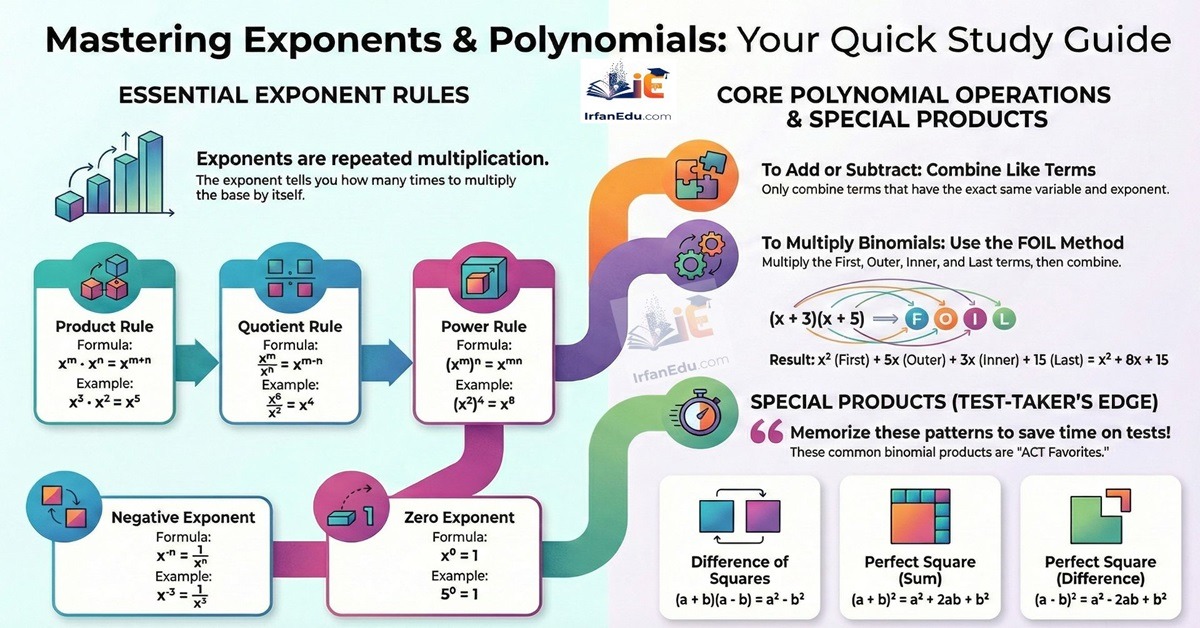
    1️⃣ Exponent Rules (Critical for Polynomials)

    Rule Name Formula Example
    Product Rule $$x^a \cdot x^b = x^{a+b}$$ $$x^3 \cdot x^5 = x^8$$
    Quotient Rule $$\frac{x^a}{x^b} = x^{a-b}$$ $$\frac{x^7}{x^3} = x^4$$
    Power Rule $$(x^a)^b = x^{a \cdot b}$$ $$(x^2)^3 = x^6$$
    Zero Exponent $$x^0 = 1$$ (where $$x \neq 0$$) $$5^0 = 1$$
    Negative Exponent $$x^{-a} = \frac{1}{x^a}$$ $$x^{-3} = \frac{1}{x^3}$$

    2️⃣ Polynomial Operation Rules

    Addition/Subtraction: Combine only like terms

    $$(3x^2 + 5x – 2) + (2x^2 – 3x + 7) = 5x^2 + 2x + 5$$

    Multiplication (Distributive Property):

    $$a(b + c) = ab + ac$$

    Example: $$3x(2x^2 – 5x + 4) = 6x^3 – 15x^2 + 12x$$

    FOIL Method (Binomial Multiplication):

    $$(a + b)(c + d) = ac + ad + bc + bd$$

    Example: $$(x + 3)(x + 5) = x^2 + 5x + 3x + 15 = x^2 + 8x + 15$$

    3️⃣ Special Polynomial Products (ACT Favorites!)

    Pattern Name Formula
    Perfect Square (Sum) $$(a + b)^2 = a^2 + 2ab + b^2$$
    Perfect Square (Difference) $$(a – b)^2 = a^2 – 2ab + b^2$$
    Difference of Squares $$(a + b)(a – b) = a^2 – b^2$$

    ⚡ ACT Time-Saver: Memorize these special products! They appear on nearly every ACT Math test and can save you 30-60 seconds per question when you recognize the pattern instantly.

    ✅ Step-by-Step Examples: Mastering Polynomial Operations

    📘 Example 1: Adding and Subtracting Polynomials

    Problem: Simplify $$(4x^3 – 2x^2 + 7x – 5) – (2x^3 + 3x^2 – 4x + 8)$$

    Step 1: Distribute the negative sign
    When subtracting polynomials, distribute the negative sign to every term in the second polynomial:

    $$= 4x^3 – 2x^2 + 7x – 5 – 2x^3 – 3x^2 + 4x – 8$$

    Step 2: Group like terms
    Organize terms by their degree (exponent):

    $$= (4x^3 – 2x^3) + (-2x^2 – 3x^2) + (7x + 4x) + (-5 – 8)$$

    Step 3: Combine like terms
    Add or subtract the coefficients of like terms:

    $$= 2x^3 – 5x^2 + 11x – 13$$

    ✓ Final Answer: $$2x^3 – 5x^2 + 11x – 13$$

    ⏱️ ACT Time Estimate: 45-60 seconds

    📗 Example 2: Multiplying Polynomials (Distributive Property)

    Problem: Multiply $$3x^2(2x^2 – 5x + 4)$$

    Step 1: Apply the distributive property
    Multiply $$3x^2$$ by each term inside the parentheses:

    $$= 3x^2 \cdot 2x^2 + 3x^2 \cdot (-5x) + 3x^2 \cdot 4$$

    Step 2: Multiply coefficients and add exponents
    Use the product rule for exponents ($$x^a \cdot x^b = x^{a+b}$$):

    $$= 6x^4 – 15x^3 + 12x^2$$

    ✓ Final Answer: $$6x^4 – 15x^3 + 12x^2$$

    ⏱️ ACT Time Estimate: 30-45 seconds

    📙 Example 3: Multiplying Binomials (FOIL Method)

    Problem: Expand $$(2x + 5)(3x – 4)$$

    Step 1: Apply FOIL (First, Outer, Inner, Last)

    First: $$2x \cdot 3x = 6x^2$$

    Outer: $$2x \cdot (-4) = -8x$$

    Inner: $$5 \cdot 3x = 15x$$

    Last: $$5 \cdot (-4) = -20$$

    Step 2: Combine all terms

    $$= 6x^2 – 8x + 15x – 20$$

    Step 3: Combine like terms

    $$= 6x^2 + 7x – 20$$

    ✓ Final Answer: $$6x^2 + 7x – 20$$

    ⏱️ ACT Time Estimate: 40-50 seconds

    📕 Example 4: Special Product (Difference of Squares)

    Problem: Simplify $$(4x + 7)(4x – 7)$$

    Step 1: Recognize the pattern
    This is a difference of squares pattern: $$(a + b)(a – b) = a^2 – b^2$$
    Here, $$a = 4x$$ and $$b = 7$$

    Step 2: Apply the formula

    $$= (4x)^2 – (7)^2$$

    Step 3: Simplify

    $$= 16x^2 – 49$$

    ✓ Final Answer: $$16x^2 – 49$$

    ⚡ ACT Pro Tip: Recognizing this pattern saved us from using FOIL! This shortcut can save 20-30 seconds on the ACT. Always check if binomials follow the $$(a+b)(a-b)$$ pattern before multiplying.

    ⏱️ ACT Time Estimate: 20-30 seconds (with pattern recognition!)

    📝 ACT-Style Practice Questions

    Test your understanding with these ACT-style practice problems. Try solving them on your own before checking the solutions!

    Practice Question 1 (Basic)

    What is the result when $$(5x^2 – 3x + 2)$$ is added to $$(2x^2 + 7x – 9)$$?

    A) $$7x^2 + 4x – 7$$
    B) $$7x^2 + 10x – 7$$
    C) $$3x^2 + 4x – 7$$
    D) $$7x^2 – 4x + 11$$
    E) $$10x^2 + 4x – 7$$
    Show Detailed Solution

    Step 1: Write out both polynomials:
    $$(5x^2 – 3x + 2) + (2x^2 + 7x – 9)$$

    Step 2: Group like terms:
    $$(5x^2 + 2x^2) + (-3x + 7x) + (2 – 9)$$

    Step 3: Combine like terms:
    $$7x^2 + 4x – 7$$

    ✓ Correct Answer: A) $$7x^2 + 4x – 7$$

    Difficulty: Basic | Time: 30-40 seconds

    Practice Question 2 (Intermediate)

    Simplify: $$-2x(3x^2 – 4x + 5)$$

    A) $$-6x^3 + 8x^2 – 10x$$
    B) $$-6x^3 – 8x^2 – 10x$$
    C) $$-6x^2 + 8x – 10$$
    D) $$6x^3 – 8x^2 + 10x$$
    E) $$-6x^3 – 8x + 10$$
    Show Detailed Solution

    Step 1: Distribute $$-2x$$ to each term:
    $$= -2x \cdot 3x^2 + (-2x) \cdot (-4x) + (-2x) \cdot 5$$

    Step 2: Multiply coefficients and add exponents:
    $$= -6x^3 + 8x^2 – 10x$$

    ✓ Correct Answer: A) $$-6x^3 + 8x^2 – 10x$$

    Common Mistake: Watch the signs! $$-2x \cdot (-4x) = +8x^2$$ (negative times negative equals positive)

    Difficulty: Intermediate | Time: 35-45 seconds

    Practice Question 3 (Intermediate)

    Which of the following is equivalent to $$(x – 6)(x + 9)$$?

    A) $$x^2 + 3x – 54$$
    B) $$x^2 – 3x – 54$$
    C) $$x^2 + 15x – 54$$
    D) $$x^2 + 3x + 54$$
    E) $$x^2 – 15x – 54$$
    Show Detailed Solution

    Step 1: Apply FOIL method:

    • First: $$x \cdot x = x^2$$
    • Outer: $$x \cdot 9 = 9x$$
    • Inner: $$-6 \cdot x = -6x$$
    • Last: $$-6 \cdot 9 = -54$$

    Step 2: Combine all terms:
    $$= x^2 + 9x – 6x – 54$$

    Step 3: Combine like terms:
    $$= x^2 + 3x – 54$$

    ✓ Correct Answer: A) $$x^2 + 3x – 54$$

    Difficulty: Intermediate | Time: 40-50 seconds

    Practice Question 4 (Advanced)

    What is the simplified form of $$(3x + 5)^2$$?

    A) $$9x^2 + 25$$
    B) $$9x^2 + 15x + 25$$
    C) $$9x^2 + 30x + 25$$
    D) $$3x^2 + 30x + 25$$
    E) $$9x^2 + 10x + 25$$
    Show Detailed Solution

    Method 1: Using the Perfect Square Formula
    Recognize the pattern: $$(a + b)^2 = a^2 + 2ab + b^2$$
    Here, $$a = 3x$$ and $$b = 5$$

    Step 1: Apply the formula:
    $$= (3x)^2 + 2(3x)(5) + (5)^2$$

    Step 2: Simplify each term:
    $$= 9x^2 + 30x + 25$$

    ✓ Correct Answer: C) $$9x^2 + 30x + 25$$

    ⚠️ Common Trap Answer: A) $$9x^2 + 25$$ — This is WRONG! Many students forget the middle term $$2ab$$. Always remember: $$(a+b)^2 \neq a^2 + b^2$$

    Difficulty: Advanced | Time: 30-40 seconds (with formula recognition)

    Practice Question 5 (Advanced – ACT Challenge)

    If $$x^2 – y^2 = 48$$ and $$x – y = 6$$, what is the value of $$x + y$$?

    A) 6
    B) 8
    C) 10
    D) 12
    E) 14
    Show Detailed Solution

    Step 1: Recognize the difference of squares pattern
    $$x^2 – y^2 = (x + y)(x – y)$$

    Step 2: Substitute the known values:
    $$48 = (x + y)(6)$$

    Step 3: Solve for $$(x + y)$$:
    $$x + y = \frac{48}{6} = 8$$

    ✓ Correct Answer: B) 8

    💡 ACT Strategy: This question tests whether you recognize the difference of squares factorization. Without this recognition, you’d need to solve a system of equations, which takes much longer!

    Difficulty: Advanced | Time: 30-45 seconds (with pattern recognition) or 90+ seconds (without)

    📝

    Ready to Test Your Polynomial Skills?

    Take our full-length ACT practice test and see how well you’ve mastered polynomial operations. Get instant scoring, detailed explanations, and personalized recommendations!

    🚀 Start ACT Practice Test Now →
    Full-Length Tests
    Instant Scoring
    Detailed Solutions

    💡 ACT Pro Tips & Tricks for Polynomial Success

    ⚡ Tip 1: Master Pattern Recognition for Speed

    The ACT rewards students who can instantly recognize special products like $$(a+b)^2$$, $$(a-b)^2$$, and $$(a+b)(a-b)$$. Memorize these patterns cold! When you see $$(x+7)(x-7)$$, your brain should immediately think “difference of squares = $$x^2-49$$” without needing to FOIL. This single skill can save you 2-3 minutes per test.

    📋 Tip 2: Write Vertically for Complex Addition/Subtraction

    When adding or subtracting polynomials with many terms, align them vertically by degree. This prevents careless errors with signs and makes it easier to combine like terms. For example, stack $$x^3$$, $$x^2$$, $$x$$, and constant terms in columns—just like you learned in elementary school for multi-digit addition!

    ⚠️ Tip 3: Watch Out for Negative Sign Distribution

    The #1 mistake students make with polynomials? Forgetting to distribute the negative sign when subtracting. When you see $$-(3x^2 – 5x + 2)$$, EVERY term inside changes sign: $$-3x^2 + 5x – 2$$. Circle or highlight negative signs in your test booklet to avoid this trap!

    🧮 Tip 4: Use Your Calculator Strategically

    Your calculator can verify polynomial operations! After simplifying, plug in a test value (like $$x=2$$) into both the original expression and your answer. If they give different results, you made an error. This 10-second check can save you from losing easy points. Just don’t rely on your calculator to do the algebra—it’s usually slower than doing it by hand.

    🎯 Tip 5: Eliminate Answer Choices Using Degree and Leading Coefficient

    Before doing full calculations, check the degree (highest exponent) and leading coefficient of answer choices. If you’re multiplying $$3x^2$$ by $$2x^3$$, the result MUST start with $$6x^5$$. Eliminate any answer that doesn’t match this immediately! This process of elimination can help you narrow down to 2-3 choices before you even finish the problem.

    ⏰ Tip 6: Time Management – Know When to Skip

    Most polynomial problems should take 30-60 seconds. If you’re spending more than 90 seconds on one question, mark it and move on. You can always return to it later. The ACT doesn’t give extra points for hard questions—a basic polynomial addition question is worth the same as a complex multiplication problem. Get the easy points first!

    🚫 Common Mistakes to Avoid

    ❌ Mistake #1: The Perfect Square Trap

    Wrong: $$(x + 5)^2 = x^2 + 25$$
    Right: $$(x + 5)^2 = x^2 + 10x + 25$$

    Why it happens: Students forget the middle term $$2ab$$. Always remember: $$(a+b)^2 = a^2 + 2ab + b^2$$

    ❌ Mistake #2: Exponent Addition vs. Multiplication

    Wrong: $$(x^2)^3 = x^5$$
    Right: $$(x^2)^3 = x^6$$

    Why it happens: Confusing the power rule with the product rule. When raising a power to a power, you MULTIPLY exponents, not add them.

    ❌ Mistake #3: Sign Errors in Subtraction

    Wrong: $$(5x – 3) – (2x – 7) = 3x – 10$$
    Right: $$(5x – 3) – (2x – 7) = 3x + 4$$

    Why it happens: Not distributing the negative sign to ALL terms. $$-(2x – 7) = -2x + 7$$, not $$-2x – 7$$.

    ❌ Mistake #4: Combining Unlike Terms

    Wrong: $$3x^2 + 5x = 8x^2$$ or $$8x^3$$
    Right: $$3x^2 + 5x$$ (cannot be simplified further)

    Why it happens: Only terms with identical variable parts can be combined. $$x^2$$ and $$x$$ are NOT like terms!

    🎥 Video Explanation: Polynomial Operations

    Watch this detailed video explanation to understand polynomial operations better with visual demonstrations and step-by-step guidance.

    🎯 ACT Test-Taking Strategy for Polynomial Operations

    ⏱️ Time Allocation Strategy

    With 60 questions in 60 minutes, you have an average of 1 minute per question on the ACT Math section. For polynomial operations:

    • Basic addition/subtraction: 30-45 seconds
    • Multiplication with distribution: 45-60 seconds
    • FOIL problems: 40-50 seconds
    • Special products (if recognized): 20-35 seconds
    • Complex multi-step problems: 60-90 seconds

    🎲 Smart Guessing Strategy

    If you’re running out of time or stuck on a polynomial problem:

    1. Check the degree: Eliminate answers with wrong highest exponent
    2. Check the leading coefficient: Eliminate answers that don’t match
    3. Check the constant term: Often easier to calculate quickly
    4. Plug in x=0 or x=1: Test remaining answer choices
    5. Never leave blank: There’s no penalty for guessing on the ACT!

    🔍 Answer Verification Techniques

    If you have 10-15 seconds left after solving:

    Quick Check Method: Substitute $$x = 2$$ into both the original expression and your answer. If they give the same result, you’re likely correct. If not, you made an error.

    🎯 Question Priority System

    Not all polynomial questions are created equal. Use this priority system:

    Priority Question Type Strategy
    HIGH Simple addition/subtraction, special products you recognize Do these first—quick points!
    MEDIUM FOIL problems, basic distribution Do these second—manageable in 45-60 seconds
    LOW Complex multi-step, unfamiliar patterns Skip and return if time permits

    📝 Scratch Work Organization

    Use your test booklet effectively:

    • Write out polynomial operations vertically when possible
    • Circle or box negative signs to avoid sign errors
    • Cross out answer choices you’ve eliminated
    • Use arrows to track like terms when combining
    • Write clearly—you may need to return to check your work

    🏆 Score Improvement Guarantee

    Students who master polynomial operations and apply these strategies typically see a 3-5 point improvement on their ACT Math score. That’s because polynomials appear in 8-12 questions per test, and many other algebra questions build on these foundational skills. Invest the time to master this topic—it’s one of the highest-ROI areas for ACT prep!

    🌍 Real-World Applications: Why Polynomials Matter

    You might wonder, “When will I ever use polynomial operations in real life?” The answer: more often than you think! Here’s where these skills show up beyond the ACT:

    🏗️ Architecture & Engineering

    Calculating areas, volumes, and structural loads often involves polynomial expressions. For example, finding the area of a complex shape might require multiplying $$(2x + 5)(3x – 2)$$.

    💰 Finance & Economics

    Profit functions, cost analysis, and investment growth models use polynomial equations. Business analysts regularly work with expressions like $$-2x^2 + 50x – 100$$ to maximize profit.

    🎮 Computer Graphics & Gaming

    Video game physics, animation curves, and 3D modeling all rely heavily on polynomial mathematics. Every smooth curve you see in a video game involves polynomial calculations.

    🔬 Science & Research

    Physics equations for motion, chemistry calculations for reaction rates, and biology models for population growth all use polynomial expressions extensively.

    College Connection: Polynomial operations are foundational for college courses including Calculus, Physics, Chemistry, Economics, Engineering, and Computer Science. Mastering them now gives you a significant advantage in your first-year college courses!

    ❓ Frequently Asked Questions (FAQs)

    Q1: How many polynomial questions are typically on the ACT Math section? +

    Polynomial operations appear in approximately 8-12 questions on every ACT Math test, making them one of the most frequently tested topics. This includes direct polynomial manipulation questions as well as word problems involving area, perimeter, and other applications. Additionally, polynomial skills are foundational for many other algebra questions, so mastering this topic impacts your performance on 20-25% of the entire Math section.

    Q2: Should I memorize all the special polynomial products, or can I just use FOIL every time? +

    Definitely memorize the special products! While FOIL always works, recognizing patterns like $$(a+b)^2 = a^2 + 2ab + b^2$$ and $$(a+b)(a-b) = a^2 – b^2$$ can save you 20-30 seconds per question. On a timed test like the ACT, this time savings is crucial. Plus, these patterns appear on nearly every ACT Math test—usually 2-4 times. The investment of 15-20 minutes to memorize these formulas will pay dividends on test day and throughout your college math courses.

    Q3: Can I use my calculator for polynomial operations on the ACT? +

    While calculators are allowed on the ACT Math section, they’re generally not helpful for polynomial operations. Most calculators can’t symbolically manipulate algebraic expressions, so you’ll need to do the algebra by hand anyway. However, you CAN use your calculator to verify your answer by plugging in a test value (like $$x=2$$) into both the original expression and your simplified answer. If they match, you’re likely correct. This verification technique takes only 10-15 seconds and can catch careless errors.

    Q4: What’s the most common mistake students make with polynomial operations? +

    The #1 mistake is sign errors when distributing negative signs. When you see $$-(3x^2 – 5x + 2)$$, every term inside must change sign: $$-3x^2 + 5x – 2$$. Many students correctly change the first term but forget about the others. The second most common mistake is thinking $$(a+b)^2 = a^2 + b^2$$ and forgetting the middle term $$2ab$$. To avoid these errors: (1) Circle all negative signs in your test booklet, (2) Write out the distribution step explicitly rather than doing it in your head, and (3) Memorize the special product formulas so thoroughly that you can recite them in your sleep!

    Q5: How can I improve my speed on polynomial problems without sacrificing accuracy? +

    Speed comes from pattern recognition and deliberate practice. Here’s a proven strategy: (1) Master the exponent rules and special products until they’re automatic, (2) Practice 10-15 polynomial problems daily for 2 weeks—time yourself and track your progress, (3) Learn to eliminate wrong answers quickly by checking degree and leading coefficients, (4) Develop a consistent scratch work system so you don’t waste time thinking about how to organize your work. Most importantly, focus on accuracy first—speed will naturally increase as the patterns become familiar. Students who rush through problems make careless errors that cost more time than they save. Aim for smooth, confident execution rather than frantic speed.

    Dr. Irfan Mansuri - ACT Test Prep Specialist

    ✍️ Written by Dr. Irfan Mansuri

    Educational Content Creator & Competitive Exam Specialist

    IrfanEdu.com • United States

    Dr. Irfan Mansuri is a distinguished educational content creator with over 15 years of experience spanning high school, undergraduate, and postgraduate levels. As the founder of IrfanEdu.com, he has successfully guided thousands of students through competitive examinations, helping them achieve exceptional results and gain admission to their dream institutions.

    15+ years in competitive exam preparation Certified Instructor LinkedIn Profile

    🎓 Final Thoughts: Your Path to Polynomial Mastery

    Mastering polynomial operations is one of the smartest investments you can make in your ACT Prep journey. These skills appear throughout the Math section and form the foundation for success in higher-level math courses. Remember: speed comes from understanding, not memorization. Focus on truly grasping why the rules work, practice consistently, and use the strategic approaches outlined in this guide.

    With dedicated practice, you can transform polynomial operations from a source of anxiety into a reliable source of quick points on test day. Start with the basics, build your confidence with practice problems, and gradually work up to the more challenging questions. Your future self—and your ACT score—will thank you!

    📚 Related ACT Math Resources

    • Complete ACT Math Prep Guide
    • ACT Algebra: Solving Quadratic Equations
    • ACT Math: Factoring Polynomials Strategies
    • Elementary Algebra: Functions and Graphs
    • ACT Math Time Management Strategies
    Master Exponents and Polynomials – IrfanEdu.com

    🎓 Exponents and Polynomials Mastery

    Your Complete Guide to Understanding Algebraic Operations | IrfanEdu.com

    📊 Understanding Exponents

    Exponents represent repeated multiplication. When you see , you multiply x by itself three times.

    Visual Example

    2⁵ = 2 × 2 × 2 × 2 × 2 = 32

    Here, we multiply the base (2) by itself five times because the exponent is 5.

    Essential Exponent Rules

    Product Rule

    x^m × x^n = x^(m+n)

    Example: x³ × x² = x⁵

    Quotient Rule

    x^m ÷ x^n = x^(m-n)

    Example: x⁶ ÷ x² = x⁴

    Power Rule

    (x^m)^n = x^(mn)

    Example: (x²)⁴ = x⁸

    💡 Pro Tip

    When you multiply terms with the same base, you add the exponents. When you divide, you subtract them. This pattern makes calculations much easier!

    Special Cases You Must Know

    Rule Formula Example
    Zero Exponent x⁰ = 1 5⁰ = 1
    Negative Exponent x⁻ⁿ = 1/xⁿ x⁻³ = 1/x³
    Power of Product (xy)ⁿ = xⁿyⁿ (2x)³ = 8x³
    Power of Quotient (x/y)ⁿ = xⁿ/yⁿ (x/2)² = x²/4

    🔢 What Are Polynomials?

    A polynomial combines variables, constants, and exponents using addition, subtraction, and multiplication. You can recognize polynomials by their structure.

    Polynomial Components

    3x² + 5x – 7

    Breaking it down:

    • 3x² → First term (coefficient: 3, variable: x, exponent: 2)
    • 5x → Second term (coefficient: 5, variable: x, exponent: 1)
    • -7 → Constant term (no variable)

    Types of Polynomials by Degree

    Linear (Degree 1)

    2x + 3

    Creates a straight line graph

    Quadratic (Degree 2)

    x² + 4x + 4

    Creates a parabola graph

    Cubic (Degree 3)

    x³ – 2x² + x

    Creates an S-shaped curve

    ⚠️ What’s NOT a Polynomial?

    • ❌ Division by a variable: 3/x + 2
    • ❌ Negative exponents: x⁻² + 5
    • ❌ Fractional exponents: x^(1/2) + 3
    • ❌ Variables in denominators: 1/(x+1)

    ➕➖ Adding and Subtracting Polynomials

    You combine polynomials by adding or subtracting like terms – terms with the same variable and exponent.

    Step-by-Step Addition Example

    Problem: Add (3x² + 2x + 5) + (x² – 4x + 3)

    1 Remove parentheses: 3x² + 2x + 5 + x² – 4x + 3
    2 Group like terms: (3x² + x²) + (2x – 4x) + (5 + 3)
    3 Combine: 4x² – 2x + 8

    Step-by-Step Subtraction Example

    Problem: Subtract (5x² + 3x – 2) – (2x² + x + 4)

    1 Distribute the negative: 5x² + 3x – 2 – 2x² – x – 4
    2 Group like terms: (5x² – 2x²) + (3x – x) + (-2 – 4)
    3 Simplify: 3x² + 2x – 6

    💡 Key Strategy

    When subtracting, change the sign of every term in the second polynomial. This prevents common mistakes!

    ✖️ Multiplying Polynomials

    The FOIL Method (For Binomials)

    FOIL stands for: First, Outer, Inner, Last

    FOIL Example

    Problem: (x + 3)(x + 5)

    F First: x × x = x²
    O Outer: x × 5 = 5x
    I Inner: 3 × x = 3x
    L Last: 3 × 5 = 15
    Result: x² + 5x + 3x + 15 = x² + 8x + 15

    Multiplying Larger Polynomials

    Distribution Method

    Problem: 2x(3x² – 4x + 5)

    1 Multiply first term: 2x × 3x² = 6x³
    2 Multiply second term: 2x × (-4x) = -8x²
    3 Multiply third term: 2x × 5 = 10x
    Result: 6x³ – 8x² + 10x

    ➗ Dividing Polynomials

    Simple Division by Monomials

    Breaking Down Division

    Problem: (6x³ + 9x²) ÷ 3x

    1 Separate terms: (6x³/3x) + (9x²/3x)
    2 Simplify each: 2x² + 3x

    Long Division Method

    Polynomial Long Division

    Problem: (x² + 5x + 6) ÷ (x + 2)

    1 Divide leading terms: x² ÷ x = x
    2 Multiply and subtract: x(x + 2) = x² + 2x
    Subtract: (x² + 5x + 6) – (x² + 2x) = 3x + 6
    3 Repeat: 3x ÷ x = 3
    3(x + 2) = 3x + 6
    Subtract: (3x + 6) – (3x + 6) = 0
    Result: x + 3

    💡 Division Tip

    Always arrange polynomials in descending order of exponents before dividing. This keeps your work organized and prevents errors.

    🌍 Real-World Applications

    📐 Area Calculations

    Engineers use polynomials to calculate areas of complex shapes.

    Area = (x + 3)(x + 5)

    = x² + 8x + 15

    💰 Business Profit

    Companies model profit using polynomial functions.

    P(x) = -2x² + 50x – 100

    Where x represents units sold

    🚀 Physics Motion

    Scientists describe object motion with polynomials.

    h(t) = -16t² + 64t + 80

    Height at time t

    ✍️ Practice Problems

    Try These Yourself!

    1. Simplify: (2x³)(4x²)

    2. Add: (3x² + 2x – 5) + (x² – 3x + 7)

    3. Multiply: (x + 4)(x – 2)

    4. Divide: (12x⁴ + 8x³) ÷ 4x²

    📝 Answers

    1. 8x⁵

    2. 4x² – x + 2

    3. x² + 2x – 8

    4. 3x² + 2x

    📚 Quick Reference Guide

    Operation Rule Example
    Adding Exponents x^a × x^b = x^(a+b) x³ × x² = x⁵
    Subtracting Exponents x^a ÷ x^b = x^(a-b) x⁵ ÷ x² = x³
    Power of Power (x^a)^b = x^(ab) (x²)³ = x⁶
    Adding Polynomials Combine like terms 3x + 2x = 5x
    Multiplying Binomials Use FOIL (x+2)(x+3) = x²+5x+6

    🎓 IrfanEdu.com

    Making Math Simple and Accessible for Everyone

    © 2024 IrfanEdu.com | All Rights Reserved

    [pdf_viewer id=”206″]