How to Translate Word Problems into Algebraic Equations | ACT Math Guide for Grades 9-12
Word problems can feel like puzzles written in a foreign language, but they’re actually one of the most practical skills you’ll use on the ACT Math section—and in real life. The key to conquering them isn’t memorizing formulas; it’s learning to translate everyday language into the precise language of algebra. Once you master this translation skill, word problems transform from intimidating obstacles into straightforward point-earning opportunities. Let’s break down exactly how to make that translation happen, step by step.
ACT SCORE BOOSTER: Master This Topic for 2-4 Extra Points!
This topic appears in 5-10 questions on the ACT Math section. Understanding it thoroughly can add 2-4 points to your composite score. Let’s break it down with proven strategies that work!
🚀 Jump to ACT Strategy →⚡ Quick Answer: The 5-Step Translation Method
- Identify the unknown – What are you solving for?
- Assign variables – Let $$x$$ represent the unknown quantity
- Translate keywords – Convert words to math symbols
- Set up the equation – Write the mathematical relationship
- Solve and verify – Calculate and check if your answer makes sense
📖 Understanding Word Problems for ACT Success
Word problems on the ACT Math section test your ability to read a real-world scenario and extract the mathematical relationships hidden within it. These questions typically appear in the ACT prep resources as part of the Elementary Algebra section, but they can also show up in other areas like Pre-Algebra and Intermediate Algebra.
The challenge isn’t usually the math itself—it’s understanding what the problem is asking and translating that into an equation you can solve. According to the official ACT website, approximately 15-20% of the Math section involves word problems that require algebraic translation. That’s roughly 9-12 questions out of 60, making this skill absolutely essential for a strong score.
Why Translation Skills Matter
Think of word problems as a language barrier between you and the solution. On one side, you have English sentences describing a situation. On the other side, you have algebraic equations that can be solved. Your job is to be the translator. The better you become at recognizing common phrases and their mathematical equivalents, the faster and more accurately you’ll solve these problems—crucial when you’re working against the ACT’s strict time limits.
🔄 The Word-to-Algebra Translation Process
Step 1: Identify What You’re Solving For
Before you write anything down, read the entire problem carefully and identify the question. What is the problem asking you to find? This becomes your target, and everything else in the problem should help you get there.
Example: “Sarah has three times as many books as Tom. If Sarah has 24 books, how many books does Tom have?”
What we’re solving for: The number of books Tom has
Step 2: Assign Variables to Unknown Quantities
Choose a variable (usually $$x$$, $$y$$, or $$n$$) to represent the unknown quantity. Be specific about what your variable represents—write it down to avoid confusion later.
For our example: Let $$x$$ = the number of books Tom has
Step 3: Master the Keyword Translation Dictionary
Certain words and phrases consistently translate to specific mathematical operations. Memorizing these connections will dramatically speed up your problem-solving process.
| Word/Phrase | Mathematical Operation | Symbol | Example |
|---|---|---|---|
| sum, total, more than, increased by, added to | Addition | $$+$$ | “5 more than x” → $$x + 5$$ |
| difference, less than, decreased by, subtracted from | Subtraction | $$-$$ | “7 less than x” → $$x – 7$$ |
| product, times, of, multiplied by | Multiplication | $$\times$$ or $$\cdot$$ | “twice x” → $$2x$$ |
| quotient, divided by, per, ratio of | Division | $$\div$$ or $$\frac{}{}$$ | “x divided by 3” → $$\frac{x}{3}$$ |
| is, equals, results in, gives | Equals | $$=$$ | “x is 10” → $$x = 10$$ |
Step 4: Set Up the Equation
Using your variable and the translation dictionary, convert the word problem into an algebraic equation. Pay careful attention to the order of operations and the relationships described.
Continuing our example:
“Sarah has three times as many books as Tom” translates to:
Sarah’s books = $$3 \times$$ Tom’s books
We know Sarah has 24 books, and Tom has $$x$$ books, so:
$$24 = 3x$$
Step 5: Solve and Verify
Solve the equation using algebraic techniques, then plug your answer back into the original problem to verify it makes sense in the context.
Solution:
$$24 = 3x$$
$$\frac{24}{3} = x$$
$$x = 8$$
Verification: If Tom has 8 books, then Sarah has $$3 \times 8 = 24$$ books. ✓ This matches the problem!
✅ Step-by-Step Examples with Visual Solutions
Example 1: Age Problem (Basic Level)
Problem Statement
Jessica is 4 years older than her brother Mike. The sum of their ages is 28. How old is Mike?
Solution Process
Step 1: Identify what we’re solving for
We need to find Mike’s age.
Step 2: Assign variables
Let $$x$$ = Mike’s age
Then Jessica’s age = $$x + 4$$ (since she’s 4 years older)
Step 3: Translate to equation
“The sum of their ages is 28” means:
Mike’s age + Jessica’s age = 28
$$x + (x + 4) = 28$$
Step 4: Solve
$$x + x + 4 = 28$$
$$2x + 4 = 28$$
$$2x = 24$$
$$x = 12$$
Step 5: Verify
Mike is 12 years old, Jessica is $$12 + 4 = 16$$ years old
Sum: $$12 + 16 = 28$$ ✓
✓ Answer: Mike is 12 years old
⏱️ ACT Time Estimate: 45-60 seconds
🎨 Visual Solution Breakdown
Mike's Age:        [====x====]
Jessica's Age:     [====x====][+4]

Combined:          [====x====] + [====x====][+4] = 28

Simplified:        [====2x====][+4] = 28

Remove +4:         [====2x====] = 24

Divide by 2:       [====x====] = 12

Result: Mike = 12, Jessica = 16
Example 2: Money Problem (Intermediate Level)
Problem Statement
A movie ticket costs $12, and a popcorn costs $6. If Alex spent $54 total and bought 3 popcorns, how many movie tickets did he buy?
Solution Process
Step 1: Identify what we’re solving for
Number of movie tickets Alex bought.
Step 2: Assign variables
Let $$x$$ = number of movie tickets
Step 3: Translate to equation
Cost of tickets + Cost of popcorns = Total spent
$$12x + 6(3) = 54$$
Step 4: Solve
$$12x + 18 = 54$$
$$12x = 36$$
$$x = 3$$
Step 5: Verify
3 tickets at $12 each: $$3 \times 12 = 36$$
3 popcorns at $6 each: $$3 \times 6 = 18$$
Total: $$36 + 18 = 54$$ ✓
✓ Answer: Alex bought 3 movie tickets
⏱️ ACT Time Estimate: 60-75 seconds
Example 3: Consecutive Integer Problem (Advanced Level)
Problem Statement
The sum of three consecutive even integers is 78. What is the smallest of these integers?
Solution Process
Step 1: Identify what we’re solving for
The smallest of three consecutive even integers.
Step 2: Assign variables
Let $$x$$ = the smallest even integer
Then $$x + 2$$ = the second even integer
And $$x + 4$$ = the third even integer
(We add 2 each time because consecutive even integers differ by 2)
Step 3: Translate to equation
“The sum of three consecutive even integers is 78”:
$$x + (x + 2) + (x + 4) = 78$$
Step 4: Solve
$$x + x + 2 + x + 4 = 78$$
$$3x + 6 = 78$$
$$3x = 72$$
$$x = 24$$
Step 5: Verify
The three integers are: 24, 26, 28
Sum: $$24 + 26 + 28 = 78$$ ✓
All are even ✓
They are consecutive ✓
✓ Answer: The smallest integer is 24
⏱️ ACT Time Estimate: 75-90 seconds
Ready to Test Your Knowledge?
Take our full-length ACT practice test and see how well you’ve mastered this topic. Get instant scoring, detailed explanations, and personalized recommendations!
🚀 Start ACT Practice Test Now →🚫 Common Mistakes to Avoid
❌ Mistake #1: Mixing Up “Less Than” Order
Wrong: “5 less than x” → $$5 – x$$
Correct: “5 less than x” → $$x – 5$$
Why it matters: The phrase “less than” reverses the order. Think of it as “x with 5 taken away.”
❌ Mistake #2: Forgetting to Define All Variables
In problems with multiple unknowns, students often define only one variable and forget to express the others in terms of it.
Example: “John has twice as many apples as Mary”
Don’t just write $$x$$ for John’s apples. Also write: Mary has $$\frac{x}{2}$$ apples (or let $$x$$ be Mary’s and John has $$2x$$).
❌ Mistake #3: Not Verifying Your Answer
You might solve the equation correctly but get the wrong answer to the actual question asked. Always plug your solution back into the original problem to check.
Example: If the problem asks for “the larger number” and you solved for $$x$$ (the smaller number), make sure to calculate and report the larger number, not $$x$$.
❌ Mistake #4: Confusing “Of” with Addition
Wrong: “Half of x” → $$\frac{1}{2} + x$$
Correct: “Half of x” → $$\frac{1}{2} \times x$$ or $$\frac{x}{2}$$
Remember: The word “of” in math almost always means multiplication, especially with fractions and percentages.
🎯 ACT Test-Taking Strategy for Word Problems
⏱️ Time Allocation Strategy
You have an average of 60 seconds per question on the ACT Math section. For word problems:
- 15 seconds: Read and understand the problem
- 10 seconds: Set up your equation
- 25 seconds: Solve the equation
- 10 seconds: Verify and bubble your answer
🎯 When to Skip and Return
If you can’t set up the equation within 20 seconds, circle the question and move on. Come back to it after completing easier questions. Don’t let one difficult word problem eat up 3 minutes of your test time.
🔍 Answer Choice Elimination
Before solving, look at the answer choices. Sometimes you can eliminate obviously wrong answers:
- If the problem asks for a person’s age, eliminate negative numbers
- If it asks for a number of items, eliminate fractions (unless the context allows them)
- Use estimation to eliminate answers that are too large or too small
✅ Quick Verification Trick
Instead of re-solving the entire problem, plug your answer back into the original word problem (not your equation). Does it make logical sense? This catches errors where you set up the equation wrong but solved it correctly.
🎲 Smart Guessing Strategy
If you must guess, eliminate any answers that don’t make sense in context, then choose from the remaining options. There’s no penalty for wrong answers on the ACT, so never leave a question blank.
🎥 Video Explanation
Watch this detailed video explanation to understand the concept better with visual demonstrations and step-by-step guidance.
💡 ACT Pro Tips & Tricks
💡 Tip #1: Underline Key Information
As you read, underline numbers, relationships, and the question being asked. This helps you focus on what matters and prevents you from missing crucial details.
💡 Tip #2: Draw a Simple Diagram
For problems involving multiple people, objects, or quantities, sketch a quick visual representation. Even a simple box or line can help you see relationships more clearly.
💡 Tip #3: Use Consistent Variable Names
If the problem mentions “Tom” and “Sarah,” consider using $$t$$ and $$s$$ as variables instead of $$x$$ and $$y$$. This reduces confusion and helps you remember what each variable represents.
💡 Tip #4: Watch for “Trap” Answer Choices
The ACT often includes answer choices that represent common mistakes. For example, if you solve for $$x$$ but the question asks for $$2x$$, one answer choice will likely be your value of $$x$$ (the trap), while the correct answer is $$2x$$.
💡 Tip #5: Practice Mental Math for Common Operations
Being quick with basic operations (multiplying by 2, dividing by 3, etc.) saves precious seconds. Practice mental math regularly so you don’t need to reach for your calculator for simple calculations.
💡 Tip #6: Create Your Own Word Problems
One of the best ways to master translation is to reverse the process. Take simple equations like $$2x + 5 = 15$$ and write your own word problem for them. This deepens your understanding of how words and math connect.
📝 Practice Questions with Solutions
Test your understanding with these ACT-style word problems. Try solving them on your own before checking the solutions!
Practice Question 1 (Basic)
A number decreased by 7 equals 15. What is the number?
Show Solution
Translation:
“A number decreased by 7” → $$x – 7$$
“equals 15” → $$= 15$$
Equation: $$x – 7 = 15$$
Solution:
$$x – 7 = 15$$
$$x = 15 + 7$$
$$x = 22$$
✓ Correct Answer: C) 22
Practice Question 2 (Intermediate)
The length of a rectangle is 3 times its width. If the perimeter is 48 inches, what is the width of the rectangle?
Show Solution
Setup:
Let $$w$$ = width
Then length = $$3w$$
Perimeter formula: $$P = 2l + 2w$$
Equation:
$$2(3w) + 2w = 48$$
$$6w + 2w = 48$$
$$8w = 48$$
$$w = 6$$
Verification:
Width = 6, Length = 18
Perimeter = $$2(18) + 2(6) = 36 + 12 = 48$$ ✓
✓ Correct Answer: B) 6 inches
Practice Question 3 (Intermediate)
Maria has $5 more than twice the amount of money that Carlos has. If Maria has $37, how much money does Carlos have?
Show Solution
Translation:
Let $$c$$ = Carlos’s money
“Twice the amount Carlos has” → $$2c$$
“$5 more than twice” → $$2c + 5$$
“Maria has $37” → $$2c + 5 = 37$$
Solution:
$$2c + 5 = 37$$
$$2c = 32$$
$$c = 16$$
Verification:
Carlos has $16
Twice Carlos’s amount: $$2 \times 16 = 32$$
$5 more than twice: $$32 + 5 = 37$$ ✓ (Maria’s amount)
✓ Correct Answer: B) $16
Practice Question 4 (Advanced)
In a class, there are 8 more girls than boys. If the total number of students is 32, how many boys are in the class?
Show Solution
Setup:
Let $$b$$ = number of boys
“8 more girls than boys” → girls = $$b + 8$$
“Total is 32” → boys + girls = 32
Equation:
$$b + (b + 8) = 32$$
$$2b + 8 = 32$$
$$2b = 24$$
$$b = 12$$
Verification:
Boys = 12, Girls = $$12 + 8 = 20$$
Total = $$12 + 20 = 32$$ ✓
✓ Correct Answer: B) 12
Practice Question 5 (Advanced)
A store sells notebooks for $3 each and pens for $2 each. If a student bought a total of 15 items and spent $38, how many notebooks did the student buy?
Show Solution
Setup:
Let $$n$$ = number of notebooks
Let $$p$$ = number of pens
We have two conditions:
1) Total items: $$n + p = 15$$
2) Total cost: $$3n + 2p = 38$$
Solution using substitution:
From equation 1: $$p = 15 – n$$
Substitute into equation 2:
$$3n + 2(15 – n) = 38$$
$$3n + 30 – 2n = 38$$
$$n + 30 = 38$$
$$n = 8$$
Verification:
Notebooks = 8, Pens = $$15 – 8 = 7$$
Total items: $$8 + 7 = 15$$ ✓
Total cost: $$3(8) + 2(7) = 24 + 14 = 38$$ ✓
✓ Correct Answer: C) 8
❓ Frequently Asked Questions
✍️ Written by Dr. Irfan Mansuri
Educational Content Creator & Competitive Exam Specialist
IrfanEdu.com • United States
Dr. Irfan Mansuri is a distinguished educational content creator with over 15 years of experience spanning high school, undergraduate, and postgraduate levels. As the founder of IrfanEdu.com, he has successfully guided thousands of students through competitive examinations, helping them achieve exceptional results and gain admission to their dream institutions.
📚 Related ACT Math Resources
- Explore more comprehensive ACT preparation materials
- Practice with our full-length ACT practice tests
- Visit the official ACT website for test dates and registration
🎓 You’ve Got This!
Translating word problems into algebraic equations is a skill that improves with practice. Every problem you solve makes the next one easier. Keep practicing, stay confident, and watch your ACT Math score soar! Remember: the ACT isn’t testing whether you’re “good at math”—it’s testing whether you can recognize patterns and apply strategies. You’ve learned those strategies today. Now go use them!
Understanding Algebraic Equations: A Complete Guide to Solving Word Problems
Algebraic equations form the backbone of mathematical problem-solving. These mathematical statements demonstrate equality between two expressions by connecting them with an equal sign (=). Each side of this equation contains variables (letters representing unknown values), constants (fixed numbers), and mathematical operations such as addition, subtraction, multiplication, and division. Mastering the translation of real-world scenarios into algebraic equations empowers you to solve complex problems systematically.
What Defines an Algebraic Equation?
An algebraic equation represents a mathematical balance—a statement declaring that two expressions hold equal value. Think of it as a scale in perfect equilibrium. When you write $$3x + 5 = 14$$, you’re asserting that the expression on the left side equals the value on the right side. Your task involves finding the value of the variable that maintains this balance.
Step-by-Step Process for Writing Algebraic Equations from Word Problems
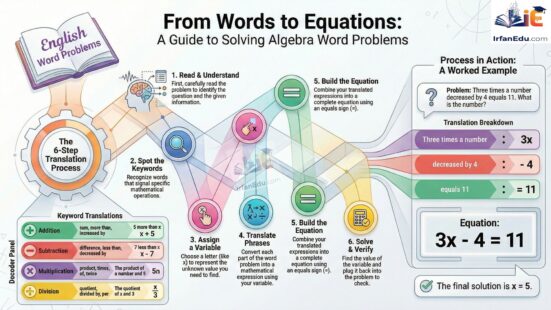
Transforming word problems into algebraic equations requires a systematic approach. Follow these proven steps to translate English phrases into mathematical language effectively:
Step 1: Read and Comprehend the Problem
Begin by reading the entire problem carefully. Don’t rush through this crucial first step. Identify what the problem asks you to find and what information it provides. Understanding the context helps you visualize the situation and determine the appropriate mathematical approach.
Step 2: Recognize Key Mathematical Terms
Certain words signal specific mathematical operations. Learning these keywords accelerates your translation process:
Addition Keywords: sum, more than, increased by, total, plus, combined, added to
Subtraction Keywords: difference, less than, decreased by, minus, reduced by, fewer than
Multiplication Keywords: product, times, multiplied by, of, twice, double, triple
Division Keywords: quotient, divided by, per, ratio, out of, split
Equality Keywords: is, are, will be, gives, equals, results in, yields
Step 3: Assign Variables to Unknown Quantities
Choose a letter (commonly $$x$$, $$y$$, or $$n$$) to represent the unknown value you need to find. Write down what your variable represents—this practice prevents confusion and helps you track your work. For example: “Let $$x$$ = the unknown number” or “Let $$w$$ = the width of the rectangle.”
Step 4: Translate Words into Mathematical Expressions
Convert each phrase in the problem into its mathematical equivalent using your assigned variable. Pay close attention to the order of operations and the sequence of terms, especially for subtraction and division where order matters significantly.
Step 5: Construct the Complete Equation
Combine all the translated parts into a single equation. The equal sign connects the two expressions that the problem states are equal.
Step 6: Solve and Verify Your Answer
Use inverse operations to isolate the variable and find its value. Always check your solution by substituting it back into the original equation to verify it satisfies the problem’s conditions.
Detailed Example: Translating and Solving a Word Problem
Problem: “Three times a number decreased by 4 equals 11. What is the number?”
Solution Process:
1. Identify the unknown: Let $$x$$ represent the unknown number
2. Translate each phrase:
- “Three times a number” → $$3x$$
- “Decreased by 4” → $$3x – 4$$
- “Equals 11” → $$= 11$$
3. Write the equation: $$3x – 4 = 11$$
4. Solve the equation:
$$3x – 4 = 11$$
$$3x = 15$$ (add 4 to both sides)
$$x = 5$$ (divide both sides by 3)
Answer: The number is 5
Essential Translation Examples
Understanding how to translate specific phrases helps you tackle any word problem. Here are critical examples that appear frequently:
Example 1: “The sum of 8 and y”
The keyword “sum” indicates addition. This phrase translates directly to:
$$8 + y$$
While $$y + 8$$ produces the same mathematical result, maintaining the order given in the problem develops good habits for situations where order matters.
Example 2: “4 less than x”
This construction requires careful attention! The phrase “less than” reverses the order in mathematical notation. The English says “4 less than x,” but mathematically we write:
$$x – 4$$
Important Note: “Four less than x” means “x minus 4,” NOT “4 minus x.” Test this with real numbers: if someone earns four dollars less per hour than you, and you earn $$p$$ dollars per hour, they earn $$p – 4$$, not $$4 – p$$.
Example 3: “x multiplied by 13”
The keyword “multiplied by” clearly indicates multiplication. In algebra, we place the constant before the variable:
$$13x$$
Since multiplication is commutative, $$(x)(13) = (13)(x)$$, but algebraic convention favors writing $$13x$$.
Example 4: “The quotient of x and 3”
The word “quotient” signals division. Order matters critically in division. Since the unknown comes first in the English expression, it goes in the numerator:
$$\frac{x}{3}$$
Example 5: “The difference of 5 and y”
The keyword “difference” indicates subtraction. Maintain the order given in the problem:
$$5 – y$$
Complex Translation: Multi-Part Expressions
Real-world problems often involve more complex phrases requiring multiple operations. Work through these systematically:
Example 6: “The ratio of 9 more than x to x”
Analysis: “The ratio of (this) to (that)” means “(this) divided by (that).” Break down the components:
- “9 more than x” translates to $$x + 9$$ (this goes in the numerator)
- “x” remains as the denominator
$$\frac{x + 9}{x}$$
Example 7: “Nine less than the total of a number and two”
Step-by-step translation:
1. Let $$n$$ = the unknown number
2. “The total of a number and two” → $$n + 2$$
3. “Nine less than” this total → $$(n + 2) – 9$$
4. Simplify: $$n – 7$$
The “How Much Is Left” Construction
This crucial concept appears frequently in word problems but often confuses students. When you have a total amount and you’ve accounted for part of it with a variable, the remaining portion equals the total minus what you’ve already named:
Example 8: Oil Container Problem
Problem: “Twenty gallons of crude oil were poured into two containers of different sizes. Express the amount poured into the smaller container in terms of the amount $$g$$ poured into the larger container.”
Reasoning:
- Total amount: 20 gallons
- Amount in larger container: $$g$$ gallons
- Amount in smaller container: what’s left over
Solution: The amount left equals the total minus what’s been used:
$$20 – g$$ gallons
Practice Problems with Solutions
Apply your translation skills to these problems. Work through each one systematically using the steps outlined above:
Problem 1: A number decreased by 4 equals 10. Find the number.
Solution:
Let $$x$$ = the unknown number
Equation: $$x – 4 = 10$$
Solve: $$x = 14$$
Answer: 14
Problem 2: The product of a number and 5 equals 35. Find the number.
Solution:
Let $$n$$ = the unknown number
Equation: $$5n = 35$$
Solve: $$n = 7$$
Answer: 7
Problem 3: The length of a rectangle is twice its width. If the perimeter is 36 units, find the dimensions.
Solution:
Let $$w$$ = width, then length = $$2w$$
Perimeter formula: $$P = 2l + 2w$$
Equation: $$2(2w) + 2w = 36$$
Simplify: $$6w = 36$$, so $$w = 6$$
Answer: Width = 6 units, Length = 12 units
Problem 4: A father is three times as old as his son. If the sum of their ages is 48 years, find their ages.
Solution:
Let $$s$$ = son’s age, then father’s age = $$3s$$
Equation: $$s + 3s = 48$$
Simplify: $$4s = 48$$, so $$s = 12$$
Answer: Son = 12 years, Father = 36 years
Problem 5: Two numbers differ by 8 and their sum is 48. Find the numbers.
Solution:
Let $$x$$ = smaller number, then larger number = $$x + 8$$
Equation: $$x + (x + 8) = 48$$
Simplify: $$2x + 8 = 48$$, so $$2x = 40$$, thus $$x = 20$$
Answer: The numbers are 20 and 28
Problem 6: The sum of a number and twice another number is 22. If the second number is 3 less than the first number, find the numbers.
Solution:
Let $$x$$ = first number, then second number = $$x – 3$$
Equation: $$x + 2(x – 3) = 22$$
Simplify: $$x + 2x – 6 = 22$$, so $$3x = 28$$, thus $$x = \frac{28}{3}$$ or approximately 9.33
Second number: $$\frac{28}{3} – 3 = \frac{19}{3}$$ or approximately 6.33
Answer: First number = $$\frac{28}{3}$$, Second number = $$\frac{19}{3}$$
Problem 7: A shop sells pencils at $2 each and erasers at $3 each. If a student buys a total of 10 items and spends $24, how many pencils and erasers did the student buy?
Solution:
Let $$p$$ = number of pencils, then erasers = $$10 – p$$
Equation: $$2p + 3(10 – p) = 24$$
Simplify: $$2p + 30 – 3p = 24$$, so $$-p = -6$$, thus $$p = 6$$
Erasers: $$10 – 6 = 4$$
Answer: 6 pencils and 4 erasers
Problem 8: The difference between a number and 7 equals twice the number decreased by 5. Find the number.
Solution:
Let $$x$$ = the unknown number
Equation: $$x – 7 = 2x – 5$$
Solve: $$-7 + 5 = 2x – x$$, so $$-2 = x$$
Answer: -2
Problem 9: The sum of three consecutive integers is 51. Find the integers.
Solution:
Let $$n$$ = first integer, then $$n + 1$$ and $$n + 2$$ are the next two
Equation: $$n + (n + 1) + (n + 2) = 51$$
Simplify: $$3n + 3 = 51$$, so $$3n = 48$$, thus $$n = 16$$
Answer: The integers are 16, 17, and 18
Problem 10: A car rental company charges a flat fee of $30 plus $0.20 per mile driven. If a customer paid $50 for a rental, how many miles did they drive?
Solution:
Let $$m$$ = number of miles driven
Equation: $$30 + 0.20m = 50$$
Solve: $$0.20m = 20$$, so $$m = 100$$
Answer: 100 miles
Types of Word Problems You’ll Encounter
As you progress in algebra, you’ll encounter various categories of word problems. Each type follows specific patterns:
- Age Problems: Determining people’s ages at different times
- Geometry Problems: Finding dimensions using perimeter, area, and volume formulas
- Coin Problems: Calculating quantities of different coin denominations
- Distance Problems: Using the formula $$d = rt$$ (distance = rate × time)
- Investment Problems: Applying interest formulas $$I = Prt$$
- Mixture Problems: Combining substances with different concentrations or prices
- Number Problems: Finding unknown numbers based on relationships
- Percent Problems: Calculating discounts, increases, and percentages
- Work Problems: Determining completion times when multiple people work together
Essential Tips for Success
- Don’t treat keywords as absolute rules—use them as helpful guides while applying logical thinking
- Test your translations with real numbers to verify they make sense
- Write down what your variable represents before setting up equations
- Pay special attention to order in subtraction and division problems
- Check your final answer by substituting it back into the original problem
- Practice explaining your work to others—if you can teach it, you’ve mastered it
- Draw diagrams when appropriate to visualize the problem
- Break complex problems into smaller steps rather than attempting everything at once
Conclusion: Building Your Problem-Solving Foundation
Translating word problems into algebraic equations represents a critical skill that extends far beyond the classroom. This ability helps you model real-world situations mathematically, enabling you to solve practical problems in finance, science, engineering, and everyday life. By identifying key variables and understanding the relationships described in problems, you develop analytical thinking that serves you throughout your academic and professional career.
Mastery comes through consistent practice with various problem types. Each problem you solve strengthens your pattern recognition and builds your confidence. Remember that understanding the “why” behind each step matters more than memorizing procedures. When you truly comprehend the logic of translation, you can tackle any word problem that comes your way.
Start with simple problems and gradually progress to more complex scenarios. Use the keywords as guides, but always engage your critical thinking. Test your translations with concrete numbers when you’re uncertain. Most importantly, don’t get discouraged by mistakes—they’re valuable learning opportunities that help you refine your problem-solving approach. With dedication and practice, you’ll develop the expertise to confidently translate any word problem into its algebraic equivalent and solve it efficiently.
Final Reminder: The journey to mastering algebraic word problems requires patience and persistence. Keep practicing, stay curious, and always verify your answers. Your problem-solving abilities will improve dramatically with each problem you tackle!
[pdf_viewer id=”217″]