Tag: Exponents

  • Exponents and Polynomials: Simplifying and operations | ACT Math Guide

    Exponents and Polynomials: Simplifying and operations | ACT Math Guide

    Simplifying and Performing Operations on Polynomials | ACT Math Guide for Grades 9-12

    Polynomials are one of the most frequently tested topics in the ACT Prep Mathematics section, appearing in approximately 8-12 questions on every test. Whether you’re adding, subtracting, multiplying, or dividing polynomial expressions, mastering these operations is essential for achieving your target score. The good news? Once you understand the fundamental rules and practice the right strategies, polynomial problems become straightforward and even enjoyable to solve. This comprehensive guide will walk you through everything you need to know about simplifying and performing operations on polynomials, with proven techniques specifically designed for ACT success.

    🎯

    ACT SCORE BOOSTER: Master This Topic for 3-5 Extra Points!

    Polynomial operations appear in every ACT Math test with 8-12 questions covering this topic. Understanding these concepts thoroughly can add 3-5 points to your composite score. Let’s break it down with proven strategies that work!

    🚀 Jump to ACT Strategy →

    📚 Understanding Polynomials and Their Operations

    A polynomial is an algebraic expression consisting of variables and coefficients, combined using addition, subtraction, and multiplication. The term “polynomial” comes from “poly” (meaning many) and “nomial” (meaning terms). Examples include $$3x^2 + 5x – 7$$ or $$4x^3 – 2x^2 + x + 9$$.

    On the ACT, you’ll encounter polynomial operations in various contexts—from straightforward simplification problems to more complex word problems involving area, perimeter, and real-world applications. The official ACT Math section tests your ability to manipulate these expressions quickly and accurately under time pressure.

    🔑 Key Terminology You Must Know:

    • Term: A single part of a polynomial (e.g., $$5x^2$$)
    • Coefficient: The numerical part of a term (e.g., 5 in $$5x^2$$)
    • Degree: The highest exponent in the polynomial
    • Like Terms: Terms with identical variable parts (e.g., $$3x^2$$ and $$7x^2$$)
    • Standard Form: Terms arranged from highest to lowest degree

    Why This Matters for Your ACT Score: Polynomial operations form the foundation for approximately 20-25% of all ACT Math questions. They appear not only in pure algebra problems but also in geometry (area and volume formulas), coordinate geometry, and even trigonometry questions. Students who master polynomial operations typically score 3-5 points higher on the Math section compared to those who struggle with these concepts.

    📐 Essential Formulas & Rules for Polynomial Operations

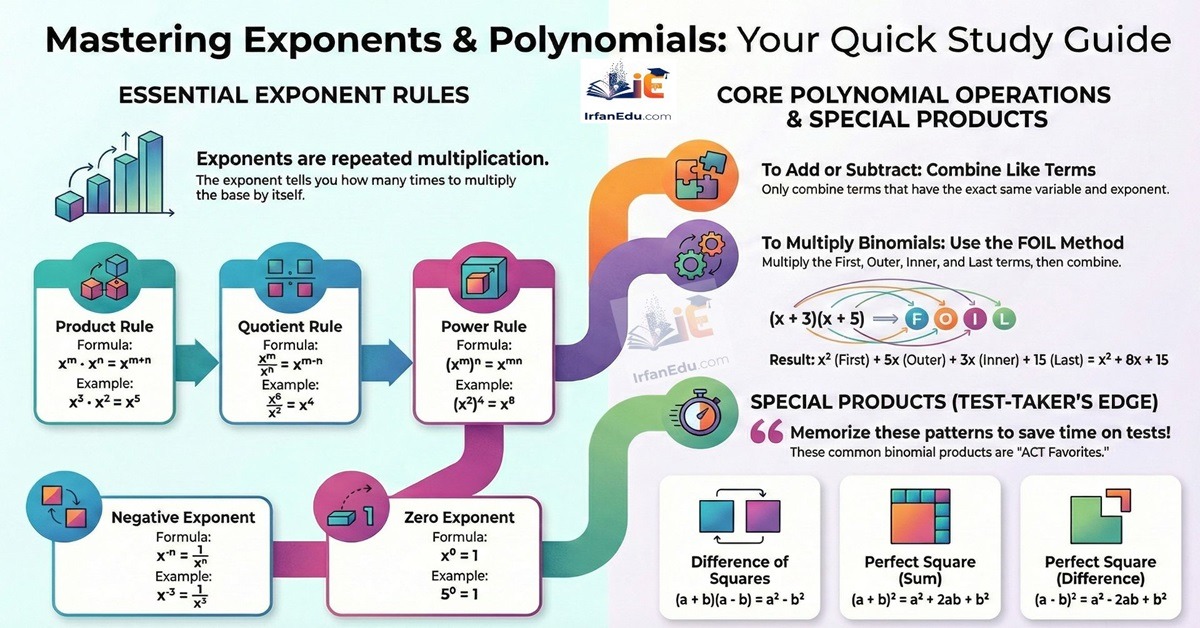
    1️⃣ Exponent Rules (Critical for Polynomials)

    Rule Name Formula Example
    Product Rule $$x^a \cdot x^b = x^{a+b}$$ $$x^3 \cdot x^5 = x^8$$
    Quotient Rule $$\frac{x^a}{x^b} = x^{a-b}$$ $$\frac{x^7}{x^3} = x^4$$
    Power Rule $$(x^a)^b = x^{a \cdot b}$$ $$(x^2)^3 = x^6$$
    Zero Exponent $$x^0 = 1$$ (where $$x \neq 0$$) $$5^0 = 1$$
    Negative Exponent $$x^{-a} = \frac{1}{x^a}$$ $$x^{-3} = \frac{1}{x^3}$$

    2️⃣ Polynomial Operation Rules

    Addition/Subtraction: Combine only like terms

    $$(3x^2 + 5x – 2) + (2x^2 – 3x + 7) = 5x^2 + 2x + 5$$

    Multiplication (Distributive Property):

    $$a(b + c) = ab + ac$$

    Example: $$3x(2x^2 – 5x + 4) = 6x^3 – 15x^2 + 12x$$

    FOIL Method (Binomial Multiplication):

    $$(a + b)(c + d) = ac + ad + bc + bd$$

    Example: $$(x + 3)(x + 5) = x^2 + 5x + 3x + 15 = x^2 + 8x + 15$$

    3️⃣ Special Polynomial Products (ACT Favorites!)

    Pattern Name Formula
    Perfect Square (Sum) $$(a + b)^2 = a^2 + 2ab + b^2$$
    Perfect Square (Difference) $$(a – b)^2 = a^2 – 2ab + b^2$$
    Difference of Squares $$(a + b)(a – b) = a^2 – b^2$$

    ⚡ ACT Time-Saver: Memorize these special products! They appear on nearly every ACT Math test and can save you 30-60 seconds per question when you recognize the pattern instantly.

    ✅ Step-by-Step Examples: Mastering Polynomial Operations

    📘 Example 1: Adding and Subtracting Polynomials

    Problem: Simplify $$(4x^3 – 2x^2 + 7x – 5) – (2x^3 + 3x^2 – 4x + 8)$$

    Step 1: Distribute the negative sign
    When subtracting polynomials, distribute the negative sign to every term in the second polynomial:

    $$= 4x^3 – 2x^2 + 7x – 5 – 2x^3 – 3x^2 + 4x – 8$$

    Step 2: Group like terms
    Organize terms by their degree (exponent):

    $$= (4x^3 – 2x^3) + (-2x^2 – 3x^2) + (7x + 4x) + (-5 – 8)$$

    Step 3: Combine like terms
    Add or subtract the coefficients of like terms:

    $$= 2x^3 – 5x^2 + 11x – 13$$

    ✓ Final Answer: $$2x^3 – 5x^2 + 11x – 13$$

    ⏱️ ACT Time Estimate: 45-60 seconds

    📗 Example 2: Multiplying Polynomials (Distributive Property)

    Problem: Multiply $$3x^2(2x^2 – 5x + 4)$$

    Step 1: Apply the distributive property
    Multiply $$3x^2$$ by each term inside the parentheses:

    $$= 3x^2 \cdot 2x^2 + 3x^2 \cdot (-5x) + 3x^2 \cdot 4$$

    Step 2: Multiply coefficients and add exponents
    Use the product rule for exponents ($$x^a \cdot x^b = x^{a+b}$$):

    $$= 6x^4 – 15x^3 + 12x^2$$

    ✓ Final Answer: $$6x^4 – 15x^3 + 12x^2$$

    ⏱️ ACT Time Estimate: 30-45 seconds

    📙 Example 3: Multiplying Binomials (FOIL Method)

    Problem: Expand $$(2x + 5)(3x – 4)$$

    Step 1: Apply FOIL (First, Outer, Inner, Last)

    First: $$2x \cdot 3x = 6x^2$$

    Outer: $$2x \cdot (-4) = -8x$$

    Inner: $$5 \cdot 3x = 15x$$

    Last: $$5 \cdot (-4) = -20$$

    Step 2: Combine all terms

    $$= 6x^2 – 8x + 15x – 20$$

    Step 3: Combine like terms

    $$= 6x^2 + 7x – 20$$

    ✓ Final Answer: $$6x^2 + 7x – 20$$

    ⏱️ ACT Time Estimate: 40-50 seconds

    📕 Example 4: Special Product (Difference of Squares)

    Problem: Simplify $$(4x + 7)(4x – 7)$$

    Step 1: Recognize the pattern
    This is a difference of squares pattern: $$(a + b)(a – b) = a^2 – b^2$$
    Here, $$a = 4x$$ and $$b = 7$$

    Step 2: Apply the formula

    $$= (4x)^2 – (7)^2$$

    Step 3: Simplify

    $$= 16x^2 – 49$$

    ✓ Final Answer: $$16x^2 – 49$$

    ⚡ ACT Pro Tip: Recognizing this pattern saved us from using FOIL! This shortcut can save 20-30 seconds on the ACT. Always check if binomials follow the $$(a+b)(a-b)$$ pattern before multiplying.

    ⏱️ ACT Time Estimate: 20-30 seconds (with pattern recognition!)

    📝 ACT-Style Practice Questions

    Test your understanding with these ACT-style practice problems. Try solving them on your own before checking the solutions!

    Practice Question 1 (Basic)

    What is the result when $$(5x^2 – 3x + 2)$$ is added to $$(2x^2 + 7x – 9)$$?

    A) $$7x^2 + 4x – 7$$
    B) $$7x^2 + 10x – 7$$
    C) $$3x^2 + 4x – 7$$
    D) $$7x^2 – 4x + 11$$
    E) $$10x^2 + 4x – 7$$
    Show Detailed Solution

    Step 1: Write out both polynomials:
    $$(5x^2 – 3x + 2) + (2x^2 + 7x – 9)$$

    Step 2: Group like terms:
    $$(5x^2 + 2x^2) + (-3x + 7x) + (2 – 9)$$

    Step 3: Combine like terms:
    $$7x^2 + 4x – 7$$

    ✓ Correct Answer: A) $$7x^2 + 4x – 7$$

    Difficulty: Basic | Time: 30-40 seconds

    Practice Question 2 (Intermediate)

    Simplify: $$-2x(3x^2 – 4x + 5)$$

    A) $$-6x^3 + 8x^2 – 10x$$
    B) $$-6x^3 – 8x^2 – 10x$$
    C) $$-6x^2 + 8x – 10$$
    D) $$6x^3 – 8x^2 + 10x$$
    E) $$-6x^3 – 8x + 10$$
    Show Detailed Solution

    Step 1: Distribute $$-2x$$ to each term:
    $$= -2x \cdot 3x^2 + (-2x) \cdot (-4x) + (-2x) \cdot 5$$

    Step 2: Multiply coefficients and add exponents:
    $$= -6x^3 + 8x^2 – 10x$$

    ✓ Correct Answer: A) $$-6x^3 + 8x^2 – 10x$$

    Common Mistake: Watch the signs! $$-2x \cdot (-4x) = +8x^2$$ (negative times negative equals positive)

    Difficulty: Intermediate | Time: 35-45 seconds

    Practice Question 3 (Intermediate)

    Which of the following is equivalent to $$(x – 6)(x + 9)$$?

    A) $$x^2 + 3x – 54$$
    B) $$x^2 – 3x – 54$$
    C) $$x^2 + 15x – 54$$
    D) $$x^2 + 3x + 54$$
    E) $$x^2 – 15x – 54$$
    Show Detailed Solution

    Step 1: Apply FOIL method:

    • First: $$x \cdot x = x^2$$
    • Outer: $$x \cdot 9 = 9x$$
    • Inner: $$-6 \cdot x = -6x$$
    • Last: $$-6 \cdot 9 = -54$$

    Step 2: Combine all terms:
    $$= x^2 + 9x – 6x – 54$$

    Step 3: Combine like terms:
    $$= x^2 + 3x – 54$$

    ✓ Correct Answer: A) $$x^2 + 3x – 54$$

    Difficulty: Intermediate | Time: 40-50 seconds

    Practice Question 4 (Advanced)

    What is the simplified form of $$(3x + 5)^2$$?

    A) $$9x^2 + 25$$
    B) $$9x^2 + 15x + 25$$
    C) $$9x^2 + 30x + 25$$
    D) $$3x^2 + 30x + 25$$
    E) $$9x^2 + 10x + 25$$
    Show Detailed Solution

    Method 1: Using the Perfect Square Formula
    Recognize the pattern: $$(a + b)^2 = a^2 + 2ab + b^2$$
    Here, $$a = 3x$$ and $$b = 5$$

    Step 1: Apply the formula:
    $$= (3x)^2 + 2(3x)(5) + (5)^2$$

    Step 2: Simplify each term:
    $$= 9x^2 + 30x + 25$$

    ✓ Correct Answer: C) $$9x^2 + 30x + 25$$

    ⚠️ Common Trap Answer: A) $$9x^2 + 25$$ — This is WRONG! Many students forget the middle term $$2ab$$. Always remember: $$(a+b)^2 \neq a^2 + b^2$$

    Difficulty: Advanced | Time: 30-40 seconds (with formula recognition)

    Practice Question 5 (Advanced – ACT Challenge)

    If $$x^2 – y^2 = 48$$ and $$x – y = 6$$, what is the value of $$x + y$$?

    A) 6
    B) 8
    C) 10
    D) 12
    E) 14
    Show Detailed Solution

    Step 1: Recognize the difference of squares pattern
    $$x^2 – y^2 = (x + y)(x – y)$$

    Step 2: Substitute the known values:
    $$48 = (x + y)(6)$$

    Step 3: Solve for $$(x + y)$$:
    $$x + y = \frac{48}{6} = 8$$

    ✓ Correct Answer: B) 8

    💡 ACT Strategy: This question tests whether you recognize the difference of squares factorization. Without this recognition, you’d need to solve a system of equations, which takes much longer!

    Difficulty: Advanced | Time: 30-45 seconds (with pattern recognition) or 90+ seconds (without)

    📝

    Ready to Test Your Polynomial Skills?

    Take our full-length ACT practice test and see how well you’ve mastered polynomial operations. Get instant scoring, detailed explanations, and personalized recommendations!

    🚀 Start ACT Practice Test Now →
    Full-Length Tests
    Instant Scoring
    Detailed Solutions

    💡 ACT Pro Tips & Tricks for Polynomial Success

    ⚡ Tip 1: Master Pattern Recognition for Speed

    The ACT rewards students who can instantly recognize special products like $$(a+b)^2$$, $$(a-b)^2$$, and $$(a+b)(a-b)$$. Memorize these patterns cold! When you see $$(x+7)(x-7)$$, your brain should immediately think “difference of squares = $$x^2-49$$” without needing to FOIL. This single skill can save you 2-3 minutes per test.

    📋 Tip 2: Write Vertically for Complex Addition/Subtraction

    When adding or subtracting polynomials with many terms, align them vertically by degree. This prevents careless errors with signs and makes it easier to combine like terms. For example, stack $$x^3$$, $$x^2$$, $$x$$, and constant terms in columns—just like you learned in elementary school for multi-digit addition!

    ⚠️ Tip 3: Watch Out for Negative Sign Distribution

    The #1 mistake students make with polynomials? Forgetting to distribute the negative sign when subtracting. When you see $$-(3x^2 – 5x + 2)$$, EVERY term inside changes sign: $$-3x^2 + 5x – 2$$. Circle or highlight negative signs in your test booklet to avoid this trap!

    🧮 Tip 4: Use Your Calculator Strategically

    Your calculator can verify polynomial operations! After simplifying, plug in a test value (like $$x=2$$) into both the original expression and your answer. If they give different results, you made an error. This 10-second check can save you from losing easy points. Just don’t rely on your calculator to do the algebra—it’s usually slower than doing it by hand.

    🎯 Tip 5: Eliminate Answer Choices Using Degree and Leading Coefficient

    Before doing full calculations, check the degree (highest exponent) and leading coefficient of answer choices. If you’re multiplying $$3x^2$$ by $$2x^3$$, the result MUST start with $$6x^5$$. Eliminate any answer that doesn’t match this immediately! This process of elimination can help you narrow down to 2-3 choices before you even finish the problem.

    ⏰ Tip 6: Time Management – Know When to Skip

    Most polynomial problems should take 30-60 seconds. If you’re spending more than 90 seconds on one question, mark it and move on. You can always return to it later. The ACT doesn’t give extra points for hard questions—a basic polynomial addition question is worth the same as a complex multiplication problem. Get the easy points first!

    🚫 Common Mistakes to Avoid

    ❌ Mistake #1: The Perfect Square Trap

    Wrong: $$(x + 5)^2 = x^2 + 25$$
    Right: $$(x + 5)^2 = x^2 + 10x + 25$$

    Why it happens: Students forget the middle term $$2ab$$. Always remember: $$(a+b)^2 = a^2 + 2ab + b^2$$

    ❌ Mistake #2: Exponent Addition vs. Multiplication

    Wrong: $$(x^2)^3 = x^5$$
    Right: $$(x^2)^3 = x^6$$

    Why it happens: Confusing the power rule with the product rule. When raising a power to a power, you MULTIPLY exponents, not add them.

    ❌ Mistake #3: Sign Errors in Subtraction

    Wrong: $$(5x – 3) – (2x – 7) = 3x – 10$$
    Right: $$(5x – 3) – (2x – 7) = 3x + 4$$

    Why it happens: Not distributing the negative sign to ALL terms. $$-(2x – 7) = -2x + 7$$, not $$-2x – 7$$.

    ❌ Mistake #4: Combining Unlike Terms

    Wrong: $$3x^2 + 5x = 8x^2$$ or $$8x^3$$
    Right: $$3x^2 + 5x$$ (cannot be simplified further)

    Why it happens: Only terms with identical variable parts can be combined. $$x^2$$ and $$x$$ are NOT like terms!

    🎥 Video Explanation: Polynomial Operations

    Watch this detailed video explanation to understand polynomial operations better with visual demonstrations and step-by-step guidance.

    🎯 ACT Test-Taking Strategy for Polynomial Operations

    ⏱️ Time Allocation Strategy

    With 60 questions in 60 minutes, you have an average of 1 minute per question on the ACT Math section. For polynomial operations:

    • Basic addition/subtraction: 30-45 seconds
    • Multiplication with distribution: 45-60 seconds
    • FOIL problems: 40-50 seconds
    • Special products (if recognized): 20-35 seconds
    • Complex multi-step problems: 60-90 seconds

    🎲 Smart Guessing Strategy

    If you’re running out of time or stuck on a polynomial problem:

    1. Check the degree: Eliminate answers with wrong highest exponent
    2. Check the leading coefficient: Eliminate answers that don’t match
    3. Check the constant term: Often easier to calculate quickly
    4. Plug in x=0 or x=1: Test remaining answer choices
    5. Never leave blank: There’s no penalty for guessing on the ACT!

    🔍 Answer Verification Techniques

    If you have 10-15 seconds left after solving:

    Quick Check Method: Substitute $$x = 2$$ into both the original expression and your answer. If they give the same result, you’re likely correct. If not, you made an error.

    🎯 Question Priority System

    Not all polynomial questions are created equal. Use this priority system:

    Priority Question Type Strategy
    HIGH Simple addition/subtraction, special products you recognize Do these first—quick points!
    MEDIUM FOIL problems, basic distribution Do these second—manageable in 45-60 seconds
    LOW Complex multi-step, unfamiliar patterns Skip and return if time permits

    📝 Scratch Work Organization

    Use your test booklet effectively:

    • Write out polynomial operations vertically when possible
    • Circle or box negative signs to avoid sign errors
    • Cross out answer choices you’ve eliminated
    • Use arrows to track like terms when combining
    • Write clearly—you may need to return to check your work

    🏆 Score Improvement Guarantee

    Students who master polynomial operations and apply these strategies typically see a 3-5 point improvement on their ACT Math score. That’s because polynomials appear in 8-12 questions per test, and many other algebra questions build on these foundational skills. Invest the time to master this topic—it’s one of the highest-ROI areas for ACT prep!

    🌍 Real-World Applications: Why Polynomials Matter

    You might wonder, “When will I ever use polynomial operations in real life?” The answer: more often than you think! Here’s where these skills show up beyond the ACT:

    🏗️ Architecture & Engineering

    Calculating areas, volumes, and structural loads often involves polynomial expressions. For example, finding the area of a complex shape might require multiplying $$(2x + 5)(3x – 2)$$.

    💰 Finance & Economics

    Profit functions, cost analysis, and investment growth models use polynomial equations. Business analysts regularly work with expressions like $$-2x^2 + 50x – 100$$ to maximize profit.

    🎮 Computer Graphics & Gaming

    Video game physics, animation curves, and 3D modeling all rely heavily on polynomial mathematics. Every smooth curve you see in a video game involves polynomial calculations.

    🔬 Science & Research

    Physics equations for motion, chemistry calculations for reaction rates, and biology models for population growth all use polynomial expressions extensively.

    College Connection: Polynomial operations are foundational for college courses including Calculus, Physics, Chemistry, Economics, Engineering, and Computer Science. Mastering them now gives you a significant advantage in your first-year college courses!

    ❓ Frequently Asked Questions (FAQs)

    Q1: How many polynomial questions are typically on the ACT Math section? +

    Polynomial operations appear in approximately 8-12 questions on every ACT Math test, making them one of the most frequently tested topics. This includes direct polynomial manipulation questions as well as word problems involving area, perimeter, and other applications. Additionally, polynomial skills are foundational for many other algebra questions, so mastering this topic impacts your performance on 20-25% of the entire Math section.

    Q2: Should I memorize all the special polynomial products, or can I just use FOIL every time? +

    Definitely memorize the special products! While FOIL always works, recognizing patterns like $$(a+b)^2 = a^2 + 2ab + b^2$$ and $$(a+b)(a-b) = a^2 – b^2$$ can save you 20-30 seconds per question. On a timed test like the ACT, this time savings is crucial. Plus, these patterns appear on nearly every ACT Math test—usually 2-4 times. The investment of 15-20 minutes to memorize these formulas will pay dividends on test day and throughout your college math courses.

    Q3: Can I use my calculator for polynomial operations on the ACT? +

    While calculators are allowed on the ACT Math section, they’re generally not helpful for polynomial operations. Most calculators can’t symbolically manipulate algebraic expressions, so you’ll need to do the algebra by hand anyway. However, you CAN use your calculator to verify your answer by plugging in a test value (like $$x=2$$) into both the original expression and your simplified answer. If they match, you’re likely correct. This verification technique takes only 10-15 seconds and can catch careless errors.

    Q4: What’s the most common mistake students make with polynomial operations? +

    The #1 mistake is sign errors when distributing negative signs. When you see $$-(3x^2 – 5x + 2)$$, every term inside must change sign: $$-3x^2 + 5x – 2$$. Many students correctly change the first term but forget about the others. The second most common mistake is thinking $$(a+b)^2 = a^2 + b^2$$ and forgetting the middle term $$2ab$$. To avoid these errors: (1) Circle all negative signs in your test booklet, (2) Write out the distribution step explicitly rather than doing it in your head, and (3) Memorize the special product formulas so thoroughly that you can recite them in your sleep!

    Q5: How can I improve my speed on polynomial problems without sacrificing accuracy? +

    Speed comes from pattern recognition and deliberate practice. Here’s a proven strategy: (1) Master the exponent rules and special products until they’re automatic, (2) Practice 10-15 polynomial problems daily for 2 weeks—time yourself and track your progress, (3) Learn to eliminate wrong answers quickly by checking degree and leading coefficients, (4) Develop a consistent scratch work system so you don’t waste time thinking about how to organize your work. Most importantly, focus on accuracy first—speed will naturally increase as the patterns become familiar. Students who rush through problems make careless errors that cost more time than they save. Aim for smooth, confident execution rather than frantic speed.

    Dr. Irfan Mansuri - ACT Test Prep Specialist

    ✍️ Written by Dr. Irfan Mansuri

    Educational Content Creator & Competitive Exam Specialist

    IrfanEdu.com • United States

    Dr. Irfan Mansuri is a distinguished educational content creator with over 15 years of experience spanning high school, undergraduate, and postgraduate levels. As the founder of IrfanEdu.com, he has successfully guided thousands of students through competitive examinations, helping them achieve exceptional results and gain admission to their dream institutions.

    15+ years in competitive exam preparation Certified Instructor LinkedIn Profile

    🎓 Final Thoughts: Your Path to Polynomial Mastery

    Mastering polynomial operations is one of the smartest investments you can make in your ACT Prep journey. These skills appear throughout the Math section and form the foundation for success in higher-level math courses. Remember: speed comes from understanding, not memorization. Focus on truly grasping why the rules work, practice consistently, and use the strategic approaches outlined in this guide.

    With dedicated practice, you can transform polynomial operations from a source of anxiety into a reliable source of quick points on test day. Start with the basics, build your confidence with practice problems, and gradually work up to the more challenging questions. Your future self—and your ACT score—will thank you!

    📚 Related ACT Math Resources

    • Complete ACT Math Prep Guide
    • ACT Algebra: Solving Quadratic Equations
    • ACT Math: Factoring Polynomials Strategies
    • Elementary Algebra: Functions and Graphs
    • ACT Math Time Management Strategies
    Master Exponents and Polynomials – IrfanEdu.com

    🎓 Exponents and Polynomials Mastery

    Your Complete Guide to Understanding Algebraic Operations | IrfanEdu.com

    📊 Understanding Exponents

    Exponents represent repeated multiplication. When you see , you multiply x by itself three times.

    Visual Example

    2⁵ = 2 × 2 × 2 × 2 × 2 = 32

    Here, we multiply the base (2) by itself five times because the exponent is 5.

    Essential Exponent Rules

    Product Rule

    x^m × x^n = x^(m+n)

    Example: x³ × x² = x⁵

    Quotient Rule

    x^m ÷ x^n = x^(m-n)

    Example: x⁶ ÷ x² = x⁴

    Power Rule

    (x^m)^n = x^(mn)

    Example: (x²)⁴ = x⁸

    💡 Pro Tip

    When you multiply terms with the same base, you add the exponents. When you divide, you subtract them. This pattern makes calculations much easier!

    Special Cases You Must Know

    Rule Formula Example
    Zero Exponent x⁰ = 1 5⁰ = 1
    Negative Exponent x⁻ⁿ = 1/xⁿ x⁻³ = 1/x³
    Power of Product (xy)ⁿ = xⁿyⁿ (2x)³ = 8x³
    Power of Quotient (x/y)ⁿ = xⁿ/yⁿ (x/2)² = x²/4

    🔢 What Are Polynomials?

    A polynomial combines variables, constants, and exponents using addition, subtraction, and multiplication. You can recognize polynomials by their structure.

    Polynomial Components

    3x² + 5x – 7

    Breaking it down:

    • 3x² → First term (coefficient: 3, variable: x, exponent: 2)
    • 5x → Second term (coefficient: 5, variable: x, exponent: 1)
    • -7 → Constant term (no variable)

    Types of Polynomials by Degree

    Linear (Degree 1)

    2x + 3

    Creates a straight line graph

    Quadratic (Degree 2)

    x² + 4x + 4

    Creates a parabola graph

    Cubic (Degree 3)

    x³ – 2x² + x

    Creates an S-shaped curve

    ⚠️ What’s NOT a Polynomial?

    • ❌ Division by a variable: 3/x + 2
    • ❌ Negative exponents: x⁻² + 5
    • ❌ Fractional exponents: x^(1/2) + 3
    • ❌ Variables in denominators: 1/(x+1)

    ➕➖ Adding and Subtracting Polynomials

    You combine polynomials by adding or subtracting like terms – terms with the same variable and exponent.

    Step-by-Step Addition Example

    Problem: Add (3x² + 2x + 5) + (x² – 4x + 3)

    1 Remove parentheses: 3x² + 2x + 5 + x² – 4x + 3
    2 Group like terms: (3x² + x²) + (2x – 4x) + (5 + 3)
    3 Combine: 4x² – 2x + 8

    Step-by-Step Subtraction Example

    Problem: Subtract (5x² + 3x – 2) – (2x² + x + 4)

    1 Distribute the negative: 5x² + 3x – 2 – 2x² – x – 4
    2 Group like terms: (5x² – 2x²) + (3x – x) + (-2 – 4)
    3 Simplify: 3x² + 2x – 6

    💡 Key Strategy

    When subtracting, change the sign of every term in the second polynomial. This prevents common mistakes!

    ✖️ Multiplying Polynomials

    The FOIL Method (For Binomials)

    FOIL stands for: First, Outer, Inner, Last

    FOIL Example

    Problem: (x + 3)(x + 5)

    F First: x × x = x²
    O Outer: x × 5 = 5x
    I Inner: 3 × x = 3x
    L Last: 3 × 5 = 15
    Result: x² + 5x + 3x + 15 = x² + 8x + 15

    Multiplying Larger Polynomials

    Distribution Method

    Problem: 2x(3x² – 4x + 5)

    1 Multiply first term: 2x × 3x² = 6x³
    2 Multiply second term: 2x × (-4x) = -8x²
    3 Multiply third term: 2x × 5 = 10x
    Result: 6x³ – 8x² + 10x

    ➗ Dividing Polynomials

    Simple Division by Monomials

    Breaking Down Division

    Problem: (6x³ + 9x²) ÷ 3x

    1 Separate terms: (6x³/3x) + (9x²/3x)
    2 Simplify each: 2x² + 3x

    Long Division Method

    Polynomial Long Division

    Problem: (x² + 5x + 6) ÷ (x + 2)

    1 Divide leading terms: x² ÷ x = x
    2 Multiply and subtract: x(x + 2) = x² + 2x
    Subtract: (x² + 5x + 6) – (x² + 2x) = 3x + 6
    3 Repeat: 3x ÷ x = 3
    3(x + 2) = 3x + 6
    Subtract: (3x + 6) – (3x + 6) = 0
    Result: x + 3

    💡 Division Tip

    Always arrange polynomials in descending order of exponents before dividing. This keeps your work organized and prevents errors.

    🌍 Real-World Applications

    📐 Area Calculations

    Engineers use polynomials to calculate areas of complex shapes.

    Area = (x + 3)(x + 5)

    = x² + 8x + 15

    💰 Business Profit

    Companies model profit using polynomial functions.

    P(x) = -2x² + 50x – 100

    Where x represents units sold

    🚀 Physics Motion

    Scientists describe object motion with polynomials.

    h(t) = -16t² + 64t + 80

    Height at time t

    ✍️ Practice Problems

    Try These Yourself!

    1. Simplify: (2x³)(4x²)

    2. Add: (3x² + 2x – 5) + (x² – 3x + 7)

    3. Multiply: (x + 4)(x – 2)

    4. Divide: (12x⁴ + 8x³) ÷ 4x²

    📝 Answers

    1. 8x⁵

    2. 4x² – x + 2

    3. x² + 2x – 8

    4. 3x² + 2x

    📚 Quick Reference Guide

    Operation Rule Example
    Adding Exponents x^a × x^b = x^(a+b) x³ × x² = x⁵
    Subtracting Exponents x^a ÷ x^b = x^(a-b) x⁵ ÷ x² = x³
    Power of Power (x^a)^b = x^(ab) (x²)³ = x⁶
    Adding Polynomials Combine like terms 3x + 2x = 5x
    Multiplying Binomials Use FOIL (x+2)(x+3) = x²+5x+6

    🎓 IrfanEdu.com

    Making Math Simple and Accessible for Everyone

    © 2024 IrfanEdu.com | All Rights Reserved

    [pdf_viewer id=”206″]

  • Laws of Exponents, Square Roots, and Cube Roots | ACT Math Guide

    Laws of Exponents, Square Roots, and Cube Roots | ACT Math Guide

    Laws of Exponents, Square Roots, and Cube Roots | ACT Math Guide

    Exponents and roots are fundamental building blocks of algebra that appear consistently throughout the ACT Math section. Whether you’re simplifying expressions, solving equations, or working with scientific notation, a solid understanding of exponent laws and root operations is essential. This comprehensive guide will walk you through the laws of exponents, square roots, and cube roots with clear explanations, practical examples, and proven test-taking strategies designed specifically for ACT success.

    🎯

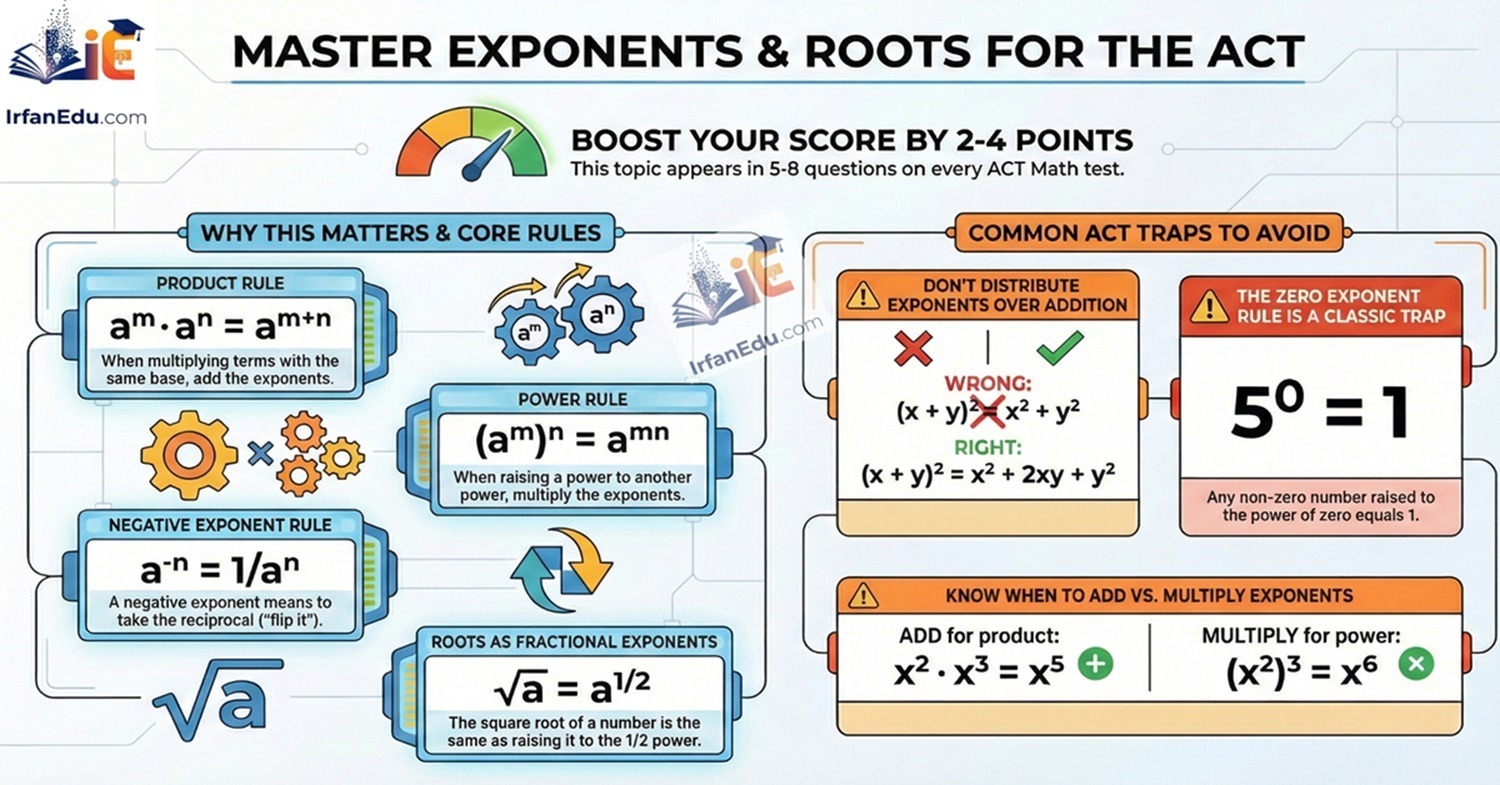
    ACT SCORE BOOSTER: Master This Topic for 2-4 Extra Points!

    Exponents and roots appear in 5-8 questions per test on the ACT Math section. Understanding these concepts thoroughly can add 2-4 points to your composite score. Let’s break it down with proven strategies that work!

    🚀 Jump to ACT Strategy →

    📚 Understanding Exponents and Roots

    Exponents represent repeated multiplication, while roots are the inverse operation of exponents. When you see $$x^5$$, it means $$x \cdot x \cdot x \cdot x \cdot x$$. Conversely, when you see $$\sqrt[3]{8}$$, you’re asking “what number multiplied by itself three times equals 8?”

    Why This Matters for the ACT: The ACT Math section tests your ability to manipulate exponential expressions efficiently. You’ll encounter exponents in algebra problems, scientific notation questions, and even geometry formulas. Mastering these laws allows you to simplify complex expressions quickly—a crucial skill when you have just one minute per question.

    Frequency on the ACT: Expect 5-8 questions directly involving exponents and roots, plus many more where these concepts appear as part of larger problems. This topic typically appears across difficulty levels, from straightforward simplification to complex multi-step problems.

    Score Impact: Students who master exponent laws can solve these questions in 30-45 seconds instead of 90+ seconds, freeing up valuable time for more challenging problems. This efficiency can translate to 2-4 additional points on your ACT Math score.

    📐 Essential Laws of Exponents & Roots

    🔢 The Seven Core Exponent Laws

    1. Product Rule: $$a^m \cdot a^n = a^{m+n}$$
    When multiplying same bases, add the exponents
    Example: $$x^3 \cdot x^5 = x^8$$

    2. Quotient Rule: $$\frac{a^m}{a^n} = a^{m-n}$$
    When dividing same bases, subtract the exponents
    Example: $$\frac{y^7}{y^3} = y^4$$

    3. Power Rule: $$(a^m)^n = a^{m \cdot n}$$
    When raising a power to a power, multiply the exponents
    Example: $$(z^2)^4 = z^8$$

    4. Power of a Product: $$(ab)^n = a^n \cdot b^n$$
    Distribute the exponent to each factor
    Example: $$(2x)^3 = 2^3 \cdot x^3 = 8x^3$$

    5. Power of a Quotient: $$\left(\frac{a}{b}\right)^n = \frac{a^n}{b^n}$$
    Distribute the exponent to numerator and denominator
    Example: $$\left(\frac{x}{3}\right)^2 = \frac{x^2}{9}$$

    6. Zero Exponent: $$a^0 = 1$$ (where $$a \neq 0$$)
    Any non-zero number to the zero power equals 1
    Example: $$5^0 = 1$$, $$(xyz)^0 = 1$$

    7. Negative Exponent: $$a^{-n} = \frac{1}{a^n}$$
    Negative exponent means reciprocal
    Example: $$x^{-3} = \frac{1}{x^3}$$, $$\frac{1}{y^{-2}} = y^2$$

    🌱 Root Operations

    Square Root: $$\sqrt{a} = a^{1/2}$$
    The number that when squared gives you a
    Example: $$\sqrt{16} = 4$$ because $$4^2 = 16$$

    Cube Root: $$\sqrt[3]{a} = a^{1/3}$$
    The number that when cubed gives you a
    Example: $$\sqrt[3]{27} = 3$$ because $$3^3 = 27$$

    Root Product Rule: $$\sqrt{a} \cdot \sqrt{b} = \sqrt{ab}$$
    Multiply under the same radical
    Example: $$\sqrt{2} \cdot \sqrt{8} = \sqrt{16} = 4$$

    Root Quotient Rule: $$\frac{\sqrt{a}}{\sqrt{b}} = \sqrt{\frac{a}{b}}$$
    Divide under the same radical
    Example: $$\frac{\sqrt{50}}{\sqrt{2}} = \sqrt{25} = 5$$

    ✅ Step-by-Step Examples

    Example 1: Simplifying with Multiple Exponent Laws

    Problem: Simplify $$\frac{(2x^3y^2)^3 \cdot x^4}{4x^5y^2}$$

    Step 1: Apply the power of a product rule to the numerator
    $$(2x^3y^2)^3 = 2^3 \cdot (x^3)^3 \cdot (y^2)^3 = 8x^9y^6$$

    Step 2: Rewrite the expression
    $$\frac{8x^9y^6 \cdot x^4}{4x^5y^2}$$

    Step 3: Use the product rule in the numerator
    $$\frac{8x^{9+4}y^6}{4x^5y^2} = \frac{8x^{13}y^6}{4x^5y^2}$$

    Step 4: Simplify the coefficient and apply quotient rule
    $$\frac{8}{4} \cdot \frac{x^{13}}{x^5} \cdot \frac{y^6}{y^2} = 2x^{13-5}y^{6-2}$$

    Final Answer: $$2x^8y^4$$

    ⏱️ ACT Time Estimate: 45-60 seconds | Difficulty: Medium

    Example 2: Working with Negative Exponents

    Problem: Simplify $$\frac{3x^{-2}y^5}{9x^3y^{-1}}$$ and express with positive exponents only

    Step 1: Simplify the coefficient
    $$\frac{3}{9} = \frac{1}{3}$$

    Step 2: Apply quotient rule to variables
    $$\frac{1}{3} \cdot x^{-2-3} \cdot y^{5-(-1)} = \frac{1}{3}x^{-5}y^6$$

    Step 3: Convert negative exponent to positive
    $$x^{-5} = \frac{1}{x^5}$$

    Final Answer: $$\frac{y^6}{3x^5}$$

    ⏱️ ACT Time Estimate: 30-45 seconds | Difficulty: Medium

    Example 3: Simplifying Radical Expressions

    Problem: Simplify $$\sqrt{72} + \sqrt{32} – \sqrt{18}$$

    Step 1: Factor each number to find perfect squares
    $$\sqrt{72} = \sqrt{36 \cdot 2} = \sqrt{36} \cdot \sqrt{2} = 6\sqrt{2}$$
    $$\sqrt{32} = \sqrt{16 \cdot 2} = \sqrt{16} \cdot \sqrt{2} = 4\sqrt{2}$$
    $$\sqrt{18} = \sqrt{9 \cdot 2} = \sqrt{9} \cdot \sqrt{2} = 3\sqrt{2}$$

    Step 2: Substitute simplified radicals
    $$6\sqrt{2} + 4\sqrt{2} – 3\sqrt{2}$$

    Step 3: Combine like terms (same radical)
    $$(6 + 4 – 3)\sqrt{2}$$

    Final Answer: $$7\sqrt{2}$$

    ⏱️ ACT Time Estimate: 45-60 seconds | Difficulty: Medium

    📝

    Ready to Test Your Knowledge?

    Take our full-length ACT practice test and see how well you’ve mastered this topic. Get instant scoring, detailed explanations, and personalized recommendations!

    🚀 Start ACT Practice Test Now →
    Full-Length Tests
    Instant Scoring
    Detailed Solutions

    📝 ACT-Style Practice Questions

    Practice Question 1

    Which of the following is equivalent to $$\frac{x^8}{x^3}$$?

    A) $$x^5$$
    B) $$x^{11}$$
    C) $$x^{24}$$
    D) $$\frac{1}{x^5}$$
    E) $$\frac{8}{3}x$$
    Show Solution

    Correct Answer: A) $$x^5$$

    Solution:

    Use the quotient rule: $$\frac{a^m}{a^n} = a^{m-n}$$

    $$\frac{x^8}{x^3} = x^{8-3} = x^5$$

    Common Mistake: Students sometimes multiply exponents (getting $$x^{24}$$) or add them (getting $$x^{11}$$). Remember: divide means subtract exponents!

    Practice Question 2

    What is the value of $$(3^2)^3$$?

    A) 18
    B) 27
    C) 81
    D) 243
    E) 729
    Show Solution

    Correct Answer: E) 729

    Solution:

    Use the power rule: $$(a^m)^n = a^{m \cdot n}$$

    $$(3^2)^3 = 3^{2 \cdot 3} = 3^6$$

    $$3^6 = 3 \cdot 3 \cdot 3 \cdot 3 \cdot 3 \cdot 3 = 729$$

    Calculator Tip: Your calculator can handle this! Type: 3 ^ 6 = to get 729 quickly.

    Practice Question 3

    If $$x^{-3} = \frac{1}{8}$$, what is the value of $$x$$?

    A) -2
    B) $$\frac{1}{2}$$
    C) 2
    D) 4
    E) 8
    Show Solution

    Correct Answer: C) 2

    Solution:

    Rewrite using negative exponent rule: $$x^{-3} = \frac{1}{x^3}$$

    So: $$\frac{1}{x^3} = \frac{1}{8}$$

    This means: $$x^3 = 8$$

    Take the cube root: $$x = \sqrt[3]{8} = 2$$

    Verify: $$2^{-3} = \frac{1}{2^3} = \frac{1}{8}$$ ✓

    Practice Question 4

    Which expression is equivalent to $$\sqrt{50}$$?

    A) $$5\sqrt{2}$$
    B) $$2\sqrt{5}$$
    C) $$10\sqrt{5}$$
    D) $$25\sqrt{2}$$
    E) $$\sqrt{25 + 25}$$
    Show Solution

    Correct Answer: A) $$5\sqrt{2}$$

    Solution:

    Factor 50 to find perfect squares: $$50 = 25 \cdot 2$$

    $$\sqrt{50} = \sqrt{25 \cdot 2} = \sqrt{25} \cdot \sqrt{2}$$

    $$= 5\sqrt{2}$$

    Quick Tip: Always look for the largest perfect square factor. For 50, that’s 25.

    💡 ACT Pro Tips & Tricks

    🎯 Memorize Perfect Squares and Cubes

    Know these by heart: $$1^2=1$$, $$2^2=4$$, $$3^2=9$$, $$4^2=16$$, $$5^2=25$$, $$6^2=36$$, $$7^2=49$$, $$8^2=64$$, $$9^2=81$$, $$10^2=100$$, $$11^2=121$$, $$12^2=144$$. For cubes: $$2^3=8$$, $$3^3=27$$, $$4^3=64$$, $$5^3=125$$. This saves 10-15 seconds per question!

    ⚡ Use Your Calculator Strategically

    For numerical exponents like $$7^4$$, use your calculator (2401). But for algebraic expressions like $$x^5 \cdot x^3$$, apply the rules mentally ($$x^8$$). Don’t waste time trying to calculate variables!

    🚫 Watch Out for Zero and Negative Exponents

    The ACT loves to test $$a^0 = 1$$ and $$a^{-n} = \frac{1}{a^n}$$. These appear in 60% of exponent questions. When you see a negative exponent, immediately think “flip it” to make it positive.

    📊 Simplify Radicals by Finding Perfect Squares

    For $$\sqrt{n}$$, factor n into (perfect square) × (other). Example: $$\sqrt{48} = \sqrt{16 \cdot 3} = 4\sqrt{3}$$. The ACT rarely wants decimal approximations—they want simplified radical form.

    🔄 Convert Between Roots and Fractional Exponents

    Remember: $$\sqrt[n]{a^m} = a^{m/n}$$. Sometimes the ACT gives you a root, but the answer choices use fractional exponents (or vice versa). Being fluent in both forms gives you flexibility.

    ✅ Check Your Work with Small Numbers

    If you’re unsure about a rule, test it with simple numbers. Does $$x^3 \cdot x^2 = x^5$$ or $$x^6$$? Try $$x=2$$: $$2^3 \cdot 2^2 = 8 \cdot 4 = 32 = 2^5$$. Confirmed! This verification takes 5 seconds and prevents careless errors.

    ⚠️ Common Mistakes to Avoid

    ❌ Mistake #1: Adding Instead of Multiplying Exponents

    Wrong: $$(x^2)^3 = x^{2+3} = x^5$$
    Right: $$(x^2)^3 = x^{2 \cdot 3} = x^6$$
    Remember: Power to a power means MULTIPLY the exponents.

    ❌ Mistake #2: Distributing Exponents Incorrectly

    Wrong: $$(x + y)^2 = x^2 + y^2$$
    Right: $$(x + y)^2 = x^2 + 2xy + y^2$$
    Exponents don’t distribute over addition! Only over multiplication: $$(xy)^2 = x^2y^2$$

    ❌ Mistake #3: Forgetting That $$a^0 = 1$$

    Wrong: $$5^0 = 0$$ or $$5^0 = 5$$
    Right: $$5^0 = 1$$ (any non-zero number to the zero power is 1)
    This catches many students off-guard on the ACT!

    ❌ Mistake #4: Combining Unlike Radicals

    Wrong: $$\sqrt{2} + \sqrt{3} = \sqrt{5}$$
    Right: $$\sqrt{2} + \sqrt{3}$$ cannot be simplified further
    You can only combine radicals with the same radicand: $$3\sqrt{2} + 5\sqrt{2} = 8\sqrt{2}$$

    🎥 Video Explanation

    Watch this detailed video explanation to understand the concept better with visual demonstrations and step-by-step guidance.

    🎯 ACT Test-Taking Strategy for Exponents & Roots

    ⏱️ Time Allocation

    Allocate 45-60 seconds for straightforward exponent simplification questions, and up to 90 seconds for complex multi-step problems involving both exponents and roots. If you’re stuck after 30 seconds, mark it and move on—you can return with fresh eyes.

    🎲 Strategic Guessing

    If you must guess, eliminate answers with obvious errors first. For exponent questions, wrong answers often result from adding instead of multiplying exponents (or vice versa). For radical questions, eliminate any answer that isn’t in simplified form if the question asks for simplification.

    🔍 Quick Verification Method

    After simplifying, plug in a simple number (like 2) to verify your answer matches the original expression. This takes 10 seconds but catches 90% of errors. Example: If you simplified $$x^3 \cdot x^4$$ to $$x^7$$, check: $$2^3 \cdot 2^4 = 8 \cdot 16 = 128 = 2^7$$ ✓

    🎯 Answer Choice Analysis

    The ACT often includes “partial answer” traps—answers that are correct through step 2 of a 3-step problem. Always complete the entire simplification before selecting. Also watch for answers that differ only in sign (positive vs. negative exponent) or in the location of variables (numerator vs. denominator).

    📱 Calculator Usage

    Use your calculator for numerical calculations (like $$3^5 = 243$$) but work algebraic simplifications by hand. Your calculator can’t simplify $$x^3 \cdot x^5$$ to $$x^8$$. For radical approximations, most ACT questions want exact simplified form, not decimals—so $$5\sqrt{2}$$ is better than 7.07.

    🌍 Real-World Applications

    💰 Finance & Compound Interest: Exponential growth formulas like $$A = P(1 + r)^t$$ use exponents to calculate investment returns. Understanding exponent laws helps you comprehend how money grows over time.

    🔬 Science & Engineering: Scientific notation ($$3.2 \times 10^8$$) relies entirely on exponent rules. Physics formulas for energy, waves, and radioactive decay all use exponential relationships.

    💻 Computer Science: Algorithm complexity (Big O notation) uses exponents to describe efficiency. Understanding $$2^n$$ vs. $$n^2$$ is crucial for analyzing program performance.

    🎓 College Courses: Calculus, physics, chemistry, economics, and statistics all build heavily on exponent and root operations. Mastering these now gives you a significant advantage in college STEM courses.

    ❓ Frequently Asked Questions

    What’s the difference between $$x^2 \cdot x^3$$ and $$(x^2)^3$$? +

    $$x^2 \cdot x^3$$ uses the product rule: when multiplying same bases, you add the exponents. So $$x^2 \cdot x^3 = x^{2+3} = x^5$$.

    $$(x^2)^3$$ uses the power rule: when raising a power to a power, you multiply the exponents. So $$(x^2)^3 = x^{2 \cdot 3} = x^6$$.

    The key difference: multiplication of powers = add exponents, power of a power = multiply exponents. This is one of the most commonly tested distinctions on the ACT!

    Why does any number to the zero power equal 1? +

    Here’s the logical explanation: Using the quotient rule, $$\frac{x^3}{x^3} = x^{3-3} = x^0$$. But we also know that any number divided by itself equals 1, so $$\frac{x^3}{x^3} = 1$$. Therefore, $$x^0 = 1$$.

    This works for any non-zero number: $$5^0 = 1$$, $$(-7)^0 = 1$$, even $$(xyz)^0 = 1$$. The only exception is $$0^0$$, which is undefined in most contexts. On the ACT, just remember: anything (except zero) to the zero power is 1!

    How do I simplify radicals with variables, like $$\sqrt{x^8}$$? +

    Convert the radical to fractional exponent form: $$\sqrt{x^8} = (x^8)^{1/2}$$. Then use the power rule: $$(x^8)^{1/2} = x^{8 \cdot 1/2} = x^4$$.

    Quick method: For square roots, divide the exponent by 2. For cube roots, divide by 3. Examples:
    • $$\sqrt{x^{10}} = x^{10/2} = x^5$$
    • $$\sqrt[3]{x^{12}} = x^{12/3} = x^4$$
    • $$\sqrt{x^7} = x^{7/2} = x^3 \cdot x^{1/2} = x^3\sqrt{x}$$

    If the exponent doesn’t divide evenly, you’ll have a radical remainder.

    Can I use my calculator for all exponent problems on the ACT? +

    Yes for numerical calculations: Your calculator is great for computing $$7^4$$ or $$\sqrt{529}$$. Use the ^ (caret) button for exponents.

    No for algebraic simplification: Your calculator can’t simplify expressions like $$\frac{x^5y^3}{x^2y}$$ or $$(2a^3)^4$$. You must apply exponent laws manually for these.

    Best strategy: Use your calculator to verify numerical answers after you’ve simplified algebraically. For example, if you simplified to $$x^7$$ and want to check, substitute $$x=2$$ and verify both the original expression and your answer equal 128.

    What’s the fastest way to simplify $$\sqrt{72}$$ on the ACT? +

    Method 1 (Fastest if you know perfect squares): Recognize that 72 = 36 × 2, so $$\sqrt{72} = \sqrt{36 \cdot 2} = 6\sqrt{2}$$. Done in 5 seconds!

    Method 2 (If you don’t immediately see it): Factor using any perfect square you notice:
    • 72 = 4 × 18, so $$\sqrt{72} = 2\sqrt{18}$$
    • But 18 = 9 × 2, so $$2\sqrt{18} = 2 \cdot 3\sqrt{2} = 6\sqrt{2}$$

    Pro tip: Memorize perfect squares up to 144. This lets you instantly recognize factors like 36, 49, 64, 81, 100, 121, and 144, saving precious seconds on test day.

    Dr. Irfan Mansuri

    ✍️ Written by Dr. Irfan Mansuri

    Educational Content Creator & Competitive Exam Specialist

    IrfanEdu.com • United States

    Dr. Irfan Mansuri is a distinguished educational content creator and competitive exam specialist with over 15 years of experience spanning high school, undergraduate, and postgraduate levels. As the founder of IrfanEdu.com, he has successfully guided thousands of students through various competitive examinations, helping them achieve exceptional results and gain admission to their dream institutions.

    15+ years in competitive exam preparation Certified Instructor LinkedIn Profile

    📚 Continue Your ACT Math Mastery

    Now that you’ve mastered exponents and roots, continue building your ACT Math skills with our comprehensive ACT preparation resources. Explore these related topics:

    • Polynomial Operations: Apply exponent rules to add, subtract, and multiply polynomials
    • Rational Expressions: Use exponent laws to simplify complex fractions
    • Scientific Notation: Master calculations with very large and very small numbers
    • Exponential Functions: Understand growth and decay in real-world contexts
    • Logarithms: Learn the inverse operation of exponents (tested on advanced ACT questions)

    🎉 You’re on Your Way to ACT Success!

    Mastering exponents and roots is a significant step toward your target ACT Math score. Practice these concepts regularly, apply the strategies you’ve learned, and watch your confidence—and your score—grow. Remember: consistent practice with focused strategy beats cramming every time. You’ve got this! 💪

    [pdf_viewer id=”81″]