Tag: Equations of Motion Calculator

  • Equation of Motion Calculator – 1st, 2nd & 3rd Equation Solver

    Equation of Motion Calculator – 1st, 2nd & 3rd Equation Solver

    AI-Powered Physics Engine

    Equations of Motion
    Calculator

    Solve all three equations of motion with step-by-step AI solutions. Enter any known values and instantly find the unknown.

    ⚡ 1st Equation 📐 2nd Equation 🔮 3rd Equation 📋 Step-by-Step 📚 NCERT Based
    🎯

    1st Equation: v = u + at

    Solve for: final velocity, initial velocity, acceleration, or time

    Solve For
    ⚠️ Please enter valid numbers in all required fields!
    ✅ Result
    v = u + at
    FINAL VELOCITY
    m/s
    Step-by-Step Solution

    1st Equation of Motion

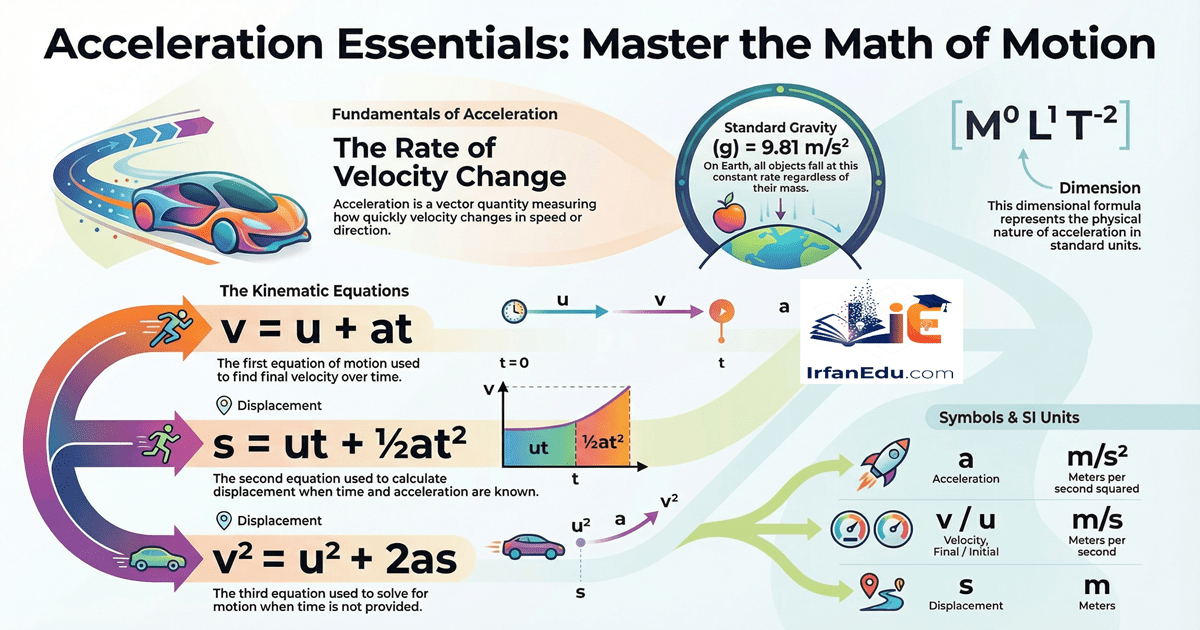
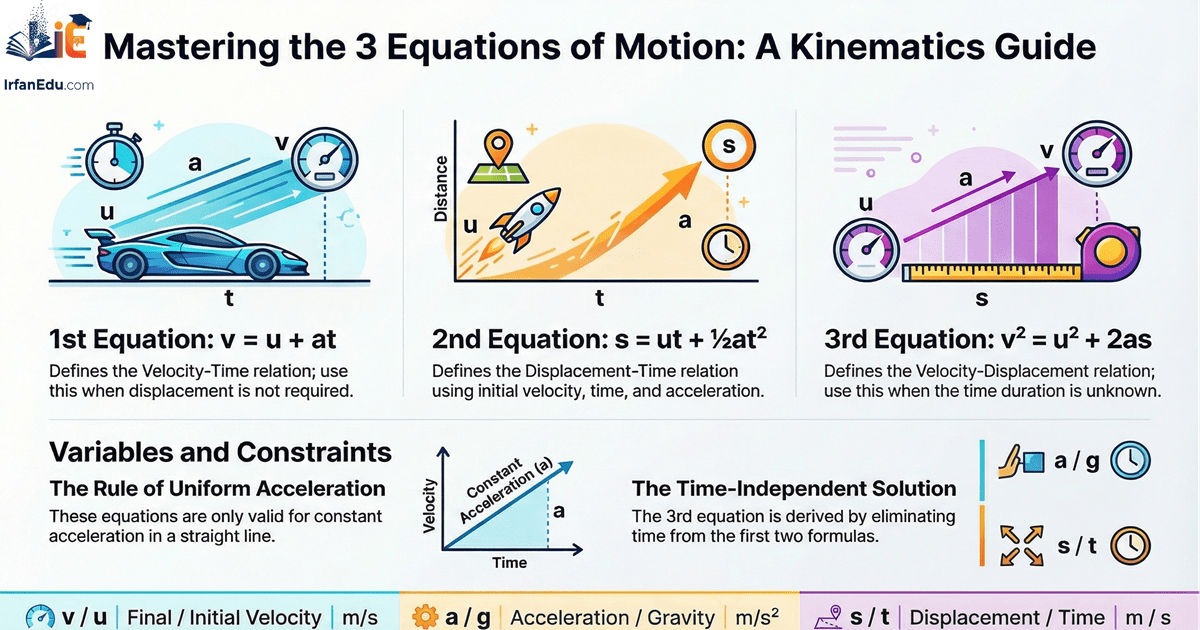
    Relates final velocity to initial velocity, acceleration and time. Used when displacement is not required.

    v = u + at
    📐

    2nd Equation of Motion

    Gives displacement in terms of initial velocity, time and acceleration. Derived by integrating velocity.

    s = ut + ½at²
    🔮

    3rd Equation of Motion

    Connects velocity and displacement without time. Most useful in projectile & free-fall problems.

    v² = u² + 2as
    📌

    Derivation Summary

    How each equation is derived

    1
    From definition of acceleration: a = (v−u)/t → rearranging gives v = u + at
    2
    Average velocity = (u+v)/2. Displacement = avg velocity × time → s = ut + ½at²
    3
    Eliminate t from 1st & 2nd equations → v² = u² + 2as (time-independent equation)
    ⚠️
    All three equations are valid only for uniform acceleration (constant a) in a straight line.
    🔢

    Variables & Symbols

    All symbols used in equations of motion

    SymbolQuantitySI UnitTypeNotes
    vFinal Velocitym/sVectorVelocity at end of motion
    uInitial Velocitym/sVectorVelocity at start of motion
    aAccelerationm/s²VectorMust be constant (uniform)
    tTimesScalarDuration of motion
    sDisplacementmVectorStraight-line distance
    gGravity9.81 m/s²VectorUse 10 m/s² for NCERT

  • Acceleration Calculator – Solve All Equations of Motion Instantly

    Acceleration Calculator – Solve All Equations of Motion Instantly

    🚀

    Acceleration Calculator

    Master Newton’s Laws with our interactive acceleration calculator. Solve for acceleration, velocity change, or time instantly with step-by-step solutions!

    📐 Kinematics ⚡ Instant Results 📋 Step-by-Step 📚 NCERT Based
    📌 Core Formula
    a = (v − u) ÷ t
    FIND ACCELERATION
    a = (v − u) / t
    FIND FINAL VELOCITY
    v = u + at
    FIND INITIAL VELOCITY
    u = v − at
    FIND TIME
    t = (v − u) / a
    🎯

    Choose What to Solve

    Select a mode and enter your known values

    m/s
    🔙 m/s
    ⏱️ s
    🔙 m/s
    🚀 m/s²
    ⏱️ s
    m/s
    🚀 m/s²
    ⏱️ s
    m/s
    🔙 m/s
    🚀 m/s²
    ⚖️ kg
    🚀 m/s²
    🔙 m/s
    🚀 m/s²
    ⏱️ s
    ⚠️ Please enter valid numbers in all fields!
    ✅ Result
    📋 Step-by-Step Solution
    🚀

    What is Acceleration?

    Acceleration is a vector quantity that describes the rate of change of velocity with respect to time. It can be a change in speed, direction, or both.

    a = (v − u) / t
    📊

    Average Acceleration

    Average acceleration is the total change in velocity divided by total time. It tells us how fast velocity changed over an interval.

    a_avg = Δv / Δt

    Instantaneous Acceleration

    Acceleration at a specific instant in time. It is the second derivative of position or the first derivative of velocity with respect to time.

    a = dv/dt = d²x/dt²
    📐

    SI Unit & Dimensions

    The standard unit of acceleration is metre per second squared (m/s²). Its dimensional formula is [M⁰ L¹ T⁻²].

    [M⁰ L¹ T⁻²]
    💡

    Newton’s Second Law

    Force equals mass times acceleration: F = ma. A net force on an object causes it to accelerate in the direction of the force. More mass = less acceleration for same force.

    F = m × a
    🌍

    Gravitational Acceleration

    On Earth’s surface, all objects fall with the same acceleration due to gravity: g = 9.81 m/s² (approx. 10 m/s² in NCERT). This is independent of mass.

    g = 9.81 m/s²
    🗂️

    Types of Acceleration

    UniformConstant acceleration in a straight line
    Non-UniformChanging rate of velocity change
    PositiveVelocity increasing with time
    Negative (Decel.)Velocity decreasing (retardation)
    CentripetalDirected toward center of circular path
    GravitationalDue to Earth’s gravity (9.81 m/s²)
    🔢

    Variables & Symbols

    All mathematical symbols used in acceleration formulas

    SymbolQuantitySI UnitType
    aAccelerationm/s²Vector
    vFinal Velocitym/sVector
    uInitial Velocitym/sVector
    tTimeseconds (s)Scalar
    sDisplacementmVector
    FForceNewton (N)Vector
    mMasskilogram (kg)Scalar
    gGravitational Accel.9.81 m/s²Vector
    📌

    Key Acceleration Equations

    All important formulas — Equations of Motion

    Basic Acceleration
    a = (v−u) / t
    1st Equation of Motion
    v = u + at
    2nd Equation of Motion
    s = ut + ½at²
    3rd Equation of Motion
    v² = u² + 2as
    Newton’s 2nd Law
    F = m × a
    Centripetal Accel.
    a = v² / r
    Free Fall
    a = g = 9.81 m/s²
    Average Accel.
    a = Δv / Δt

    Free Physics Calculators for Students & Educators
    irfanedu.com · Physics Calculator Series · Unit 02: Acceleration