Tag: Elementary Algebra

  • Word Problems into Algebraic Equations | ACT Math Guide

    Word Problems into Algebraic Equations | ACT Math Guide

    How to Translate Word Problems into Algebraic Equations | ACT Math Guide for Grades 9-12

    Word problems can feel like puzzles written in a foreign language, but they’re actually one of the most practical skills you’ll use on the ACT Math section—and in real life. The key to conquering them isn’t memorizing formulas; it’s learning to translate everyday language into the precise language of algebra. Once you master this translation skill, word problems transform from intimidating obstacles into straightforward point-earning opportunities. Let’s break down exactly how to make that translation happen, step by step.

    🎯

    ACT SCORE BOOSTER: Master This Topic for 2-4 Extra Points!

    This topic appears in 5-10 questions on the ACT Math section. Understanding it thoroughly can add 2-4 points to your composite score. Let’s break it down with proven strategies that work!

    🚀 Jump to ACT Strategy →

    ⚡ Quick Answer: The 5-Step Translation Method

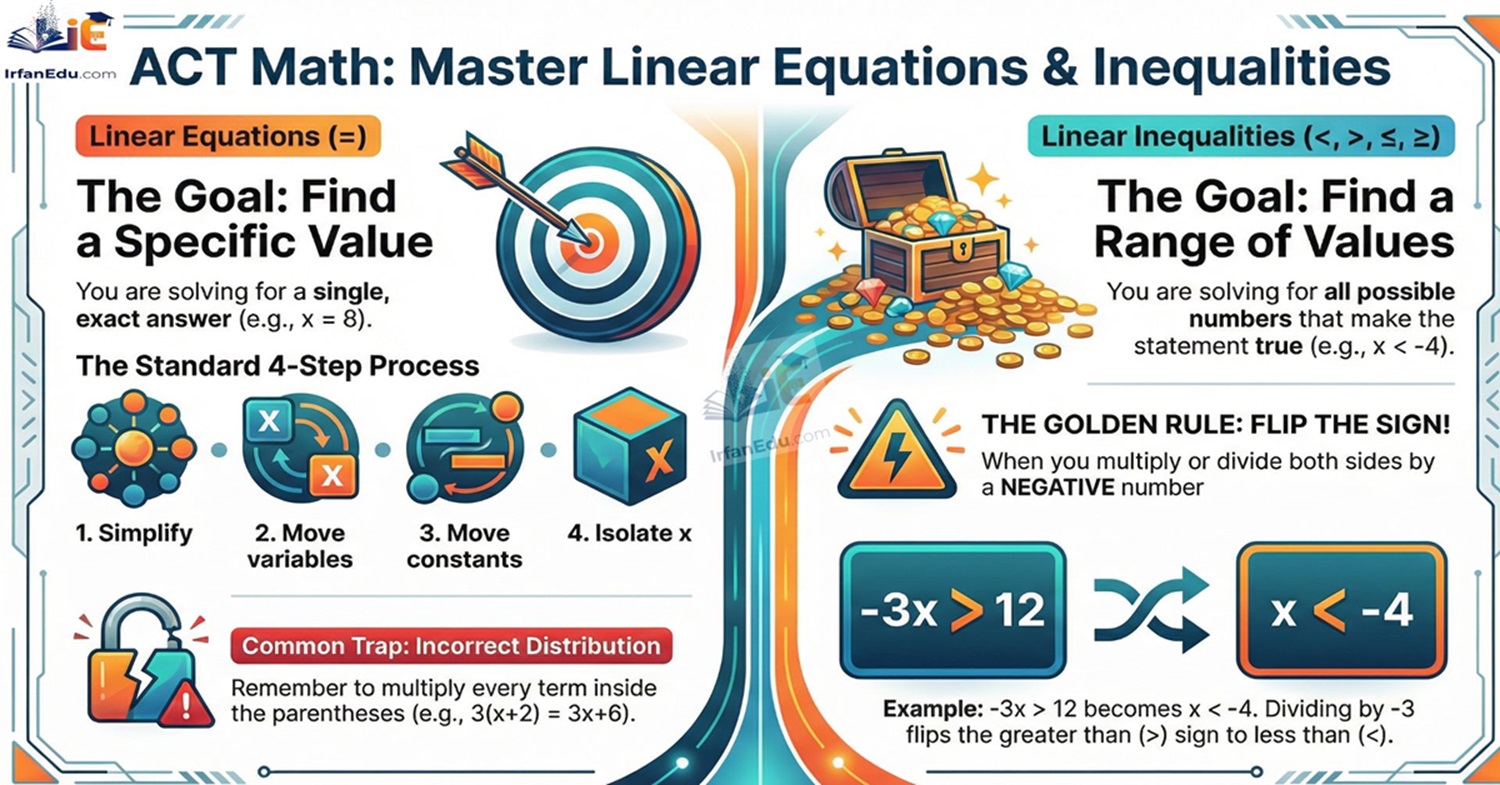
    1. Identify the unknown – What are you solving for?
    2. Assign variables – Let $$x$$ represent the unknown quantity
    3. Translate keywords – Convert words to math symbols
    4. Set up the equation – Write the mathematical relationship
    5. Solve and verify – Calculate and check if your answer makes sense

    📖 Understanding Word Problems for ACT Success

    Word problems on the ACT Math section test your ability to read a real-world scenario and extract the mathematical relationships hidden within it. These questions typically appear in the ACT prep resources as part of the Elementary Algebra section, but they can also show up in other areas like Pre-Algebra and Intermediate Algebra.

    The challenge isn’t usually the math itself—it’s understanding what the problem is asking and translating that into an equation you can solve. According to the official ACT website, approximately 15-20% of the Math section involves word problems that require algebraic translation. That’s roughly 9-12 questions out of 60, making this skill absolutely essential for a strong score.

    Why Translation Skills Matter

    Think of word problems as a language barrier between you and the solution. On one side, you have English sentences describing a situation. On the other side, you have algebraic equations that can be solved. Your job is to be the translator. The better you become at recognizing common phrases and their mathematical equivalents, the faster and more accurately you’ll solve these problems—crucial when you’re working against the ACT’s strict time limits.

    🔄 The Word-to-Algebra Translation Process

    Step 1: Identify What You’re Solving For

    Before you write anything down, read the entire problem carefully and identify the question. What is the problem asking you to find? This becomes your target, and everything else in the problem should help you get there.

    Example: “Sarah has three times as many books as Tom. If Sarah has 24 books, how many books does Tom have?”

    What we’re solving for: The number of books Tom has

    Step 2: Assign Variables to Unknown Quantities

    Choose a variable (usually $$x$$, $$y$$, or $$n$$) to represent the unknown quantity. Be specific about what your variable represents—write it down to avoid confusion later.

    For our example: Let $$x$$ = the number of books Tom has

    Step 3: Master the Keyword Translation Dictionary

    Certain words and phrases consistently translate to specific mathematical operations. Memorizing these connections will dramatically speed up your problem-solving process.

    Word/Phrase Mathematical Operation Symbol Example
    sum, total, more than, increased by, added to Addition $$+$$ “5 more than x” → $$x + 5$$
    difference, less than, decreased by, subtracted from Subtraction $$-$$ “7 less than x” → $$x – 7$$
    product, times, of, multiplied by Multiplication $$\times$$ or $$\cdot$$ “twice x” → $$2x$$
    quotient, divided by, per, ratio of Division $$\div$$ or $$\frac{}{}$$ “x divided by 3” → $$\frac{x}{3}$$
    is, equals, results in, gives Equals $$=$$ “x is 10” → $$x = 10$$

    Step 4: Set Up the Equation

    Using your variable and the translation dictionary, convert the word problem into an algebraic equation. Pay careful attention to the order of operations and the relationships described.

    Continuing our example:
    “Sarah has three times as many books as Tom” translates to:
    Sarah’s books = $$3 \times$$ Tom’s books

    We know Sarah has 24 books, and Tom has $$x$$ books, so:
    $$24 = 3x$$

    Step 5: Solve and Verify

    Solve the equation using algebraic techniques, then plug your answer back into the original problem to verify it makes sense in the context.

    Solution:
    $$24 = 3x$$
    $$\frac{24}{3} = x$$
    $$x = 8$$

    Verification: If Tom has 8 books, then Sarah has $$3 \times 8 = 24$$ books. ✓ This matches the problem!

    ✅ Step-by-Step Examples with Visual Solutions

    Example 1: Age Problem (Basic Level)

    Problem Statement

    Jessica is 4 years older than her brother Mike. The sum of their ages is 28. How old is Mike?

    Solution Process

    Step 1: Identify what we’re solving for
    We need to find Mike’s age.

    Step 2: Assign variables
    Let $$x$$ = Mike’s age
    Then Jessica’s age = $$x + 4$$ (since she’s 4 years older)

    Step 3: Translate to equation
    “The sum of their ages is 28” means:
    Mike’s age + Jessica’s age = 28
    $$x + (x + 4) = 28$$

    Step 4: Solve
    $$x + x + 4 = 28$$
    $$2x + 4 = 28$$
    $$2x = 24$$
    $$x = 12$$

    Step 5: Verify
    Mike is 12 years old, Jessica is $$12 + 4 = 16$$ years old
    Sum: $$12 + 16 = 28$$ ✓

    ✓ Answer: Mike is 12 years old

    ⏱️ ACT Time Estimate: 45-60 seconds

    🎨 Visual Solution Breakdown

    Mike's Age:        [====x====]
    Jessica's Age:     [====x====][+4]
                       
    Combined:          [====x====] + [====x====][+4] = 28
                       
    Simplified:        [====2x====][+4] = 28
                       
    Remove +4:         [====2x====] = 24
                       
    Divide by 2:       [====x====] = 12
    
    Result: Mike = 12, Jessica = 16
    

    Example 2: Money Problem (Intermediate Level)

    Problem Statement

    A movie ticket costs $12, and a popcorn costs $6. If Alex spent $54 total and bought 3 popcorns, how many movie tickets did he buy?

    Solution Process

    Step 1: Identify what we’re solving for
    Number of movie tickets Alex bought.

    Step 2: Assign variables
    Let $$x$$ = number of movie tickets

    Step 3: Translate to equation
    Cost of tickets + Cost of popcorns = Total spent
    $$12x + 6(3) = 54$$

    Step 4: Solve
    $$12x + 18 = 54$$
    $$12x = 36$$
    $$x = 3$$

    Step 5: Verify
    3 tickets at $12 each: $$3 \times 12 = 36$$
    3 popcorns at $6 each: $$3 \times 6 = 18$$
    Total: $$36 + 18 = 54$$ ✓

    ✓ Answer: Alex bought 3 movie tickets

    ⏱️ ACT Time Estimate: 60-75 seconds

    Example 3: Consecutive Integer Problem (Advanced Level)

    Problem Statement

    The sum of three consecutive even integers is 78. What is the smallest of these integers?

    Solution Process

    Step 1: Identify what we’re solving for
    The smallest of three consecutive even integers.

    Step 2: Assign variables
    Let $$x$$ = the smallest even integer
    Then $$x + 2$$ = the second even integer
    And $$x + 4$$ = the third even integer
    (We add 2 each time because consecutive even integers differ by 2)

    Step 3: Translate to equation
    “The sum of three consecutive even integers is 78”:
    $$x + (x + 2) + (x + 4) = 78$$

    Step 4: Solve
    $$x + x + 2 + x + 4 = 78$$
    $$3x + 6 = 78$$
    $$3x = 72$$
    $$x = 24$$

    Step 5: Verify
    The three integers are: 24, 26, 28
    Sum: $$24 + 26 + 28 = 78$$ ✓
    All are even ✓
    They are consecutive ✓

    ✓ Answer: The smallest integer is 24

    ⏱️ ACT Time Estimate: 75-90 seconds

    📝

    Ready to Test Your Knowledge?

    Take our full-length ACT practice test and see how well you’ve mastered this topic. Get instant scoring, detailed explanations, and personalized recommendations!

    🚀 Start ACT Practice Test Now →
    Full-Length Tests
    Instant Scoring
    Detailed Solutions

    🚫 Common Mistakes to Avoid

    ❌ Mistake #1: Mixing Up “Less Than” Order

    Wrong: “5 less than x” → $$5 – x$$
    Correct: “5 less than x” → $$x – 5$$

    Why it matters: The phrase “less than” reverses the order. Think of it as “x with 5 taken away.”

    ❌ Mistake #2: Forgetting to Define All Variables

    In problems with multiple unknowns, students often define only one variable and forget to express the others in terms of it.

    Example: “John has twice as many apples as Mary”
    Don’t just write $$x$$ for John’s apples. Also write: Mary has $$\frac{x}{2}$$ apples (or let $$x$$ be Mary’s and John has $$2x$$).

    ❌ Mistake #3: Not Verifying Your Answer

    You might solve the equation correctly but get the wrong answer to the actual question asked. Always plug your solution back into the original problem to check.

    Example: If the problem asks for “the larger number” and you solved for $$x$$ (the smaller number), make sure to calculate and report the larger number, not $$x$$.

    ❌ Mistake #4: Confusing “Of” with Addition

    Wrong: “Half of x” → $$\frac{1}{2} + x$$
    Correct: “Half of x” → $$\frac{1}{2} \times x$$ or $$\frac{x}{2}$$

    Remember: The word “of” in math almost always means multiplication, especially with fractions and percentages.

    🎯 ACT Test-Taking Strategy for Word Problems

    ⏱️ Time Allocation Strategy

    You have an average of 60 seconds per question on the ACT Math section. For word problems:

    • 15 seconds: Read and understand the problem
    • 10 seconds: Set up your equation
    • 25 seconds: Solve the equation
    • 10 seconds: Verify and bubble your answer

    🎯 When to Skip and Return

    If you can’t set up the equation within 20 seconds, circle the question and move on. Come back to it after completing easier questions. Don’t let one difficult word problem eat up 3 minutes of your test time.

    🔍 Answer Choice Elimination

    Before solving, look at the answer choices. Sometimes you can eliminate obviously wrong answers:

    • If the problem asks for a person’s age, eliminate negative numbers
    • If it asks for a number of items, eliminate fractions (unless the context allows them)
    • Use estimation to eliminate answers that are too large or too small

    ✅ Quick Verification Trick

    Instead of re-solving the entire problem, plug your answer back into the original word problem (not your equation). Does it make logical sense? This catches errors where you set up the equation wrong but solved it correctly.

    🎲 Smart Guessing Strategy

    If you must guess, eliminate any answers that don’t make sense in context, then choose from the remaining options. There’s no penalty for wrong answers on the ACT, so never leave a question blank.

    🎥 Video Explanation

    Watch this detailed video explanation to understand the concept better with visual demonstrations and step-by-step guidance.

    💡 ACT Pro Tips & Tricks

    💡 Tip #1: Underline Key Information

    As you read, underline numbers, relationships, and the question being asked. This helps you focus on what matters and prevents you from missing crucial details.

    💡 Tip #2: Draw a Simple Diagram

    For problems involving multiple people, objects, or quantities, sketch a quick visual representation. Even a simple box or line can help you see relationships more clearly.

    💡 Tip #3: Use Consistent Variable Names

    If the problem mentions “Tom” and “Sarah,” consider using $$t$$ and $$s$$ as variables instead of $$x$$ and $$y$$. This reduces confusion and helps you remember what each variable represents.

    💡 Tip #4: Watch for “Trap” Answer Choices

    The ACT often includes answer choices that represent common mistakes. For example, if you solve for $$x$$ but the question asks for $$2x$$, one answer choice will likely be your value of $$x$$ (the trap), while the correct answer is $$2x$$.

    💡 Tip #5: Practice Mental Math for Common Operations

    Being quick with basic operations (multiplying by 2, dividing by 3, etc.) saves precious seconds. Practice mental math regularly so you don’t need to reach for your calculator for simple calculations.

    💡 Tip #6: Create Your Own Word Problems

    One of the best ways to master translation is to reverse the process. Take simple equations like $$2x + 5 = 15$$ and write your own word problem for them. This deepens your understanding of how words and math connect.

    📝 Practice Questions with Solutions

    Test your understanding with these ACT-style word problems. Try solving them on your own before checking the solutions!

    Practice Question 1 (Basic)

    A number decreased by 7 equals 15. What is the number?

    A) 8
    B) 15
    C) 22
    D) 105
    E) 108
    Show Solution

    Translation:
    “A number decreased by 7” → $$x – 7$$
    “equals 15” → $$= 15$$
    Equation: $$x – 7 = 15$$

    Solution:
    $$x – 7 = 15$$
    $$x = 15 + 7$$
    $$x = 22$$

    ✓ Correct Answer: C) 22

    Practice Question 2 (Intermediate)

    The length of a rectangle is 3 times its width. If the perimeter is 48 inches, what is the width of the rectangle?

    A) 4 inches
    B) 6 inches
    C) 8 inches
    D) 12 inches
    E) 16 inches
    Show Solution

    Setup:
    Let $$w$$ = width
    Then length = $$3w$$
    Perimeter formula: $$P = 2l + 2w$$

    Equation:
    $$2(3w) + 2w = 48$$
    $$6w + 2w = 48$$
    $$8w = 48$$
    $$w = 6$$

    Verification:
    Width = 6, Length = 18
    Perimeter = $$2(18) + 2(6) = 36 + 12 = 48$$ ✓

    ✓ Correct Answer: B) 6 inches

    Practice Question 3 (Intermediate)

    Maria has $5 more than twice the amount of money that Carlos has. If Maria has $37, how much money does Carlos have?

    A) $11
    B) $16
    C) $21
    D) $32
    E) $42
    Show Solution

    Translation:
    Let $$c$$ = Carlos’s money
    “Twice the amount Carlos has” → $$2c$$
    “$5 more than twice” → $$2c + 5$$
    “Maria has $37” → $$2c + 5 = 37$$

    Solution:
    $$2c + 5 = 37$$
    $$2c = 32$$
    $$c = 16$$

    Verification:
    Carlos has $16
    Twice Carlos’s amount: $$2 \times 16 = 32$$
    $5 more than twice: $$32 + 5 = 37$$ ✓ (Maria’s amount)

    ✓ Correct Answer: B) $16

    Practice Question 4 (Advanced)

    In a class, there are 8 more girls than boys. If the total number of students is 32, how many boys are in the class?

    A) 10
    B) 12
    C) 16
    D) 20
    E) 24
    Show Solution

    Setup:
    Let $$b$$ = number of boys
    “8 more girls than boys” → girls = $$b + 8$$
    “Total is 32” → boys + girls = 32

    Equation:
    $$b + (b + 8) = 32$$
    $$2b + 8 = 32$$
    $$2b = 24$$
    $$b = 12$$

    Verification:
    Boys = 12, Girls = $$12 + 8 = 20$$
    Total = $$12 + 20 = 32$$ ✓

    ✓ Correct Answer: B) 12

    Practice Question 5 (Advanced)

    A store sells notebooks for $3 each and pens for $2 each. If a student bought a total of 15 items and spent $38, how many notebooks did the student buy?

    A) 5
    B) 7
    C) 8
    D) 10
    E) 12
    Show Solution

    Setup:
    Let $$n$$ = number of notebooks
    Let $$p$$ = number of pens
    We have two conditions:
    1) Total items: $$n + p = 15$$
    2) Total cost: $$3n + 2p = 38$$

    Solution using substitution:
    From equation 1: $$p = 15 – n$$
    Substitute into equation 2:
    $$3n + 2(15 – n) = 38$$
    $$3n + 30 – 2n = 38$$
    $$n + 30 = 38$$
    $$n = 8$$

    Verification:
    Notebooks = 8, Pens = $$15 – 8 = 7$$
    Total items: $$8 + 7 = 15$$ ✓
    Total cost: $$3(8) + 2(7) = 24 + 14 = 38$$ ✓

    ✓ Correct Answer: C) 8

    ❓ Frequently Asked Questions

    Q1: How do I know which variable to use for which quantity?

    Choose your variable to represent the quantity you’re solving for, or the simplest unknown. For example, if the problem asks “How old is Tom?” let $$x$$ = Tom’s age. If it asks for “the larger number,” you might let $$x$$ = the smaller number and express the larger as $$x + d$$ where $$d$$ is the difference. The key is to write down clearly what your variable represents before you start setting up equations.

    Q2: What if a word problem has two unknowns? Do I need two equations?

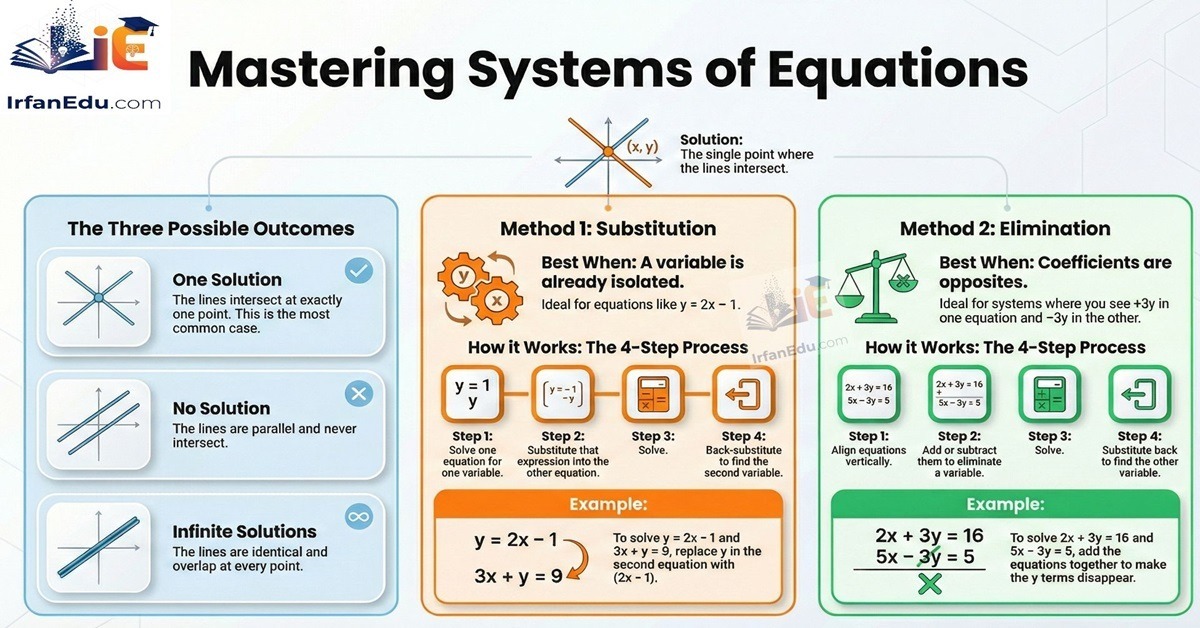
    Not always! If the two unknowns have a clear relationship, you can often express one in terms of the other. For example, “John has twice as many as Mary” means if Mary has $$x$$, John has $$2x$$—you only need one variable. However, if the problem gives you two separate conditions (like total items AND total cost), you’ll need to set up a system of two equations with two variables, or use substitution to reduce it to one equation.

    Q3: How can I get faster at translating word problems?

    Practice is essential, but practice with purpose. Create flashcards of common phrases and their translations (like “5 more than x” = $$x + 5$$). Time yourself solving word problems to build speed. Most importantly, after solving each problem, write out the translation process in your own words. This metacognitive practice—thinking about your thinking—dramatically improves your translation speed and accuracy over time.

    Q4: What should I do if I set up the equation wrong?

    This is why verification is crucial! If your answer doesn’t make sense when you plug it back into the original problem, you know something went wrong. Go back to the translation step and check: Did you correctly identify what each variable represents? Did you translate each phrase accurately? Did you capture all the relationships in the problem? Common errors include reversing “less than” operations or forgetting to account for all quantities mentioned in the problem.

    Q5: Are there any shortcuts for ACT word problems?

    Yes! One powerful shortcut is “working backwards” from the answer choices. Since the ACT is multiple choice, you can sometimes plug each answer into the problem to see which one works. This is especially useful when setting up the equation feels complicated. Another shortcut: if you’re stuck between two answers, estimate which one makes more sense given the context. For instance, if someone’s age should be between 10-20 based on the problem description, eliminate answers outside that range.

    Dr. Irfan Mansuri

    ✍️ Written by Dr. Irfan Mansuri

    Educational Content Creator & Competitive Exam Specialist

    IrfanEdu.com • United States

    Dr. Irfan Mansuri is a distinguished educational content creator with over 15 years of experience spanning high school, undergraduate, and postgraduate levels. As the founder of IrfanEdu.com, he has successfully guided thousands of students through competitive examinations, helping them achieve exceptional results and gain admission to their dream institutions.

    15+ years in competitive exam preparation Certified Instructor LinkedIn Profile

    📚 Related ACT Math Resources

    🎓 You’ve Got This!

    Translating word problems into algebraic equations is a skill that improves with practice. Every problem you solve makes the next one easier. Keep practicing, stay confident, and watch your ACT Math score soar! Remember: the ACT isn’t testing whether you’re “good at math”—it’s testing whether you can recognize patterns and apply strategies. You’ve learned those strategies today. Now go use them!

    Understanding Algebraic Equations: A Complete Guide to Solving Word Problems

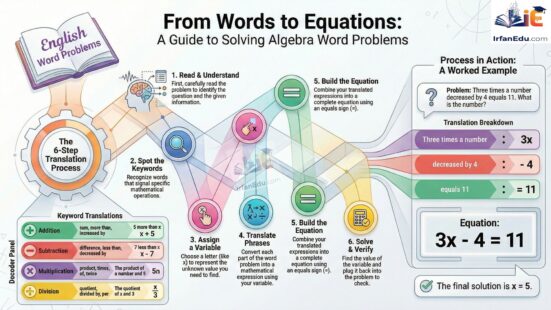
    Algebraic equations form the backbone of mathematical problem-solving. These mathematical statements demonstrate equality between two expressions by connecting them with an equal sign (=). Each side of this equation contains variables (letters representing unknown values), constants (fixed numbers), and mathematical operations such as addition, subtraction, multiplication, and division. Mastering the translation of real-world scenarios into algebraic equations empowers you to solve complex problems systematically.

    What Defines an Algebraic Equation?

    An algebraic equation represents a mathematical balance—a statement declaring that two expressions hold equal value. Think of it as a scale in perfect equilibrium. When you write $$3x + 5 = 14$$, you’re asserting that the expression on the left side equals the value on the right side. Your task involves finding the value of the variable that maintains this balance.

    Step-by-Step Process for Writing Algebraic Equations from Word Problems

    Transforming word problems into algebraic equations requires a systematic approach. Follow these proven steps to translate English phrases into mathematical language effectively:

    Step 1: Read and Comprehend the Problem

    Begin by reading the entire problem carefully. Don’t rush through this crucial first step. Identify what the problem asks you to find and what information it provides. Understanding the context helps you visualize the situation and determine the appropriate mathematical approach.

    Step 2: Recognize Key Mathematical Terms

    Certain words signal specific mathematical operations. Learning these keywords accelerates your translation process:

    Addition Keywords: sum, more than, increased by, total, plus, combined, added to

    Subtraction Keywords: difference, less than, decreased by, minus, reduced by, fewer than

    Multiplication Keywords: product, times, multiplied by, of, twice, double, triple

    Division Keywords: quotient, divided by, per, ratio, out of, split

    Equality Keywords: is, are, will be, gives, equals, results in, yields

    Step 3: Assign Variables to Unknown Quantities

    Choose a letter (commonly $$x$$, $$y$$, or $$n$$) to represent the unknown value you need to find. Write down what your variable represents—this practice prevents confusion and helps you track your work. For example: “Let $$x$$ = the unknown number” or “Let $$w$$ = the width of the rectangle.”

    Step 4: Translate Words into Mathematical Expressions

    Convert each phrase in the problem into its mathematical equivalent using your assigned variable. Pay close attention to the order of operations and the sequence of terms, especially for subtraction and division where order matters significantly.

    Step 5: Construct the Complete Equation

    Combine all the translated parts into a single equation. The equal sign connects the two expressions that the problem states are equal.

    Step 6: Solve and Verify Your Answer

    Use inverse operations to isolate the variable and find its value. Always check your solution by substituting it back into the original equation to verify it satisfies the problem’s conditions.

    Detailed Example: Translating and Solving a Word Problem

    Problem: “Three times a number decreased by 4 equals 11. What is the number?”

    Solution Process:

    1. Identify the unknown: Let $$x$$ represent the unknown number

    2. Translate each phrase:

    • “Three times a number” → $$3x$$
    • “Decreased by 4” → $$3x – 4$$
    • “Equals 11” → $$= 11$$

    3. Write the equation: $$3x – 4 = 11$$

    4. Solve the equation:

    $$3x – 4 = 11$$

    $$3x = 15$$ (add 4 to both sides)

    $$x = 5$$ (divide both sides by 3)

    Answer: The number is 5

    Essential Translation Examples

    Understanding how to translate specific phrases helps you tackle any word problem. Here are critical examples that appear frequently:

    Example 1: “The sum of 8 and y”

    The keyword “sum” indicates addition. This phrase translates directly to:

    $$8 + y$$

    While $$y + 8$$ produces the same mathematical result, maintaining the order given in the problem develops good habits for situations where order matters.

    Example 2: “4 less than x”

    This construction requires careful attention! The phrase “less than” reverses the order in mathematical notation. The English says “4 less than x,” but mathematically we write:

    $$x – 4$$

    Important Note: “Four less than x” means “x minus 4,” NOT “4 minus x.” Test this with real numbers: if someone earns four dollars less per hour than you, and you earn $$p$$ dollars per hour, they earn $$p – 4$$, not $$4 – p$$.

    Example 3: “x multiplied by 13”

    The keyword “multiplied by” clearly indicates multiplication. In algebra, we place the constant before the variable:

    $$13x$$

    Since multiplication is commutative, $$(x)(13) = (13)(x)$$, but algebraic convention favors writing $$13x$$.

    Example 4: “The quotient of x and 3”

    The word “quotient” signals division. Order matters critically in division. Since the unknown comes first in the English expression, it goes in the numerator:

    $$\frac{x}{3}$$

    Example 5: “The difference of 5 and y”

    The keyword “difference” indicates subtraction. Maintain the order given in the problem:

    $$5 – y$$

    Complex Translation: Multi-Part Expressions

    Real-world problems often involve more complex phrases requiring multiple operations. Work through these systematically:

    Example 6: “The ratio of 9 more than x to x”

    Analysis: “The ratio of (this) to (that)” means “(this) divided by (that).” Break down the components:

    • “9 more than x” translates to $$x + 9$$ (this goes in the numerator)
    • “x” remains as the denominator

    $$\frac{x + 9}{x}$$

    Example 7: “Nine less than the total of a number and two”

    Step-by-step translation:

    1. Let $$n$$ = the unknown number

    2. “The total of a number and two” → $$n + 2$$

    3. “Nine less than” this total → $$(n + 2) – 9$$

    4. Simplify: $$n – 7$$

    The “How Much Is Left” Construction

    This crucial concept appears frequently in word problems but often confuses students. When you have a total amount and you’ve accounted for part of it with a variable, the remaining portion equals the total minus what you’ve already named:

    Example 8: Oil Container Problem

    Problem: “Twenty gallons of crude oil were poured into two containers of different sizes. Express the amount poured into the smaller container in terms of the amount $$g$$ poured into the larger container.”

    Reasoning:

    • Total amount: 20 gallons
    • Amount in larger container: $$g$$ gallons
    • Amount in smaller container: what’s left over

    Solution: The amount left equals the total minus what’s been used:

    $$20 – g$$ gallons

    Practice Problems with Solutions

    Apply your translation skills to these problems. Work through each one systematically using the steps outlined above:

    Problem 1: A number decreased by 4 equals 10. Find the number.

    Solution:

    Let $$x$$ = the unknown number

    Equation: $$x – 4 = 10$$

    Solve: $$x = 14$$

    Answer: 14

    Problem 2: The product of a number and 5 equals 35. Find the number.

    Solution:

    Let $$n$$ = the unknown number

    Equation: $$5n = 35$$

    Solve: $$n = 7$$

    Answer: 7

    Problem 3: The length of a rectangle is twice its width. If the perimeter is 36 units, find the dimensions.

    Solution:

    Let $$w$$ = width, then length = $$2w$$

    Perimeter formula: $$P = 2l + 2w$$

    Equation: $$2(2w) + 2w = 36$$

    Simplify: $$6w = 36$$, so $$w = 6$$

    Answer: Width = 6 units, Length = 12 units

    Problem 4: A father is three times as old as his son. If the sum of their ages is 48 years, find their ages.

    Solution:

    Let $$s$$ = son’s age, then father’s age = $$3s$$

    Equation: $$s + 3s = 48$$

    Simplify: $$4s = 48$$, so $$s = 12$$

    Answer: Son = 12 years, Father = 36 years

    Problem 5: Two numbers differ by 8 and their sum is 48. Find the numbers.

    Solution:

    Let $$x$$ = smaller number, then larger number = $$x + 8$$

    Equation: $$x + (x + 8) = 48$$

    Simplify: $$2x + 8 = 48$$, so $$2x = 40$$, thus $$x = 20$$

    Answer: The numbers are 20 and 28

    Problem 6: The sum of a number and twice another number is 22. If the second number is 3 less than the first number, find the numbers.

    Solution:

    Let $$x$$ = first number, then second number = $$x – 3$$

    Equation: $$x + 2(x – 3) = 22$$

    Simplify: $$x + 2x – 6 = 22$$, so $$3x = 28$$, thus $$x = \frac{28}{3}$$ or approximately 9.33

    Second number: $$\frac{28}{3} – 3 = \frac{19}{3}$$ or approximately 6.33

    Answer: First number = $$\frac{28}{3}$$, Second number = $$\frac{19}{3}$$

    Problem 7: A shop sells pencils at $2 each and erasers at $3 each. If a student buys a total of 10 items and spends $24, how many pencils and erasers did the student buy?

    Solution:

    Let $$p$$ = number of pencils, then erasers = $$10 – p$$

    Equation: $$2p + 3(10 – p) = 24$$

    Simplify: $$2p + 30 – 3p = 24$$, so $$-p = -6$$, thus $$p = 6$$

    Erasers: $$10 – 6 = 4$$

    Answer: 6 pencils and 4 erasers

    Problem 8: The difference between a number and 7 equals twice the number decreased by 5. Find the number.

    Solution:

    Let $$x$$ = the unknown number

    Equation: $$x – 7 = 2x – 5$$

    Solve: $$-7 + 5 = 2x – x$$, so $$-2 = x$$

    Answer: -2

    Problem 9: The sum of three consecutive integers is 51. Find the integers.

    Solution:

    Let $$n$$ = first integer, then $$n + 1$$ and $$n + 2$$ are the next two

    Equation: $$n + (n + 1) + (n + 2) = 51$$

    Simplify: $$3n + 3 = 51$$, so $$3n = 48$$, thus $$n = 16$$

    Answer: The integers are 16, 17, and 18

    Problem 10: A car rental company charges a flat fee of $30 plus $0.20 per mile driven. If a customer paid $50 for a rental, how many miles did they drive?

    Solution:

    Let $$m$$ = number of miles driven

    Equation: $$30 + 0.20m = 50$$

    Solve: $$0.20m = 20$$, so $$m = 100$$

    Answer: 100 miles

    Types of Word Problems You’ll Encounter

    As you progress in algebra, you’ll encounter various categories of word problems. Each type follows specific patterns:

    • Age Problems: Determining people’s ages at different times
    • Geometry Problems: Finding dimensions using perimeter, area, and volume formulas
    • Coin Problems: Calculating quantities of different coin denominations
    • Distance Problems: Using the formula $$d = rt$$ (distance = rate × time)
    • Investment Problems: Applying interest formulas $$I = Prt$$
    • Mixture Problems: Combining substances with different concentrations or prices
    • Number Problems: Finding unknown numbers based on relationships
    • Percent Problems: Calculating discounts, increases, and percentages
    • Work Problems: Determining completion times when multiple people work together

    Essential Tips for Success

    1. Don’t treat keywords as absolute rules—use them as helpful guides while applying logical thinking
    2. Test your translations with real numbers to verify they make sense
    3. Write down what your variable represents before setting up equations
    4. Pay special attention to order in subtraction and division problems
    5. Check your final answer by substituting it back into the original problem
    6. Practice explaining your work to others—if you can teach it, you’ve mastered it
    7. Draw diagrams when appropriate to visualize the problem
    8. Break complex problems into smaller steps rather than attempting everything at once

    Conclusion: Building Your Problem-Solving Foundation

    Translating word problems into algebraic equations represents a critical skill that extends far beyond the classroom. This ability helps you model real-world situations mathematically, enabling you to solve practical problems in finance, science, engineering, and everyday life. By identifying key variables and understanding the relationships described in problems, you develop analytical thinking that serves you throughout your academic and professional career.

    Mastery comes through consistent practice with various problem types. Each problem you solve strengthens your pattern recognition and builds your confidence. Remember that understanding the “why” behind each step matters more than memorizing procedures. When you truly comprehend the logic of translation, you can tackle any word problem that comes your way.

    Start with simple problems and gradually progress to more complex scenarios. Use the keywords as guides, but always engage your critical thinking. Test your translations with concrete numbers when you’re uncertain. Most importantly, don’t get discouraged by mistakes—they’re valuable learning opportunities that help you refine your problem-solving approach. With dedication and practice, you’ll develop the expertise to confidently translate any word problem into its algebraic equivalent and solve it efficiently.

    Final Reminder: The journey to mastering algebraic word problems requires patience and persistence. Keep practicing, stay curious, and always verify your answers. Your problem-solving abilities will improve dramatically with each problem you tackle!

    [pdf_viewer id=”217″]
  • Simplifying Radical Expressions | ACT Math Guide

    Simplifying Radical Expressions | ACT Math Guide

    Simplifying Radical Expressions | ACT Math Guide for Grades 9-12

    Radical expressions appear frequently on the ACT Math section, and knowing how to simplify them quickly can save you valuable time during the test. Whether you’re dealing with square roots, cube roots, or higher-order radicals, mastering simplification techniques is essential for success. This comprehensive guide will walk you through everything you need to know about simplifying radical expressions, complete with step-by-step examples, proven strategies, and practice questions designed specifically for ACT prep resources.

    🎯

    ACT SCORE BOOSTER: Master This Topic for 2-3 Extra Points!

    Radical expressions appear in 5-8 questions on the ACT Math section. Understanding simplification thoroughly can add 2-3 points to your composite score. Let’s break it down with proven strategies that work!

    🚀 Jump to ACT Strategy →

    📚 Understanding Radical Expressions for ACT Success

    A radical expression contains a root symbol ($$\sqrt{}$$) with a number or expression underneath called the radicand. Simplifying radicals means rewriting them in their most reduced form by removing perfect square factors (or perfect cube factors for cube roots). This skill is fundamental to Elementary Algebra on the ACT and appears in various contexts throughout the test.

    The ACT Math section tests your ability to simplify radicals quickly and accurately. You’ll encounter these expressions in standalone questions, within algebraic equations, and as part of geometry problems. According to the official ACT website, Elementary Algebra comprises approximately 15-20% of the Math section, making radical simplification a high-value skill to master.

    💡 Quick Answer: What Does “Simplifying” Mean?

    Simplifying a radical means expressing it with the smallest possible radicand by factoring out perfect squares (or cubes, fourths, etc.). For example, $$\sqrt{50}$$ simplifies to $$5\sqrt{2}$$ because 50 = 25 × 2, and $$\sqrt{25} = 5$$.

    📐 Essential Rules for Simplifying Radicals

    Product Property of Radicals

    $$\sqrt{a \cdot b} = \sqrt{a} \cdot \sqrt{b}$$

    When to use: Breaking down radicands into smaller factors, especially when identifying perfect squares.

    Quotient Property of Radicals

    $$\sqrt{\frac{a}{b}} = \frac{\sqrt{a}}{\sqrt{b}}$$

    When to use: Simplifying fractions under radical signs or rationalizing denominators.

    Perfect Squares to Memorize

    $$1^2 = 1$$ $$2^2 = 4$$ $$3^2 = 9$$ $$4^2 = 16$$ $$5^2 = 25$$
    $$6^2 = 36$$ $$7^2 = 49$$ $$8^2 = 64$$ $$9^2 = 81$$ $$10^2 = 100$$
    $$11^2 = 121$$ $$12^2 = 144$$ $$13^2 = 169$$ $$14^2 = 196$$ $$15^2 = 225$$

    Memory trick: Knowing perfect squares up to 15² will handle 95% of ACT radical questions!

    Simplified Radical Form Requirements

    • No perfect square factors remain under the radical
    • No fractions appear under the radical
    • No radicals appear in denominators (rationalized)

    ✅ Step-by-Step Examples with Visual Solutions

    Example 1: Simplify $$\sqrt{72}$$

    Step 1: Find the prime factorization

    Break 72 into prime factors: $$72 = 2 \times 36 = 2 \times 6 \times 6 = 2 \times 2 \times 3 \times 2 \times 3 = 2^3 \times 3^2$$

    Step 2: Identify perfect square factors

    $$72 = 36 \times 2$$ (36 is a perfect square: $$6^2$$)

    Step 3: Apply the product property

    $$\sqrt{72} = \sqrt{36 \times 2} = \sqrt{36} \times \sqrt{2}$$

    Step 4: Simplify the perfect square

    $$\sqrt{36} \times \sqrt{2} = 6\sqrt{2}$$

    ✓ Final Answer: $$6\sqrt{2}$$

    ⏱️ ACT Time Estimate: 30-45 seconds

    Example 2: Simplify $$\sqrt{98} + \sqrt{32}$$

    Step 1: Simplify each radical separately

    For $$\sqrt{98}$$: $$98 = 49 \times 2$$, so $$\sqrt{98} = \sqrt{49 \times 2} = 7\sqrt{2}$$

    For $$\sqrt{32}$$: $$32 = 16 \times 2$$, so $$\sqrt{32} = \sqrt{16 \times 2} = 4\sqrt{2}$$

    Step 2: Combine like radicals

    $$7\sqrt{2} + 4\sqrt{2} = (7 + 4)\sqrt{2} = 11\sqrt{2}$$

    ✓ Final Answer: $$11\sqrt{2}$$

    ⏱️ ACT Time Estimate: 45-60 seconds

    ⚠️ Common Mistake: Students often try to add $$\sqrt{98} + \sqrt{32} = \sqrt{130}$$. This is WRONG! You can only combine radicals with the same radicand after simplification.

    Example 3: Simplify $$\frac{6}{\sqrt{3}}$$ (Rationalizing the Denominator)

    Step 1: Identify the problem

    We have a radical in the denominator, which needs to be rationalized.

    Step 2: Multiply by $$\frac{\sqrt{3}}{\sqrt{3}}$$

    $$\frac{6}{\sqrt{3}} \times \frac{\sqrt{3}}{\sqrt{3}} = \frac{6\sqrt{3}}{3}$$

    Step 3: Simplify the fraction

    $$\frac{6\sqrt{3}}{3} = 2\sqrt{3}$$

    ✓ Final Answer: $$2\sqrt{3}$$

    ⏱️ ACT Time Estimate: 30-40 seconds

    📝

    Ready to Test Your Radical Skills?

    Take our full-length ACT Math practice test and see how well you’ve mastered radical simplification. Get instant scoring, detailed explanations, and personalized recommendations!

    🚀 Start ACT Practice Test Now →
    Full-Length Tests
    Instant Scoring
    Detailed Solutions

    📝 Practice Questions

    Test your understanding with these ACT-style practice problems. Click “Show Solution” to see detailed explanations.

    Practice Question 1 MEDIUM

    Simplify: $$\sqrt{200}$$

    A) $$10\sqrt{2}$$
    B) $$20\sqrt{10}$$
    C) $$2\sqrt{100}$$
    D) $$100\sqrt{2}$$
    E) $$5\sqrt{8}$$
    Show Solution

    Step 1: Factor 200 to find perfect squares: $$200 = 100 \times 2$$

    Step 2: Apply product property: $$\sqrt{200} = \sqrt{100 \times 2} = \sqrt{100} \times \sqrt{2}$$

    Step 3: Simplify: $$\sqrt{100} \times \sqrt{2} = 10\sqrt{2}$$

    ✓ Correct Answer: A) $$10\sqrt{2}$$

    Practice Question 2 HARD

    Simplify: $$3\sqrt{48} – 2\sqrt{75}$$

    A) $$\sqrt{27}$$
    B) $$2\sqrt{3}$$
    C) $$12\sqrt{3} – 10\sqrt{3}$$
    D) $$2\sqrt{3}$$
    E) $$-2\sqrt{3}$$
    Show Solution

    Step 1: Simplify $$\sqrt{48}$$: $$48 = 16 \times 3$$, so $$\sqrt{48} = 4\sqrt{3}$$

    Step 2: Simplify $$\sqrt{75}$$: $$75 = 25 \times 3$$, so $$\sqrt{75} = 5\sqrt{3}$$

    Step 3: Substitute: $$3(4\sqrt{3}) – 2(5\sqrt{3}) = 12\sqrt{3} – 10\sqrt{3}$$

    Step 4: Combine like terms: $$12\sqrt{3} – 10\sqrt{3} = 2\sqrt{3}$$

    ✓ Correct Answer: D) $$2\sqrt{3}$$

    Practice Question 3 EASY

    Which of the following is equivalent to $$\sqrt{45}$$?

    A) $$9\sqrt{5}$$
    B) $$5\sqrt{9}$$
    C) $$3\sqrt{5}$$
    D) $$15\sqrt{3}$$
    E) $$\sqrt{15}$$
    Show Solution

    Step 1: Factor 45: $$45 = 9 \times 5$$

    Step 2: Apply product property: $$\sqrt{45} = \sqrt{9 \times 5} = \sqrt{9} \times \sqrt{5}$$

    Step 3: Simplify: $$\sqrt{9} \times \sqrt{5} = 3\sqrt{5}$$

    ✓ Correct Answer: C) $$3\sqrt{5}$$

    🎥 Video Explanation: Simplifying Radical Expressions

    Watch this comprehensive video explanation to master radical simplification with visual demonstrations and step-by-step guidance.

    💡 ACT Pro Tips & Tricks

    🎯 Memorize Perfect Squares Through 15

    Knowing $$1^2$$ through $$15^2$$ instantly will save you 15-20 seconds per radical question. That’s huge on a timed test! Practice until these become automatic.

    ⚡ Look for the Largest Perfect Square First

    Instead of breaking down to prime factors every time, scan for the largest perfect square factor. For $$\sqrt{72}$$, recognize 36 immediately rather than working through $$2 \times 2 \times 2 \times 3 \times 3$$.

    🚫 Common Trap: Don’t Add Radicals Incorrectly

    $$\sqrt{a} + \sqrt{b} \neq \sqrt{a+b}$$. The ACT loves to include wrong answers like $$\sqrt{50}$$ when the correct answer is $$\sqrt{32} + \sqrt{18} = 4\sqrt{2} + 3\sqrt{2} = 7\sqrt{2}$$.

    🧮 Calculator Verification Trick

    Calculate the decimal value of both your answer and the original expression. For example, $$\sqrt{72} \approx 8.485$$ and $$6\sqrt{2} \approx 8.485$$. They should match!

    ⏰ Time Management Strategy

    Spend no more than 60 seconds on radical simplification questions. If you’re stuck after 45 seconds, use your calculator to check answer choices and move on.

    📐 Rationalize Denominators Automatically

    If you see a radical in the denominator, the ACT expects you to rationalize it. Answer choices will reflect this, so always complete this step.

    🎯 ACT Test-Taking Strategy for Radical Expressions

    Time Allocation

    Allocate 45-60 seconds for straightforward simplification problems and up to 90 seconds for complex problems involving multiple radicals or algebraic expressions. These questions typically appear in the first 30 questions of the ACT Math section.

    When to Skip and Return

    If you don’t immediately recognize a perfect square factor within 15 seconds, mark the question and return to it. Don’t waste time on prime factorization if the pattern isn’t obvious—use your calculator to test answer choices instead.

    Strategic Guessing

    If you must guess, eliminate answers that aren’t in simplified form (still have perfect squares under the radical) or have radicals in denominators. The correct answer will always be fully simplified.

    Quick Verification Method

    Use your calculator to compute decimal approximations. Calculate $$\sqrt{72}$$ directly (8.485…), then verify your answer $$6\sqrt{2}$$ by computing $$6 \times \sqrt{2}$$ (8.485…). They should match exactly.

    Common Trap Answers

    • Answers that incorrectly add radicands: $$\sqrt{a} + \sqrt{b} = \sqrt{a+b}$$ (WRONG!)
    • Answers with radicals still in denominators (not rationalized)
    • Answers with remaining perfect square factors under the radical
    • Answers that confuse coefficients with radicands

    ❓ Frequently Asked Questions

    What’s the difference between simplifying and solving a radical?
    Simplifying a radical means rewriting it in its most reduced form (e.g., $$\sqrt{72} = 6\sqrt{2}$$). Solving a radical equation means finding the value of a variable (e.g., solving $$\sqrt{x} = 6$$ gives $$x = 36$$). On the ACT, you’ll encounter both types of questions, but simplification is more common in Elementary Algebra.
    Can I leave my answer as $$\sqrt{72}$$ instead of $$6\sqrt{2}$$?
    No! On the ACT, answer choices will always be in simplified form. If you leave $$\sqrt{72}$$ unsimplified, you won’t find it among the options. The test expects you to recognize that $$\sqrt{72} = 6\sqrt{2}$$, and that’s what will appear in the correct answer choice.
    Do I need to rationalize denominators on the ACT?
    Yes! The ACT considers radicals in denominators to be “unsimplified.” If you have $$\frac{6}{\sqrt{3}}$$, you must rationalize it to $$2\sqrt{3}$$. Answer choices will reflect this expectation, so always complete the rationalization step.
    How do I know which perfect square to look for?
    Start by checking if the number is divisible by common perfect squares in descending order: 144, 100, 81, 64, 49, 36, 25, 16, 9, 4. For $$\sqrt{180}$$, check: Is it divisible by 144? No. By 100? No. By 81? No. By 64? No. By 49? No. By 36? Yes! $$180 = 36 \times 5$$, so $$\sqrt{180} = 6\sqrt{5}$$.
    Can I use my calculator for radical questions?
    Yes, strategically! Your calculator can verify answers by computing decimal approximations. However, you still need to know how to simplify radicals algebraically because answer choices are in simplified radical form, not decimals. Use your calculator to check your work, not replace your algebraic skills.
    Dr. Irfan Mansuri

    ✍️ Written by Dr. Irfan Mansuri

    Educational Content Creator & Competitive Exam Specialist

    IrfanEdu.com • United States

    Dr. Irfan Mansuri is a distinguished educational content creator with over 15 years of experience spanning high school, undergraduate, and postgraduate levels. As the founder of IrfanEdu.com, he has successfully guided thousands of students through competitive examinations, helping them achieve exceptional results and gain admission to their dream institutions.

    15+ years in competitive exam preparation Certified Instructor LinkedIn Profile

    📚 Related ACT Math Resources

    Continue building your ACT Math skills with these related topics from our comprehensive ACT preparation collection:

    • Exponent Rules: Master the laws of exponents for ACT success
    • Solving Quadratic Equations: Learn multiple methods for solving quadratics
    • Factoring Polynomials: Essential algebra skills for the ACT
    • Rational Expressions: Simplifying and operating with fractions
    • Linear Equations: Solving and graphing linear relationships

    🎓 Ready to Ace the ACT Math Section?

    You’ve learned the fundamentals of simplifying radical expressions. Now it’s time to put your skills to the test with our comprehensive ACT practice platform!

    🚀 Start Your Free ACT Practice Test

    Join thousands of students who have improved their ACT scores with IrfanEdu.com

    Mastering Radical Simplification: A Complete Guide to Square Roots

    Understanding how to work with radicals represents a fundamental skill in algebra. You’ve likely encountered square roots before—expressions like $$\sqrt{25} = 5$$ or $$\sqrt{2} \approx 1.414$$. Now, we’ll explore powerful techniques that help you simplify radical expressions efficiently. Throughout this guide, we focus exclusively on square roots, while higher-order roots (cube roots, fourth roots, etc.) appear in advanced algebra courses.

    Essential Properties of Square Roots

    Two fundamental properties govern how we manipulate radicals. These rules become your toolkit for simplification:

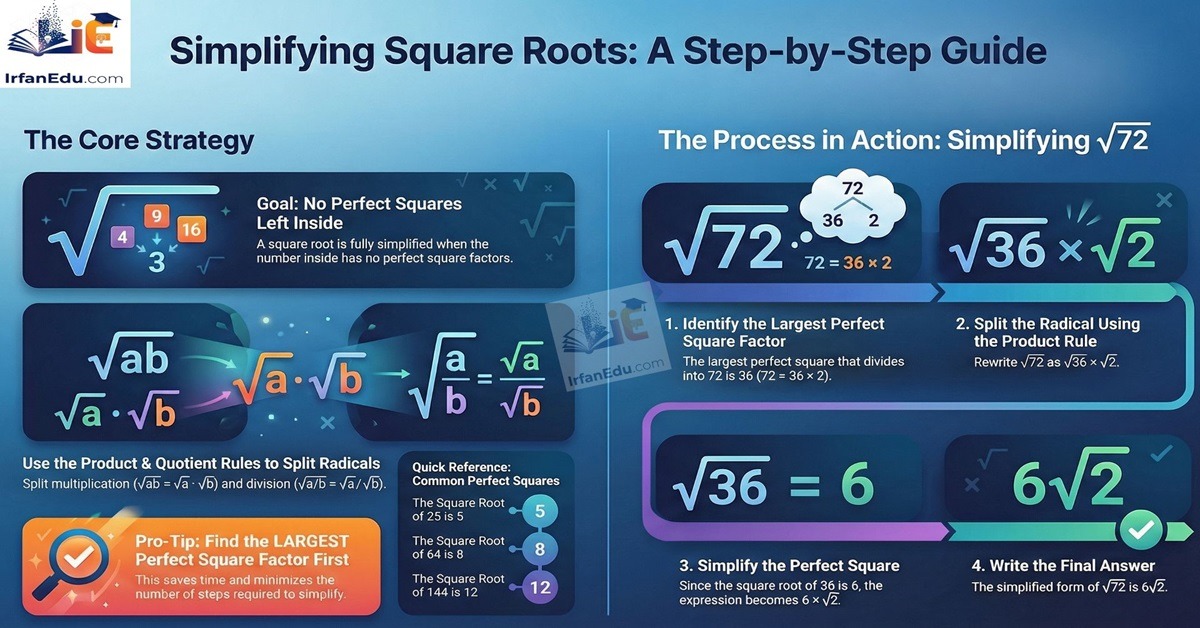
    Property 1 (Product Rule): When you multiply two positive numbers under a square root, you can split them into separate radicals:

    $$\sqrt{ab} = \sqrt{a} \times \sqrt{b}$$

    Property 2 (Quotient Rule): When you divide two positive numbers under a square root, you can separate them into individual radicals:

    $$\sqrt{\frac{a}{b}} = \frac{\sqrt{a}}{\sqrt{b}}$$

    Understanding These Properties Through Examples

    Let’s see how these properties work in practice. Consider the square root of 144. We can break this down using the product rule:

    $$\sqrt{144} = \sqrt{36 \times 4} = \sqrt{36} \times \sqrt{4} = 6 \times 2 = 12$$

    Similarly, the quotient rule helps us simplify fractions under radicals:

    $$\sqrt{\frac{9}{25}} = \frac{\sqrt{9}}{\sqrt{25}} = \frac{3}{5}$$

    The Key to Simplification: Finding Perfect Square Factors

    When you simplify a radical expression, your goal involves identifying the largest perfect square factor within the radicand (the number under the radical symbol). Let’s explore this concept with $$\sqrt{450}$$:

    You might initially factor 450 as $$25 \times 18$$:

    $$\sqrt{450} = \sqrt{25 \times 18} = \sqrt{25} \times \sqrt{18} = 5\sqrt{18}$$

    However, this doesn’t represent the simplest form! Notice that 18 still contains a perfect square factor (9). We need to simplify further:

    $$\sqrt{18} = \sqrt{9 \times 2} = \sqrt{9} \times \sqrt{2} = 3\sqrt{2}$$

    Therefore, the complete simplification becomes:

    $$\sqrt{450} = 5 \times 3\sqrt{2} = 15\sqrt{2}$$

    Pro Tip: You can save time by identifying the largest perfect square factor from the start. For 450, that’s 225, giving us: $$\sqrt{450} = \sqrt{225 \times 2} = 15\sqrt{2}$$

    What Makes a Radical “Simplified”?

    A radical expression reaches its simplest form when the radicand contains no perfect square factors. This means you’ve extracted all possible square roots from under the radical symbol.

    Step-by-Step Examples: Simplifying Radicals

    Let’s work through several examples to build your confidence with radical simplification:

    Example 1: Simplify $$\sqrt{24}$$

    Strategy: We need to factor 24 so that one factor represents a perfect square.

    Since $$24 = 4 \times 6$$, and 4 is a perfect square, we can write:

    $$\sqrt{24} = \sqrt{4 \times 6} = \sqrt{4} \times \sqrt{6} = 2\sqrt{6}$$

    Answer: $$2\sqrt{6}$$

    Example 2: Simplify $$\sqrt{72}$$

    Strategy: Look for the largest perfect square factor to minimize your work.

    The largest perfect square factor of 72 is 36:

    $$\sqrt{72} = \sqrt{36 \times 2} = \sqrt{36} \times \sqrt{2} = 6\sqrt{2}$$

    Alternatively, if you didn’t spot 36 immediately, you could factor using smaller squares:

    $$\sqrt{72} = \sqrt{9 \times 8} = \sqrt{9} \times \sqrt{8} = 3\sqrt{8}$$

    But we’re not finished! Since $$8 = 4 \times 2$$:

    $$3\sqrt{8} = 3\sqrt{4 \times 2} = 3 \times \sqrt{4} \times \sqrt{2} = 3 \times 2 \times \sqrt{2} = 6\sqrt{2}$$

    Answer: $$6\sqrt{2}$$

    Example 3: Simplify $$-\sqrt{288}$$

    Strategy: The negative sign stays outside the radical throughout the simplification process.

    We identify 144 as the largest perfect square factor of 288:

    $$-\sqrt{288} = -\sqrt{144 \times 2} = -\sqrt{144} \times \sqrt{2} = -12\sqrt{2}$$

    Answer: $$-12\sqrt{2}$$

    Example 4: Simplify $$\sqrt{\frac{75}{4}}$$

    Strategy: Apply the quotient rule first, then simplify the numerator.

    $$\sqrt{\frac{75}{4}} = \frac{\sqrt{75}}{\sqrt{4}} = \frac{\sqrt{25 \times 3}}{2} = \frac{\sqrt{25} \times \sqrt{3}}{2} = \frac{5\sqrt{3}}{2}$$

    Answer: $$\frac{5\sqrt{3}}{2}$$

    Example 5: Simplify $$\frac{3 + \sqrt{18}}{3}$$

    Strategy: Simplify the radical first, then reduce the entire fraction.

    First, we simplify $$\sqrt{18}$$:

    $$\sqrt{18} = \sqrt{9 \times 2} = \sqrt{9} \times \sqrt{2} = 3\sqrt{2}$$

    Now we substitute this back into our original expression:

    $$\frac{3 + \sqrt{18}}{3} = \frac{3 + 3\sqrt{2}}{3}$$

    We can factor out 3 from the numerator and simplify:

    $$\frac{3 + 3\sqrt{2}}{3} = \frac{3(1 + \sqrt{2})}{3} = 1 + \sqrt{2}$$

    Or, you can split the fraction into separate terms:

    $$\frac{3 + 3\sqrt{2}}{3} = \frac{3}{3} + \frac{3\sqrt{2}}{3} = 1 + \sqrt{2}$$

    Answer: $$1 + \sqrt{2}$$

    Understanding the Relationship Between Powers and Roots

    Radicals and exponents work as inverse operations—they undo each other. When you square a number and then take its square root, you return to your original value. Consider these relationships:

    • Since $$2^2 = 4$$, we know that $$\sqrt{4} = 2$$
    • Since $$3^2 = 9$$, we know that $$\sqrt{9} = 3$$
    • Since $$12^2 = 144$$, we know that $$\sqrt{144} = 12$$

    Important Note About Principal Square Roots

    When you see the square root symbol, it always refers to the principal (positive) square root. Although both 2 and -2 square to give 4, the expression $$\sqrt{4}$$ specifically means the positive value, 2.

    Key Distinction: Evaluating an expression like $$\sqrt{4}$$ gives one answer (2), while solving an equation like $$x^2 = 4$$ gives two solutions ($$x = 2$$ or $$x = -2$$).

    Working With Non-Perfect Squares

    Not every number under a radical can simplify to a whole number. For example, $$\sqrt{3}$$ has no perfect square factors, so it remains in radical form. When you need a decimal approximation for practical applications, you can use a calculator:

    $$\sqrt{3} \approx 1.732$$

    However, for mathematical exercises requiring exact answers, you should leave your answer as $$\sqrt{3}$$.

    Quick Reference: Common Perfect Squares

    Memorizing these perfect squares will significantly speed up your radical simplification:

    • $$1^2 = 1$$
    • $$2^2 = 4$$
    • $$3^2 = 9$$
    • $$4^2 = 16$$
    • $$5^2 = 25$$
    • $$6^2 = 36$$
    • $$7^2 = 49$$
    • $$8^2 = 64$$
    • $$9^2 = 81$$
    • $$10^2 = 100$$
    • $$11^2 = 121$$
    • $$12^2 = 144$$
    • $$13^2 = 169$$
    • $$14^2 = 196$$
    • $$15^2 = 225$$

    Practice Tips for Mastering Radical Simplification

    1. Memorize perfect squares up to at least 15² to recognize them quickly in problems
    2. Look for the largest perfect square factor first to minimize your steps
    3. Check your final answer by ensuring no perfect square factors remain under the radical
    4. Practice prime factorization to help identify all factors of a number
    5. Remember the properties: $$\sqrt{ab} = \sqrt{a} \times \sqrt{b}$$ and $$\sqrt{\frac{a}{b}} = \frac{\sqrt{a}}{\sqrt{b}}$$

    Summary: Key Takeaways

    • A radical reaches its simplest form when the radicand contains no perfect square factors
    • You can split radicals using the product and quotient rules
    • Finding the largest perfect square factor saves time and effort
    • The square root symbol always refers to the principal (positive) root
    • Radicals and exponents function as inverse operations

    Mastering radical simplification builds a strong foundation for advanced algebra topics. With practice, you’ll quickly recognize perfect square factors and simplify expressions efficiently. Keep these properties and techniques in mind as you progress through more complex mathematical concepts.

    [pdf_viewer id=”214″]

  • Exponents and Polynomials: Simplifying and operations | ACT Math Guide

    Exponents and Polynomials: Simplifying and operations | ACT Math Guide

    Simplifying and Performing Operations on Polynomials | ACT Math Guide for Grades 9-12

    Polynomials are one of the most frequently tested topics in the ACT Prep Mathematics section, appearing in approximately 8-12 questions on every test. Whether you’re adding, subtracting, multiplying, or dividing polynomial expressions, mastering these operations is essential for achieving your target score. The good news? Once you understand the fundamental rules and practice the right strategies, polynomial problems become straightforward and even enjoyable to solve. This comprehensive guide will walk you through everything you need to know about simplifying and performing operations on polynomials, with proven techniques specifically designed for ACT success.

    🎯

    ACT SCORE BOOSTER: Master This Topic for 3-5 Extra Points!

    Polynomial operations appear in every ACT Math test with 8-12 questions covering this topic. Understanding these concepts thoroughly can add 3-5 points to your composite score. Let’s break it down with proven strategies that work!

    🚀 Jump to ACT Strategy →

    📚 Understanding Polynomials and Their Operations

    A polynomial is an algebraic expression consisting of variables and coefficients, combined using addition, subtraction, and multiplication. The term “polynomial” comes from “poly” (meaning many) and “nomial” (meaning terms). Examples include $$3x^2 + 5x – 7$$ or $$4x^3 – 2x^2 + x + 9$$.

    On the ACT, you’ll encounter polynomial operations in various contexts—from straightforward simplification problems to more complex word problems involving area, perimeter, and real-world applications. The official ACT Math section tests your ability to manipulate these expressions quickly and accurately under time pressure.

    🔑 Key Terminology You Must Know:

    • Term: A single part of a polynomial (e.g., $$5x^2$$)
    • Coefficient: The numerical part of a term (e.g., 5 in $$5x^2$$)
    • Degree: The highest exponent in the polynomial
    • Like Terms: Terms with identical variable parts (e.g., $$3x^2$$ and $$7x^2$$)
    • Standard Form: Terms arranged from highest to lowest degree

    Why This Matters for Your ACT Score: Polynomial operations form the foundation for approximately 20-25% of all ACT Math questions. They appear not only in pure algebra problems but also in geometry (area and volume formulas), coordinate geometry, and even trigonometry questions. Students who master polynomial operations typically score 3-5 points higher on the Math section compared to those who struggle with these concepts.

    📐 Essential Formulas & Rules for Polynomial Operations

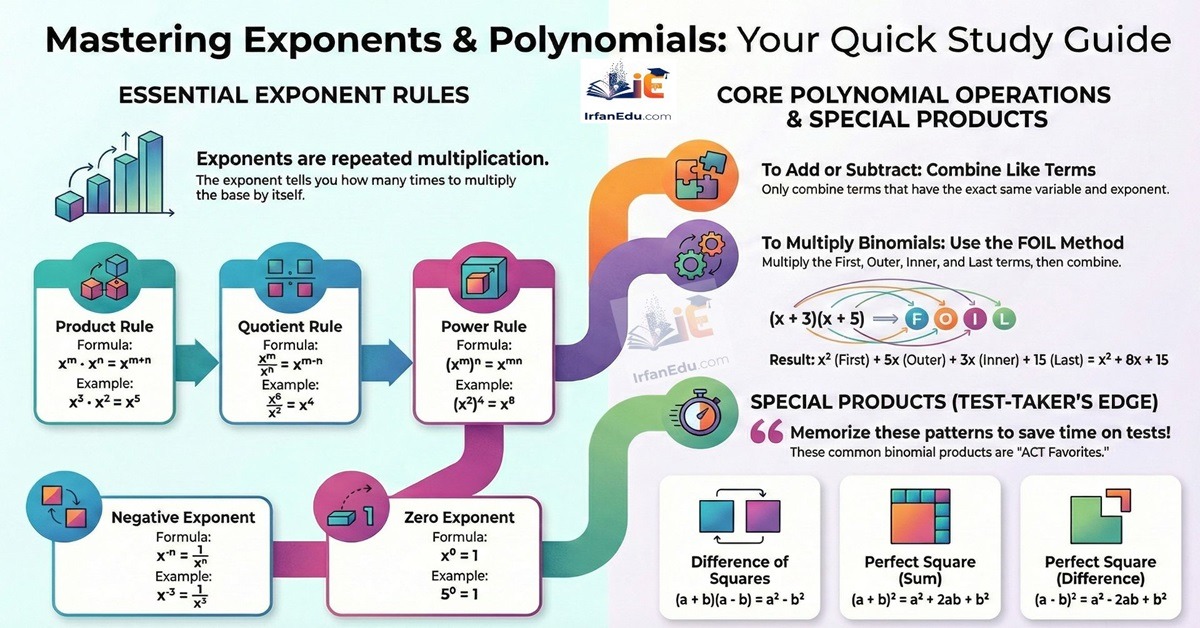
    1️⃣ Exponent Rules (Critical for Polynomials)

    Rule Name Formula Example
    Product Rule $$x^a \cdot x^b = x^{a+b}$$ $$x^3 \cdot x^5 = x^8$$
    Quotient Rule $$\frac{x^a}{x^b} = x^{a-b}$$ $$\frac{x^7}{x^3} = x^4$$
    Power Rule $$(x^a)^b = x^{a \cdot b}$$ $$(x^2)^3 = x^6$$
    Zero Exponent $$x^0 = 1$$ (where $$x \neq 0$$) $$5^0 = 1$$
    Negative Exponent $$x^{-a} = \frac{1}{x^a}$$ $$x^{-3} = \frac{1}{x^3}$$

    2️⃣ Polynomial Operation Rules

    Addition/Subtraction: Combine only like terms

    $$(3x^2 + 5x – 2) + (2x^2 – 3x + 7) = 5x^2 + 2x + 5$$

    Multiplication (Distributive Property):

    $$a(b + c) = ab + ac$$

    Example: $$3x(2x^2 – 5x + 4) = 6x^3 – 15x^2 + 12x$$

    FOIL Method (Binomial Multiplication):

    $$(a + b)(c + d) = ac + ad + bc + bd$$

    Example: $$(x + 3)(x + 5) = x^2 + 5x + 3x + 15 = x^2 + 8x + 15$$

    3️⃣ Special Polynomial Products (ACT Favorites!)

    Pattern Name Formula
    Perfect Square (Sum) $$(a + b)^2 = a^2 + 2ab + b^2$$
    Perfect Square (Difference) $$(a – b)^2 = a^2 – 2ab + b^2$$
    Difference of Squares $$(a + b)(a – b) = a^2 – b^2$$

    ⚡ ACT Time-Saver: Memorize these special products! They appear on nearly every ACT Math test and can save you 30-60 seconds per question when you recognize the pattern instantly.

    ✅ Step-by-Step Examples: Mastering Polynomial Operations

    📘 Example 1: Adding and Subtracting Polynomials

    Problem: Simplify $$(4x^3 – 2x^2 + 7x – 5) – (2x^3 + 3x^2 – 4x + 8)$$

    Step 1: Distribute the negative sign
    When subtracting polynomials, distribute the negative sign to every term in the second polynomial:

    $$= 4x^3 – 2x^2 + 7x – 5 – 2x^3 – 3x^2 + 4x – 8$$

    Step 2: Group like terms
    Organize terms by their degree (exponent):

    $$= (4x^3 – 2x^3) + (-2x^2 – 3x^2) + (7x + 4x) + (-5 – 8)$$

    Step 3: Combine like terms
    Add or subtract the coefficients of like terms:

    $$= 2x^3 – 5x^2 + 11x – 13$$

    ✓ Final Answer: $$2x^3 – 5x^2 + 11x – 13$$

    ⏱️ ACT Time Estimate: 45-60 seconds

    📗 Example 2: Multiplying Polynomials (Distributive Property)

    Problem: Multiply $$3x^2(2x^2 – 5x + 4)$$

    Step 1: Apply the distributive property
    Multiply $$3x^2$$ by each term inside the parentheses:

    $$= 3x^2 \cdot 2x^2 + 3x^2 \cdot (-5x) + 3x^2 \cdot 4$$

    Step 2: Multiply coefficients and add exponents
    Use the product rule for exponents ($$x^a \cdot x^b = x^{a+b}$$):

    $$= 6x^4 – 15x^3 + 12x^2$$

    ✓ Final Answer: $$6x^4 – 15x^3 + 12x^2$$

    ⏱️ ACT Time Estimate: 30-45 seconds

    📙 Example 3: Multiplying Binomials (FOIL Method)

    Problem: Expand $$(2x + 5)(3x – 4)$$

    Step 1: Apply FOIL (First, Outer, Inner, Last)

    First: $$2x \cdot 3x = 6x^2$$

    Outer: $$2x \cdot (-4) = -8x$$

    Inner: $$5 \cdot 3x = 15x$$

    Last: $$5 \cdot (-4) = -20$$

    Step 2: Combine all terms

    $$= 6x^2 – 8x + 15x – 20$$

    Step 3: Combine like terms

    $$= 6x^2 + 7x – 20$$

    ✓ Final Answer: $$6x^2 + 7x – 20$$

    ⏱️ ACT Time Estimate: 40-50 seconds

    📕 Example 4: Special Product (Difference of Squares)

    Problem: Simplify $$(4x + 7)(4x – 7)$$

    Step 1: Recognize the pattern
    This is a difference of squares pattern: $$(a + b)(a – b) = a^2 – b^2$$
    Here, $$a = 4x$$ and $$b = 7$$

    Step 2: Apply the formula

    $$= (4x)^2 – (7)^2$$

    Step 3: Simplify

    $$= 16x^2 – 49$$

    ✓ Final Answer: $$16x^2 – 49$$

    ⚡ ACT Pro Tip: Recognizing this pattern saved us from using FOIL! This shortcut can save 20-30 seconds on the ACT. Always check if binomials follow the $$(a+b)(a-b)$$ pattern before multiplying.

    ⏱️ ACT Time Estimate: 20-30 seconds (with pattern recognition!)

    📝 ACT-Style Practice Questions

    Test your understanding with these ACT-style practice problems. Try solving them on your own before checking the solutions!

    Practice Question 1 (Basic)

    What is the result when $$(5x^2 – 3x + 2)$$ is added to $$(2x^2 + 7x – 9)$$?

    A) $$7x^2 + 4x – 7$$
    B) $$7x^2 + 10x – 7$$
    C) $$3x^2 + 4x – 7$$
    D) $$7x^2 – 4x + 11$$
    E) $$10x^2 + 4x – 7$$
    Show Detailed Solution

    Step 1: Write out both polynomials:
    $$(5x^2 – 3x + 2) + (2x^2 + 7x – 9)$$

    Step 2: Group like terms:
    $$(5x^2 + 2x^2) + (-3x + 7x) + (2 – 9)$$

    Step 3: Combine like terms:
    $$7x^2 + 4x – 7$$

    ✓ Correct Answer: A) $$7x^2 + 4x – 7$$

    Difficulty: Basic | Time: 30-40 seconds

    Practice Question 2 (Intermediate)

    Simplify: $$-2x(3x^2 – 4x + 5)$$

    A) $$-6x^3 + 8x^2 – 10x$$
    B) $$-6x^3 – 8x^2 – 10x$$
    C) $$-6x^2 + 8x – 10$$
    D) $$6x^3 – 8x^2 + 10x$$
    E) $$-6x^3 – 8x + 10$$
    Show Detailed Solution

    Step 1: Distribute $$-2x$$ to each term:
    $$= -2x \cdot 3x^2 + (-2x) \cdot (-4x) + (-2x) \cdot 5$$

    Step 2: Multiply coefficients and add exponents:
    $$= -6x^3 + 8x^2 – 10x$$

    ✓ Correct Answer: A) $$-6x^3 + 8x^2 – 10x$$

    Common Mistake: Watch the signs! $$-2x \cdot (-4x) = +8x^2$$ (negative times negative equals positive)

    Difficulty: Intermediate | Time: 35-45 seconds

    Practice Question 3 (Intermediate)

    Which of the following is equivalent to $$(x – 6)(x + 9)$$?

    A) $$x^2 + 3x – 54$$
    B) $$x^2 – 3x – 54$$
    C) $$x^2 + 15x – 54$$
    D) $$x^2 + 3x + 54$$
    E) $$x^2 – 15x – 54$$
    Show Detailed Solution

    Step 1: Apply FOIL method:

    • First: $$x \cdot x = x^2$$
    • Outer: $$x \cdot 9 = 9x$$
    • Inner: $$-6 \cdot x = -6x$$
    • Last: $$-6 \cdot 9 = -54$$

    Step 2: Combine all terms:
    $$= x^2 + 9x – 6x – 54$$

    Step 3: Combine like terms:
    $$= x^2 + 3x – 54$$

    ✓ Correct Answer: A) $$x^2 + 3x – 54$$

    Difficulty: Intermediate | Time: 40-50 seconds

    Practice Question 4 (Advanced)

    What is the simplified form of $$(3x + 5)^2$$?

    A) $$9x^2 + 25$$
    B) $$9x^2 + 15x + 25$$
    C) $$9x^2 + 30x + 25$$
    D) $$3x^2 + 30x + 25$$
    E) $$9x^2 + 10x + 25$$
    Show Detailed Solution

    Method 1: Using the Perfect Square Formula
    Recognize the pattern: $$(a + b)^2 = a^2 + 2ab + b^2$$
    Here, $$a = 3x$$ and $$b = 5$$

    Step 1: Apply the formula:
    $$= (3x)^2 + 2(3x)(5) + (5)^2$$

    Step 2: Simplify each term:
    $$= 9x^2 + 30x + 25$$

    ✓ Correct Answer: C) $$9x^2 + 30x + 25$$

    ⚠️ Common Trap Answer: A) $$9x^2 + 25$$ — This is WRONG! Many students forget the middle term $$2ab$$. Always remember: $$(a+b)^2 \neq a^2 + b^2$$

    Difficulty: Advanced | Time: 30-40 seconds (with formula recognition)

    Practice Question 5 (Advanced – ACT Challenge)

    If $$x^2 – y^2 = 48$$ and $$x – y = 6$$, what is the value of $$x + y$$?

    A) 6
    B) 8
    C) 10
    D) 12
    E) 14
    Show Detailed Solution

    Step 1: Recognize the difference of squares pattern
    $$x^2 – y^2 = (x + y)(x – y)$$

    Step 2: Substitute the known values:
    $$48 = (x + y)(6)$$

    Step 3: Solve for $$(x + y)$$:
    $$x + y = \frac{48}{6} = 8$$

    ✓ Correct Answer: B) 8

    💡 ACT Strategy: This question tests whether you recognize the difference of squares factorization. Without this recognition, you’d need to solve a system of equations, which takes much longer!

    Difficulty: Advanced | Time: 30-45 seconds (with pattern recognition) or 90+ seconds (without)

    📝

    Ready to Test Your Polynomial Skills?

    Take our full-length ACT practice test and see how well you’ve mastered polynomial operations. Get instant scoring, detailed explanations, and personalized recommendations!

    🚀 Start ACT Practice Test Now →
    Full-Length Tests
    Instant Scoring
    Detailed Solutions

    💡 ACT Pro Tips & Tricks for Polynomial Success

    ⚡ Tip 1: Master Pattern Recognition for Speed

    The ACT rewards students who can instantly recognize special products like $$(a+b)^2$$, $$(a-b)^2$$, and $$(a+b)(a-b)$$. Memorize these patterns cold! When you see $$(x+7)(x-7)$$, your brain should immediately think “difference of squares = $$x^2-49$$” without needing to FOIL. This single skill can save you 2-3 minutes per test.

    📋 Tip 2: Write Vertically for Complex Addition/Subtraction

    When adding or subtracting polynomials with many terms, align them vertically by degree. This prevents careless errors with signs and makes it easier to combine like terms. For example, stack $$x^3$$, $$x^2$$, $$x$$, and constant terms in columns—just like you learned in elementary school for multi-digit addition!

    ⚠️ Tip 3: Watch Out for Negative Sign Distribution

    The #1 mistake students make with polynomials? Forgetting to distribute the negative sign when subtracting. When you see $$-(3x^2 – 5x + 2)$$, EVERY term inside changes sign: $$-3x^2 + 5x – 2$$. Circle or highlight negative signs in your test booklet to avoid this trap!

    🧮 Tip 4: Use Your Calculator Strategically

    Your calculator can verify polynomial operations! After simplifying, plug in a test value (like $$x=2$$) into both the original expression and your answer. If they give different results, you made an error. This 10-second check can save you from losing easy points. Just don’t rely on your calculator to do the algebra—it’s usually slower than doing it by hand.

    🎯 Tip 5: Eliminate Answer Choices Using Degree and Leading Coefficient

    Before doing full calculations, check the degree (highest exponent) and leading coefficient of answer choices. If you’re multiplying $$3x^2$$ by $$2x^3$$, the result MUST start with $$6x^5$$. Eliminate any answer that doesn’t match this immediately! This process of elimination can help you narrow down to 2-3 choices before you even finish the problem.

    ⏰ Tip 6: Time Management – Know When to Skip

    Most polynomial problems should take 30-60 seconds. If you’re spending more than 90 seconds on one question, mark it and move on. You can always return to it later. The ACT doesn’t give extra points for hard questions—a basic polynomial addition question is worth the same as a complex multiplication problem. Get the easy points first!

    🚫 Common Mistakes to Avoid

    ❌ Mistake #1: The Perfect Square Trap

    Wrong: $$(x + 5)^2 = x^2 + 25$$
    Right: $$(x + 5)^2 = x^2 + 10x + 25$$

    Why it happens: Students forget the middle term $$2ab$$. Always remember: $$(a+b)^2 = a^2 + 2ab + b^2$$

    ❌ Mistake #2: Exponent Addition vs. Multiplication

    Wrong: $$(x^2)^3 = x^5$$
    Right: $$(x^2)^3 = x^6$$

    Why it happens: Confusing the power rule with the product rule. When raising a power to a power, you MULTIPLY exponents, not add them.

    ❌ Mistake #3: Sign Errors in Subtraction

    Wrong: $$(5x – 3) – (2x – 7) = 3x – 10$$
    Right: $$(5x – 3) – (2x – 7) = 3x + 4$$

    Why it happens: Not distributing the negative sign to ALL terms. $$-(2x – 7) = -2x + 7$$, not $$-2x – 7$$.

    ❌ Mistake #4: Combining Unlike Terms

    Wrong: $$3x^2 + 5x = 8x^2$$ or $$8x^3$$
    Right: $$3x^2 + 5x$$ (cannot be simplified further)

    Why it happens: Only terms with identical variable parts can be combined. $$x^2$$ and $$x$$ are NOT like terms!

    🎥 Video Explanation: Polynomial Operations

    Watch this detailed video explanation to understand polynomial operations better with visual demonstrations and step-by-step guidance.

    🎯 ACT Test-Taking Strategy for Polynomial Operations

    ⏱️ Time Allocation Strategy

    With 60 questions in 60 minutes, you have an average of 1 minute per question on the ACT Math section. For polynomial operations:

    • Basic addition/subtraction: 30-45 seconds
    • Multiplication with distribution: 45-60 seconds
    • FOIL problems: 40-50 seconds
    • Special products (if recognized): 20-35 seconds
    • Complex multi-step problems: 60-90 seconds

    🎲 Smart Guessing Strategy

    If you’re running out of time or stuck on a polynomial problem:

    1. Check the degree: Eliminate answers with wrong highest exponent
    2. Check the leading coefficient: Eliminate answers that don’t match
    3. Check the constant term: Often easier to calculate quickly
    4. Plug in x=0 or x=1: Test remaining answer choices
    5. Never leave blank: There’s no penalty for guessing on the ACT!

    🔍 Answer Verification Techniques

    If you have 10-15 seconds left after solving:

    Quick Check Method: Substitute $$x = 2$$ into both the original expression and your answer. If they give the same result, you’re likely correct. If not, you made an error.

    🎯 Question Priority System

    Not all polynomial questions are created equal. Use this priority system:

    Priority Question Type Strategy
    HIGH Simple addition/subtraction, special products you recognize Do these first—quick points!
    MEDIUM FOIL problems, basic distribution Do these second—manageable in 45-60 seconds
    LOW Complex multi-step, unfamiliar patterns Skip and return if time permits

    📝 Scratch Work Organization

    Use your test booklet effectively:

    • Write out polynomial operations vertically when possible
    • Circle or box negative signs to avoid sign errors
    • Cross out answer choices you’ve eliminated
    • Use arrows to track like terms when combining
    • Write clearly—you may need to return to check your work

    🏆 Score Improvement Guarantee

    Students who master polynomial operations and apply these strategies typically see a 3-5 point improvement on their ACT Math score. That’s because polynomials appear in 8-12 questions per test, and many other algebra questions build on these foundational skills. Invest the time to master this topic—it’s one of the highest-ROI areas for ACT prep!

    🌍 Real-World Applications: Why Polynomials Matter

    You might wonder, “When will I ever use polynomial operations in real life?” The answer: more often than you think! Here’s where these skills show up beyond the ACT:

    🏗️ Architecture & Engineering

    Calculating areas, volumes, and structural loads often involves polynomial expressions. For example, finding the area of a complex shape might require multiplying $$(2x + 5)(3x – 2)$$.

    💰 Finance & Economics

    Profit functions, cost analysis, and investment growth models use polynomial equations. Business analysts regularly work with expressions like $$-2x^2 + 50x – 100$$ to maximize profit.

    🎮 Computer Graphics & Gaming

    Video game physics, animation curves, and 3D modeling all rely heavily on polynomial mathematics. Every smooth curve you see in a video game involves polynomial calculations.

    🔬 Science & Research

    Physics equations for motion, chemistry calculations for reaction rates, and biology models for population growth all use polynomial expressions extensively.

    College Connection: Polynomial operations are foundational for college courses including Calculus, Physics, Chemistry, Economics, Engineering, and Computer Science. Mastering them now gives you a significant advantage in your first-year college courses!

    ❓ Frequently Asked Questions (FAQs)

    Q1: How many polynomial questions are typically on the ACT Math section? +

    Polynomial operations appear in approximately 8-12 questions on every ACT Math test, making them one of the most frequently tested topics. This includes direct polynomial manipulation questions as well as word problems involving area, perimeter, and other applications. Additionally, polynomial skills are foundational for many other algebra questions, so mastering this topic impacts your performance on 20-25% of the entire Math section.

    Q2: Should I memorize all the special polynomial products, or can I just use FOIL every time? +

    Definitely memorize the special products! While FOIL always works, recognizing patterns like $$(a+b)^2 = a^2 + 2ab + b^2$$ and $$(a+b)(a-b) = a^2 – b^2$$ can save you 20-30 seconds per question. On a timed test like the ACT, this time savings is crucial. Plus, these patterns appear on nearly every ACT Math test—usually 2-4 times. The investment of 15-20 minutes to memorize these formulas will pay dividends on test day and throughout your college math courses.

    Q3: Can I use my calculator for polynomial operations on the ACT? +

    While calculators are allowed on the ACT Math section, they’re generally not helpful for polynomial operations. Most calculators can’t symbolically manipulate algebraic expressions, so you’ll need to do the algebra by hand anyway. However, you CAN use your calculator to verify your answer by plugging in a test value (like $$x=2$$) into both the original expression and your simplified answer. If they match, you’re likely correct. This verification technique takes only 10-15 seconds and can catch careless errors.

    Q4: What’s the most common mistake students make with polynomial operations? +

    The #1 mistake is sign errors when distributing negative signs. When you see $$-(3x^2 – 5x + 2)$$, every term inside must change sign: $$-3x^2 + 5x – 2$$. Many students correctly change the first term but forget about the others. The second most common mistake is thinking $$(a+b)^2 = a^2 + b^2$$ and forgetting the middle term $$2ab$$. To avoid these errors: (1) Circle all negative signs in your test booklet, (2) Write out the distribution step explicitly rather than doing it in your head, and (3) Memorize the special product formulas so thoroughly that you can recite them in your sleep!

    Q5: How can I improve my speed on polynomial problems without sacrificing accuracy? +

    Speed comes from pattern recognition and deliberate practice. Here’s a proven strategy: (1) Master the exponent rules and special products until they’re automatic, (2) Practice 10-15 polynomial problems daily for 2 weeks—time yourself and track your progress, (3) Learn to eliminate wrong answers quickly by checking degree and leading coefficients, (4) Develop a consistent scratch work system so you don’t waste time thinking about how to organize your work. Most importantly, focus on accuracy first—speed will naturally increase as the patterns become familiar. Students who rush through problems make careless errors that cost more time than they save. Aim for smooth, confident execution rather than frantic speed.

    Dr. Irfan Mansuri - ACT Test Prep Specialist

    ✍️ Written by Dr. Irfan Mansuri

    Educational Content Creator & Competitive Exam Specialist

    IrfanEdu.com • United States

    Dr. Irfan Mansuri is a distinguished educational content creator with over 15 years of experience spanning high school, undergraduate, and postgraduate levels. As the founder of IrfanEdu.com, he has successfully guided thousands of students through competitive examinations, helping them achieve exceptional results and gain admission to their dream institutions.

    15+ years in competitive exam preparation Certified Instructor LinkedIn Profile

    🎓 Final Thoughts: Your Path to Polynomial Mastery

    Mastering polynomial operations is one of the smartest investments you can make in your ACT Prep journey. These skills appear throughout the Math section and form the foundation for success in higher-level math courses. Remember: speed comes from understanding, not memorization. Focus on truly grasping why the rules work, practice consistently, and use the strategic approaches outlined in this guide.

    With dedicated practice, you can transform polynomial operations from a source of anxiety into a reliable source of quick points on test day. Start with the basics, build your confidence with practice problems, and gradually work up to the more challenging questions. Your future self—and your ACT score—will thank you!

    📚 Related ACT Math Resources

    • Complete ACT Math Prep Guide
    • ACT Algebra: Solving Quadratic Equations
    • ACT Math: Factoring Polynomials Strategies
    • Elementary Algebra: Functions and Graphs
    • ACT Math Time Management Strategies
    Master Exponents and Polynomials – IrfanEdu.com

    🎓 Exponents and Polynomials Mastery

    Your Complete Guide to Understanding Algebraic Operations | IrfanEdu.com

    📊 Understanding Exponents

    Exponents represent repeated multiplication. When you see , you multiply x by itself three times.

    Visual Example

    2⁵ = 2 × 2 × 2 × 2 × 2 = 32

    Here, we multiply the base (2) by itself five times because the exponent is 5.

    Essential Exponent Rules

    Product Rule

    x^m × x^n = x^(m+n)

    Example: x³ × x² = x⁵

    Quotient Rule

    x^m ÷ x^n = x^(m-n)

    Example: x⁶ ÷ x² = x⁴

    Power Rule

    (x^m)^n = x^(mn)

    Example: (x²)⁴ = x⁸

    💡 Pro Tip

    When you multiply terms with the same base, you add the exponents. When you divide, you subtract them. This pattern makes calculations much easier!

    Special Cases You Must Know

    Rule Formula Example
    Zero Exponent x⁰ = 1 5⁰ = 1
    Negative Exponent x⁻ⁿ = 1/xⁿ x⁻³ = 1/x³
    Power of Product (xy)ⁿ = xⁿyⁿ (2x)³ = 8x³
    Power of Quotient (x/y)ⁿ = xⁿ/yⁿ (x/2)² = x²/4

    🔢 What Are Polynomials?

    A polynomial combines variables, constants, and exponents using addition, subtraction, and multiplication. You can recognize polynomials by their structure.

    Polynomial Components

    3x² + 5x – 7

    Breaking it down:

    • 3x² → First term (coefficient: 3, variable: x, exponent: 2)
    • 5x → Second term (coefficient: 5, variable: x, exponent: 1)
    • -7 → Constant term (no variable)

    Types of Polynomials by Degree

    Linear (Degree 1)

    2x + 3

    Creates a straight line graph

    Quadratic (Degree 2)

    x² + 4x + 4

    Creates a parabola graph

    Cubic (Degree 3)

    x³ – 2x² + x

    Creates an S-shaped curve

    ⚠️ What’s NOT a Polynomial?

    • ❌ Division by a variable: 3/x + 2
    • ❌ Negative exponents: x⁻² + 5
    • ❌ Fractional exponents: x^(1/2) + 3
    • ❌ Variables in denominators: 1/(x+1)

    ➕➖ Adding and Subtracting Polynomials

    You combine polynomials by adding or subtracting like terms – terms with the same variable and exponent.

    Step-by-Step Addition Example

    Problem: Add (3x² + 2x + 5) + (x² – 4x + 3)

    1 Remove parentheses: 3x² + 2x + 5 + x² – 4x + 3
    2 Group like terms: (3x² + x²) + (2x – 4x) + (5 + 3)
    3 Combine: 4x² – 2x + 8

    Step-by-Step Subtraction Example

    Problem: Subtract (5x² + 3x – 2) – (2x² + x + 4)

    1 Distribute the negative: 5x² + 3x – 2 – 2x² – x – 4
    2 Group like terms: (5x² – 2x²) + (3x – x) + (-2 – 4)
    3 Simplify: 3x² + 2x – 6

    💡 Key Strategy

    When subtracting, change the sign of every term in the second polynomial. This prevents common mistakes!

    ✖️ Multiplying Polynomials

    The FOIL Method (For Binomials)

    FOIL stands for: First, Outer, Inner, Last

    FOIL Example

    Problem: (x + 3)(x + 5)

    F First: x × x = x²
    O Outer: x × 5 = 5x
    I Inner: 3 × x = 3x
    L Last: 3 × 5 = 15
    Result: x² + 5x + 3x + 15 = x² + 8x + 15

    Multiplying Larger Polynomials

    Distribution Method

    Problem: 2x(3x² – 4x + 5)

    1 Multiply first term: 2x × 3x² = 6x³
    2 Multiply second term: 2x × (-4x) = -8x²
    3 Multiply third term: 2x × 5 = 10x
    Result: 6x³ – 8x² + 10x

    ➗ Dividing Polynomials

    Simple Division by Monomials

    Breaking Down Division

    Problem: (6x³ + 9x²) ÷ 3x

    1 Separate terms: (6x³/3x) + (9x²/3x)
    2 Simplify each: 2x² + 3x

    Long Division Method

    Polynomial Long Division

    Problem: (x² + 5x + 6) ÷ (x + 2)

    1 Divide leading terms: x² ÷ x = x
    2 Multiply and subtract: x(x + 2) = x² + 2x
    Subtract: (x² + 5x + 6) – (x² + 2x) = 3x + 6
    3 Repeat: 3x ÷ x = 3
    3(x + 2) = 3x + 6
    Subtract: (3x + 6) – (3x + 6) = 0
    Result: x + 3

    💡 Division Tip

    Always arrange polynomials in descending order of exponents before dividing. This keeps your work organized and prevents errors.

    🌍 Real-World Applications

    📐 Area Calculations

    Engineers use polynomials to calculate areas of complex shapes.

    Area = (x + 3)(x + 5)

    = x² + 8x + 15

    💰 Business Profit

    Companies model profit using polynomial functions.

    P(x) = -2x² + 50x – 100

    Where x represents units sold

    🚀 Physics Motion

    Scientists describe object motion with polynomials.

    h(t) = -16t² + 64t + 80

    Height at time t

    ✍️ Practice Problems

    Try These Yourself!

    1. Simplify: (2x³)(4x²)

    2. Add: (3x² + 2x – 5) + (x² – 3x + 7)

    3. Multiply: (x + 4)(x – 2)

    4. Divide: (12x⁴ + 8x³) ÷ 4x²

    📝 Answers

    1. 8x⁵

    2. 4x² – x + 2

    3. x² + 2x – 8

    4. 3x² + 2x

    📚 Quick Reference Guide

    Operation Rule Example
    Adding Exponents x^a × x^b = x^(a+b) x³ × x² = x⁵
    Subtracting Exponents x^a ÷ x^b = x^(a-b) x⁵ ÷ x² = x³
    Power of Power (x^a)^b = x^(ab) (x²)³ = x⁶
    Adding Polynomials Combine like terms 3x + 2x = 5x
    Multiplying Binomials Use FOIL (x+2)(x+3) = x²+5x+6

    🎓 IrfanEdu.com

    Making Math Simple and Accessible for Everyone

    © 2024 IrfanEdu.com | All Rights Reserved

    [pdf_viewer id=”206″]

  • Systems of Equations: Substitution & Elimination | ACT Math Guide

    Systems of Equations: Substitution & Elimination | ACT Math Guide

    Systems of Equations: Substitution & Elimination | ACT Math Guide for Grades 9-12

    Systems of equations are a critical component of ACT Prep Math section, appearing in approximately 3-5 questions per test. Whether you’re solving for two variables simultaneously or determining where two lines intersect, mastering both the substitution and elimination methods will give you the flexibility to tackle these problems efficiently. According to ACT.org, these questions test your ability to manipulate equations and find solutions systematically—skills that are essential for success in college-level mathematics.

    🎯

    ACT SCORE BOOSTER: Master This Topic for 2-4 Extra Points!

    This topic appears in most ACT tests (3-5 questions) on the ACT Math section. Understanding it thoroughly can add 2-4 points to your composite score. Let’s break it down with proven strategies that work!

    🚀 Jump to ACT Strategy →

    📚 Understanding Systems of Equations

    A system of equations consists of two or more equations with the same variables. The solution to a system is the set of values that satisfies all equations simultaneously. On the ACT, you’ll typically encounter systems of two linear equations with two variables (usually $$x$$ and $$y$$).

    📌 What You’re Looking For:

    The solution $$(x, y)$$ represents the point where two lines intersect on a coordinate plane. This means both equations are true for these specific values.

    Example System:

    $$2x + y = 10$$

    $$x – y = 2$$

    Why This Matters for the ACT: Systems of equations appear in 3-5 questions per test, often in word problem format. These questions test your ability to set up equations from real-world scenarios and solve them efficiently. Mastering both methods gives you strategic flexibility—you can choose the faster approach based on the problem structure.

    Score Impact: Students who confidently solve systems of equations typically see a 2-4 point improvement in their ACT Math score, as this skill also helps with related topics like inequalities, functions, and word problems.

    📐 Two Essential Methods

    🔹 Method 1: Substitution

    Best for: When one equation is already solved for a variable, or can be easily solved for one.

    Step-by-Step Process:

    1. Solve one equation for one variable (e.g., solve for $$y$$ in terms of $$x$$)
    2. Substitute this expression into the other equation
    3. Solve for the remaining variable
    4. Back-substitute to find the other variable
    5. Check your solution in both original equations

    💡 ACT Tip: Use substitution when you see $$y = …$$ or $$x = …$$ already solved, or when coefficients are 1 or -1.

    🔹 Method 2: Elimination (Addition/Subtraction)

    Best for: When coefficients of one variable are the same or opposites, or can be made so easily.

    Step-by-Step Process:

    1. Align equations vertically by variables
    2. Multiply one or both equations to make coefficients of one variable opposites
    3. Add or subtract equations to eliminate one variable
    4. Solve for the remaining variable
    5. Substitute back to find the other variable
    6. Check your solution in both original equations

    💡 ACT Tip: Use elimination when both equations are in standard form ($$ax + by = c$$) or when coefficients are already convenient.

    ✅ Step-by-Step Examples

    1 Example 1: Substitution Method

    Problem: Solve the system:

    $$y = 2x – 1$$

    $$3x + y = 9$$

    Step 1: Identify which variable is already solved
    The first equation is already solved for $$y$$: $$y = 2x – 1$$

    Step 2: Substitute into the second equation
    Replace $$y$$ with $$2x – 1$$ in the second equation:

    $$3x + (2x – 1) = 9$$

    Step 3: Solve for $$x$$

    $$3x + 2x – 1 = 9$$

    $$5x – 1 = 9$$

    $$5x = 10$$

    $$x = 2$$

    Step 4: Back-substitute to find $$y$$
    Use $$x = 2$$ in the first equation:

    $$y = 2(2) – 1$$

    $$y = 4 – 1$$

    $$y = 3$$

    Step 5: Verify the solution
    Check in both equations:

    Equation 1: $$y = 2x – 1$$ → $$3 = 2(2) – 1$$ → $$3 = 3$$ ✓

    Equation 2: $$3x + y = 9$$ → $$3(2) + 3 = 9$$ → $$9 = 9$$ ✓

    ✓ Final Answer: $$x = 2$$, $$y = 3$$ or $$(2, 3)$$

    ⏱️ ACT Time Tip: This should take 45-60 seconds on the ACT. Substitution was ideal here because $$y$$ was already isolated!

    2 Example 2: Elimination Method

    Problem: Solve the system:

    $$2x + 3y = 16$$

    $$5x – 3y = 5$$

    Step 1: Observe the coefficients
    Notice that $$y$$ has coefficients $$+3$$ and $$-3$$ (opposites!). This makes elimination perfect.

    Step 2: Add the equations to eliminate $$y$$

    $$2x + 3y = 16$$

    $$+ (5x – 3y = 5)$$

    $$7x + 0 = 21$$

    Step 3: Solve for $$x$$

    $$7x = 21$$

    $$x = 3$$

    Step 4: Substitute back to find $$y$$
    Use $$x = 3$$ in the first equation:

    $$2(3) + 3y = 16$$

    $$6 + 3y = 16$$

    $$3y = 10$$

    $$y = \frac{10}{3}$$

    Step 5: Verify the solution

    Equation 1: $$2(3) + 3(\frac{10}{3}) = 6 + 10 = 16$$ ✓

    Equation 2: $$5(3) – 3(\frac{10}{3}) = 15 – 10 = 5$$ ✓

    ✓ Final Answer: $$x = 3$$, $$y = \frac{10}{3}$$ or $$(3, \frac{10}{3})$$

    ⏱️ ACT Time Tip: This should take 50-70 seconds. Elimination was perfect here because the $$y$$ coefficients were already opposites!

    3 Example 3: Elimination with Multiplication (ACT-Style)

    Problem: Solve the system:

    $$3x + 2y = 12$$

    $$4x – y = 5$$

    Step 1: Choose which variable to eliminate
    Let’s eliminate $$y$$. We need to make the coefficients opposites.

    Step 2: Multiply the second equation by 2
    This makes the $$y$$ coefficient $$-2$$ (opposite of $$+2$$):

    $$2 \times (4x – y = 5)$$

    $$8x – 2y = 10$$

    Step 3: Add the equations

    $$3x + 2y = 12$$

    $$+ (8x – 2y = 10)$$

    $$11x = 22$$

    Step 4: Solve for $$x$$

    $$x = 2$$

    Step 5: Substitute to find $$y$$
    Use $$x = 2$$ in the second original equation:

    $$4(2) – y = 5$$

    $$8 – y = 5$$

    $$-y = -3$$

    $$y = 3$$

    ✓ Final Answer: $$x = 2$$, $$y = 3$$ or $$(2, 3)$$

    ⏱️ ACT Time Tip: This should take 60-90 seconds. The multiplication step adds time, but elimination is still faster than substitution for this problem!

    📝 ACT-Style Practice Questions

    Test your understanding with these ACT-style problems. Try solving them on your own before checking the solutions!

    Question 1 ⭐ Basic

    What is the solution to the following system of equations?

    $$x + y = 8$$

    $$x – y = 2$$

    A) $$(3, 5)$$
    B) $$(5, 3)$$
    C) $$(4, 4)$$
    D) $$(6, 2)$$
    E) $$(2, 6)$$
    📖 Show Detailed Solution

    Method: Elimination (Add the equations)

    Add both equations to eliminate $$y$$:

    $$(x + y) + (x – y) = 8 + 2$$

    $$2x = 10$$

    $$x = 5$$

    Substitute $$x = 5$$ into first equation:

    $$5 + y = 8$$

    $$y = 3$$

    ✓ Correct Answer: B) $$(5, 3)$$

    Question 2 ⭐⭐ Intermediate

    Solve for $$x$$ and $$y$$:

    $$y = 3x + 2$$

    $$2x + y = 12$$

    A) $$(1, 5)$$
    B) $$(2, 8)$$
    C) $$(3, 11)$$
    D) $$(2, 6)$$
    E) $$(4, 14)$$
    📖 Show Detailed Solution

    Method: Substitution

    Substitute $$y = 3x + 2$$ into the second equation:

    $$2x + (3x + 2) = 12$$

    $$5x + 2 = 12$$

    $$5x = 10$$

    $$x = 2$$

    Find $$y$$ using $$x = 2$$:

    $$y = 3(2) + 2 = 6 + 2 = 8$$

    ✓ Correct Answer: B) $$(2, 8)$$

    Question 3 ⭐⭐⭐ Advanced

    What values of $$x$$ and $$y$$ satisfy both equations?

    $$4x + 3y = 18$$

    $$2x – y = 4$$

    A) $$(2, 0)$$
    B) $$(3, 2)$$
    C) $$(4, 4)$$
    D) $$(1, -2)$$
    E) $$(5, 6)$$
    📖 Show Detailed Solution

    Method: Elimination (multiply second equation by 3)

    Multiply second equation by 3:

    $$3(2x – y) = 3(4)$$

    $$6x – 3y = 12$$

    Add to first equation:

    $$4x + 3y = 18$$

    $$+ (6x – 3y = 12)$$

    $$10x = 30$$

    $$x = 3$$

    Substitute $$x = 3$$ into second equation:

    $$2(3) – y = 4$$

    $$6 – y = 4$$

    $$y = 2$$

    ✓ Correct Answer: B) $$(3, 2)$$

    💡 ACT Pro Tips & Tricks

    🎯 Tip #1: Choose the Right Method

    Use substitution when: One variable is already isolated ($$y = …$$) or has a coefficient of 1 or -1. Use elimination when: Both equations are in standard form or coefficients are convenient multiples.

    Tip #2: Look for Opposite Coefficients

    If you see coefficients like $$+3y$$ and $$-3y$$, elimination is lightning fast—just add the equations! This saves precious seconds on the ACT.

    Tip #3: Always Verify Your Answer

    Plug your solution back into BOTH original equations. If it doesn’t work in both, you made an error. This 10-second check can save you from losing points!

    🚀 Tip #4: Use Answer Choices Strategically

    On the ACT, you can plug answer choices into both equations to find which one works. Start with choice C (middle value) and adjust up or down. This “backsolving” method is sometimes faster than algebra!

    ⚠️ Tip #5: Watch Your Signs!

    The #1 error in systems is sign mistakes. When subtracting equations or dealing with negative coefficients, double-check every sign. Write neatly and line up your work vertically.

    📝 Tip #6: Organize Your Work

    Line up equations vertically with variables aligned. This makes it easier to add/subtract and spot errors. Neat work = fewer mistakes = higher scores!

    🤔 How to Choose: Substitution vs. Elimination

    Situation Best Method Why?
    One variable already isolated ($$y = …$$) Substitution No need to manipulate—just plug it in!
    Opposite coefficients ($$+3y$$ and $$-3y$$) Elimination Add equations immediately—fastest method!
    Same coefficients ($$2x$$ and $$2x$$) Elimination Subtract equations to eliminate variable
    Coefficient of 1 or -1 on one variable Substitution Easy to solve for that variable first
    Both equations in standard form ($$ax + by = c$$) Elimination Already set up perfectly for elimination
    Fractions or decimals present Either Clear fractions first, then choose method
    📝

    Ready to Test Your Knowledge?

    Take our full-length ACT practice test and see how well you’ve mastered this topic. Get instant scoring, detailed explanations, and personalized recommendations!

    🚀 Start ACT Practice Test Now →
    Full-Length Tests
    Instant Scoring
    Detailed Solutions

    🎯 ACT Test-Taking Strategy for Systems of Equations

    ⏱️ Time Management

    • Simple substitution: 45-60 seconds
    • Direct elimination: 50-70 seconds
    • Elimination with multiplication: 60-90 seconds
    • Word problems requiring setup: 90-120 seconds
    • If you’re taking longer than 2 minutes, mark it and move on—you can return later

    🎲 When to Skip and Return

    • If both equations need significant manipulation before you can apply either method
    • If you see fractions with large denominators or complicated coefficients
    • If it’s a word problem and you can’t quickly identify what the variables represent
    • Trust your instinct: if it feels overwhelming, skip it and come back with fresh eyes

    ✂️ Process of Elimination Strategy

    • Plug in $$x = 0$$: This eliminates $$x$$ terms and helps you check the constant and $$y$$ relationship
    • Plug in $$y = 0$$: Similarly, this helps verify the $$x$$ and constant relationship
    • Check answer format: If the problem asks for $$x + y$$, eliminate answers that don’t make sense
    • Test answer choices: Sometimes plugging in answer choices is faster than solving algebraically

    🔍 Quick Verification Technique

    After finding your solution, use this 10-second verification:

    Example: You found $$(x, y) = (3, 2)$$

    Quick check: Plug into both equations mentally
    Equation 1: Does it work? ✓
    Equation 2: Does it work? ✓
    If both check out, you’re done!

    🎯 Common ACT Trap Answers

    • Switched coordinates: They’ll offer $$(y, x)$$ instead of $$(x, y)$$—read carefully!
    • Partial solution: An answer showing only $$x$$ or only $$y$$ when both are needed
    • Sign error result: The answer you’d get if you made a common sign mistake
    • Wrong operation: The result if you subtracted instead of added (or vice versa)

    💪 Score Boost Tip: Master both substitution and elimination methods so you can choose the fastest approach for each problem. This flexibility can save you 2-3 minutes over the entire test, giving you more time for challenging questions—potentially adding 2-4 points to your ACT Math score!

    🌍 Real-World Applications

    Systems of equations aren’t just abstract math—they’re used constantly in real life and professional fields!

    💰 Business & Economics

    Finding break-even points, optimizing profit and cost equations, and determining supply-demand equilibrium all use systems of equations. Every business analyst uses these skills daily.

    🔬 Science & Engineering

    Chemical reactions (balancing equations), electrical circuits (Kirchhoff’s laws), and physics problems (motion, forces) all require solving systems. Engineers use this constantly.

    🚗 Transportation & Logistics

    Route optimization, fuel consumption calculations, and delivery scheduling all involve systems of equations. GPS navigation systems solve these problems millions of times per day!

    💊 Medicine & Health

    Drug dosage calculations, nutrition planning (balancing proteins, carbs, fats), and medical imaging (CT scans, MRIs) all rely on solving systems of equations.

    🎓 College Connection: Systems of equations are foundational for college courses in mathematics, economics, engineering, physics, chemistry, computer science, and business. The ACT tests this skill because it’s essential for college success. Mastering it now gives you a huge advantage in your first year!

    🎥 Video Explanation

    Watch this detailed video explanation to understand systems of equations better with visual demonstrations and step-by-step guidance.

    ❓ Frequently Asked Questions

    Which method is faster: substitution or elimination?

    It depends on the problem! Substitution is faster when one variable is already isolated (like $$y = 2x + 3$$). Elimination is faster when coefficients are opposites or can easily be made opposites. On the ACT, scan the problem for 5 seconds to identify which method will be quicker—this strategic choice can save you 20-30 seconds per problem!

    What if I get a fraction or decimal answer?

    That’s perfectly normal! ACT answers can be fractions (like $$\frac{10}{3}$$) or decimals (like $$3.33$$). Always check the answer choices to see which format they use. If answer choices show fractions, leave your answer as a fraction. If they show decimals, convert. Don’t assume you made an error just because you got a non-integer answer!

    Can I use my calculator for systems of equations on the ACT?

    Yes! Calculators are allowed on the ACT Math section. Some graphing calculators (like TI-84) have built-in system solvers, but learning to solve by hand is usually faster. You can use your calculator to check your answer by plugging values into both equations. However, for most ACT problems, solving by hand with substitution or elimination takes 45-90 seconds, which is faster than navigating calculator menus.

    What if the system has no solution or infinitely many solutions?

    Good question! No solution occurs when lines are parallel (same slope, different y-intercepts). You’ll get a false statement like $$0 = 5$$. Infinitely many solutions occurs when equations represent the same line. You’ll get a true statement like $$0 = 0$$. These special cases rarely appear on the ACT, but if you encounter one, the question will usually ask “How many solutions does the system have?” rather than asking you to find the solution.

    How many systems of equations questions are on the ACT Math section?

    Typically, you’ll see 3-5 questions directly involving systems of equations on each ACT Math test. However, the concept also appears indirectly in word problems, function questions, and coordinate geometry. That’s why mastering this topic is so valuable—it helps with multiple question types! For comprehensive ACT Prep resources, including more practice problems, visit our complete guide section.

    Dr. Irfan Mansuri - ACT Test Prep Specialist

    ✍️ Written by Dr. Irfan Mansuri

    Educational Content Creator & Competitive Exam Specialist

    IrfanEdu.com • United States

    Dr. Irfan Mansuri is a distinguished educational content creator with over 15 years of experience spanning high school, undergraduate, and postgraduate levels. As the founder of IrfanEdu.com, he has successfully guided thousands of students through competitive examinations, helping them achieve exceptional results and gain admission to their dream institutions.

    15+ years in competitive exam preparation Certified Instructor LinkedIn Profile

    📚 Continue Your ACT Math Journey

    Now that you’ve mastered systems of equations, take your skills to the next level with these related topics:

    • Linear Inequalities: Extend your system-solving skills to inequalities
    • Quadratic Systems: Solve systems involving parabolas and other curves
    • Word Problems: Apply systems to real-world ACT scenarios
    • Matrices: Advanced method for solving larger systems
    • Functions and Relations: Understanding how systems relate to function intersections

    💡 Study Tip: Practice 3-5 systems problems daily for two weeks. Mix substitution and elimination methods to build flexibility. This builds muscle memory and dramatically improves your speed and accuracy on test day!

    🎉 You’ve Got This!

    Systems of equations are a powerful tool that will serve you throughout the ACT Math section and beyond. With both substitution and elimination methods in your toolkit, you’re equipped to tackle any system efficiently. Remember: practice makes perfect, and strategic method selection makes you fast. Keep practicing, stay confident, and watch your ACT Math score soar!

    🚀 Your ACT Success Starts Here!
    System of Equations – Complete Guide | IrfanEdu.com

    📐 System of Equations

    Master the Art of Solving Multiple Equations Together

    Welcome to IrfanEdu.com’s comprehensive guide on System of Equations! We explore how multiple equations work together to find common solutions. You’ll discover practical methods, real-world applications, and master techniques that make solving these systems straightforward and intuitive.

    🎯 Understanding Systems of Equations

    A system of equations represents multiple equations that we solve together to find values that satisfy all equations simultaneously. Think of it as finding the perfect balance point where all conditions meet.

    Core Concept: When you have two unknowns (like x and y), you need at least two equations to find their unique values. Each equation provides one piece of the puzzle!

    🔍 Simple Example

    x + y = 10
    x – y = 4

    Here, we need to find values of x and y that make BOTH equations true. The answer: x = 7 and y = 3

    Check: 7 + 3 = 10 ✓ and 7 – 3 = 4 ✓

    🎨 Types of Solutions

    Systems of equations can have three different outcomes. Understanding these helps you know what to expect!

    Solution Type What It Means Visual Representation
    One Solution Lines intersect at exactly one point Two lines crossing each other (different slopes)
    No Solution Lines never meet – they’re parallel Two parallel lines (same slope, different intercepts)
    Infinite Solutions Lines overlap completely – they’re identical One line on top of another (same slope and intercept)

    🛠️ Solution Methods

    Method 1: Substitution Method

    Best When: One variable is already isolated or easy to isolate

    How It Works: Solve one equation for a variable, then substitute that expression into the other equation.

    📝 Substitution Example

    y = 2x + 1
    3x + y = 11
    1. Step 1: Notice y is already isolated in the first equation: y = 2x + 1
    2. Step 2: Substitute (2x + 1) for y in the second equation:
      3x + (2x + 1) = 11
    3. Step 3: Simplify and solve:
      5x + 1 = 11
      5x = 10
      x = 2
    4. Step 4: Find y by plugging x = 2 back:
      y = 2(2) + 1 = 5
    5. Answer: x = 2, y = 5

    Method 2: Elimination Method

    Best When: Coefficients are easy to match or are already matched

    How It Works: Add or subtract equations to eliminate one variable, making it disappear!

    📝 Elimination Example

    2x + 3y = 13
    4x – 3y = 5
    1. Step 1: Notice the y-terms (+3y and -3y) will cancel when added
    2. Step 2: Add both equations:
      (2x + 3y) + (4x – 3y) = 13 + 5
      6x = 18
    3. Step 3: Solve for x:
      x = 3
    4. Step 4: Substitute x = 3 into first equation:
      2(3) + 3y = 13
      6 + 3y = 13
      3y = 7
      y = 7/3
    5. Answer: x = 3, y = 7/3

    Method 3: Graphical Method

    Best When: You want to visualize the solution or verify your algebraic answer

    How It Works: Plot both equations on a graph; the intersection point is your solution!

    Visual Example: Finding the Intersection

    When we graph y = x + 1 and y = -x + 5, they intersect at the point (2, 3)

    y = x + 1 y = -x + 5 Solution: (2, 3)

    📊 Graphical Interpretation

    Understanding what equations look like as lines helps you predict solution types before solving!

    Quick Tip: Convert equations to slope-intercept form (y = mx + b) to quickly identify:
    m (slope) – determines the line’s steepness
    b (y-intercept) – where the line crosses the y-axis

    🎯 Predicting Solutions

    Equation 1: y = 2x + 3 (slope = 2, intercept = 3)
    Equation 2: y = -x + 9 (slope = -1, intercept = 9)

    Different slopes → Lines will intersect → ONE SOLUTION ✓

    🌍 Real-World Applications

    🎫 Example: Concert Tickets

    Problem: A concert sold adult tickets for $25 and student tickets for $15. They sold 200 tickets total and made $4,000. How many of each ticket type were sold?

    Setting Up:

    • Let a = number of adult tickets
    • Let s = number of student tickets
    a + s = 200 (total tickets)
    25a + 15s = 4000 (total revenue)

    Solving:

    1. From equation 1: s = 200 – a
    2. Substitute into equation 2: 25a + 15(200 – a) = 4000
    3. Simplify: 25a + 3000 – 15a = 4000
    4. Solve: 10a = 1000, so a = 100
    5. Find s: s = 200 – 100 = 100

    Answer: 100 adult tickets and 100 student tickets were sold! 🎉

    🚗 Example: Distance and Speed

    Problem: Two cars start from the same point. Car A travels at 60 mph, Car B at 45 mph. After how many hours will they be 75 miles apart if they travel in opposite directions?

    Setting Up:

    Distance of Car A: 60t
    Distance of Car B: 45t
    Total distance apart: 60t + 45t = 75

    Solving:

    1. Combine: 105t = 75
    2. Solve: t = 75/105 = 5/7 hours
    3. Convert: 5/7 × 60 ≈ 43 minutes

    Answer: They’ll be 75 miles apart in approximately 43 minutes! 🚗💨

    ✏️ Practice Problems

    Problem 1: Age Problem

    Sarah is 4 years older than Tom. The sum of their ages is 28. Find their ages.

    Click to see solution

    Let t = Tom’s age, s = Sarah’s age

    s = t + 4
    s + t = 28

    Substitute: (t + 4) + t = 28
    2t + 4 = 28
    2t = 24
    t = 12, s = 16

    Answer: Tom is 12 years old, Sarah is 16 years old

    Problem 2: Money Problem

    A wallet contains $50 in $5 and $10 bills. There are 7 bills total. How many of each bill are there?

    Click to see solution

    Let f = number of $5 bills, t = number of $10 bills

    f + t = 7
    5f + 10t = 50

    From equation 1: f = 7 – t
    Substitute: 5(7 – t) + 10t = 50
    35 – 5t + 10t = 50
    5t = 15
    t = 3, f = 4

    Answer: 4 five-dollar bills and 3 ten-dollar bills

    🎓 Key Takeaways:
    • Systems of equations help us find values that satisfy multiple conditions simultaneously
    • Choose substitution when a variable is isolated; choose elimination when coefficients match
    • Graphical methods provide visual confirmation of your solutions
    • Real-world problems often require translating words into equations first
    • Always check your answers by substituting back into the original equations

    © 2024 IrfanEdu.com | Making Mathematics Clear and Accessible

    Master Math Concepts with Confidence

    [pdf_viewer id=”200″]

  • Understanding Function Notation & Evaluating Functions | ACT Math Guide

    Understanding Function Notation & Evaluating Functions | ACT Math Guide

    Understanding Function Notation & Evaluating Functions | ACT Math Guide for Grades 9-12

    If you’ve ever wondered what $$f(x)$$ really means or why functions matter for your ACT Math score, you’re in the right place! Functions are one of the most tested topics in the ACT Math section, appearing in 12-15% of all questions. That’s roughly 7-9 questions out of 60, making this topic absolutely crucial for your composite score. [[2]](#__2)

    🎯

    ACT SCORE BOOSTER: Master This Topic for 3-5 Extra Points!

    Functions appear in 12-15% of ACT Math questions (7-9 questions per test). Understanding function notation and evaluation thoroughly can add 3-5 points to your composite score. These are some of the most straightforward points you can earn with the right strategies! [[2]](#__2)

    🚀 Jump to ACT Strategy →

    📚 What Are Functions and Why Do They Matter?

    A function is simply a mathematical relationship where each input produces exactly one output. Think of it like a vending machine: you press a button (input), and you get a specific snack (output). Every time you press B3, you get the same chips—that’s what makes it a function! [[3]](#__3)

    In the ACT Math section, functions are tested extensively because they form the foundation for advanced mathematics, including calculus and statistics that you’ll encounter in college. The ACT specifically tests your ability to understand function notation (like $$f(x)$$), evaluate functions by substituting values, and interpret what functions mean in real-world contexts. [[0]](#__0)

    Why it matters for your ACT score: Function questions are often among the quickest to solve once you understand the pattern. While geometry problems might take 90 seconds, a well-prepared student can solve function evaluation problems in 30-45 seconds, giving you more time for challenging questions. [[1]](#__1)

    📐 Key Concepts & Function Notation Rules

    🔹 Understanding Function Notation

    $$f(x)$$ is read as “f of x” and means “the function f evaluated at x”

    • $$f$$ = the name of the function (could be $$g$$, $$h$$, or any letter)
    • $$x$$ = the input variable (independent variable)
    • $$f(x)$$ = the output value (dependent variable)

    💡 Important: $$f(x)$$ does NOT mean “f times x”—it’s a notation showing the relationship between input and output!

    🔹 Evaluating Functions: The Substitution Method

    To evaluate $$f(a)$$, replace every $$x$$ in the function with the value $$a$$

    Example Format:

    If $$f(x) = 2x + 3$$, then:

    $$f(5) = 2(5) + 3 = 10 + 3 = 13$$

    🔹 Common Function Types on the ACT

    Function Type General Form Example
    Linear $$f(x) = mx + b$$ $$f(x) = 3x – 2$$
    Quadratic $$f(x) = ax^2 + bx + c$$ $$f(x) = x^2 + 4x – 5$$
    Absolute Value $$f(x) = |x|$$ $$f(x) = |2x – 3|$$
    Piecewise Different rules for different inputs $$f(x) = \begin{cases} x+1 & \text{if } x < 0 \\ x^2 & \text{if } x \geq 0 \end{cases}$$

    🌍 Real-World Applications of Functions

    📱 Cell Phone Plans

    If your phone plan charges $$30 + 0.10$$ per text message, the function is $$C(t) = 30 + 0.10t$$, where $$t$$ is the number of texts. To find the cost for 50 texts: $$C(50) = 30 + 0.10(50) = 30 + 5 = 35$$ dollars.

    🚗 Uber/Lyft Pricing

    A ride-share service charges a base fee of $$2.50$$ plus $$1.75$$ per mile. The function is $$P(m) = 2.50 + 1.75m$$. For a 12-mile trip: $$P(12) = 2.50 + 1.75(12) = 2.50 + 21 = 23.50$$ dollars.

    🏃‍♂️ Fitness & Calorie Burning

    If you burn 8 calories per minute running, the function is $$C(t) = 8t$$, where $$t$$ is time in minutes. After 45 minutes: $$C(45) = 8(45) = 360$$ calories burned.

    💰 Salary & Commission

    A salesperson earns $$2000$$ base salary plus $$150$$ per sale. The function is $$S(n) = 2000 + 150n$$. For 18 sales: $$S(18) = 2000 + 150(18) = 2000 + 2700 = 4700$$ dollars.

    ACT Connection: The ACT frequently uses real-world scenarios like these to test your understanding of functions. Being able to translate word problems into function notation is a critical skill! [[0]](#__0)

    ✅ Step-by-Step Examples with Solutions

    📌 Example 1: Basic Function Evaluation

    If $$f(x) = 3x – 7$$, find $$f(4)$$.

    Step 1: Identify the function and the input value

    Function: $$f(x) = 3x – 7$$

    Input: $$x = 4$$

    Step 2: Replace every $$x$$ with 4

    $$f(4) = 3(4) – 7$$

    Step 3: Simplify using order of operations

    $$f(4) = 12 – 7$$

    $$f(4) = 5$$

    ✅ Final Answer: $$f(4) = 5$$

    ⏱️ ACT Time Estimate: 20-30 seconds

    📌 Example 2: Quadratic Function Evaluation

    If $$g(x) = x^2 – 5x + 6$$, find $$g(-3)$$.

    Step 1: Write out the function with the input value

    $$g(-3) = (-3)^2 – 5(-3) + 6$$

    ⚠️ Common Mistake Alert: When substituting negative numbers, always use parentheses! $$(-3)^2 = 9$$, not $$-9$$.

    Step 2: Calculate each term separately

    $$(-3)^2 = 9$$

    $$-5(-3) = 15$$

    Constant: $$6$$

    Step 3: Combine all terms

    $$g(-3) = 9 + 15 + 6 = 30$$

    ✅ Final Answer: $$g(-3) = 30$$

    ⏱️ ACT Time Estimate: 30-45 seconds

    📌 Example 3: Function Composition

    If $$f(x) = 2x + 1$$ and $$g(x) = x^2$$, find $$f(g(3))$$.

    Step 1: Work from the inside out—evaluate $$g(3)$$ first

    $$g(3) = 3^2 = 9$$

    Step 2: Use that result as the input for $$f(x)$$

    Now we need to find $$f(9)$$

    Step 3: Evaluate $$f(9)$$

    $$f(9) = 2(9) + 1 = 18 + 1 = 19$$

    ✅ Final Answer: $$f(g(3)) = 19$$

    💡 Pro Tip: Function composition $$f(g(x))$$ means “apply $$g$$ first, then apply $$f$$ to the result.” Think of it like putting on socks ($$g$$) before shoes ($$f$$)! [[3]](#__3)

    ⏱️ ACT Time Estimate: 45-60 seconds

    📌 Example 4: Real-World Application (ACT-Style)

    A streaming service charges a monthly fee based on the function $$C(h) = 12 + 0.50h$$, where $$h$$ is the number of hours of premium content watched. How much will a customer pay if they watch 24 hours of premium content in one month?

    Step 1: Identify what the question is asking

    We need to find $$C(24)$$ (the cost when $$h = 24$$)

    Step 2: Substitute $$h = 24$$ into the function

    $$C(24) = 12 + 0.50(24)$$

    Step 3: Calculate

    $$C(24) = 12 + 12 = 24$$

    Step 4: Interpret the answer in context

    The customer will pay $24 for the month.

    ✅ Final Answer: $24.00

    ⏱️ ACT Time Estimate: 40-50 seconds

    📝 ACT-Style Practice Questions

    Test your understanding with these ACT-style practice problems. Try solving them on your own before checking the solutions! [[1]](#__1)

    Practice Question 1 BASIC

    If $$f(x) = 5x – 3$$, what is the value of $$f(6)$$?

    A) 27
    B) 28
    C) 30
    D) 33
    E) 36
    Show Solution

    Solution:

    $$f(6) = 5(6) – 3 = 30 – 3 = 27$$

    ✅ Correct Answer: A) 27

    Practice Question 2 INTERMEDIATE

    For $$h(x) = 2x^2 – 3x + 1$$, what is $$h(-2)$$?

    A) -5
    B) 3
    C) 11
    D) 15
    E) 19
    Show Solution

    Solution:

    $$h(-2) = 2(-2)^2 – 3(-2) + 1$$

    $$h(-2) = 2(4) + 6 + 1$$

    $$h(-2) = 8 + 6 + 1 = 15$$

    ✅ Correct Answer: D) 15

    Key Point: Remember that $$(-2)^2 = 4$$, and $$-3(-2) = +6$$

    Practice Question 3 INTERMEDIATE

    If $$f(x) = x + 4$$ and $$g(x) = 3x$$, what is $$f(g(2))$$?

    A) 6
    B) 8
    C) 10
    D) 12
    E) 14
    Show Solution

    Solution:

    Step 1: Evaluate $$g(2)$$ first

    $$g(2) = 3(2) = 6$$

    Step 2: Now evaluate $$f(6)$$

    $$f(6) = 6 + 4 = 10$$

    ✅ Correct Answer: C) 10

    Practice Question 4 ADVANCED

    A taxi company charges according to the function $$C(m) = 3.50 + 2.25m$$, where $$m$$ is the number of miles traveled. If a customer’s fare was $25.75, how many miles did they travel?

    A) 8 miles
    B) 9 miles
    C) 10 miles
    D) 11 miles
    E) 12 miles
    Show Solution

    Solution:

    We know $$C(m) = 25.75$$, so:

    $$3.50 + 2.25m = 25.75$$

    $$2.25m = 25.75 – 3.50$$

    $$2.25m = 22.25$$

    $$m = 22.25 \div 2.25 = 9.889… \approx 10$$

    ✅ Correct Answer: C) 10 miles

    ACT Strategy: This is a “reverse” function problem—you’re given the output and finding the input. Set up an equation and solve for the variable! [[0]](#__0)

    Practice Question 5 ADVANCED

    If $$f(x) = |2x – 5|$$, what is $$f(-3)$$?

    A) -11
    B) -1
    C) 1
    D) 11
    E) 13
    Show Solution

    Solution:

    $$f(-3) = |2(-3) – 5|$$

    $$f(-3) = |-6 – 5|$$

    $$f(-3) = |-11|$$

    $$f(-3) = 11$$

    ✅ Correct Answer: D) 11

    Remember: Absolute value always gives a non-negative result. $$|-11| = 11$$

    💡 ACT Pro Tips & Tricks for Functions

    🎯 Tip #1: Use Parentheses for Negative Numbers

    Always wrap negative numbers in parentheses when substituting: $$f(-3)$$ means replace $$x$$ with $$(-3)$$, not $$-3$$. This prevents sign errors, especially with exponents. $$(-3)^2 = 9$$, but $$-3^2 = -9$$. [[0]](#__0)

    ⚡ Tip #2: Work Inside-Out for Composition

    For $$f(g(x))$$, always evaluate the inner function first ($$g$$), then use that result in the outer function ($$f$$). Think “PEMDAS”—work from the inside out, just like with parentheses in order of operations.

    🔍 Tip #3: Check Your Answer with the Original Function

    After finding $$f(a)$$, quickly verify by asking: “Does this output make sense given the input?” For linear functions, larger inputs should give proportionally larger outputs (if the slope is positive). [[1]](#__1)

    📊 Tip #4: Recognize Common Function Patterns

    Linear functions ($$mx + b$$) change at a constant rate. Quadratic functions ($$x^2$$) create parabolas. Absolute value functions ($$|x|$$) always produce non-negative outputs. Recognizing these patterns helps you eliminate wrong answers quickly.

    ⏱️ Tip #5: Calculator Strategy for Complex Functions

    For complicated functions, use your calculator’s “Y=” function. Enter the function as Y1, then evaluate by typing Y1(value). This saves time and reduces arithmetic errors on test day. [[0]](#__0)

    🚫 Tip #6: Avoid the “Multiplication” Trap

    $$f(x)$$ does NOT mean “$$f$$ times $$x$$”! This is the #1 misconception. $$f(x)$$ is notation showing the relationship between input and output. If you see $$f(3)$$, you’re evaluating the function at $$x = 3$$, not multiplying.

    🚫 Common Mistakes to Avoid

    Mistake #1: Sign Errors with Negative Inputs

    Wrong: For $$f(x) = x^2 – 4$$, evaluating $$f(-2)$$ as $$-2^2 – 4 = -4 – 4 = -8$$

    Right: $$f(-2) = (-2)^2 – 4 = 4 – 4 = 0$$

    Fix: Always use parentheses around negative numbers!

    Mistake #2: Order Confusion in Composition

    Wrong: For $$f(g(2))$$, evaluating $$f(2)$$ first

    Right: Evaluate $$g(2)$$ first, then use that result in $$f$$

    Fix: Remember: work from the inside out, like nested parentheses!

    Mistake #3: Forgetting to Distribute

    Wrong: For $$f(x) = 2(x + 3)$$, evaluating $$f(4)$$ as $$2(4) + 3 = 11$$

    Right: $$f(4) = 2(4 + 3) = 2(7) = 14$$

    Fix: Replace ALL instances of $$x$$ with the input value before simplifying!

    🎯 ACT Test-Taking Strategy for Functions

    ⏱️ Time Management

    Allocate 30-45 seconds for basic function evaluation questions and 60-90 seconds for composition or word problems. If you’re stuck after 60 seconds, mark it and move on—you can always return. [[0]](#__0)

    🎲 Strategic Guessing

    If you must guess, eliminate answers that don’t make logical sense. For example, if the function is $$f(x) = x^2$$ and you’re evaluating $$f(-3)$$, eliminate any negative answer choices since squares are always non-negative.

    ✅ Quick Verification Method

    After solving, do a quick “reasonableness check”: If $$f(x) = 2x + 5$$ and you found $$f(10) = 100$$, that should trigger alarm bells (correct answer is 25). This 3-second check can save you from careless errors. [[1]](#__1)

    🔄 When to Use Your Calculator

    Use your calculator for functions with decimals, large numbers, or complex arithmetic. For simple substitutions like $$f(x) = x + 3$$, mental math is faster. Store the function in your calculator’s Y= menu for repeated evaluations—this is especially useful for composition problems.

    🎯 Trap Answer Recognition

    ACT test writers include common mistakes as answer choices. Watch for: (1) answers that result from sign errors with negatives, (2) answers from evaluating composition in the wrong order, and (3) answers from treating $$f(x)$$ as multiplication. If your answer matches choice A or B and seems too easy, double-check your work!

    📋 The 3-Step Function Checklist

    1. Identify: What function? What input value?
    2. Substitute: Replace every $$x$$ with the input (use parentheses!)
    3. Simplify: Follow order of operations carefully

    🧠 Memory Tricks & Mnemonics

    🎯 “SIPS” Method for Function Evaluation

    See the function
    Identify the input
    Plug it in (with parentheses!)
    Simplify step by step

    🔄 “Inside Before Outside” for Composition

    For $$f(g(x))$$, think of Russian nesting dolls: you must open the inner doll ($$g$$) before you can see the outer one ($$f$$). Always work from the inside out!

    📦 “Function Machine” Visualization

    Picture a function as a machine: you drop a number in the top (input), the machine processes it according to its rule, and a new number comes out the bottom (output). This helps you remember that $$f(x)$$ is NOT multiplication—it’s a transformation process.

    🎨 Visual Representation: How Functions Work

     FUNCTION MACHINE: f(x) = 2x + 3
    ┌─────────────────────────────────┐
    │                                 │
    │         INPUT: x = 5            │
    │              ↓                  │
    │         ┌─────────┐             │
    │         │         │             │
    │    x →  │ f(x) =  │  → f(x)    │
    │         │ 2x + 3  │             │
    │         │         │             │
    │         └─────────┘             │
    │              ↓                  │
    │      2(5) + 3 = 13              │
    │              ↓                  │
    │        OUTPUT: 13               │
    │                                 │
    └─────────────────────────────────┘
    
     COMPOSITION: f(g(x)) where f(x) = x + 4 and g(x) = 3x Finding f(g(2)):
    Step 1: Inner function first
    ┌──────────────┐
    │   g(2) = ?   │
    │   g(x) = 3x  │
    │   g(2) = 3(2)│
    │   g(2) = 6   │
    └──────────────┘
           ↓
    Step 2: Use result in outer function
    ┌──────────────┐
    │   f(6) = ?   │
    │   f(x) = x+4 │
    │   f(6) = 6+4 │
    │   f(6) = 10  │
    └──────────────┘
           ↓
    ANSWER: f(g(2)) = 10
    

    These visual representations help you understand the flow of function evaluation. The input goes in, gets transformed by the function’s rule, and produces an output.

    ❓ Frequently Asked Questions (FAQs)

    Q1: What’s the difference between $$f(x)$$ and $$f \cdot x$$?

    A: $$f(x)$$ is function notation meaning “the function $$f$$ evaluated at $$x$$”—it shows a relationship. $$f \cdot x$$ would mean “$$f$$ multiplied by $$x$$,” which is completely different. Function notation uses parentheses to indicate evaluation, not multiplication. This is one of the most common sources of confusion for students!

    Q2: How do I know if I should use my calculator for function problems?

    A: Use your calculator when: (1) the function involves decimals or fractions, (2) you need to evaluate the same function multiple times, or (3) the arithmetic is complex (like $$7.5^2 – 3.2(7.5) + 1.8$$). For simple functions like $$f(x) = x + 5$$, mental math is faster. The TI-84 calculator’s “Y=” function is particularly useful—enter the function once and evaluate it multiple times quickly.

    Q3: What if the function has two variables, like $$f(x, y) = 2x + 3y$$?

    A: Functions with multiple variables work the same way—just substitute each value in its correct place. For $$f(4, 5)$$, replace $$x$$ with 4 and $$y$$ with 5: $$f(4, 5) = 2(4) + 3(5) = 8 + 15 = 23$$. These appear less frequently on the ACT but follow the same substitution principle.

    Q4: Can a function have the same output for different inputs?

    A: Yes! A function can have the same output for different inputs. For example, $$f(x) = x^2$$ gives $$f(3) = 9$$ and $$f(-3) = 9$$. The key rule is that each INPUT must produce exactly ONE output, but multiple inputs can share the same output. This is called a “many-to-one” relationship and is perfectly valid for functions.

    Q5: How can I get faster at evaluating functions on the ACT?

    A: Practice these three strategies: (1) Pattern recognition—learn to quickly identify function types (linear, quadratic, etc.), (2) Mental math—strengthen your ability to calculate simple operations without writing everything down, and (3) Systematic approach—use the SIPS method (See, Identify, Plug, Simplify) every time so it becomes automatic. Students who practice 10-15 function problems daily for two weeks typically cut their solving time in half.

    📈 Score Improvement Tips: From Good to Great

    🎯 Target Score 20-24: Master the Basics

    Focus on linear function evaluation ($$f(x) = mx + b$$) and simple substitution. These appear in 60% of function questions and are the easiest points to secure. Practice 5 basic problems daily until you can solve them in under 30 seconds each.

    🎯 Target Score 25-29: Add Complexity

    Master quadratic functions, absolute value functions, and basic composition ($$f(g(x))$$). Learn to recognize when to use your calculator versus mental math. Practice word problems that require translating real-world scenarios into function notation. Aim for 80% accuracy on intermediate-level problems.

    🎯 Target Score 30-36: Perfect Your Strategy

    Focus on advanced composition, piecewise functions, and “reverse” problems (given output, find input). Learn to spot trap answers immediately. Practice under timed conditions: 30 seconds for basic, 45 seconds for intermediate, 60 seconds for advanced. At this level, it’s not about knowing more—it’s about executing faster and more accurately.

    💡 Universal Tip: The students who improve most dramatically are those who review their mistakes systematically. After each practice session, spend 5 minutes analyzing WHY you got problems wrong—was it a conceptual misunderstanding, a calculation error, or a time management issue? Address the root cause, not just the symptom.

    🎓 Wrapping It Up: Your Path to Function Mastery

    Understanding function notation and evaluation is one of the highest-yield topics you can master for the ACT Math section. With 12-15% of questions testing this concept, you’re looking at 7-9 questions per test—that’s potentially 3-5 points on your composite score just from this one topic!

    Remember the key principles: (1) $$f(x)$$ is notation, not multiplication, (2) always use parentheses when substituting negative numbers, (3) work inside-out for composition, and (4) check your answers for reasonableness. These four rules will prevent 90% of common errors.

    The real-world applications we covered—from cell phone plans to ride-share pricing—aren’t just examples; they’re the exact types of scenarios the ACT uses to test your understanding. When you can translate a word problem into function notation and evaluate it correctly, you’re demonstrating the mathematical reasoning skills that colleges value.

    🚀 Practice consistently, review your mistakes, and watch your confidence—and your score—soar. You’ve got this!

    Irfan Mansuri

    ✍️ Written by Irfan Mansuri

    ACT Test Prep Specialist & Educator

    IrfanEdu.com • United States

    Irfan Mansuri is a dedicated ACT test preparation specialist with over 15 years of experience helping high school students achieve their target scores. As the founder of IrfanEdu.com, he has guided thousands of students through the ACT journey, with many achieving scores of 30+ and gaining admission to their dream colleges. His teaching methodology combines deep content knowledge with proven test-taking strategies, making complex concepts accessible and helping students build confidence. Irfan’s approach focuses not just on memorization, but on true understanding and strategic thinking that translates to higher scores.

    15+ years in ACT test preparation Certified ACT Instructor LinkedIn Profile

    📚 Related ACT Math Resources

    • Linear Equations & Inequalities: Build your algebra foundation
    • Quadratic Functions & Parabolas: Advanced function concepts
    • Systems of Equations: Working with multiple functions
    • Coordinate Geometry: Graphing functions on the coordinate plane
    • ACT Math Time Management: Strategies for the full 60-question section

    Continue building your ACT Math skills by exploring these related topics on IrfanEdu.com!

    📖 Sources & References

    1. Piqosity. (2024). “ACT Math Strategies | Math Tips for the 2025 ACT.” Retrieved from https://www.piqosity.com/act-math-tips-strategies/
    2. Time Flies Education. (2024). “10 Practice Questions for the Math Portion of the ACT.” Retrieved from https://timefliesedu.com/2024/06/29/10-practice-questions-for-the-math-portion-of-the-act/
    3. ACT. (2024). “Preparing for the ACT® Test 2024-2025.” Retrieved from ACT Official Guide
    4. Fiveable. (2024). “Preparing for Higher Math: Functions – ACT Study Guide.” Retrieved from https://fiveable.me/act/math/functions/study-guide/
    “` Understanding Functions and Function Notation – IrfanEdu.com
    📘 IrfanEdu.com – Your Learning Companion

    Understanding Functions and Function Notation

    A Complete Student-Friendly Guide to Mastering Functions

    Welcome, future mathematician! Have you ever wondered how your smartphone knows exactly how much battery life you have left? Or how weather apps predict tomorrow’s temperature? The answer lies in something called functions—one of the most powerful concepts in mathematics!

    Think about it: when you drive faster, you cover more distance. When you study more hours, your grades improve. When you add more ingredients, you make more cookies. In each case, one thing depends on another. That’s exactly what functions help us understand and predict!

    🎯 What Exactly is a Function?

    Real-World Connection

    Imagine you’re at a vending machine. You press button A3, and you get a specific snack—let’s say, chips. Every time you press A3, you get chips. You never press A3 and get both chips AND a soda. That’s how functions work! One input (button press) gives you exactly one output (snack).

    Before we define functions, let’s start with something simpler called a relation.

    Understanding Relations First

    A relation is simply a way of pairing things from one group with things from another group. Think of it like matching students with their test scores, or cities with their temperatures.

    Example: Students and Their Ages

    Students (Input)

    Sarah
    Mike
    Emma
    James

    Ages (Output)

    16
    17
    16
    18

    ✓ This IS a function! Each student has exactly ONE age.

    In this relation:

    • The domain (all inputs) = {Sarah, Mike, Emma, James}
    • The range (all outputs) = {16, 17, 18}
    • Notice that Sarah and Emma are both 16—that’s okay! Different inputs can have the same output.

    Official Definition: Function

    A function is a special type of relation where each input is paired with exactly one output. No input can have multiple outputs!

    Think of it this way: If you know the input, you can predict exactly what the output will be—no surprises, no multiple possibilities!

    • Domain: All possible input values (the $$x$$ values)
    • Range: All possible output values (the $$y$$ values)

    When is Something NOT a Function?

    Example: Students and Their Favorite Colors

    Students (Input)

    Alex
    Jordan
    Taylor

    Favorite Colors (Output)

    Blue
    Red
    Blue
    Green
    Red

    ✗ This is NOT a function if Alex likes both Blue AND Red!

    ✓ This IS a Function

    Phone Number → Owner

    Each phone number belongs to exactly one person. When you call a number, you reach one specific person.

    ✗ This is NOT a Function

    Person → Phone Number

    One person might have multiple phone numbers (home, mobile, work). One input, multiple outputs!

    Quick Check Method

    Ask yourself: “If I give you an input, can you tell me exactly one output without any doubt?”

    • If YES → It’s a function! ✓
    • If NO (because there could be multiple outputs) → Not a function! ✗

    Example 1: Streaming Service Subscriptions

    A streaming service has these subscription plans:

    Plan Name Monthly Price
    Basic $8.99
    Standard $13.99
    Premium $17.99

    Question 1: Is price a function of plan name?

    Answer: YES! ✓

    Why? Each plan name (Basic, Standard, Premium) has exactly ONE price. If you choose “Standard,” you pay $13.99—not multiple prices.

    Question 2: Is plan name a function of price?

    Answer: YES! ✓

    Why? Each price corresponds to exactly ONE plan. If you’re paying $13.99, you have the Standard plan—no confusion!

    Example 2: Online Shopping Delivery Times

    An online store offers these delivery options:

    Delivery Speed Cost
    Standard (5-7 days) Free
    Express (2-3 days) $5.99
    Next Day $12.99
    Same Day $12.99

    Question: Is delivery speed a function of cost?

    Answer: NO! ✗

    Why? The cost $12.99 corresponds to TWO different delivery speeds (Next Day AND Same Day). One input (price) produces multiple outputs (delivery options), so it’s not a function!

    Practice Problem 1

    A school cafeteria has this menu:

    Food Item Calories
    Burger 550
    Salad 250
    Pizza Slice 300
    Sandwich 400

    Question: Is calories a function of food item?

    Answer: YES! ✓

    Explanation: Each food item has exactly one calorie count. If you choose “Burger,” you know it has 550 calories—not 550 or 600 or any other number. One input → One output!

    📝 Function Notation: The Mathematical Language

    Now that you understand what functions are, let’s learn how to write them mathematically. Function notation is like a shorthand that mathematicians use worldwide—once you learn it, you can communicate complex ideas simply!

    Why Do We Need Special Notation?

    Imagine texting your friend: “The temperature in degrees Fahrenheit depends on the temperature in degrees Celsius.” That’s long! Instead, we write: $$F = f(C)$$. Much cleaner, right?

    The Anatomy of Function Notation

    Breaking Down $$f(x) = y$$
    $$f(x) = y$$
    $$f$$

    The Function Name

    Like naming a recipe

    $$x$$

    The Input

    What you put in

    $$y$$

    The Output

    What you get out

    Important: Parentheses Don’t Mean Multiplication!

    In function notation, $$f(x)$$ does NOT mean “$$f$$ times $$x$$”!

    Instead, it means: “the function $$f$$ evaluated at input $$x$$” or simply “$$f$$ of $$x$$”

    Think of it like: $$f(x)$$ = “What does function $$f$$ give me when I input $$x$$?”

    Example 3: Temperature Conversion

    Let’s say we have a function that converts Celsius to Fahrenheit. We can write:

    $$F = f(C)$$

    Reading this aloud: “F is a function of C” or “Fahrenheit depends on Celsius”

    The actual formula is: $$f(C) = \frac{9}{5}C + 32$$

    Let’s use it!

    Find $$f(0)$$: What’s 0°C in Fahrenheit?

    $$f(0) = \frac{9}{5}(0) + 32 = 32$$

    So 0°C = 32°F (water freezes!)

    Find $$f(100)$$: What’s 100°C in Fahrenheit?

    $$f(100) = \frac{9}{5}(100) + 32 = 180 + 32 = 212$$

    So 100°C = 212°F (water boils!)

    Example 4: Uber Ride Pricing

    Imagine an Uber ride costs $3 base fare plus $1.50 per mile. We can write this as a function:

    $$C = f(m) = 3 + 1.50m$$

    Where $$C$$ is the cost and $$m$$ is miles traveled.

    Calculate $$f(5)$$: How much for a 5-mile ride?

    $$f(5) = 3 + 1.50(5) = 3 + 7.50 = 10.50$$

    Answer: A 5-mile ride costs $10.50

    Calculate $$f(10)$$: How much for a 10-mile ride?

    $$f(10) = 3 + 1.50(10) = 3 + 15 = 18$$

    Answer: A 10-mile ride costs $18.00

    Practice Problem 2

    A phone plan charges $25 per month plus $0.10 per text message. Write this as a function and calculate the cost for 100 text messages.

    Function: $$C = f(t) = 25 + 0.10t$$

    Where $$C$$ is cost and $$t$$ is number of texts

    For 100 texts:

    $$f(100) = 25 + 0.10(100) = 25 + 10 = 35$$

    Answer: $35.00 for the month

    📊 Representing Functions with Tables

    Tables are fantastic for organizing function data, especially when you have specific values to work with. They make it super easy to see the relationship between inputs and outputs at a glance!

    Example 5: Social Media Followers Growth

    Let’s say you’re tracking your Instagram followers over 6 months:

    Month ($$m$$) 1 2 3 4 5 6
    Followers ($$f(m)$$) 100 250 500 850 1200 1600

    Reading the table:

    • $$f(1) = 100$$ means: In month 1, you had 100 followers
    • $$f(3) = 500$$ means: In month 3, you had 500 followers
    • $$f(6) = 1600$$ means: In month 6, you had 1,600 followers

    Is this a function? YES! Each month (input) has exactly one follower count (output).

    How to Check if a Table Represents a Function

    1
    Look at all the input values

    Check the first row (or column) for the input values

    2
    Check for repeating inputs

    Does any input value appear more than once?

    3
    If an input repeats, check its outputs

    Do the repeated inputs have the SAME output? If yes → still a function! If no → NOT a function!

    4
    Make your conclusion

    If each input has only one output → It’s a function! ✓

    Example 6: Which Tables Show Functions?

    Table A: Video Game Scores

    Player Score
    Alex1500
    Jordan2200
    Casey1500

    Is this a function? YES! ✓

    Each player has exactly one score. Alex and Casey both scored 1500—that’s fine! Different inputs can have the same output.

    Table B: Student Course Enrollments

    Student Course
    MariaMath
    DavidScience
    MariaEnglish

    Is this a function? NO! ✗

    Maria appears twice with two different courses. One input (Maria) produces multiple outputs (Math AND English), so this is NOT a function.

    Practice Problem 3

    Does this table represent a function?

    Hours Studied ($$h$$) 1 2 3 4
    Test Score ($$s$$) 65 75 85 95

    Answer: YES! ✓ This is a function.

    Why? Each input (hours studied) has exactly one output (test score). No input value repeats with different outputs.

    🧮 Evaluating Functions: Finding Outputs

    When you evaluate a function, you’re answering the question: “What output do I get for this specific input?” It’s like asking, “If I put this ingredient into my recipe, what will I get?”

    Example 7: Evaluating a Simple Function

    Given the function $$f(x) = 3x + 5$$, let’s evaluate it at different inputs:

    Find $$f(2)$$:

    1
    Replace $$x$$ with 2: $$f(2) = 3(2) + 5$$
    2
    Multiply: $$f(2) = 6 + 5$$
    3
    Add: $$f(2) = 11$$

    Answer: When $$x = 2$$, the output is 11

    Find $$f(0)$$:

    $$f(0) = 3(0) + 5 = 0 + 5 = 5$$

    Answer: When $$x = 0$$, the output is 5

    Find $$f(-3)$$:

    $$f(-3) = 3(-3) + 5 = -9 + 5 = -4$$

    Answer: When $$x = -3$$, the output is -4

    Example 8: Quadratic Function

    Given $$g(x) = x^2 – 4x + 7$$, evaluate $$g(3)$$:

    1
    Substitute 3 for $$x$$:
    $$g(3) = (3)^2 – 4(3) + 7$$
    2
    Calculate the exponent:
    $$g(3) = 9 – 4(3) + 7$$
    3
    Multiply:
    $$g(3) = 9 – 12 + 7$$
    4
    Add and subtract from left to right:
    $$g(3) = -3 + 7 = 4$$

    Final Answer: $$g(3) = 4$$

    Practice Problem 4

    Given $$h(x) = 2x^2 + 3x – 1$$, evaluate $$h(4)$$.

    Solution:

    $$\begin{align} h(4) &= 2(4)^2 + 3(4) – 1\\ &= 2(16) + 12 – 1\\ &= 32 + 12 – 1\\ &= 43 \end{align}$$

    Answer: $$h(4) = 43$$

    🔍 Solving Functions: Finding Inputs

    Sometimes we work backwards! Instead of “What output do I get?”, we ask “What input gives me this output?” This is called solving a function.

    Example 9: Solving for Input

    Given $$f(x) = 2x + 6$$, solve for $$f(x) = 14$$

    Question: What input $$x$$ gives us an output of 14?

    1
    Set the function equal to 14:
    $$2x + 6 = 14$$
    2
    Subtract 6 from both sides:
    $$2x = 8$$
    3
    Divide both sides by 2:
    $$x = 4$$

    Answer: When $$x = 4$$, we get $$f(4) = 14$$

    Check: $$f(4) = 2(4) + 6 = 8 + 6 = 14$$ ✓

    Example 10: Solving a Quadratic (Two Solutions!)

    Given $$g(x) = x^2 – 5x + 6$$, solve for $$g(x) = 0$$

    1
    Set equal to 0:
    $$x^2 – 5x + 6 = 0$$
    2
    Factor the quadratic:
    $$(x – 2)(x – 3) = 0$$
    3
    Set each factor to zero:

    $$x – 2 = 0$$ or $$x – 3 = 0$$

    4
    Solve for $$x$$:

    $$x = 2$$ or $$x = 3$$

    Answer: Two solutions! $$x = 2$$ and $$x = 3$$ both give us $$g(x) = 0$$

    Practice Problem 5

    Given $$f(x) = 4x – 7$$, solve for $$f(x) = 21$$

    Solution:

    $$\begin{align} 4x – 7 &= 21\\ 4x &= 28\\ x &= 7 \end{align}$$

    Answer: $$x = 7$$

    Verification: $$f(7) = 4(7) – 7 = 28 – 7 = 21$$ ✓

    🎨 One-to-One Functions: The Special Ones

    Some functions are extra special—they’re called one-to-one functions. Not only does each input have one output, but each output comes from only one input!

    One-to-One Function

    A function is one-to-one if:

    • Each input produces exactly one output (that’s just being a function)
    • AND each output comes from exactly one input (this is the special part!)

    In other words: No two different inputs can produce the same output!

    ✓ One-to-One Function

    Student ID → Student Name

    ID: 1001Emma
    ID: 1002Liam
    ID: 1003Olivia

    Each ID goes to one name, and each name has one ID!

    ✗ NOT One-to-One

    Birth Year → Age

    200519 years
    200618 years
    200717 years

    It’s a function, but multiple birth years can give the same age in different years!

    Example 11: Testing for One-to-One

    Function A: $$f(x) = 2x + 3$$

    Is it one-to-one? YES! ✓

    Why? If two different inputs gave the same output:

    $$2x_1 + 3 = 2x_2 + 3$$ $$2x_1 = 2x_2$$ $$x_1 = x_2$$

    This means the inputs must be the same! So different inputs always give different outputs.

    Function B: $$g(x) = x^2$$

    Is it one-to-one? NO! ✗

    Why? Look at these examples:

    • $$g(3) = 9$$
    • $$g(-3) = 9$$

    Two different inputs (3 and -3) produce the same output (9)! Not one-to-one!

    Practice Problem 6

    Is the function $$h(x) = x^3$$ one-to-one?

    Answer: YES! ✓ It is one-to-one.

    Why? Different numbers have different cubes. For example:

    • $$2^3 = 8$$
    • $$3^3 = 27$$
    • $$(-2)^3 = -8$$ (different from $$2^3$$!)

    No two different inputs produce the same output!

    📈 The Vertical Line Test

    The vertical line test is a super quick visual trick to check if a graph represents a function. It’s like a magic wand for identifying functions!

    The Vertical Line Test

    The Rule: Imagine drawing vertical lines (up and down) anywhere on a graph.

    • If ANY vertical line crosses the graph more than once → NOT a function! ✗
    • If EVERY vertical line crosses the graph at most once → It’s a function! ✓

    Why does this work? A vertical line represents one $$x$$-value (one input). If it hits the graph twice, that means one input produces two outputs—which breaks the function rule!

    Vertical Line Test Examples
    ✓ This IS a Function

    Any vertical line crosses only once!

    ✗ This is NOT a Function

    Vertical line crosses twice—not a function!

    Quick Memory Trick

    Vertical = Function Test

    Think: “V for Vertical, F for Function”

    If a vertical line hits more than once, it’s not a function!

    ↔️ The Horizontal Line Test

    The horizontal line test checks if a function is one-to-one. It’s similar to the vertical line test, but we use horizontal lines instead!

    The Horizontal Line Test

    The Rule: Imagine drawing horizontal lines (left to right) across a function’s graph.

    • If ANY horizontal line crosses the graph more than once → NOT one-to-one! ✗
    • If EVERY horizontal line crosses the graph at most once → It’s one-to-one! ✓

    Why? A horizontal line represents one $$y$$-value (one output). If it hits the graph twice, two different inputs produce the same output—not one-to-one!

    Horizontal Line Test Examples
    ✓ One-to-One Function

    Horizontal line crosses once—one-to-one!

    ✗ NOT One-to-One

    Horizontal line crosses twice—not one-to-one!

    Remember Both Tests!

    Vertical Line Test: Checks if it’s a function

    Horizontal Line Test: Checks if it’s one-to-one

    A graph must pass the vertical line test to be a function. If it also passes the horizontal line test, it’s a one-to-one function!

    🔧 Essential Toolkit Functions

    Just like a carpenter has basic tools (hammer, saw, screwdriver), mathematicians have basic “toolkit functions” that appear everywhere! Let’s meet the most important ones:

    1. The Constant Function: $$f(x) = c$$

    What it does: Always gives the same output, no matter what input you use!

    Example: $$f(x) = 5$$

    • $$f(0) = 5$$
    • $$f(100) = 5$$
    • $$f(-50) = 5$$

    Real-world: A flat monthly subscription fee—same price every month!

    y = 5

    2. The Identity Function: $$f(x) = x$$

    What it does: Output equals input—what you put in is what you get out!

    Example: $$f(x) = x$$

    • $$f(3) = 3$$
    • $$f(-7) = -7$$
    • $$f(0) = 0$$

    Real-world: Converting dollars to dollars (no conversion needed!)

    y = x

    3. The Absolute Value Function: $$f(x) = |x|$$

    What it does: Makes everything positive (distance from zero)!

    Example: $$f(x) = |x|$$

    • $$f(5) = 5$$
    • $$f(-5) = 5$$
    • $$f(0) = 0$$

    Real-world: Distance traveled (always positive, whether you go forward or backward!)

    y = |x|

    4. The Quadratic Function: $$f(x) = x^2$$

    What it does: Squares the input (multiplies it by itself)!

    Example: $$f(x) = x^2$$

    • $$f(3) = 9$$
    • $$f(-3) = 9$$
    • $$f(0) = 0$$

    Real-world: Area of a square with side length $$x$$, or the path of a thrown ball!

    y = x²

    5. The Square Root Function: $$f(x) = \sqrt{x}$$

    What it does: Finds what number, when squared, gives you $$x$$!

    Example: $$f(x) = \sqrt{x}$$

    • $$f(9) = 3$$ (because $$3^2 = 9$$)
    • $$f(16) = 4$$ (because $$4^2 = 16$$)
    • $$f(0) = 0$$

    Important: Only works for $$x \geq 0$$ (can’t take square root of negative numbers in basic math!)

    Real-world: Finding the side length of a square when you know its area!

    y = √x

    6. The Cubic Function: $$f(x) = x^3$$

    What it does: Cubes the input (multiplies it by itself three times)!

    Example: $$f(x) = x^3$$

    • $$f(2) = 8$$
    • $$f(-2) = -8$$
    • $$f(0) = 0$$

    Real-world: Volume of a cube with side length $$x$$!

    y = x³
    Quick Reference: Toolkit Functions Summary
    Function Name Formula Key Feature One-to-One?
    Constant $$f(x) = c$$ Flat horizontal line No (unless domain has one point)
    Identity $$f(x) = x$$ Diagonal line through origin Yes ✓
    Absolute Value $$f(x) = |x|$$ V-shaped, always positive No
    Quadratic $$f(x) = x^2$$ U-shaped parabola No
    Square Root $$f(x) = \sqrt{x}$$ Half parabola, $$x \geq 0$$ Yes ✓
    Cubic $$f(x) = x^3$$ S-shaped curve Yes ✓

    Practice Problem 7: Identify the Function

    Match each description to the correct toolkit function:

    1. The output is always 7, no matter what input you use
    2. When you input 4, you get 16
    3. When you input -5, you get 5
    4. When you input 3, you get 3

    Answers:

    1. Constant function: $$f(x) = 7$$
    2. Quadratic function: $$f(x) = x^2$$ (because $$4^2 = 16$$)
    3. Absolute value function: $$f(x) = |x|$$ (because $$|-5| = 5$$)
    4. Identity function: $$f(x) = x$$ (output equals input)

    🎓 Putting It All Together: Real-World Applications

    Application 1: Cell Phone Data Plans

    Your cell phone company charges $40 per month plus $10 for each GB of data over your limit.

    Function: $$C(g) = 40 + 10g$$ where $$g$$ is GB over limit

    Questions:

    1. How much do you pay if you use 3 GB over your limit?
    2. If your bill is $80, how many GB over did you go?

    Solution 1: Evaluate $$C(3)$$

    $$C(3) = 40 + 10(3) = 40 + 30 = 70$$

    Answer: You pay $70

    Solution 2: Solve $$C(g) = 80$$

    $$\begin{align} 40 + 10g &= 80\\ 10g &= 40\\ g &= 4 \end{align}$$

    Answer: You went 4 GB over your limit

    Application 2: Online Shopping with Discount

    An online store offers free shipping on orders over $50. For orders under $50, shipping costs $8.

    Order Amount Shipping Cost
    $30$8
    $45$8
    $50$0 (Free!)
    $75$0 (Free!)
    $100$0 (Free!)

    Question: Is shipping cost a function of order amount?

    Answer: YES! ✓ Each order amount has exactly one shipping cost.

    We can write this as a piecewise function:

    $$S(x) = \begin{cases} 8 & \text{if } x < 50 \\ 0 & \text{if } x \geq 50 \end{cases}$$

    Application 3: Fitness Tracker Calories

    Your fitness tracker shows that you burn approximately 100 calories per mile when running.

    Function: $$C(m) = 100m$$ where $$m$$ is miles run

    Miles Run ($$m$$) 0 1 2 3 4 5
    Calories ($$C(m)$$) 0 100 200 300 400 500

    Question: How many miles do you need to run to burn 350 calories?

    Solution: Solve $$C(m) = 350$$

    $$\begin{align} 100m &= 350\\ m &= 3.5 \end{align}$$

    Answer: You need to run 3.5 miles to burn 350 calories!

    Key Takeaways from This Guide

    • Functions are relationships where each input has exactly one output
    • Function notation $$f(x)$$ is a clean way to express “$$f$$ of $$x$$”—the output when we input $$x$$
    • Evaluating a function means finding the output for a given input
    • Solving a function means finding the input(s) that produce a given output
    • One-to-one functions have each output corresponding to exactly one input
    • Vertical line test checks if a graph is a function
    • Horizontal line test checks if a function is one-to-one
    • Toolkit functions are the building blocks for more complex functions
    • Functions are everywhere in real life—from phone bills to fitness tracking!

    Final Challenge Problem

    A taxi charges $4 for pickup plus $2.50 per mile.

    1. Write a function $$T(m)$$ for the total cost based on miles $$m$$
    2. Calculate the cost for a 7-mile trip
    3. If a trip costs $29, how many miles was it?
    4. Is this function one-to-one? Why or why not?

    Solution 1: $$T(m) = 4 + 2.50m$$

    Solution 2: Evaluate $$T(7)$$

    $$T(7) = 4 + 2.50(7) = 4 + 17.50 = 21.50$$

    Answer: A 7-mile trip costs $21.50

    Solution 3: Solve $$T(m) = 29$$

    $$\begin{align} 4 + 2.50m &= 29\\ 2.50m &= 25\\ m &= 10 \end{align}$$

    Answer: The trip was 10 miles

    Solution 4: YES, it’s one-to-one! ✓

    Why? Each distance produces a unique cost, and each cost corresponds to exactly one distance. Different distances always produce different costs because we’re adding a constant amount per mile.

    [pdf_viewer id=”180″]

    [youtube_video url=”https://www.youtube.com/watch?v=BvhwSGztlE0″]

  • Linear Equations and Inequalities  | Elementary Algebra ACT Math Guide

    Linear Equations and Inequalities | Elementary Algebra ACT Math Guide

    How to Solve Linear Equations and Inequalities | ACT Math Guide for Grades 9-12

    Linear equations and inequalities form the foundation of algebra and are among the most frequently tested topics on the ACT Math section. Whether you’re solving for $$x$$ in a simple equation like $$2x + 5 = 13$$ or working through an inequality such as $$3x – 7 < 11$$, mastering these concepts is essential for ACT success. The good news? Once you understand the fundamental rules and strategies, these problems become straightforward and quick to solve—giving you more time for challenging questions.

    🎯

    ACT SCORE BOOSTER: Master This Topic for 2-4 Extra Points!

    Linear equations and inequalities appear in 8-12 questions on every ACT Math section. Understanding these concepts thoroughly can add 2-4 points to your composite score. Let’s break it down with proven strategies that work!

    🚀 Jump to ACT Strategy →

    📚 Understanding Linear Equations and Inequalities

    A linear equation is an algebraic statement where two expressions are equal, containing variables raised only to the first power. For example, $$3x + 7 = 22$$ is a linear equation. Your goal is to isolate the variable to find its value.

    A linear inequality is similar, but instead of an equals sign, it uses inequality symbols: $$<$$ (less than), $$>$$ (greater than), $$\leq$$ (less than or equal to), or $$\geq$$ (greater than or equal to). For example, $$2x – 5 > 9$$ is a linear inequality. The solution is typically a range of values rather than a single number.

    Why this matters for the ACT: These problems test your ability to manipulate algebraic expressions systematically and logically. They appear in various contexts—from straightforward “solve for x” questions to word problems involving real-world scenarios. Mastering these concepts builds the foundation for more advanced algebra topics like systems of equations and quadratic functions.

    Frequency on the ACT: You can expect 8-12 questions involving linear equations and inequalities on every ACT Math test. This represents approximately 13-20% of the entire math section, making it one of the highest-yield topics to master.

    ⚡ Quick Answer: The Essential Strategy

    For Linear Equations: Use inverse operations to isolate the variable. Whatever you do to one side, do to the other. Always simplify first, then solve.

    For Linear Inequalities: Follow the same rules as equations, BUT remember: when you multiply or divide by a negative number, flip the inequality sign!

    📐 Key Rules & Properties

    🔹 Properties of Equality (for Equations)

    • Addition Property: If $$a = b$$, then $$a + c = b + c$$
    • Subtraction Property: If $$a = b$$, then $$a – c = b – c$$
    • Multiplication Property: If $$a = b$$, then $$a \cdot c = b \cdot c$$
    • Division Property: If $$a = b$$ and $$c \neq 0$$, then $$\frac{a}{c} = \frac{b}{c}$$

    🔹 Properties of Inequality

    • Addition/Subtraction: You can add or subtract the same number from both sides without changing the inequality direction
    • Multiplication/Division by Positive: Multiplying or dividing by a positive number keeps the inequality direction the same
    • Multiplication/Division by Negative: ⚠️ CRITICAL: When multiplying or dividing by a negative number, flip the inequality sign!

    🔹 Standard Solving Process

    1. Simplify both sides (distribute, combine like terms)
    2. Move variable terms to one side
    3. Move constant terms to the other side
    4. Isolate the variable by dividing or multiplying
    5. Check your answer (substitute back into original)

    ✅ Step-by-Step Examples

    Example 1: Solving a Basic Linear Equation

    Problem: Solve for $$x$$: $$4x – 9 = 23$$

    Step 1: Identify what we have
    We have the equation $$4x – 9 = 23$$ and need to find the value of $$x$$.

    Step 2: Isolate the variable term
    Add 9 to both sides to eliminate the constant on the left:
    $$4x – 9 + 9 = 23 + 9$$
    $$4x = 32$$

    Step 3: Solve for x
    Divide both sides by 4:
    $$\frac{4x}{4} = \frac{32}{4}$$
    $$x = 8$$

    Step 4: Check the answer
    Substitute $$x = 8$$ back into the original equation:
    $$4(8) – 9 = 32 – 9 = 23$$ ✓

    Answer: $$x = 8$$
    ⏱️ ACT Time: 30-45 seconds

    Example 2: Variables on Both Sides

    Problem: Solve for $$x$$: $$7x + 5 = 3x + 21$$

    Step 1: Move all variable terms to one side
    Subtract $$3x$$ from both sides:
    $$7x – 3x + 5 = 3x – 3x + 21$$
    $$4x + 5 = 21$$

    Step 2: Move constant terms to the other side
    Subtract 5 from both sides:
    $$4x + 5 – 5 = 21 – 5$$
    $$4x = 16$$

    Step 3: Solve for x
    Divide both sides by 4:
    $$x = 4$$

    Step 4: Verify
    Left side: $$7(4) + 5 = 28 + 5 = 33$$
    Right side: $$3(4) + 21 = 12 + 21 = 33$$ ✓

    Answer: $$x = 4$$
    ⏱️ ACT Time: 45-60 seconds

    Example 3: Solving a Linear Inequality

    Problem: Solve for $$x$$: $$-3x + 8 > 20$$

    Step 1: Isolate the variable term
    Subtract 8 from both sides:
    $$-3x + 8 – 8 > 20 – 8$$
    $$-3x > 12$$

    Step 2: Solve for x (CRITICAL STEP!)
    Divide both sides by -3.
    ⚠️ Remember: When dividing by a negative, FLIP the inequality sign!
    $$\frac{-3x}{-3} < \frac{12}{-3}$$ (Notice the $$>$$ became $$<$$)
    $$x < -4$$

    Step 3: Interpret the solution
    The solution is all values of $$x$$ that are less than -4.
    Examples: $$x = -5$$, $$x = -10$$, $$x = -4.1$$ all work.
    $$x = -4$$ does NOT work (not less than -4).

    Step 4: Check with a test value
    Let’s try $$x = -5$$:
    $$-3(-5) + 8 = 15 + 8 = 23$$, and $$23 > 20$$ ✓

    Answer: $$x < -4$$
    ⏱️ ACT Time: 45-60 seconds

    Example 4: Equation with Distribution

    Problem: Solve for $$x$$: $$2(3x – 4) = 5x + 6$$

    Step 1: Distribute
    Apply the distributive property on the left side:
    $$2 \cdot 3x – 2 \cdot 4 = 5x + 6$$
    $$6x – 8 = 5x + 6$$

    Step 2: Move variable terms to one side
    Subtract $$5x$$ from both sides:
    $$6x – 5x – 8 = 5x – 5x + 6$$
    $$x – 8 = 6$$

    Step 3: Isolate x
    Add 8 to both sides:
    $$x – 8 + 8 = 6 + 8$$
    $$x = 14$$

    Step 4: Verify
    Left side: $$2(3(14) – 4) = 2(42 – 4) = 2(38) = 76$$
    Right side: $$5(14) + 6 = 70 + 6 = 76$$ ✓

    Answer: $$x = 14$$
    ⏱️ ACT Time: 60-75 seconds

    ⚠️ Common Mistakes to Avoid

    ❌ Mistake #1: Forgetting to Flip the Inequality Sign

    Wrong: Solving $$-2x > 6$$ → $$x > -3$$

    Correct: $$-2x > 6$$ → $$x < -3$$ (flip when dividing by negative!)

    ❌ Mistake #2: Distributing Incorrectly

    Wrong: $$3(x + 2) = 3x + 2$$

    Correct: $$3(x + 2) = 3x + 6$$ (multiply BOTH terms inside)

    ❌ Mistake #3: Not Combining Like Terms First

    Wrong: Jumping straight to solving $$2x + 3x – 5 = 10$$ without simplifying

    Correct: First simplify to $$5x – 5 = 10$$, then solve

    ❌ Mistake #4: Sign Errors When Moving Terms

    Wrong: $$x – 7 = 12$$ → $$x = 12 – 7 = 5$$

    Correct: $$x – 7 = 12$$ → $$x = 12 + 7 = 19$$ (add 7, don’t subtract!)

    ❌ Mistake #5: Dividing Only One Term

    Wrong: $$2x + 6 = 14$$ → $$x + 6 = 7$$ (only divided $$2x$$ by 2)

    Correct: First subtract 6: $$2x = 8$$, then divide: $$x = 4$$

    📝 ACT-Style Practice Questions

    Test your understanding with these ACT-style problems. Try solving them on your own before checking the solutions!

    Practice Question 1 (Basic)

    If $$5x – 12 = 33$$, what is the value of $$x$$?

    A) 4.2
    B) 6
    C) 9
    D) 11
    E) 15
    Show Solution

    Solution:
    $$5x – 12 = 33$$
    Add 12 to both sides: $$5x = 45$$
    Divide by 5: $$x = 9$$

    ✓ Answer: C) 9

    Difficulty: Basic | Time: 30 seconds

    Practice Question 2 (Intermediate)

    For what value of $$x$$ is the equation $$3(2x – 5) = 4x + 7$$ true?

    A) 2
    B) 4
    C) 5.5
    D) 8
    E) 11
    Show Solution

    Solution:
    $$3(2x – 5) = 4x + 7$$
    Distribute: $$6x – 15 = 4x + 7$$
    Subtract $$4x$$: $$2x – 15 = 7$$
    Add 15: $$2x = 22$$
    Divide by 2: $$x = 11$$

    ✓ Answer: E) 11

    Difficulty: Intermediate | Time: 60 seconds

    Practice Question 3 (Intermediate – Inequality)

    Which of the following describes all solutions to the inequality $$-4x + 6 \leq 18$$?

    A) $$x \leq -3$$
    B) $$x \geq -3$$
    C) $$x \leq 3$$
    D) $$x \geq 3$$
    E) $$x \geq -6$$
    Show Solution

    Solution:
    $$-4x + 6 \leq 18$$
    Subtract 6: $$-4x \leq 12$$
    Divide by -4 (flip the sign!): $$x \geq -3$$

    ⚠️ Key Point: When dividing by a negative number, the inequality sign flips from $$\leq$$ to $$\geq$$!

    ✓ Answer: B) $$x \geq -3$$

    Difficulty: Intermediate | Time: 45 seconds

    Practice Question 4 (Advanced)

    If $$\frac{2x + 5}{3} = \frac{x – 1}{2}$$, what is the value of $$x$$?

    A) -13
    B) -7
    C) 1
    D) 7
    E) 13
    Show Solution

    Solution:
    $$\frac{2x + 5}{3} = \frac{x – 1}{2}$$
    Cross-multiply: $$2(2x + 5) = 3(x – 1)$$
    Distribute: $$4x + 10 = 3x – 3$$
    Subtract $$3x$$: $$x + 10 = -3$$
    Subtract 10: $$x = -13$$

    💡 ACT Tip: Cross-multiplication is the fastest method for equations with fractions on both sides!

    ✓ Answer: A) -13

    Difficulty: Advanced | Time: 75 seconds

    🎯 ACT Test-Taking Strategy for Linear Equations & Inequalities

    ⏱️ Time Management

    • Basic equations: Aim for 30-45 seconds
    • Multi-step equations: Allow 60-75 seconds
    • Inequalities: Budget 45-60 seconds (extra time to check sign flips)
    • Word problems: Allow 90-120 seconds for translation and solving

    🎲 When to Skip and Return

    Skip if you encounter:

    • Equations with complex fractions that require multiple steps
    • Word problems where you can’t immediately identify the equation
    • Problems involving absolute values (these are trickier)

    Mark it and come back after completing easier questions!

    ✅ Quick Checking Strategy

    The 10-Second Check: Always substitute your answer back into the original equation. If both sides equal, you’re correct!

    For inequalities: Pick a test value from your solution range and verify it satisfies the original inequality.

    🎯 Guessing Strategy

    If you must guess:

    • Plug in the answer choices (start with B, C, or D—middle values)
    • Eliminate obviously wrong answers (e.g., negative when the equation suggests positive)
    • For inequalities, remember: dividing by negatives flips the sign (eliminates half the choices!)

    ⚠️ Common Trap Answers

    Watch out for these ACT traps:

    • The “forgot to flip” trap: For $$-2x > 6$$, they’ll offer $$x > -3$$ (wrong!) alongside $$x < -3$$ (correct)
    • The “partial solution” trap: Solving $$2x = 8$$ but forgetting to divide, offering 8 as an answer
    • The “sign error” trap: Offering the negative of the correct answer
    • The “wrong operation” trap: Results from adding when you should subtract

    💡 ACT Pro Tips & Tricks

    🚀 Tip #1: Work Backwards with Answer Choices

    When solving equations, you can often plug in the answer choices to see which one works. This is especially useful for complex equations or when you’re short on time. Start with choice C (the middle value) to eliminate answers efficiently.

    ⚡ Tip #2: The “Flip Sign” Memory Trick

    Remember: “Negative operation, flip the relation.” Whenever you multiply or divide by a negative number in an inequality, flip the inequality sign. Write a big “FLIP!” on your scratch paper when you see a negative coefficient.

    📊 Tip #3: Use the Number Line for Inequalities

    When solving inequalities, quickly sketch a number line on your scratch paper. Mark your solution and test a value to verify. This visual check takes 5 seconds and prevents costly mistakes.

    🎯 Tip #4: Simplify Before You Solve

    Always combine like terms and distribute first. Trying to solve $$2x + 3x – 5 = 10$$ without simplifying to $$5x – 5 = 10$$ wastes time and increases error risk. Make simplification your automatic first step.

    🧮 Tip #5: Calculator Smart Usage

    Your calculator can verify answers quickly! After solving algebraically, use your calculator to check: plug in your answer and verify both sides equal. This 5-second check catches arithmetic errors.

    📝 Tip #6: Show Your Work (Even on ACT)

    Write out each step on your test booklet. This prevents skipping steps mentally (where errors occur) and lets you backtrack if you get stuck. Organized work = fewer mistakes = higher score.

    ❓ Frequently Asked Questions

    Q1: What’s the difference between an equation and an inequality?

    An equation uses an equals sign (=) and has one specific solution (or sometimes no solution or infinitely many). An inequality uses symbols like <, >, ≤, or ≥ and typically has a range of solutions. For example, $$x = 5$$ is an equation with one solution, while $$x > 5$$ is an inequality with infinitely many solutions (all numbers greater than 5).

    Q2: Why do we flip the inequality sign when multiplying or dividing by a negative?

    Think about it this way: 3 < 5 is true. If we multiply both sides by -1, we get -3 and -5. But -3 is actually greater than -5 (it’s closer to zero on the number line). So the relationship flips: -3 > -5. This happens every time you multiply or divide by a negative—the order reverses. This is one of the most tested concepts on the ACT, so memorize it!

    Q3: Can I use my calculator to solve linear equations on the ACT?

    Yes, but strategically! While you should solve algebraically (it’s faster), you can use your calculator to verify answers by plugging them back into the original equation. Some graphing calculators also have equation solvers, but learning to solve by hand is faster for simple linear equations. Save calculator time for more complex problems.

    Q4: What if I get a result like 0 = 0 or 5 = 3 when solving?

    Great question! If you get 0 = 0 (or any true statement like 3 = 3), the equation has infinitely many solutions—every value of x works. If you get a false statement like 5 = 3, the equation has no solution. On the ACT, answer choices might include “all real numbers” or “no solution” for these cases.

    Q5: How do I handle fractions in linear equations?

    You have two main strategies: (1) Clear the fractions by multiplying both sides by the least common denominator (LCD), or (2) Cross-multiply if you have one fraction on each side. For example, with $$\frac{x}{3} = \frac{2x-1}{5}$$, cross-multiply to get $$5x = 3(2x-1)$$. This eliminates fractions immediately and makes solving easier. Practice both methods to see which feels more natural!

    Irfan Mansuri

    ✍️ Written by Irfan Mansuri

    ACT Test Prep Specialist & Educator

    IrfanEdu.com • United States

    Irfan Mansuri is a dedicated ACT test preparation specialist with over 15 years of experience helping high school students achieve their target scores. As the founder of IrfanEdu.com, he has guided thousands of students through the ACT journey, with many achieving scores of 30+ and gaining admission to their dream colleges. His teaching methodology combines deep content knowledge with proven test-taking strategies, making complex concepts accessible and helping students build confidence. Irfan’s approach focuses not just on memorization, but on true understanding and strategic thinking that translates to higher scores.

    15+ years in ACT test preparation Certified ACT Instructor LinkedIn Profile

    🎓 Final Thoughts: Your Path to ACT Math Success

    Mastering linear equations and inequalities is one of the highest-impact investments you can make in your ACT Math preparation. These concepts appear in 8-12 questions per test, and with the strategies you’ve learned today, you can solve them quickly and accurately—often in under 60 seconds each.

    Remember the key principles: simplify first, use inverse operations systematically, and always flip the inequality sign when multiplying or dividing by a negative. Practice these problems daily, check your work by substituting answers back, and you’ll build the speed and confidence needed for test day.

    Keep practicing, stay confident, and watch your ACT Math score improve! 🚀

    [pdf_viewer id=”165″]

    [youtube_video url=”https://youtu.be/bfDJDkC7MDc”]