Tag: ACT Prep

  • Simplifying Radical Expressions | ACT Math Guide

    Simplifying Radical Expressions | ACT Math Guide

    Simplifying Radical Expressions | ACT Math Guide for Grades 9-12

    Radical expressions appear frequently on the ACT Math section, and knowing how to simplify them quickly can save you valuable time during the test. Whether you’re dealing with square roots, cube roots, or higher-order radicals, mastering simplification techniques is essential for success. This comprehensive guide will walk you through everything you need to know about simplifying radical expressions, complete with step-by-step examples, proven strategies, and practice questions designed specifically for ACT prep resources.

    🎯

    ACT SCORE BOOSTER: Master This Topic for 2-3 Extra Points!

    Radical expressions appear in 5-8 questions on the ACT Math section. Understanding simplification thoroughly can add 2-3 points to your composite score. Let’s break it down with proven strategies that work!

    🚀 Jump to ACT Strategy →

    📚 Understanding Radical Expressions for ACT Success

    A radical expression contains a root symbol ($$\sqrt{}$$) with a number or expression underneath called the radicand. Simplifying radicals means rewriting them in their most reduced form by removing perfect square factors (or perfect cube factors for cube roots). This skill is fundamental to Elementary Algebra on the ACT and appears in various contexts throughout the test.

    The ACT Math section tests your ability to simplify radicals quickly and accurately. You’ll encounter these expressions in standalone questions, within algebraic equations, and as part of geometry problems. According to the official ACT website, Elementary Algebra comprises approximately 15-20% of the Math section, making radical simplification a high-value skill to master.

    💡 Quick Answer: What Does “Simplifying” Mean?

    Simplifying a radical means expressing it with the smallest possible radicand by factoring out perfect squares (or cubes, fourths, etc.). For example, $$\sqrt{50}$$ simplifies to $$5\sqrt{2}$$ because 50 = 25 × 2, and $$\sqrt{25} = 5$$.

    📐 Essential Rules for Simplifying Radicals

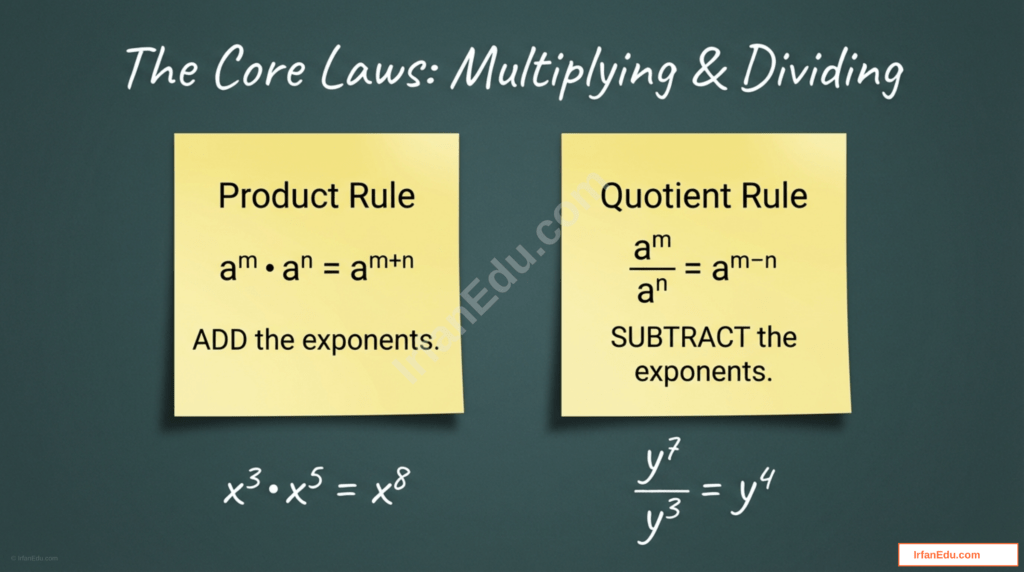
    Product Property of Radicals

    $$\sqrt{a \cdot b} = \sqrt{a} \cdot \sqrt{b}$$

    When to use: Breaking down radicands into smaller factors, especially when identifying perfect squares.

    Quotient Property of Radicals

    $$\sqrt{\frac{a}{b}} = \frac{\sqrt{a}}{\sqrt{b}}$$

    When to use: Simplifying fractions under radical signs or rationalizing denominators.

    Perfect Squares to Memorize

    $$1^2 = 1$$ $$2^2 = 4$$ $$3^2 = 9$$ $$4^2 = 16$$ $$5^2 = 25$$
    $$6^2 = 36$$ $$7^2 = 49$$ $$8^2 = 64$$ $$9^2 = 81$$ $$10^2 = 100$$
    $$11^2 = 121$$ $$12^2 = 144$$ $$13^2 = 169$$ $$14^2 = 196$$ $$15^2 = 225$$

    Memory trick: Knowing perfect squares up to 15² will handle 95% of ACT radical questions!

    Simplified Radical Form Requirements

    • No perfect square factors remain under the radical
    • No fractions appear under the radical
    • No radicals appear in denominators (rationalized)

    ✅ Step-by-Step Examples with Visual Solutions

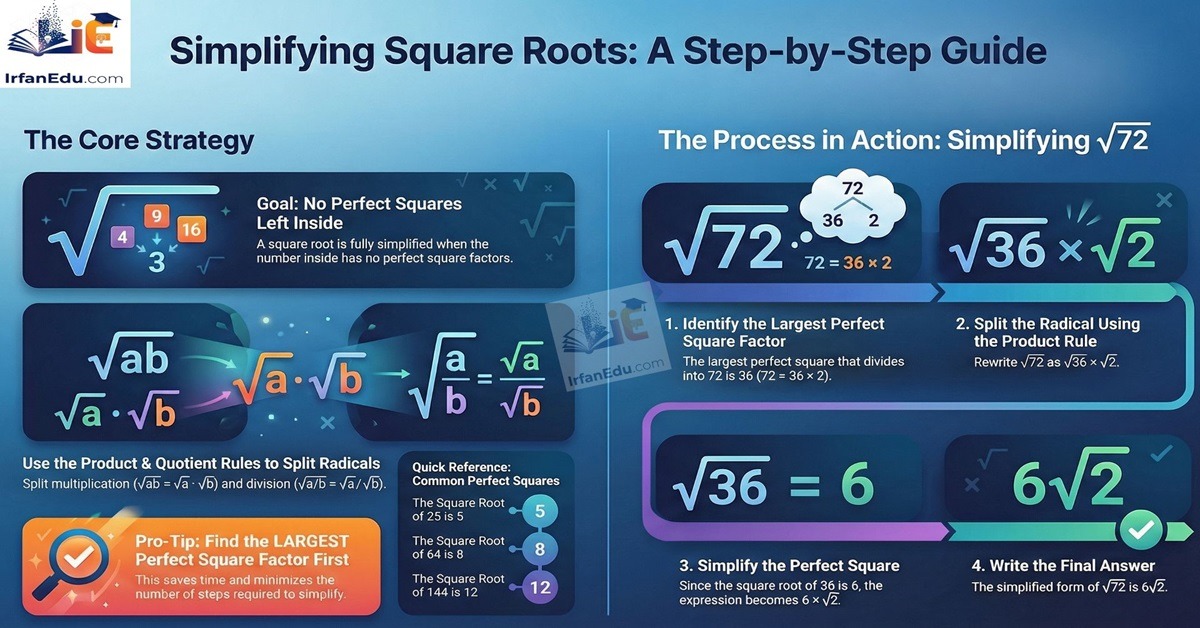
    Example 1: Simplify $$\sqrt{72}$$

    Step 1: Find the prime factorization

    Break 72 into prime factors: $$72 = 2 \times 36 = 2 \times 6 \times 6 = 2 \times 2 \times 3 \times 2 \times 3 = 2^3 \times 3^2$$

    Step 2: Identify perfect square factors

    $$72 = 36 \times 2$$ (36 is a perfect square: $$6^2$$)

    Step 3: Apply the product property

    $$\sqrt{72} = \sqrt{36 \times 2} = \sqrt{36} \times \sqrt{2}$$

    Step 4: Simplify the perfect square

    $$\sqrt{36} \times \sqrt{2} = 6\sqrt{2}$$

    ✓ Final Answer: $$6\sqrt{2}$$

    ⏱️ ACT Time Estimate: 30-45 seconds

    Example 2: Simplify $$\sqrt{98} + \sqrt{32}$$

    Step 1: Simplify each radical separately

    For $$\sqrt{98}$$: $$98 = 49 \times 2$$, so $$\sqrt{98} = \sqrt{49 \times 2} = 7\sqrt{2}$$

    For $$\sqrt{32}$$: $$32 = 16 \times 2$$, so $$\sqrt{32} = \sqrt{16 \times 2} = 4\sqrt{2}$$

    Step 2: Combine like radicals

    $$7\sqrt{2} + 4\sqrt{2} = (7 + 4)\sqrt{2} = 11\sqrt{2}$$

    ✓ Final Answer: $$11\sqrt{2}$$

    ⏱️ ACT Time Estimate: 45-60 seconds

    ⚠️ Common Mistake: Students often try to add $$\sqrt{98} + \sqrt{32} = \sqrt{130}$$. This is WRONG! You can only combine radicals with the same radicand after simplification.

    Example 3: Simplify $$\frac{6}{\sqrt{3}}$$ (Rationalizing the Denominator)

    Step 1: Identify the problem

    We have a radical in the denominator, which needs to be rationalized.

    Step 2: Multiply by $$\frac{\sqrt{3}}{\sqrt{3}}$$

    $$\frac{6}{\sqrt{3}} \times \frac{\sqrt{3}}{\sqrt{3}} = \frac{6\sqrt{3}}{3}$$

    Step 3: Simplify the fraction

    $$\frac{6\sqrt{3}}{3} = 2\sqrt{3}$$

    ✓ Final Answer: $$2\sqrt{3}$$

    ⏱️ ACT Time Estimate: 30-40 seconds

    📝

    Ready to Test Your Radical Skills?

    Take our full-length ACT Math practice test and see how well you’ve mastered radical simplification. Get instant scoring, detailed explanations, and personalized recommendations!

    🚀 Start ACT Practice Test Now →
    Full-Length Tests
    Instant Scoring
    Detailed Solutions

    📝 Practice Questions

    Test your understanding with these ACT-style practice problems. Click “Show Solution” to see detailed explanations.

    Practice Question 1 MEDIUM

    Simplify: $$\sqrt{200}$$

    A) $$10\sqrt{2}$$
    B) $$20\sqrt{10}$$
    C) $$2\sqrt{100}$$
    D) $$100\sqrt{2}$$
    E) $$5\sqrt{8}$$
    Show Solution

    Step 1: Factor 200 to find perfect squares: $$200 = 100 \times 2$$

    Step 2: Apply product property: $$\sqrt{200} = \sqrt{100 \times 2} = \sqrt{100} \times \sqrt{2}$$

    Step 3: Simplify: $$\sqrt{100} \times \sqrt{2} = 10\sqrt{2}$$

    ✓ Correct Answer: A) $$10\sqrt{2}$$

    Practice Question 2 HARD

    Simplify: $$3\sqrt{48} – 2\sqrt{75}$$

    A) $$\sqrt{27}$$
    B) $$2\sqrt{3}$$
    C) $$12\sqrt{3} – 10\sqrt{3}$$
    D) $$2\sqrt{3}$$
    E) $$-2\sqrt{3}$$
    Show Solution

    Step 1: Simplify $$\sqrt{48}$$: $$48 = 16 \times 3$$, so $$\sqrt{48} = 4\sqrt{3}$$

    Step 2: Simplify $$\sqrt{75}$$: $$75 = 25 \times 3$$, so $$\sqrt{75} = 5\sqrt{3}$$

    Step 3: Substitute: $$3(4\sqrt{3}) – 2(5\sqrt{3}) = 12\sqrt{3} – 10\sqrt{3}$$

    Step 4: Combine like terms: $$12\sqrt{3} – 10\sqrt{3} = 2\sqrt{3}$$

    ✓ Correct Answer: D) $$2\sqrt{3}$$

    Practice Question 3 EASY

    Which of the following is equivalent to $$\sqrt{45}$$?

    A) $$9\sqrt{5}$$
    B) $$5\sqrt{9}$$
    C) $$3\sqrt{5}$$
    D) $$15\sqrt{3}$$
    E) $$\sqrt{15}$$
    Show Solution

    Step 1: Factor 45: $$45 = 9 \times 5$$

    Step 2: Apply product property: $$\sqrt{45} = \sqrt{9 \times 5} = \sqrt{9} \times \sqrt{5}$$

    Step 3: Simplify: $$\sqrt{9} \times \sqrt{5} = 3\sqrt{5}$$

    ✓ Correct Answer: C) $$3\sqrt{5}$$

    🎥 Video Explanation: Simplifying Radical Expressions

    Watch this comprehensive video explanation to master radical simplification with visual demonstrations and step-by-step guidance.

    💡 ACT Pro Tips & Tricks

    🎯 Memorize Perfect Squares Through 15

    Knowing $$1^2$$ through $$15^2$$ instantly will save you 15-20 seconds per radical question. That’s huge on a timed test! Practice until these become automatic.

    ⚡ Look for the Largest Perfect Square First

    Instead of breaking down to prime factors every time, scan for the largest perfect square factor. For $$\sqrt{72}$$, recognize 36 immediately rather than working through $$2 \times 2 \times 2 \times 3 \times 3$$.

    🚫 Common Trap: Don’t Add Radicals Incorrectly

    $$\sqrt{a} + \sqrt{b} \neq \sqrt{a+b}$$. The ACT loves to include wrong answers like $$\sqrt{50}$$ when the correct answer is $$\sqrt{32} + \sqrt{18} = 4\sqrt{2} + 3\sqrt{2} = 7\sqrt{2}$$.

    🧮 Calculator Verification Trick

    Calculate the decimal value of both your answer and the original expression. For example, $$\sqrt{72} \approx 8.485$$ and $$6\sqrt{2} \approx 8.485$$. They should match!

    ⏰ Time Management Strategy

    Spend no more than 60 seconds on radical simplification questions. If you’re stuck after 45 seconds, use your calculator to check answer choices and move on.

    📐 Rationalize Denominators Automatically

    If you see a radical in the denominator, the ACT expects you to rationalize it. Answer choices will reflect this, so always complete this step.

    🎯 ACT Test-Taking Strategy for Radical Expressions

    Time Allocation

    Allocate 45-60 seconds for straightforward simplification problems and up to 90 seconds for complex problems involving multiple radicals or algebraic expressions. These questions typically appear in the first 30 questions of the ACT Math section.

    When to Skip and Return

    If you don’t immediately recognize a perfect square factor within 15 seconds, mark the question and return to it. Don’t waste time on prime factorization if the pattern isn’t obvious—use your calculator to test answer choices instead.

    Strategic Guessing

    If you must guess, eliminate answers that aren’t in simplified form (still have perfect squares under the radical) or have radicals in denominators. The correct answer will always be fully simplified.

    Quick Verification Method

    Use your calculator to compute decimal approximations. Calculate $$\sqrt{72}$$ directly (8.485…), then verify your answer $$6\sqrt{2}$$ by computing $$6 \times \sqrt{2}$$ (8.485…). They should match exactly.

    Common Trap Answers

    • Answers that incorrectly add radicands: $$\sqrt{a} + \sqrt{b} = \sqrt{a+b}$$ (WRONG!)
    • Answers with radicals still in denominators (not rationalized)
    • Answers with remaining perfect square factors under the radical
    • Answers that confuse coefficients with radicands

    ❓ Frequently Asked Questions

    What’s the difference between simplifying and solving a radical?
    Simplifying a radical means rewriting it in its most reduced form (e.g., $$\sqrt{72} = 6\sqrt{2}$$). Solving a radical equation means finding the value of a variable (e.g., solving $$\sqrt{x} = 6$$ gives $$x = 36$$). On the ACT, you’ll encounter both types of questions, but simplification is more common in Elementary Algebra.
    Can I leave my answer as $$\sqrt{72}$$ instead of $$6\sqrt{2}$$?
    No! On the ACT, answer choices will always be in simplified form. If you leave $$\sqrt{72}$$ unsimplified, you won’t find it among the options. The test expects you to recognize that $$\sqrt{72} = 6\sqrt{2}$$, and that’s what will appear in the correct answer choice.
    Do I need to rationalize denominators on the ACT?
    Yes! The ACT considers radicals in denominators to be “unsimplified.” If you have $$\frac{6}{\sqrt{3}}$$, you must rationalize it to $$2\sqrt{3}$$. Answer choices will reflect this expectation, so always complete the rationalization step.
    How do I know which perfect square to look for?
    Start by checking if the number is divisible by common perfect squares in descending order: 144, 100, 81, 64, 49, 36, 25, 16, 9, 4. For $$\sqrt{180}$$, check: Is it divisible by 144? No. By 100? No. By 81? No. By 64? No. By 49? No. By 36? Yes! $$180 = 36 \times 5$$, so $$\sqrt{180} = 6\sqrt{5}$$.
    Can I use my calculator for radical questions?
    Yes, strategically! Your calculator can verify answers by computing decimal approximations. However, you still need to know how to simplify radicals algebraically because answer choices are in simplified radical form, not decimals. Use your calculator to check your work, not replace your algebraic skills.
    Dr. Irfan Mansuri

    ✍️ Written by Dr. Irfan Mansuri

    Educational Content Creator & Competitive Exam Specialist

    IrfanEdu.com • United States

    Dr. Irfan Mansuri is a distinguished educational content creator with over 15 years of experience spanning high school, undergraduate, and postgraduate levels. As the founder of IrfanEdu.com, he has successfully guided thousands of students through competitive examinations, helping them achieve exceptional results and gain admission to their dream institutions.

    15+ years in competitive exam preparation Certified Instructor LinkedIn Profile

    📚 Related ACT Math Resources

    Continue building your ACT Math skills with these related topics from our comprehensive ACT preparation collection:

    • Exponent Rules: Master the laws of exponents for ACT success
    • Solving Quadratic Equations: Learn multiple methods for solving quadratics
    • Factoring Polynomials: Essential algebra skills for the ACT
    • Rational Expressions: Simplifying and operating with fractions
    • Linear Equations: Solving and graphing linear relationships

    🎓 Ready to Ace the ACT Math Section?

    You’ve learned the fundamentals of simplifying radical expressions. Now it’s time to put your skills to the test with our comprehensive ACT practice platform!

    🚀 Start Your Free ACT Practice Test

    Join thousands of students who have improved their ACT scores with IrfanEdu.com

    Mastering Radical Simplification: A Complete Guide to Square Roots

    Understanding how to work with radicals represents a fundamental skill in algebra. You’ve likely encountered square roots before—expressions like $$\sqrt{25} = 5$$ or $$\sqrt{2} \approx 1.414$$. Now, we’ll explore powerful techniques that help you simplify radical expressions efficiently. Throughout this guide, we focus exclusively on square roots, while higher-order roots (cube roots, fourth roots, etc.) appear in advanced algebra courses.

    Essential Properties of Square Roots

    Two fundamental properties govern how we manipulate radicals. These rules become your toolkit for simplification:

    Property 1 (Product Rule): When you multiply two positive numbers under a square root, you can split them into separate radicals:

    $$\sqrt{ab} = \sqrt{a} \times \sqrt{b}$$

    Property 2 (Quotient Rule): When you divide two positive numbers under a square root, you can separate them into individual radicals:

    $$\sqrt{\frac{a}{b}} = \frac{\sqrt{a}}{\sqrt{b}}$$

    Understanding These Properties Through Examples

    Let’s see how these properties work in practice. Consider the square root of 144. We can break this down using the product rule:

    $$\sqrt{144} = \sqrt{36 \times 4} = \sqrt{36} \times \sqrt{4} = 6 \times 2 = 12$$

    Similarly, the quotient rule helps us simplify fractions under radicals:

    $$\sqrt{\frac{9}{25}} = \frac{\sqrt{9}}{\sqrt{25}} = \frac{3}{5}$$

    The Key to Simplification: Finding Perfect Square Factors

    When you simplify a radical expression, your goal involves identifying the largest perfect square factor within the radicand (the number under the radical symbol). Let’s explore this concept with $$\sqrt{450}$$:

    You might initially factor 450 as $$25 \times 18$$:

    $$\sqrt{450} = \sqrt{25 \times 18} = \sqrt{25} \times \sqrt{18} = 5\sqrt{18}$$

    However, this doesn’t represent the simplest form! Notice that 18 still contains a perfect square factor (9). We need to simplify further:

    $$\sqrt{18} = \sqrt{9 \times 2} = \sqrt{9} \times \sqrt{2} = 3\sqrt{2}$$

    Therefore, the complete simplification becomes:

    $$\sqrt{450} = 5 \times 3\sqrt{2} = 15\sqrt{2}$$

    Pro Tip: You can save time by identifying the largest perfect square factor from the start. For 450, that’s 225, giving us: $$\sqrt{450} = \sqrt{225 \times 2} = 15\sqrt{2}$$

    What Makes a Radical “Simplified”?

    A radical expression reaches its simplest form when the radicand contains no perfect square factors. This means you’ve extracted all possible square roots from under the radical symbol.

    Step-by-Step Examples: Simplifying Radicals

    Let’s work through several examples to build your confidence with radical simplification:

    Example 1: Simplify $$\sqrt{24}$$

    Strategy: We need to factor 24 so that one factor represents a perfect square.

    Since $$24 = 4 \times 6$$, and 4 is a perfect square, we can write:

    $$\sqrt{24} = \sqrt{4 \times 6} = \sqrt{4} \times \sqrt{6} = 2\sqrt{6}$$

    Answer: $$2\sqrt{6}$$

    Example 2: Simplify $$\sqrt{72}$$

    Strategy: Look for the largest perfect square factor to minimize your work.

    The largest perfect square factor of 72 is 36:

    $$\sqrt{72} = \sqrt{36 \times 2} = \sqrt{36} \times \sqrt{2} = 6\sqrt{2}$$

    Alternatively, if you didn’t spot 36 immediately, you could factor using smaller squares:

    $$\sqrt{72} = \sqrt{9 \times 8} = \sqrt{9} \times \sqrt{8} = 3\sqrt{8}$$

    But we’re not finished! Since $$8 = 4 \times 2$$:

    $$3\sqrt{8} = 3\sqrt{4 \times 2} = 3 \times \sqrt{4} \times \sqrt{2} = 3 \times 2 \times \sqrt{2} = 6\sqrt{2}$$

    Answer: $$6\sqrt{2}$$

    Example 3: Simplify $$-\sqrt{288}$$

    Strategy: The negative sign stays outside the radical throughout the simplification process.

    We identify 144 as the largest perfect square factor of 288:

    $$-\sqrt{288} = -\sqrt{144 \times 2} = -\sqrt{144} \times \sqrt{2} = -12\sqrt{2}$$

    Answer: $$-12\sqrt{2}$$

    Example 4: Simplify $$\sqrt{\frac{75}{4}}$$

    Strategy: Apply the quotient rule first, then simplify the numerator.

    $$\sqrt{\frac{75}{4}} = \frac{\sqrt{75}}{\sqrt{4}} = \frac{\sqrt{25 \times 3}}{2} = \frac{\sqrt{25} \times \sqrt{3}}{2} = \frac{5\sqrt{3}}{2}$$

    Answer: $$\frac{5\sqrt{3}}{2}$$

    Example 5: Simplify $$\frac{3 + \sqrt{18}}{3}$$

    Strategy: Simplify the radical first, then reduce the entire fraction.

    First, we simplify $$\sqrt{18}$$:

    $$\sqrt{18} = \sqrt{9 \times 2} = \sqrt{9} \times \sqrt{2} = 3\sqrt{2}$$

    Now we substitute this back into our original expression:

    $$\frac{3 + \sqrt{18}}{3} = \frac{3 + 3\sqrt{2}}{3}$$

    We can factor out 3 from the numerator and simplify:

    $$\frac{3 + 3\sqrt{2}}{3} = \frac{3(1 + \sqrt{2})}{3} = 1 + \sqrt{2}$$

    Or, you can split the fraction into separate terms:

    $$\frac{3 + 3\sqrt{2}}{3} = \frac{3}{3} + \frac{3\sqrt{2}}{3} = 1 + \sqrt{2}$$

    Answer: $$1 + \sqrt{2}$$

    Understanding the Relationship Between Powers and Roots

    Radicals and exponents work as inverse operations—they undo each other. When you square a number and then take its square root, you return to your original value. Consider these relationships:

    • Since $$2^2 = 4$$, we know that $$\sqrt{4} = 2$$
    • Since $$3^2 = 9$$, we know that $$\sqrt{9} = 3$$
    • Since $$12^2 = 144$$, we know that $$\sqrt{144} = 12$$

    Important Note About Principal Square Roots

    When you see the square root symbol, it always refers to the principal (positive) square root. Although both 2 and -2 square to give 4, the expression $$\sqrt{4}$$ specifically means the positive value, 2.

    Key Distinction: Evaluating an expression like $$\sqrt{4}$$ gives one answer (2), while solving an equation like $$x^2 = 4$$ gives two solutions ($$x = 2$$ or $$x = -2$$).

    Working With Non-Perfect Squares

    Not every number under a radical can simplify to a whole number. For example, $$\sqrt{3}$$ has no perfect square factors, so it remains in radical form. When you need a decimal approximation for practical applications, you can use a calculator:

    $$\sqrt{3} \approx 1.732$$

    However, for mathematical exercises requiring exact answers, you should leave your answer as $$\sqrt{3}$$.

    Quick Reference: Common Perfect Squares

    Memorizing these perfect squares will significantly speed up your radical simplification:

    • $$1^2 = 1$$
    • $$2^2 = 4$$
    • $$3^2 = 9$$
    • $$4^2 = 16$$
    • $$5^2 = 25$$
    • $$6^2 = 36$$
    • $$7^2 = 49$$
    • $$8^2 = 64$$
    • $$9^2 = 81$$
    • $$10^2 = 100$$
    • $$11^2 = 121$$
    • $$12^2 = 144$$
    • $$13^2 = 169$$
    • $$14^2 = 196$$
    • $$15^2 = 225$$

    Practice Tips for Mastering Radical Simplification

    1. Memorize perfect squares up to at least 15² to recognize them quickly in problems
    2. Look for the largest perfect square factor first to minimize your steps
    3. Check your final answer by ensuring no perfect square factors remain under the radical
    4. Practice prime factorization to help identify all factors of a number
    5. Remember the properties: $$\sqrt{ab} = \sqrt{a} \times \sqrt{b}$$ and $$\sqrt{\frac{a}{b}} = \frac{\sqrt{a}}{\sqrt{b}}$$

    Summary: Key Takeaways

    • A radical reaches its simplest form when the radicand contains no perfect square factors
    • You can split radicals using the product and quotient rules
    • Finding the largest perfect square factor saves time and effort
    • The square root symbol always refers to the principal (positive) root
    • Radicals and exponents function as inverse operations

    Mastering radical simplification builds a strong foundation for advanced algebra topics. With practice, you’ll quickly recognize perfect square factors and simplify expressions efficiently. Keep these properties and techniques in mind as you progress through more complex mathematical concepts.

    [pdf_viewer id=”214″]
  • Mastering Percentages: ACT Math Pre-Algebra Guide

    Mastering Percentages: ACT Math Pre-Algebra Guide

    Mastering Percentages: ACT Math Pre-Algebra Guide

    Percentages are one of the most frequently tested concepts in the ACT Math section, appearing in approximately 8-12 questions across various problem types. Whether you’re calculating discounts during a shopping trip, analyzing data in science class, or solving complex word problems on test day, understanding percentages is absolutely essential for ACT success. This comprehensive guide will walk you through everything you need to know about finding percentages, calculating percentage increase and decrease, and applying these skills to real-world scenarios—all with proven strategies designed specifically for the ACT. For more ACT prep resources, explore our comprehensive study materials.

    🎯

    ACT SCORE BOOSTER: Master Percentages for 2-4 Extra Points!

    Percentage problems appear in nearly every ACT Math test (8-12 questions). Understanding these concepts thoroughly can add 2-4 points to your Math subscore and boost your composite score. Let’s break it down with proven strategies that work!

    🚀 Jump to ACT Strategy →

    ⚡ Quick Answer: Percentage Essentials

    Three Core Percentage Skills for ACT:

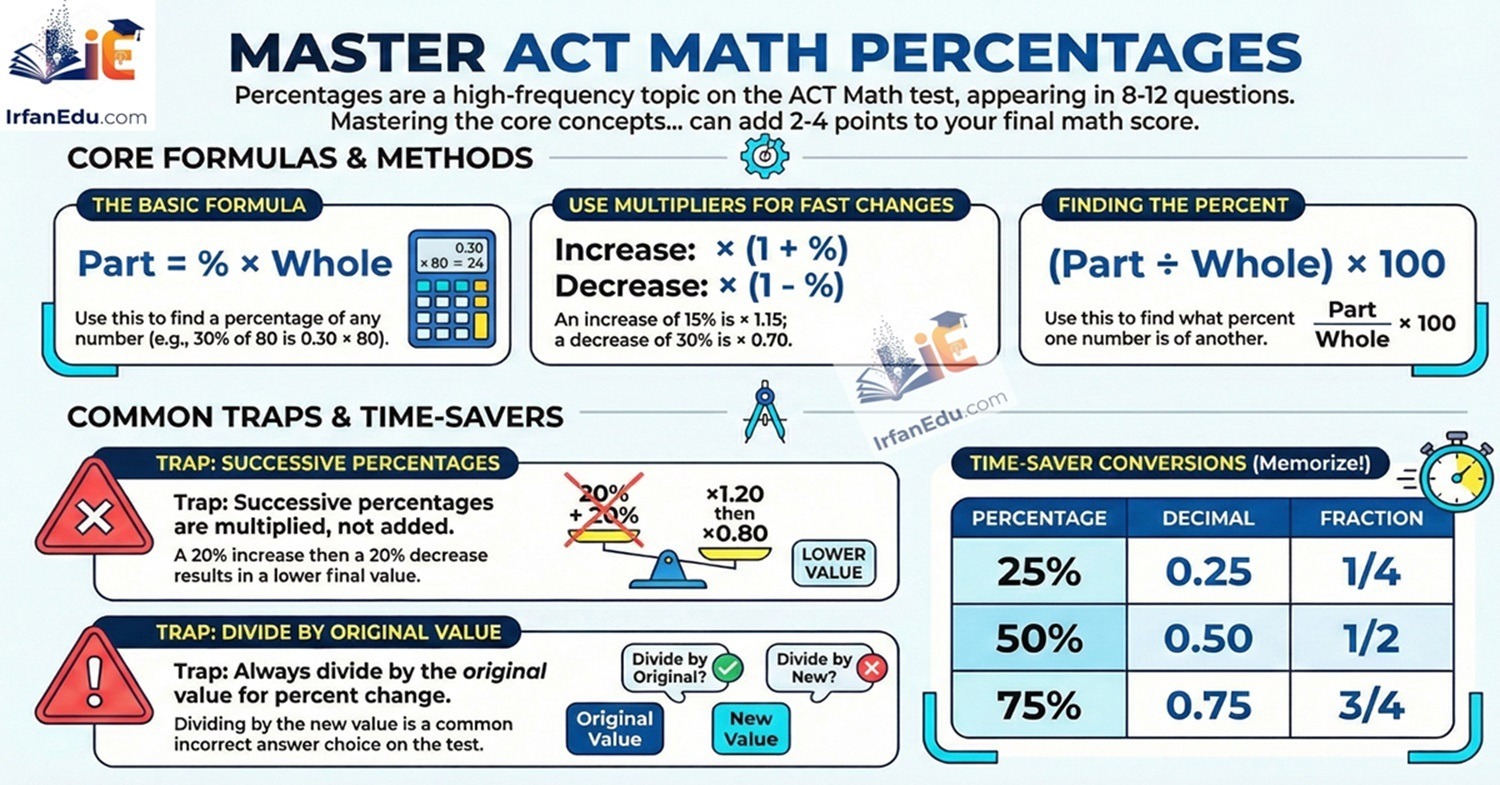
    • Finding Percentages: Use the formula $$\text{Part} = \text{Percent} \times \text{Whole}$$
    • Percentage Increase: $$\text{New Value} = \text{Original} \times (1 + \frac{\text{Percent}}{100})$$
    • Percentage Decrease: $$\text{New Value} = \text{Original} \times (1 – \frac{\text{Percent}}{100})$$

    💡 Pro Tip: Convert percentages to decimals by dividing by 100 (e.g., 25% = 0.25)

    📚 Understanding Percentages: Why They Matter for ACT

    A percentage is simply a way of expressing a number as a fraction of 100. The word “percent” literally means “per hundred” (from Latin per centum). When you see 45%, it means 45 out of 100, or $$\frac{45}{100}$$, or 0.45 as a decimal. According to the official ACT website, percentage problems are among the most frequently tested Pre-Algebra concepts.

    On the ACT Math section, percentage problems appear in multiple contexts: word problems involving discounts and sales tax, data interpretation questions, ratio and proportion problems, and even geometry questions involving percentage of area or volume. The Pre-Algebra category specifically tests your ability to work with percentages in practical, real-world scenarios.

    Why percentages are crucial for your ACT score:

    • High frequency: 8-12 questions per test involve percentages
    • Cross-category appearance: Shows up in Pre-Algebra, Elementary Algebra, and even Coordinate Geometry
    • Foundation skill: Required for more advanced topics like exponential growth and compound interest
    • Time-efficient: Once mastered, percentage problems can be solved quickly, giving you more time for harder questions

    📐 Essential Percentage Formulas & Rules

    1️⃣ Basic Percentage Formula

    $$\text{Part} = \frac{\text{Percent}}{100} \times \text{Whole}$$

    Or equivalently: $$\text{Part} = \text{Decimal} \times \text{Whole}$$

    Example: What is 30% of 80? → $$0.30 \times 80 = 24$$

    2️⃣ Finding What Percent One Number Is of Another

    $$\text{Percent} = \frac{\text{Part}}{\text{Whole}} \times 100$$

    Example: 15 is what percent of 60? → $$\frac{15}{60} \times 100 = 25\%$$

    3️⃣ Percentage Increase Formula

    $$\text{Percent Increase} = \frac{\text{New Value} – \text{Original Value}}{\text{Original Value}} \times 100$$

    $$\text{New Value} = \text{Original} \times \left(1 + \frac{\text{Percent}}{100}\right)$$

    Example: A price increases from $50 to $65. What’s the percent increase?
    $$\frac{65-50}{50} \times 100 = \frac{15}{50} \times 100 = 30\%$$

    4️⃣ Percentage Decrease Formula

    $$\text{Percent Decrease} = \frac{\text{Original Value} – \text{New Value}}{\text{Original Value}} \times 100$$

    $$\text{New Value} = \text{Original} \times \left(1 – \frac{\text{Percent}}{100}\right)$$

    Example: A $80 item is discounted by 25%. New price = $$80 \times (1 – 0.25) = 80 \times 0.75 = 60$$

    5️⃣ Successive Percentage Changes

    ⚠️ Important: When applying multiple percentage changes, you CANNOT simply add or subtract the percentages. You must apply them sequentially!

    Example: A price increases by 20%, then decreases by 20%. It does NOT return to the original!
    Original: $100 → After +20%: $120 → After -20%: $$120 \times 0.80 = 96$$ (not $100!)

    ✅ Step-by-Step Examples: Mastering Percentage Problems

    📊 Example 1: Finding a Percentage of a Number

    Problem: A store has 240 items in stock. If 35% of them are on sale, how many items are on sale?

    🔍 Step-by-Step Solution:

    Step 1: Identify what’s given and what’s asked

    • Whole (total items) = 240
    • Percent = 35%
    • Find: Part (items on sale) = ?

    Step 2: Convert percentage to decimal

    35% = $$\frac{35}{100}$$ = 0.35

    Step 3: Apply the formula

    Part = Decimal × Whole
    Part = $$0.35 \times 240$$

    Step 4: Calculate

    $$0.35 \times 240 = 84$$

    ✓ Final Answer: 84 items are on sale

    ⏱️ ACT Time Estimate: 30-45 seconds with calculator

    📈 Example 2: Calculating Percentage Increase

    Problem: The population of a town increased from 12,000 to 15,600. What is the percent increase?

    🔍 Step-by-Step Solution:

    Step 1: Identify the values

    • Original Value = 12,000
    • New Value = 15,600
    • Find: Percent Increase = ?

    Step 2: Calculate the actual increase

    Increase = New Value – Original Value
    Increase = $$15,600 – 12,000 = 3,600$$

    Step 3: Apply the percentage increase formula

    $$\text{Percent Increase} = \frac{\text{Increase}}{\text{Original Value}} \times 100$$

    $$\text{Percent Increase} = \frac{3,600}{12,000} \times 100$$

    Step 4: Simplify and calculate

    $$\frac{3,600}{12,000} = \frac{36}{120} = \frac{3}{10} = 0.30$$

    $$0.30 \times 100 = 30\%$$

    ✓ Final Answer: 30% increase

    ⏱️ ACT Time Estimate: 45-60 seconds

    💰 Example 3: Real-World Application – Sale Price with Discount

    Problem: A jacket originally priced at $120 is on sale for 40% off. If there’s an additional 8% sales tax on the discounted price, what is the final price?

    🔍 Step-by-Step Solution:

    Step 1: Calculate the discount amount

    Discount = 40% of $120
    Discount = $$0.40 \times 120 = 48$$
    Discount amount = $48

    Step 2: Calculate the sale price (before tax)

    Sale Price = Original Price – Discount
    Sale Price = $$120 – 48 = 72$$
    Or use the shortcut: $$120 \times (1 – 0.40) = 120 \times 0.60 = 72$$

    Step 3: Calculate the sales tax

    Tax = 8% of $72
    Tax = $$0.08 \times 72 = 5.76$$
    Sales tax = $5.76

    Step 4: Calculate the final price

    Final Price = Sale Price + Tax
    Final Price = $$72 + 5.76 = 77.76$$
    Or use the shortcut: $$72 \times (1 + 0.08) = 72 \times 1.08 = 77.76$$

    ✓ Final Answer: $77.76

    💡 ACT Pro Shortcut:

    You can combine both steps: $$120 \times 0.60 \times 1.08 = 77.76$$
    This saves time by eliminating intermediate calculations!

    ⏱️ ACT Time Estimate: 60-90 seconds (45 seconds with shortcut)

    📝

    Ready to Test Your Percentage Skills?

    Take our full-length ACT practice test and see how well you’ve mastered percentages. Get instant scoring, detailed explanations, and personalized recommendations!

    🚀 Start ACT Practice Test Now →
    Full-Length Tests
    Instant Scoring
    Detailed Solutions

    ⚠️ Common Mistakes to Avoid

    ❌ Mistake #1: Forgetting to convert percentages to decimals

    Wrong: 25% of 80 = $$25 \times 80 = 2000$$ ✗

    Correct: 25% of 80 = $$0.25 \times 80 = 20$$ ✓

    ❌ Mistake #2: Using the wrong base for percentage change

    When calculating percent increase/decrease, ALWAYS divide by the original value, not the new value.

    Example: Price goes from $50 to $60
    Wrong: $$\frac{10}{60} \times 100 = 16.67\%$$ ✗
    Correct: $$\frac{10}{50} \times 100 = 20\%$$ ✓

    ❌ Mistake #3: Adding/subtracting successive percentage changes

    A 20% increase followed by a 20% decrease does NOT return to the original value!

    Example: Starting with $100
    After +20%: $$100 \times 1.20 = 120$$
    After -20%: $$120 \times 0.80 = 96$$ (not $100!)

    ❌ Mistake #4: Confusing “percent” with “percentage points”

    If a score increases from 60% to 80%, that’s a 20 percentage point increase, but a $$\frac{20}{60} \times 100 = 33.33\%$$ percent increase.

    ❌ Mistake #5: Rounding too early

    Keep at least 2-3 decimal places during calculations and round only at the final answer. Early rounding can lead to incorrect answers on the ACT.

    🌍 Real-World Applications of Percentages

    Understanding percentages isn’t just about acing the ACT—it’s a crucial life skill you’ll use constantly. Here’s where percentage mastery makes a real difference:

    💳 Personal Finance

    • Calculating credit card interest rates
    • Understanding loan APRs
    • Computing investment returns
    • Analyzing savings account growth
    • Comparing discount offers

    📊 Business & Economics

    • Profit margins and markup
    • Sales commission calculations
    • Market share analysis
    • Economic growth rates
    • Inflation and deflation

    🔬 Science & Health

    • Solution concentrations in chemistry
    • Statistical significance in research
    • Body fat percentage calculations
    • Nutritional daily values
    • Population growth studies

    🎓 Academic & Career Fields

    • Grade calculations and GPA
    • Data analysis in social sciences
    • Engineering tolerances
    • Medical dosage calculations
    • Statistical reporting in journalism

    💡 College Connection: Percentage skills are foundational for college courses in business, economics, statistics, sciences, and even social sciences. Strong percentage fluency will give you a significant advantage in your first-year college math and quantitative reasoning courses.

    📝 ACT-Style Practice Questions

    Test your understanding with these ACT-style percentage problems. Try solving them on your own before checking the solutions!

    Practice Question 1 BASIC

    A student answered 42 questions correctly on a 60-question test. What percent of the questions did the student answer correctly?

    A) 60%
    B) 65%
    C) 70%
    D) 75%
    E) 80%
    👉 Show Detailed Solution

    ✓ Correct Answer: C) 70%

    Solution:
    Use the formula: $$\text{Percent} = \frac{\text{Part}}{\text{Whole}} \times 100$$

    $$\text{Percent} = \frac{42}{60} \times 100$$

    Simplify: $$\frac{42}{60} = \frac{7}{10} = 0.70$$

    $$0.70 \times 100 = 70\%$$

    ⏱️ Time-Saving Tip: Recognize that $$\frac{42}{60}$$ simplifies to $$\frac{7}{10}$$, which you should instantly recognize as 70%.

    Practice Question 2 INTERMEDIATE

    A laptop originally priced at $800 is marked down by 15%. What is the sale price of the laptop?

    A) $640
    B) $680
    C) $700
    D) $720
    E) $785
    👉 Show Detailed Solution

    ✓ Correct Answer: B) $680

    Method 1 (Traditional):
    Discount amount = 15% of $800 = $$0.15 \times 800 = 120$$
    Sale price = $$800 – 120 = 680$$

    Method 2 (Faster – ACT Recommended):
    If there’s a 15% decrease, you’re paying 85% of the original price.
    Sale price = $$800 \times (1 – 0.15) = 800 \times 0.85 = 680$$

    💡 ACT Pro Tip: Method 2 is faster because it combines both steps into one calculation. Always look for ways to minimize steps on the ACT!

    Practice Question 3 INTERMEDIATE

    The price of gasoline increased from $3.20 per gallon to $4.00 per gallon. What is the percent increase?

    A) 20%
    B) 25%
    C) 30%
    D) 35%
    E) 40%
    👉 Show Detailed Solution

    ✓ Correct Answer: B) 25%

    Solution:
    Step 1: Find the increase
    Increase = $$4.00 – 3.20 = 0.80$$

    Step 2: Apply the percentage increase formula
    $$\text{Percent Increase} = \frac{\text{Increase}}{\text{Original}} \times 100$$

    $$\text{Percent Increase} = \frac{0.80}{3.20} \times 100$$

    Step 3: Simplify
    $$\frac{0.80}{3.20} = \frac{80}{320} = \frac{1}{4} = 0.25$$

    $$0.25 \times 100 = 25\%$$

    ⚠️ Common Trap: Don’t divide by the new value ($4.00)! Always use the original value ($3.20) as the denominator for percent change calculations.

    Practice Question 4 ADVANCED

    A store increases the price of an item by 20%, then offers a 20% discount on the new price. If the original price was $50, what is the final price after both changes?

    A) $45
    B) $48
    C) $50
    D) $52
    E) $55
    👉 Show Detailed Solution

    ✓ Correct Answer: B) $48

    Solution:
    Step 1: Apply the 20% increase
    New price = $$50 \times (1 + 0.20) = 50 \times 1.20 = 60$$

    Step 2: Apply the 20% discount to the NEW price
    Final price = $$60 \times (1 – 0.20) = 60 \times 0.80 = 48$$

    One-step method:
    Final price = $$50 \times 1.20 \times 0.80 = 50 \times 0.96 = 48$$

    ⚠️ Critical Concept: A 20% increase followed by a 20% decrease does NOT return to the original! The final price is $48, not $50. This is because the 20% discount is calculated on the HIGHER price ($60), not the original price ($50).

    💡 ACT Strategy: Recognize that $$1.20 \times 0.80 = 0.96$$, meaning the final price is 96% of the original, or 4% less than the starting price.

    Practice Question 5 ADVANCED

    In a class of 150 students, 60% are girls. If 25% of the girls and 20% of the boys wear glasses, how many students in total wear glasses?

    A) 33
    B) 34
    C) 35
    D) 36
    E) 37
    👉 Show Detailed Solution

    ✓ Correct Answer: C) 35

    Solution:

    Step 1: Find the number of girls
    Girls = 60% of 150 = $$0.60 \times 150 = 90$$ girls

    Step 2: Find the number of boys
    Boys = $$150 – 90 = 60$$ boys

    Step 3: Find girls who wear glasses
    Girls with glasses = 25% of 90 = $$0.25 \times 90 = 22.5$$

    Step 4: Find boys who wear glasses
    Boys with glasses = 20% of 60 = $$0.20 \times 60 = 12$$

    Step 5: Find total students with glasses
    Total = $$22.5 + 12 = 34.5$$

    Since we can’t have half a student, we round to 35 (or the problem expects whole numbers throughout).

    💡 ACT Reality Check: Multi-step percentage problems like this test your ability to break down complex scenarios systematically. The answer 35 is the closest to our calculation of 34.5.

    💡 ACT Pro Tips & Tricks for Percentages

    ⚡ Tip #1: Master Common Percentage-Decimal-Fraction Conversions

    Memorize these for instant recognition and faster calculations:

    Percentage Decimal Fraction
    10% 0.10 1/10
    20% 0.20 1/5
    25% 0.25 1/4
    33.33% 0.333… 1/3
    50% 0.50 1/2
    66.67% 0.667… 2/3
    75% 0.75 3/4

    🎯 Tip #2: Use the Multiplier Method for Speed

    Instead of calculating the change and then adding/subtracting, use multipliers:

    • Increase by 15%: Multiply by 1.15 (not 0.15)
    • Decrease by 30%: Multiply by 0.70 (not 0.30)
    • Increase by x%: Multiply by $$(1 + \frac{x}{100})$$
    • Decrease by x%: Multiply by $$(1 – \frac{x}{100})$$

    🧮 Tip #3: Calculator Efficiency Tips

    For finding percentages: Instead of multiplying by 0.35, you can multiply by 35 and then divide by 100, or use your calculator’s % button if available.

    For successive changes: Chain your calculations: 100 × 1.2 × 0.8 = (enter all at once)

    Quick check: Use estimation. 23% of 80 should be close to 25% of 80 = 20.

    🎪 Tip #4: The “Is/Of” Method for Word Problems

    Translate percentage word problems using this pattern:

    $$\frac{\text{IS}}{\text{OF}} = \frac{\text{PERCENT}}{100}$$

    Example: “What is 40% of 250?”
    IS = ? (what we’re finding)
    OF = 250
    PERCENT = 40
    So: $$\frac{x}{250} = \frac{40}{100}$$ → $$x = 100$$

    ⏰ Tip #5: Time Management Strategy

    Basic percentage problems: Should take 30-45 seconds
    Multi-step problems: Allow 60-90 seconds
    Complex word problems: Up to 2 minutes

    If you’re stuck after 30 seconds, mark it and move on. You can return with fresh eyes later.

    🎓 Tip #6: Eliminate Wrong Answers Using Logic

    For increases: Answer must be larger than original
    For decreases: Answer must be smaller than original
    For percentages over 100%: The part is larger than the whole
    Reasonableness check: If you’re finding 20% of 80, the answer should be between 8 (10%) and 40 (50%)

    🎯 ACT Test-Taking Strategy for Percentage Problems

    📊 Time Allocation Strategy

    With 60 questions in 60 minutes on ACT Math, you have an average of 1 minute per question. Here’s how to allocate time for percentage problems:

    • Simple percentage calculations (finding x% of y): 30-45 seconds
    • Percentage increase/decrease: 45-60 seconds
    • Multi-step word problems: 60-90 seconds
    • Complex scenarios (successive changes, multiple percentages): 90-120 seconds

    💡 Pro Strategy: Percentage problems are typically in the first 40 questions (easier to moderate difficulty). Solve them quickly and accurately to bank time for harder questions later.

    🎪 When to Skip and Return

    Skip a percentage problem if:

    • You’ve spent 45+ seconds and still don’t see a clear path to the solution
    • It involves concepts you’re completely unfamiliar with
    • It’s a multi-step problem appearing in questions 50-60 (harder section)
    • You’re getting confused by the wording and need a mental reset

    Return strategy: Mark skipped questions clearly. When you return, read the problem fresh—you’ll often see the solution immediately with a clear mind.

    🎲 Strategic Guessing for Percentages

    If you must guess on a percentage problem:

    1. Eliminate illogical answers: If calculating an increase, eliminate answers smaller than the original
    2. Use estimation: Round numbers to estimate the ballpark answer
    3. Middle values: ACT often places correct answers in the middle choices (B, C, D)
    4. Avoid extremes: Very large or very small percentages are less common as correct answers

    Example: If you’re finding 35% of 200, you know it’s more than 25% (50) and less than 50% (100), so eliminate answers outside 50-100.

    ✅ Quick Check Methods

    Always verify your answer when time permits:

    • Reasonableness check: Does the answer make sense in context?
    • Reverse calculation: If you found 30% of 80 = 24, check: Is 24/80 = 0.30? ✓
    • Benchmark comparison: Compare to easy percentages (10%, 50%, 100%)
    • Unit check: Are you answering what the question asked? (percent vs. actual value)

    🚨 Common Trap Answers to Watch For

    ACT test makers intentionally include these trap answers:

    • The “forgot to convert” trap: Using 25 instead of 0.25
    • The “wrong base” trap: Dividing by new value instead of original in percent change
    • The “added percentages” trap: Adding successive percentage changes directly
    • The “partial calculation” trap: Stopping after finding discount but before final price
    • The “percentage vs. percentage points” trap: Confusing the two concepts

    🎥 Video Explanation: Mastering Percentages

    Watch this detailed video explanation to understand percentages better with visual demonstrations and step-by-step guidance.

    📈 Score Improvement Action Plan

    🎯 Your 2-Week Percentage Mastery Plan

    Week Focus Area Practice Goal
    Week 1 Basic percentage calculations, conversions, finding percentages 20 problems/day, aim for 90%+ accuracy
    Week 2 Percentage increase/decrease, successive changes, word problems 15 complex problems/day, focus on speed

    📚 Practice Resources

    • Official ACT Practice Tests: Focus on questions 1-40 in Math section
    • Khan Academy: “Percentages” section under Pre-Algebra
    • ACT Math prep books: Complete all percentage problem sets
    • Create flashcards: Common percentage-decimal-fraction conversions
    • Timed drills: Set 10-minute timers for 10 percentage problems

    🎊 Expected Score Gains

    By mastering percentages, here’s what you can realistically expect:

    • Currently scoring 18-22 (Math): Gain 2-3 points
    • Currently scoring 23-27 (Math): Gain 1-2 points
    • Currently scoring 28-32 (Math): Gain 1-2 points (by avoiding careless errors)
    • Currently scoring 33+ (Math): Maintain perfect accuracy on percentage problems

    ✨ Beyond Percentages: Building Momentum

    Once you’ve mastered percentages, you’ll find that many other ACT Math topics become easier:

    • Ratios and proportions (closely related to percentages)
    • Probability (often expressed as percentages)
    • Statistics (percentiles, percentage distributions)
    • Word problems (many involve percentage scenarios)
    • Data interpretation (graphs often show percentages)

    ❓ Frequently Asked Questions (FAQs)

    1. How do I quickly convert percentages to decimals on the ACT? +

    To convert a percentage to a decimal, simply divide by 100 (or move the decimal point two places to the left). For example: 45% = 45 ÷ 100 = 0.45, and 8% = 8 ÷ 100 = 0.08. For quick mental math, remember that 25% = 0.25, 50% = 0.50, 75% = 0.75, and 10% = 0.10. These common conversions should be automatic—practice them until they’re second nature. On the ACT, this conversion is usually the first step in solving percentage problems, so speed here saves valuable time.

    2. What’s the difference between “percent increase” and “percentage points”? +

    This is a crucial distinction! Percentage points refer to the arithmetic difference between two percentages, while percent increase is the relative change. For example: if a test score increases from 60% to 80%, that’s a 20 percentage point increase (80 – 60 = 20), but it’s a 33.33% percent increase because (20/60) × 100 = 33.33%. The ACT may test this distinction, so always read carefully to determine which one the question is asking for. Generally, “percentage points” is used for absolute differences, while “percent increase/decrease” is used for relative changes.

    3. Can I use my calculator for all percentage problems on the ACT? +

    Yes, calculators are allowed on the ACT Math section, and you should definitely use yours for percentage calculations! However, don’t become overly dependent on it. Some simple percentage problems (like finding 50%, 25%, or 10% of a number) can be solved faster mentally. Use your calculator for: (1) multiplying decimals, (2) dividing for percentage change calculations, (3) multi-step problems with complex numbers, and (4) verifying your mental math. Practice both calculator and non-calculator methods so you can choose the fastest approach for each problem. Remember: entering numbers into a calculator takes time, so mental math for simple calculations can actually be faster.

    4. Why doesn’t a 20% increase followed by a 20% decrease return to the original value? +

    This is one of the most common misconceptions about percentages! The key is that the second percentage is calculated on a different base than the first. Starting with $100: after a 20% increase, you have $120 (100 × 1.20). Now when you decrease by 20%, you’re taking 20% of $120, not $100. So 20% of $120 = $24, and $120 – $24 = $96, not $100. Mathematically: 100 × 1.20 × 0.80 = 100 × 0.96 = 96. The ACT frequently tests this concept because it reveals whether you truly understand that percentages are relative to their base value. Always apply percentage changes sequentially, never by simply adding or subtracting the percentages themselves.

    5. How can I avoid careless mistakes on percentage problems during the ACT? +

    Careless mistakes on percentage problems cost students points on every ACT. Here’s how to avoid them: (1) Always convert percentages to decimals before calculating—write it down if needed. (2) Identify what the question is asking—are they asking for the percentage, the actual value, the increase, or the final amount? Circle or underline the key phrase. (3) Use the correct base for percentage change calculations—always divide by the original value, not the new value. (4) Don’t round too early—keep at least 2-3 decimal places during calculations. (5) Do a reasonableness check—if you’re finding 15% of 200, your answer should be between 10% (20) and 20% (40). (6) Watch for multi-step problems—make sure you complete all steps before selecting your answer. Practice these habits until they become automatic!

    Dr. Irfan Mansuri

    ✍️ Written by Dr. Irfan Mansuri

    Educational Content Creator & Competitive Exam Specialist

    IrfanEdu.com • United States

    Dr. Irfan Mansuri is a distinguished educational content creator and competitive exam specialist with over 15 years of experience spanning high school, undergraduate, and postgraduate levels. As the founder of IrfanEdu.com, he has successfully guided thousands of students through various competitive examinations, helping them achieve exceptional results and gain admission to their dream institutions.

    15+ years in competitive exam preparation Certified Instructor LinkedIn Profile

    🎊 You’re Ready to Master ACT Percentages!

    Congratulations on completing this comprehensive guide to ACT percentages! You now have all the tools, strategies, and practice you need to confidently tackle percentage problems on test day. Remember these key takeaways:

    • Master the three core formulas: finding percentages, percentage increase, and percentage decrease
    • Always convert percentages to decimals before calculating
    • Use the multiplier method for speed and accuracy
    • Remember that successive percentage changes multiply, they don’t add
    • Practice until common conversions (25% = 0.25 = 1/4) are automatic
    • Allocate your time wisely—don’t spend more than 90 seconds on any single percentage problem

    With consistent practice using the strategies in this guide, you can expect to gain 2-4 points on your ACT Math score. Percentage mastery isn’t just about memorizing formulas—it’s about understanding the concepts deeply enough to apply them quickly and accurately under test conditions. Keep practicing, stay confident, and watch your score improve!

    🚀 Ready to boost your ACT Math score?

    Practice these concepts daily, work through official ACT practice tests, and apply the strategies you’ve learned. Your dream score is within reach!

    [pdf_viewer id=”75″]