Acceleration Calculator
Master Newton’s Laws with our interactive acceleration calculator. Solve for acceleration, velocity change, or time instantly with step-by-step solutions!
Choose What to Solve
Select a mode and enter your known values
What is Acceleration?
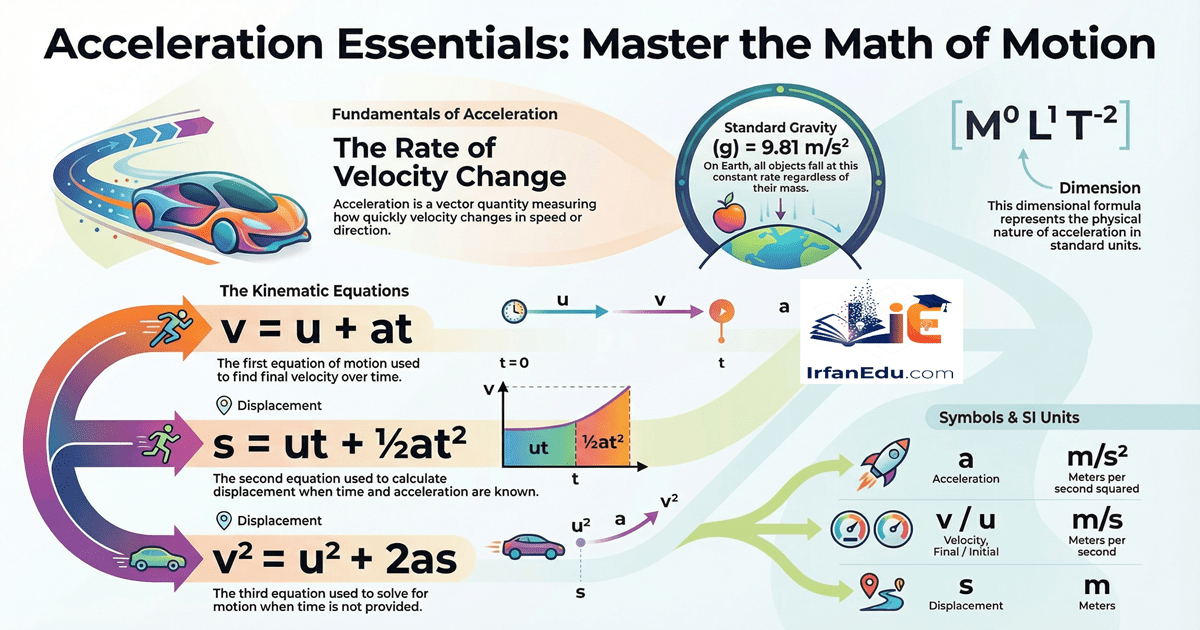
Acceleration is a vector quantity that describes the rate of change of velocity with respect to time. It can be a change in speed, direction, or both.
a = (v − u) / tAverage Acceleration
Average acceleration is the total change in velocity divided by total time. It tells us how fast velocity changed over an interval.
a_avg = Δv / ΔtInstantaneous Acceleration
Acceleration at a specific instant in time. It is the second derivative of position or the first derivative of velocity with respect to time.
a = dv/dt = d²x/dt²SI Unit & Dimensions
The standard unit of acceleration is metre per second squared (m/s²). Its dimensional formula is [M⁰ L¹ T⁻²].
[M⁰ L¹ T⁻²]Newton’s Second Law
Force equals mass times acceleration: F = ma. A net force on an object causes it to accelerate in the direction of the force. More mass = less acceleration for same force.
F = m × aGravitational Acceleration
On Earth’s surface, all objects fall with the same acceleration due to gravity: g = 9.81 m/s² (approx. 10 m/s² in NCERT). This is independent of mass.
g = 9.81 m/s²Types of Acceleration
Variables & Symbols
All mathematical symbols used in acceleration formulas
| Symbol | Quantity | SI Unit | Type |
|---|---|---|---|
| a | Acceleration | m/s² | Vector |
| v | Final Velocity | m/s | Vector |
| u | Initial Velocity | m/s | Vector |
| t | Time | seconds (s) | Scalar |
| s | Displacement | m | Vector |
| F | Force | Newton (N) | Vector |
| m | Mass | kilogram (kg) | Scalar |
| g | Gravitational Accel. | 9.81 m/s² | Vector |
Key Acceleration Equations
All important formulas — Equations of Motion
Free Physics Calculators for Students & Educators
irfanedu.com · Physics Calculator Series · Unit 02: Acceleration