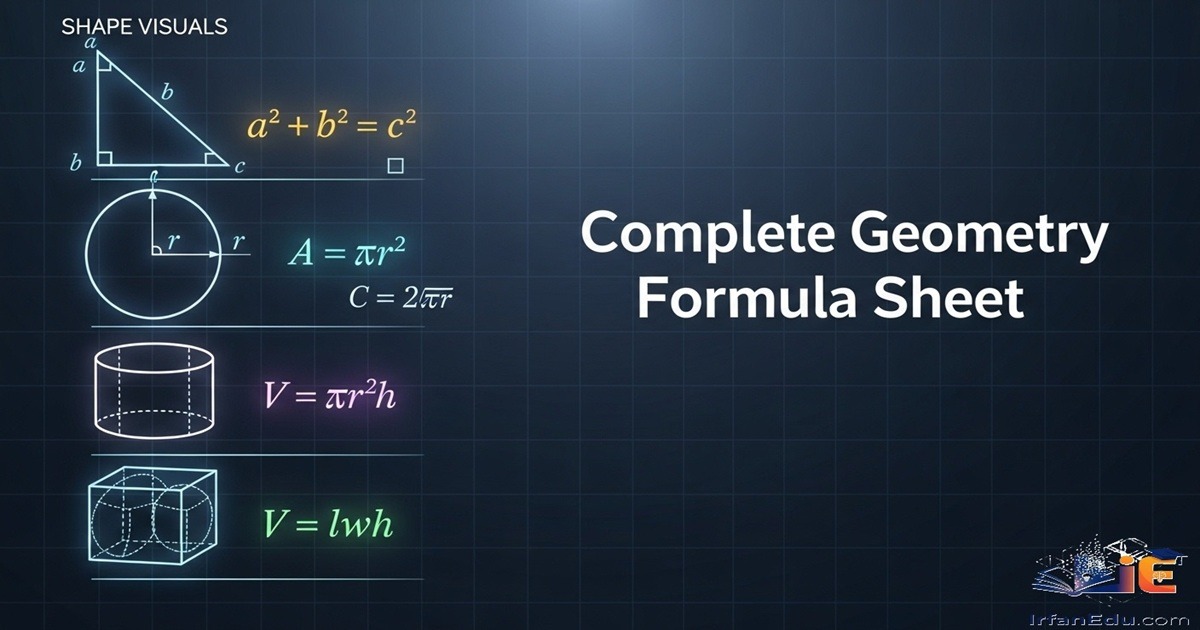
Why Geometry Formula Sheets Are Essential
A geometry formula sheet is a organized reference document containing every mathematical formula needed to solve geometry problems — from basic angle relationships to 3D surface areas. Students who use a well-organized geometry cheat sheet consistently perform better on tests because they spend mental energy on problem-solving strategy rather than formula recall.
Here is something most geometry teachers will tell you: the students who struggle on geometry tests are rarely the ones who do not understand the concepts. They are the ones who misremember a formula under pressure — writing A = 2πr instead of A = πr², or forgetting the ½ in the triangle area formula. A single misremembered formula can cost you an entire problem chain on a test.
This complete geometry formula sheet covers every formula you need for:
- High school geometry courses (Grade 8–12)
- ACT Mathematics section (no formula sheet provided)
- SAT Math section (partial formula sheet provided)
- State standardized tests and end-of-course exams
- College entrance geometry placement tests
According to ACT.org mathematics content specifications, the ACT Mathematics test covers geometry topics including plane geometry (approximately 23% of the test) and trigonometry (approximately 7%). Critically, the ACT provides NO formula sheet — students must know all geometry formulas from memory. This makes a thorough geometry cheat sheet an essential study tool for every ACT test-taker.
How to Use This Geometry Formula Sheet Effectively
- Study phase: Read each formula, understand what every variable means, then close the sheet and reproduce it from memory.
- Practice phase: Work problems without looking at the sheet first. Only reference it when genuinely stuck.
- Test prep phase: Use this as your final review — scan each section the night before your test to refresh your memory.
- Exam day: If a formula sheet is allowed, know exactly where each formula category is so you can find any formula in under 10 seconds.
Basic Geometry Definitions and Symbols
Before diving into formulas, make sure you know these fundamental terms and symbols. Geometry problems often hinge on correctly interpreting notation.
| Symbol / Term | Meaning | Example |
|---|---|---|
| ∠ ABC | Angle with vertex at B, rays BA and BC | ∠ ABC = 90° means a right angle at B |
| ⊥ | Perpendicular (90° angle between lines) | AB ⊥ CD means lines AB and CD meet at 90° |
| ∥ | Parallel (lines never intersect) | AB ∥ CD means lines AB and CD never meet |
| ≅ | Congruent (same shape and size) | △ABC ≅ △DEF means triangles are identical |
| ~ | Similar (same shape, different size) | △ABC ~ △DEF means same angles, proportional sides |
| π (pi) | Ratio of circumference to diameter ≈ 3.14159 | Use π ≈ 3.14 for calculations unless told otherwise |
| r | Radius — distance from center to edge of circle | r = d/2 where d is diameter |
| b, h | Base and height — height is always perpendicular to base | Height is NOT the slant side of a triangle |
| l (slant height) | Slant height of a cone or pyramid — the diagonal side | Different from vertical height h |
| √ | Square root | √25 = 5, √2 ≈ 1.414, √3 ≈ 1.732 |
Angle Formulas
Angle relationships are the foundation of all geometry. These formulas appear in nearly every geometry problem — from basic proofs to complex polygon questions on the ACT.
| Angle Type | Formula | Notes |
|---|---|---|
| Complementary Angles | ∠A + ∠B = 90° | Two angles that sum to 90°. Each is the complement of the other. |
| Supplementary Angles | ∠A + ∠B = 180° | Two angles that sum to 180°. Form a straight line together. |
| Vertical Angles | ∠A = ∠B | Opposite angles formed by two intersecting lines. Always equal. |
| Straight Angle | ∠ = 180° | A straight line forms a 180° angle. |
| Full Rotation | ∠ = 360° | All angles around a single point sum to 360°. |
| Corresponding Angles | ∠A = ∠B | When a transversal crosses parallel lines — corresponding angles are equal. |
| Alternate Interior Angles | ∠A = ∠B | Between parallel lines, on opposite sides of the transversal. Always equal. |
| Alternate Exterior Angles | ∠A = ∠B | Outside parallel lines, on opposite sides of the transversal. Always equal. |
| Co-Interior (Same-Side) Angles | ∠A + ∠B = 180° | Between parallel lines, on the same side of the transversal. Supplementary. |
Triangle Formulas
Triangles are the most tested shape in all of geometry. From the Pythagorean theorem to Heron’s formula, mastering triangle formulas alone will earn you significant points on any geometry test or standardized exam.
| Formula Name | Formula | Variables & Notes |
|---|---|---|
| Area (standard) | A = ½ × b × h | b = base, h = perpendicular height (NOT slant side) |
| Perimeter | P = a + b + c | Sum of all three sides |
| Pythagorean Theorem | a² + b² = c² | Right triangles only. c = hypotenuse (longest side, opposite 90°) |
| Heron’s Formula | A = √(s(s−a)(s−b)(s−c)) | s = (a+b+c)/2 is the semi-perimeter. Use when height is unknown. |
| Equilateral Triangle Area | A = (√3 / 4) × s² | s = side length. All three sides equal. |
| Equilateral Triangle Height | h = (√3 / 2) × s | Derived from Pythagorean theorem on equilateral triangle. |
| 30-60-90 Triangle Sides | 1 : √3 : 2 | Short leg : long leg : hypotenuse. If short leg = x, hypotenuse = 2x, long leg = x√3 |
| 45-45-90 Triangle Sides | 1 : 1 : √2 | Both legs equal. If leg = x, hypotenuse = x√2 |
| Triangle Angle Sum | ∠A + ∠B + ∠C = 180° | Interior angles of any triangle always sum to 180° |
| Exterior Angle Theorem | ∠ext = ∠A + ∠B | An exterior angle equals the sum of the two non-adjacent interior angles |
| Area (using trig) | A = ½ × a × b × sin(C) | a, b = two sides; C = included angle between them |
The height in A = ½bh must be perpendicular to the base — it is never the slant side of the triangle unless the triangle is a right triangle and you are using one of the legs as the height. Drawing a quick sketch and marking the perpendicular height before calculating will prevent this mistake every time.
Quadrilateral Formulas
Quadrilaterals are four-sided polygons. Each type has its own area formula — and confusing them is one of the most common geometry test mistakes. Notice how each formula builds logically from the rectangle formula.
| Shape | Area Formula | Perimeter Formula | Notes |
|---|---|---|---|
| Rectangle | A = l × w | P = 2(l + w) | l = length, w = width |
| Square | A = s² | P = 4s | s = side length. All four sides equal. |
| Parallelogram | A = b × h | P = 2(a + b) | h = perpendicular height, NOT the slant side |
| Trapezoid | A = ½(b₁ + b₂) × h | P = a + b₁ + c + b₂ | b₁ and b₂ are the two parallel bases. h = perpendicular height. |
| Rhombus | A = ½ × d₁ × d₂ | P = 4s | d₁ and d₂ are the two diagonals. All sides equal. |
| Kite | A = ½ × d₁ × d₂ | P = 2(a + b) | d₁ and d₂ are diagonals. Two pairs of consecutive equal sides. |
Circle Formulas
Circle formulas are among the most frequently tested geometry topics on both the ACT and SAT. Pay close attention to the difference between radius and diameter — mixing them up is the single most common circle mistake.
| Formula Name | Formula | Variables & Notes |
|---|---|---|
| Area of a Circle | A = πr² | r = radius. Square the radius FIRST, then multiply by π. |
| Circumference | C = 2πr = πd | d = diameter = 2r. Both forms are equivalent. |
| Diameter | d = 2r | Diameter passes through the center. Always twice the radius. |
| Arc Length | L = (θ / 360) × 2πr | θ = central angle in degrees. Fraction of full circumference. |
| Sector Area | A = (θ / 360) × πr² | θ = central angle in degrees. Fraction of full circle area. |
| Arc Length (radians) | L = r × θ | θ must be in radians. 1 radian = 180°/π ≈ 57.3° |
| Sector Area (radians) | A = ½r²θ | θ must be in radians. |
| Central Angle | ∠central = arc measure | A central angle equals the arc it intercepts in degrees. |
| Inscribed Angle | ∠inscribed = ½ × arc | An inscribed angle is half the intercepted arc measure. |
| Chord Length | c = 2r × sin(θ/2) | θ = central angle subtending the chord. |
Polygon Formulas
These formulas apply to any regular polygon — a shape with all equal sides and all equal angles. The interior angle formula is one of the most tested polygon concepts on the ACT.
| Formula Name | Formula | Variables & Notes |
|---|---|---|
| Sum of Interior Angles | S = (n − 2) × 180° | n = number of sides. Triangle: (3−2)×180 = 180°. Quadrilateral: 360°. |
| Each Interior Angle (regular) | ∠ = (n − 2) × 180° / n | Only for regular polygons (all sides and angles equal). |
| Each Exterior Angle (regular) | ∠ext = 360° / n | Exterior angles of any regular polygon always sum to 360°. |
| Interior + Exterior Angle | ∠int + ∠ext = 180° | Each interior-exterior angle pair is supplementary. |
| Number of Diagonals | D = n(n − 3) / 2 | n = number of sides. Pentagon (5 sides): 5(2)/2 = 5 diagonals. |
| Area of Regular Polygon | A = ½ × P × a | P = perimeter, a = apothem (distance from center to midpoint of a side). |
Triangle = 180° | Quadrilateral = 360° | Pentagon = 540° | Hexagon = 720° | Heptagon = 900° | Octagon = 1,080°. Each additional side adds exactly 180° to the interior angle sum.
3D Shape Volume Formulas
Volume measures the amount of space inside a 3D shape. All volume formulas are in cubic units (cm³, m³, in³). Notice that cone and pyramid volumes are exactly one-third of their corresponding prism and cylinder volumes — this relationship is worth remembering.
| Shape | Volume Formula | Variables & Notes |
|---|---|---|
| Cube | V = s³ | s = side length. All edges equal. |
| Rectangular Prism (Cuboid) | V = l × w × h | l = length, w = width, h = height. |
| Cylinder | V = πr²h | r = radius of circular base, h = height. |
| Cone | V = ⅓πr²h | r = radius of base, h = perpendicular height (not slant). V = ⅓ of cylinder. |
| Sphere | V = (4/3)πr³ | r = radius. Cube the radius, multiply by 4π, divide by 3. |
| Square Pyramid | V = ⅓ × l × w × h | l × w = area of rectangular base, h = perpendicular height. |
| Triangular Prism | V = ½ × b × h × l | b × h = area of triangular base, l = length of prism. |
| Any Prism | V = B × h | B = area of the base (any shape), h = height of prism. |
3D Surface Area Formulas
Surface area is the total area of all outer faces of a 3D shape. It is measured in square units (cm², m²). Think of surface area as the amount of wrapping paper needed to cover a 3D object completely.
| Shape | Surface Area Formula | Variables & Notes |
|---|---|---|
| Cube | SA = 6s² | 6 equal square faces. s = side length. |
| Rectangular Prism | SA = 2(lw + lh + wh) | 3 pairs of rectangular faces. l = length, w = width, h = height. |
| Cylinder | SA = 2πr² + 2πrh | 2 circular bases (2πr²) + curved lateral surface (2πrh). |
| Cone | SA = πr² + πrl | 1 circular base (πr²) + lateral surface (πrl). l = slant height = √(r²+h²). |
| Sphere | SA = 4πr² | r = radius. No flat faces — entirely curved surface. |
| Square Pyramid | SA = s² + 2sl | s² = square base area. 2sl = area of 4 triangular faces. l = slant height. |
| Triangular Prism | SA = bh + (s₁+s₂+s₃) × l | bh = 2 triangular bases. (s₁+s₂+s₃) × l = 3 rectangular lateral faces. |
Coordinate Geometry Formulas
Coordinate geometry connects algebra and geometry using the x-y coordinate plane. These formulas appear heavily on both the ACT and SAT — especially the distance formula, midpoint formula, and slope.
| Formula Name | Formula | Variables & Notes |
|---|---|---|
| Distance Formula | d = √((x₂−x₁)² + (y₂−y₁)²) | Distance between two points (x₁,y₁) and (x₂,y₂). Derived from Pythagorean theorem. |
| Midpoint Formula | M = ((x₁+x₂)/2, (y₁+y₂)/2) | Average the x-coordinates and y-coordinates separately. |
| Slope Formula | m = (y₂−y₁) / (x₂−x₁) | Rise over run. Positive slope = upward left to right. Negative = downward. |
| Slope-Intercept Form | y = mx + b | m = slope, b = y-intercept (where line crosses y-axis). |
| Point-Slope Form | y − y₁ = m(x − x₁) | Use when you know slope m and one point (x₁, y₁). |
| Standard Form of a Line | Ax + By = C | A, B, C are integers. Useful for finding intercepts quickly. |
| Parallel Lines | m₁ = m₂ | Parallel lines have identical slopes but different y-intercepts. |
| Perpendicular Lines | m₁ × m₂ = −1 | Perpendicular slopes are negative reciprocals: m₂ = −1/m₁. |
| Equation of a Circle | (x−h)² + (y−k)² = r² | (h, k) = center of circle, r = radius. |
Similarity & Congruence Rules
Similarity and congruence rules tell you when two shapes are identical (congruent) or proportionally equivalent (similar). These appear frequently in geometry proofs and word problems.
| Rule / Concept | Condition | Notes |
|---|---|---|
| SSS Congruence | 3 sides equal | If all three sides of one triangle equal all three sides of another, triangles are congruent. |
| SAS Congruence | 2 sides + included angle equal | Two sides and the angle between them are equal. |
| ASA Congruence | 2 angles + included side equal | Two angles and the side between them are equal. |
| AAS Congruence | 2 angles + non-included side equal | Two angles and a non-included side are equal. |
| HL Congruence | Hypotenuse + leg equal (right △ only) | Right triangles only: hypotenuse and one leg are equal. |
| AA Similarity | 2 angles equal | If two angles of one triangle equal two angles of another, triangles are similar. |
| SSS Similarity | All sides proportional | a/d = b/e = c/f means triangles are similar. |
| Scale Factor (k) | k = corresponding side ratio | Similar figures: lengths scale by k, areas scale by k², volumes scale by k³. |
| Perimeter Ratio | P₁/P₂ = k | Perimeters of similar figures are in the same ratio as corresponding sides. |
| Area Ratio | A₁/A₂ = k² | Areas of similar figures are in the ratio of the square of the scale factor. |
Basic Trigonometry Formulas
Trigonometry connects angle measures to side length ratios in right triangles. The mnemonic SOH-CAH-TOA is the single most important thing to memorize in all of introductory trigonometry.
SOH: Sine = Opposite / Hypotenuse | CAH: Cosine = Adjacent / Hypotenuse | TOA: Tangent = Opposite / Adjacent. Always identify which angle you are working from, then label the opposite side, adjacent side, and hypotenuse relative to that angle.
| Formula Name | Formula | Notes |
|---|---|---|
| Sine Ratio | sin(θ) = Opposite / Hypotenuse | Opposite = side across from angle θ. Hypotenuse = longest side. |
| Cosine Ratio | cos(θ) = Adjacent / Hypotenuse | Adjacent = side next to angle θ (not the hypotenuse). |
| Tangent Ratio | tan(θ) = Opposite / Adjacent | Also equals sin(θ)/cos(θ). |
| Pythagorean Identity | sin²(θ) + cos²(θ) = 1 | Fundamental identity — always true for any angle θ. |
| Inverse Sine | θ = sin⁻¹(Opposite / Hypotenuse) | Use to find an angle when you know two sides. |
| Inverse Cosine | θ = cos⁻¹(Adjacent / Hypotenuse) | Also written arccos. Use to find an angle. |
| Inverse Tangent | θ = tan⁻¹(Opposite / Adjacent) | Also written arctan. Use to find an angle. |
| Law of Sines | a/sin(A) = b/sin(B) = c/sin(C) | Use for any triangle when you know an angle-side pair. |
| Law of Cosines | c² = a² + b² − 2ab·cos(C) | Use for any triangle when you know 3 sides or 2 sides + included angle. |
| sin(30°) = cos(60°) | = ½ = 0.5 | Memorize special angle values for ACT (no calculator for some sections). |
| sin(45°) = cos(45°) | = √2/2 ≈ 0.707 | 45-45-90 triangle relationship. |
| sin(60°) = cos(30°) | = √3/2 ≈ 0.866 | 30-60-90 triangle relationship. |
Geometry on the ACT & SAT: What You Must Know
The ACT and SAT test geometry differently. Understanding exactly what each exam expects — and what it provides — is essential for targeted test preparation.
- Plane Geometry: ~23% of test (≈14 questions)
- Trigonometry: ~7% of test (≈4 questions)
- No formula sheet — all formulas must be memorized
- 60 questions in 60 minutes — speed matters
- Calculator allowed on entire math section
- Covers: angles, triangles, circles, polygons, 3D shapes, coordinate geometry, trig ratios, law of sines/cosines
- According to ACT.org, students should know all geometry formulas from memory before test day
- Geometry & Trig: ~15% of test
- Reference sheet provided with ~12 basic formulas
- SAT provides: circle area/circumference, triangle area, Pythagorean theorem, special right triangles, 3D volumes
- SAT does NOT provide: coordinate geometry formulas, trig identities, polygon angle formulas, similarity ratios
- Calculator allowed on most sections (digital SAT)
- Knowing formulas beyond the reference sheet gives you a significant speed advantage
According to ACT.org mathematics content guidelines, the most heavily tested geometry topics on the ACT are: properties of triangles and quadrilaterals, properties of circles, perimeter/area/volume calculations, and coordinate geometry. Students who memorize this complete geometry formula sheet and practice applying each formula to real problems are fully prepared for every geometry question the ACT can present.
Common Geometry Mistakes to Avoid
These are the geometry formula errors that appear most frequently on tests — and cost students the most points. Recognizing them now means you will not make them under exam pressure.
Student reads “circle has diameter 10” and calculates:
Diameter = 10, so r = 5. Then:
Using the slant side l instead of perpendicular height h:
Use perpendicular height h, not slant height l:
A very common error under test pressure:
A triangle is exactly half a parallelogram:
Student uses a² + b² = c² on a triangle with no 90° angle:
When no right angle exists, use:
How to Memorize Geometry Formulas Fast
Memorizing geometry formulas is not about reading them repeatedly — it is about active recall and understanding the logic behind each formula. These strategies are proven to work for geometry students at every level.
-
1Understand the formula — do not just memorize it. Every geometry formula has a logical reason behind it. The triangle area formula A = ½bh exists because a triangle is exactly half of a parallelogram with the same base and height. When you understand why a formula works, you can reconstruct it from logic even if you forget it under pressure. Before memorizing any formula, ask yourself: “Why does this formula make sense?”
-
2Use the cover-write-check method daily. Write all formulas in a category on a sheet of paper. Cover them completely. Now write every formula from memory on a blank sheet. Uncover and check. Repeat only the ones you missed. Do this for 10 minutes every day for one week — you will have every formula locked in permanently. This active recall method is dramatically more effective than re-reading formulas passively.
-
3Group related formulas together in your memory. Your brain remembers patterns and relationships better than isolated facts. Memorize all circle formulas as a group: A = πr², C = 2πr, Arc = (θ/360) × 2πr, Sector = (θ/360) × πr². Notice that arc length and sector area are just fractions of the full circumference and area. Seeing the pattern makes all four formulas easier to remember than memorizing each one separately.
-
4Use mnemonics for trigonometry. SOH-CAH-TOA is the most famous math mnemonic for a reason — it works. Create your own sentence: “Some Old Hippos Can Always Hear Their Old Age” (SOH-CAH-TOA). For the special angle values, remember that sin increases from 0° to 90° while cos decreases: sin(0°)=0, sin(30°)=½, sin(45°)=√2/2, sin(60°)=√3/2, sin(90°)=1. Cos goes in the exact reverse order.
-
5Draw every shape by hand when studying. Do not just read the formula for a cylinder — draw a cylinder, label the radius r and height h, then write the volume formula V = πr²h next to it. The physical act of drawing and labeling creates a visual-motor memory that is far stronger than reading alone. Students who sketch shapes while studying geometry consistently outperform those who only read formulas.
-
6Notice the one-third pattern in 3D shapes. A cone holds exactly one-third the volume of a cylinder with the same base and height: V_{cone} = ⅓πr²h vs V_{cylinder} = πr²h. A pyramid holds exactly one-third the volume of a prism with the same base and height. Once you see this pattern, you only need to remember the cylinder and prism formulas — the cone and pyramid formulas follow automatically.
-
7Use spaced repetition — review formulas across multiple days. Review all formulas on Day 1. On Day 2, test yourself without looking. On Day 4, test again. On Day 7, test again. Each time you successfully recall a formula after a gap, the memory becomes stronger and longer-lasting. This spaced repetition technique is backed by decades of cognitive science research and is the most time-efficient memorization method available.
-
8Teach the formulas to someone else. Explaining a formula out loud to a friend, family member, or even an imaginary student forces you to articulate your understanding clearly. If you cannot explain why (x-h)² + (y-k)² = r² represents a circle centered at (h, k) with radius r, you do not truly know it yet. Teaching is the highest form of learning — it reveals exactly which formulas you have genuinely mastered and which ones you only think you know.
Practice Problems with Full Solutions
Apply what you have learned. Try each problem on your own before revealing the solution. Work through the full solution steps — not just the final answer — to build the problem-solving habits that earn points on tests.
Problem 1 — A right triangle has legs of length 9 cm and 12 cm. Find the hypotenuse. Easy
Formula used: Pythagorean Theorem — a² + b² = c²
Step 1: Identify the legs: a = 9, b = 12. The hypotenuse c is what we need to find.
Step 2: Substitute into the formula:
Step 3: Calculate the squares:
Step 4: Add and take the square root:
Answer: The hypotenuse is 15 cm. This is a classic 3-4-5 Pythagorean triple scaled by 3: (9, 12, 15) = 3 × (3, 4, 5).
Problem 2 — Find the area and circumference of a circle with diameter 14 cm. Use π ≈ 3.14. Easy
Formulas used: A = πr² and C = 2πr
Step 1: The diameter is 14 cm, so the radius is:
Step 2: Calculate the area:
Step 3: Calculate the circumference:
Answer: Area = 153.86 cm², Circumference = 43.96 cm.
Key reminder: Always convert diameter to radius before using any circle formula.
Problem 3 — A trapezoid has parallel bases of 8 m and 14 m, and a height of 6 m. Find its area. Easy
Formula used: A = ½(b₁ + b₂) × h
Step 1: Identify the values: b₁ = 8 m, b₂ = 14 m, h = 6 m.
Step 2: Add the two bases:
Step 3: Apply the trapezoid area formula:
Answer: The area of the trapezoid is 66 m².
Problem 4 — Find the volume and total surface area of a cylinder with radius 5 cm and height 10 cm. Medium
Formulas used: V = πr²h and SA = 2πr² + 2πrh
Step 1: Identify values: r = 5 cm, h = 10 cm.
Step 2: Calculate the volume:
Step 3: Calculate the surface area — two circular bases plus the curved lateral surface:
Answer: Volume = 250π ≈ 785 cm³, Surface Area = 150π ≈ 471 cm².
Pro tip: Leave answers in terms of π (e.g., 250π) unless the problem specifically asks you to use a decimal approximation.
Problem 5 — Two points are A(2, 3) and B(8, 11). Find the distance AB and the midpoint M. Medium
Formulas used: Distance: d = √((x₂−x₁)² + (y₂−y₁)²) and Midpoint: M = ((x₁+x₂)/2, (y₁+y₂)/2)
Step 1: Identify coordinates: (x₁, y₁) = (2, 3) and (x₂, y₂) = (8, 11).
Step 2: Calculate the distance:
Step 3: Calculate the midpoint:
Answer: Distance AB = 10 units. Midpoint M = (5, 7).
Notice that 6-8-10 is a Pythagorean triple (3-4-5 scaled by 2). Recognizing these triples saves calculation time on the ACT.
Problem 6 — A regular hexagon has a side length of 6 cm. Find the sum of interior angles and each interior angle. Medium
Formulas used: Sum: S = (n−2) × 180° and Each angle: ∠ = S / n
Step 1: A hexagon has n = 6 sides.
Step 2: Find the sum of interior angles:
Step 3: Find each interior angle (regular hexagon — all angles equal):
Answer: Sum of interior angles = 720°. Each interior angle = 120°.
Check: Each exterior angle = 360°/6 = 60°. Interior + exterior = 120° + 60° = 180° ✓
Problem 7 — A cone has radius 6 cm and slant height 10 cm. Find its total surface area and volume. Medium
Formulas used: SA = πr² + πrl and V = ⅓πr²h
Step 1: Identify values: r = 6 cm, slant height l = 10 cm.
Step 2: Find the perpendicular height h using the Pythagorean theorem (r² + h² = l²):
Step 3: Calculate the surface area:
Step 4: Calculate the volume using perpendicular height h = 8:
Answer: Surface Area = 96π ≈ 301.6 cm². Volume = 96π ≈ 301.6 cm³.
Important: The surface area formula uses slant height l, but the volume formula uses perpendicular height h. Always identify which height you need before calculating.
Problem 8 — In a right triangle, one angle is 35° and the hypotenuse is 20 cm. Find the side opposite the 35° angle. Medium
Formula used: sin(θ) = Opposite / Hypotenuse
Step 1: Identify what we know: θ = 35°, hypotenuse = 20 cm. We need the opposite side.
Step 2: Set up the sine ratio:
Step 3: Solve for the opposite side (sin 35° ≈ 0.5736):
Answer: The side opposite the 35° angle is approximately 11.47 cm.
Strategy reminder: Always start trig problems by labeling the three sides relative to your angle — Opposite, Adjacent, Hypotenuse — before choosing which ratio (SOH, CAH, or TOA) to use.
Problem 9 — A sector of a circle has a central angle of 72° and a radius of 10 cm. Find the arc length and sector area. Hard
Formulas used: Arc length: L = (θ/360) × 2πr and Sector area: A = (θ/360) × πr²
Step 1: Identify values: θ = 72°, r = 10 cm.
Step 2: Find what fraction of the full circle this sector represents:
Step 3: Calculate the arc length:
Step 4: Calculate the sector area:
Answer: Arc length = 4π ≈ 12.57 cm. Sector area = 20π ≈ 62.83 cm².
Shortcut: Always simplify the angle fraction first (72/360 = 1/5). Working with simple fractions like 1/5 is much faster than multiplying by 0.2 under test pressure.
Problem 10 — Two similar triangles have a scale factor of 3:5. The area of the smaller triangle is 27 cm². Find the area of the larger triangle. Hard
Formula used: Area ratio of similar figures: A₁/A₂ = k² where k is the scale factor.
Step 1: Identify the scale factor: k = 3/5 (smaller to larger).
Step 2: The area ratio equals the square of the scale factor:
Step 3: Set up the proportion with the known area of the smaller triangle:
Step 4: Cross-multiply and solve:
Answer: The area of the larger triangle is 75 cm².
Key concept: When a linear scale factor is k, the area scale factor is k² and the volume scale factor is k³. This is one of the most commonly tested similarity concepts on the ACT and SAT.
Frequently Asked Questions
What formulas are on a geometry formula sheet?
A complete geometry formula sheet includes formulas for angles (supplementary, complementary, vertical), triangles (area, perimeter, Pythagorean theorem, Heron’s formula, special right triangles), quadrilaterals (rectangle, square, parallelogram, trapezoid, rhombus), circles (area, circumference, arc length, sector area), polygons (interior and exterior angles, diagonals), 3D shapes (volume and surface area of cube, cylinder, cone, sphere, prism, pyramid), coordinate geometry (distance, midpoint, slope, line equations, circle equation), similarity and congruence rules, and basic trigonometry (SOH-CAH-TOA, law of sines, law of cosines).
Is there a geometry formula sheet for the ACT and SAT?
The SAT provides a reference sheet at the beginning of the math section with approximately 12 basic geometry formulas. The ACT provides NO formula sheet — students must memorize all geometry formulas before the exam. According to ACT.org mathematics guidelines, students are expected to know all geometry formulas from memory. This makes memorizing a complete geometry cheat sheet especially critical for ACT test-takers. Even for the SAT, knowing formulas beyond the reference sheet gives you a significant speed advantage.
What is the most important geometry formula to know?
The Pythagorean theorem (a² + b² = c²) is widely considered the most important geometry formula. It applies to right triangles, distance calculations in coordinate geometry, 3D diagonal calculations, and is the foundation of trigonometry. After the Pythagorean theorem, the area formulas for triangles (½ × base × height) and circles (πr²) are the most frequently tested geometry formulas on standardized tests including the ACT and SAT.
How do I memorize geometry formulas fast?
The fastest way to memorize geometry formulas is through active recall and spaced repetition. Write each formula by hand, then immediately close your notes and try to reproduce it from memory. Use mnemonics — SOH-CAH-TOA for trigonometry ratios. Group related formulas together (all circle formulas, all triangle formulas) and practice applying them to real problems rather than just reading them. Understanding why each formula works makes it far easier to remember under test pressure.
Where can I download a geometry formula sheet PDF?
You can print this complete geometry formula sheet directly from your browser by pressing Ctrl+P (Windows) or Cmd+P (Mac). All tables, formulas, and shape visuals are print-optimized. This gives you a complete geometry cheat sheet PDF with every formula organized by category. For official standardized test formula references, visit ACT.org for ACT mathematics guidelines and College Board’s official SAT practice materials at collegeboard.org.
What geometry formulas are on the SAT math section?
The SAT math section provides a reference sheet with: area of a circle (A = πr²), circumference (C = 2πr), area of a rectangle (A = lw), area of a triangle (A = ½bh), Pythagorean theorem (a² + b² = c²), special right triangles (30-60-90 and 45-45-90), volume of a rectangular prism, cylinder, sphere, cone, and pyramid. The SAT does NOT provide coordinate geometry formulas, polygon angle formulas, similarity ratios, or trigonometric identities — these must be memorized.
What is the formula for the area of a circle?
The area of a circle is A = πr², where r is the radius and π ≈ 3.14159. Square the radius first, then multiply by π. For example, a circle with radius 7 cm has area = π × 49 ≈ 153.94 cm². The most common mistake is using the diameter instead of the radius — always check whether you are given radius or diameter, and divide by 2 if you are given the diameter before applying the formula.

- ACT.org. “ACT Mathematics Test — Content Specifications and Formula Requirements.” Retrieved from act.org
- College Board. “SAT Math Reference Sheet and Formula Information.” Retrieved from collegeboard.org
- National Council of Teachers of Mathematics (NCTM). “Geometry Standards for Grades 6–12.” Retrieved from nctm.org
- Common Core State Standards Initiative. “Mathematics Standards — Geometry (HSG).” Retrieved from corestandards.org
- Khan Academy. “Geometry — High School Math.” Retrieved from khanacademy.org
📋 Editorial Standards: This geometry formula sheet was written and reviewed by Dr. Irfan Mansuri (Ph.D. Education, Mathematics Instructor). All formulas have been verified for accuracy against current NCTM standards, Common Core State Standards for Mathematics, ACT.org content specifications, and College Board SAT guidelines. Last verified: March 7, 2026. IrfanEdu is committed to providing mathematically accurate, clearly explained, and genuinely useful content for every student.
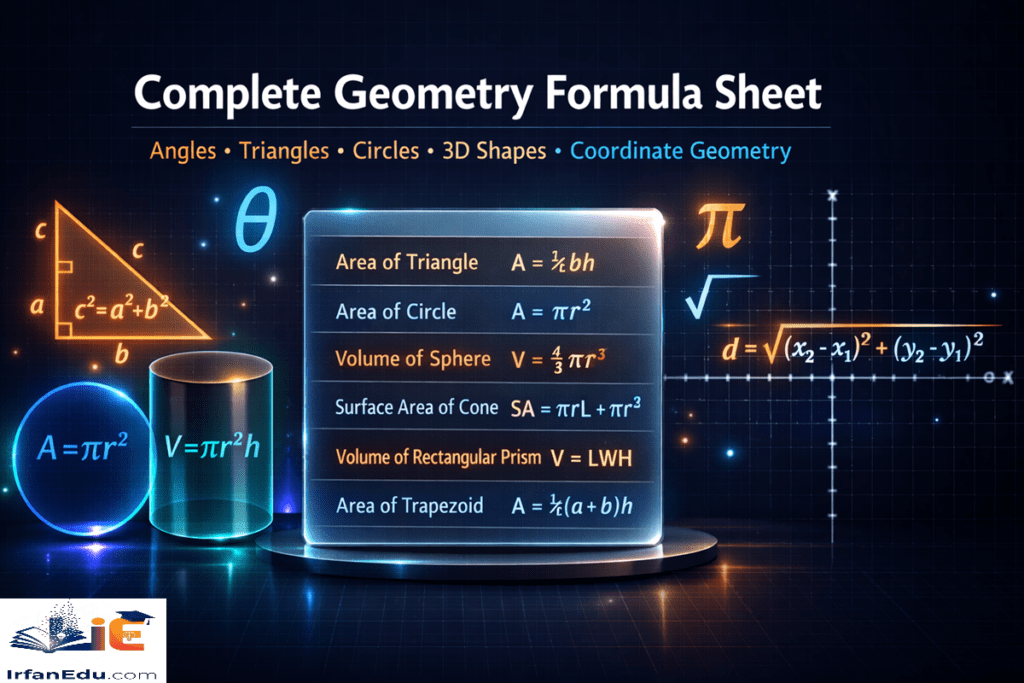
Complete Geometry Formula Sheet
Symbols · Definitions · Angles · Triangles · Quadrilaterals
Geometry Symbols Reference
| Symbol | Meaning | Example |
|---|---|---|
| ∠ | Angle | ∠ABC = 90° |
| ⊥ | Perpendicular | AB ⊥ CD |
| ∥ | Parallel | AB ∥ CD |
| ≅ | Congruent (same size & shape) | △ABC ≅ △DEF |
| ~ | Similar (same shape, diff size) | △ABC ~ △DEF |
| π | Pi ≈ 3.14159 | C = 2πr |
| ° | Degrees | ∠A = 45° |
| √ | Square root | √25 = 5 |
| Symbol | Meaning | Example |
|---|---|---|
| ⊙ | Circle | ⊙O = circle with center O |
| AB̄ | Line segment AB | AB̄ = 5 cm |
| AB⃗ | Ray from A through B | AB⃗ starts at A |
| ↔ AB | Line through A and B | Extends both directions |
| △ | Triangle | △ABC |
| ⊗ | Into the page (vector) | B field direction |
| ⊙ (dot) | Out of the page (vector) | B field direction |
| ∴ | Therefore | ∴ x = 5 |
Essential Geometry Definitions
| Term | Definition |
|---|---|
| Point | Exact location in space. No size. Named by a capital letter. |
| Line | Straight path extending infinitely in both directions. |
| Line Segment | Part of a line with two endpoints. |
| Ray | Part of a line with one endpoint, extending infinitely in one direction. |
| Plane | Flat surface extending infinitely in all directions. 2D. |
| Angle | Formed by two rays sharing a common endpoint (vertex). |
| Acute Angle | Angle measuring between 0° and 90°. |
| Right Angle | Angle measuring exactly 90°. Marked with a small square. |
| Obtuse Angle | Angle measuring between 90° and 180°. |
| Straight Angle | Angle measuring exactly 180°. Forms a straight line. |
| Reflex Angle | Angle measuring between 180° and 360°. |
| Term | Definition |
|---|---|
| Radius (r) | Distance from center of circle to any point on the circle. |
| Diameter (d) | Chord passing through center. d = 2r. |
| Chord | Line segment with both endpoints on a circle. |
| Tangent | Line touching a circle at exactly one point. |
| Secant | Line intersecting a circle at exactly two points. |
| Arc | Part of the circumference of a circle. |
| Sector | Pie-slice region bounded by two radii and an arc. |
| Apothem | Distance from center of regular polygon to midpoint of a side. |
| Hypotenuse | Longest side of a right triangle. Opposite the 90° angle. |
| Altitude / Height | Perpendicular distance from base to opposite vertex. Always ⊥ to base. |
| Median | Line from vertex to midpoint of opposite side in a triangle. |
Angle Formulas
| Angle Type | Formula | Note |
|---|---|---|
| Complementary | ∠A + ∠B = 90° | Sum equals 90° |
| Supplementary | ∠A + ∠B = 180° | Sum equals 180° |
| Vertical Angles | ∠A = ∠B | Opposite angles — always equal |
| Straight Angle | ∠ = 180° | Flat line |
| Full Rotation | ∠ = 360° | All angles at a point |
| Parallel Lines + Transversal | Formula | Note |
|---|---|---|
| Corresponding | ∠A = ∠B | Same position at each intersection |
| Alternate Interior | ∠A = ∠B | Between lines, opposite sides |
| Alternate Exterior | ∠A = ∠B | Outside lines, opposite sides |
| Co-Interior (Same-Side) | ∠A + ∠B = 180° | Between lines, same side |
| Linear Pair | ∠A + ∠B = 180° | Adjacent angles on a straight line |
Geometry Formula Sheet — Shapes
Triangles · Quadrilaterals · Circles · Polygons
Triangle Formulas
| Formula Name | Formula | Variables |
|---|---|---|
| Area (standard) | A = ½ × b × h | h ⊥ to base always |
| Perimeter | P = a + b + c | Sum of all 3 sides |
| Heron’s Formula | A = √(s(s−a)(s−b)(s−c)) | s = (a+b+c)/2 |
| Area (trig) | A = ½ab·sin(C) | C = included angle |
| Equilateral Area | A = (√3/4)s² | s = side length |
| Equilateral Height | h = (√3/2)s | s = side length |
| Formula Name | Formula | Note |
|---|---|---|
| Pythagorean Theorem | a² + b² = c² | Right triangles only. c = hypotenuse |
| 30-60-90 Sides | x : x√3 : 2x | Short : Long : Hypotenuse |
| 45-45-90 Sides | x : x : x√2 | Leg : Leg : Hypotenuse |
| Angle Sum | ∠A + ∠B + ∠C = 180° | Any triangle |
| Exterior Angle | ∠ext = ∠A + ∠B | = sum of 2 non-adjacent interior angles |
| Triangle Inequality | a + b > c | Sum of any 2 sides > third side |
Quadrilateral Formulas
| Shape | Area Formula | Perimeter Formula | Key Property |
|---|---|---|---|
| Rectangle | A = l × w | P = 2(l + w) | 4 right angles. Opposite sides equal. |
| Square | A = s² | P = 4s | All 4 sides equal. All 4 angles = 90°. |
| Parallelogram | A = b × h | P = 2(a + b) | h = perpendicular height, NOT slant side. |
| Trapezoid | A = ½(b₁ + b₂) × h | P = a + b₁ + c + b₂ | b₁, b₂ = parallel bases. h = perp. height. |
| Rhombus | A = ½ × d₁ × d₂ | P = 4s | d₁, d₂ = diagonals. All sides equal. |
| Kite | A = ½ × d₁ × d₂ | P = 2(a + b) | d₁, d₂ = diagonals. 2 pairs of equal adjacent sides. |
Circle Formulas
| Formula Name | Formula | Note |
|---|---|---|
| Area | A = πr² | r = radius. Square r first. |
| Circumference | C = 2πr = πd | d = diameter = 2r |
| Diameter | d = 2r | Always twice the radius |
| Arc Length (degrees) | L = (θ/360) × 2πr | θ = central angle in degrees |
| Sector Area (degrees) | A = (θ/360) × πr² | θ = central angle in degrees |
| Formula Name | Formula | Note |
|---|---|---|
| Arc Length (radians) | L = r × θ | θ must be in radians |
| Sector Area (radians) | A = ½r²θ | θ must be in radians |
| Central Angle | ∠central = arc° | Equals intercepted arc measure |
| Inscribed Angle | ∠inscribed = ½ arc° | Half the intercepted arc |
| Chord Length | c = 2r·sin(θ/2) | θ = central angle of chord |
Polygon Formulas
| Formula Name | Formula | Note |
|---|---|---|
| Sum of Interior Angles | S = (n − 2) × 180° | n = number of sides |
| Each Interior Angle | ∠ = (n−2)×180° / n | Regular polygons only |
| Each Exterior Angle | ∠ext = 360° / n | Regular polygons only |
| Int + Ext Angle | ∠int + ∠ext = 180° | Always supplementary |
| Number of Diagonals | D = n(n−3) / 2 | n = sides |
| Area (regular polygon) | A = ½ × P × a | P = perimeter, a = apothem |
| Shape | Sides (n) | Angle Sum | Each Angle (regular) |
|---|---|---|---|
| Triangle | 3 | 180° | 60° |
| Quadrilateral | 4 | 360° | 90° |
| Pentagon | 5 | 540° | 108° |
| Hexagon | 6 | 720° | 120° |
| Heptagon | 7 | 900° | 128.6° |
| Octagon | 8 | 1,080° | 135° |
Geometry Formula Sheet — 3D & Coordinate
3D Volume · 3D Surface Area · Coordinate Geometry · Similarity & Congruence
3D Shape — Volume Formulas
| Shape | Volume Formula | Variables | Key Note |
|---|---|---|---|
| Cube | V = s³ | s = side length | All 12 edges equal |
| Rectangular Prism | V = l × w × h | l = length, w = width, h = height | Also called cuboid |
| Cylinder | V = πr²h | r = base radius, h = height | Circular base × height |
| Cone | V = ⅓πr²h | r = base radius, h = perp. height | ⅓ of cylinder. h ≠ slant height l |
| Sphere | V = (4/3)πr³ | r = radius | Cube r, multiply by 4π, divide by 3 |
| Square Pyramid | V = ⅓ × l × w × h | l×w = base area, h = perp. height | ⅓ of rectangular prism |
| Triangular Prism | V = ½ × b × h × l | b×h = triangle base area, l = length | Base area × prism length |
| Any Prism | V = B × h | B = base area (any shape), h = height | Universal prism formula |
3D Shape — Surface Area Formulas
| Shape | Surface Area Formula | Variables | Key Note |
|---|---|---|---|
| Cube | SA = 6s² | s = side | 6 equal square faces |
| Rectangular Prism | SA = 2(lw + lh + wh) | l, w, h = dimensions | 3 pairs of rectangular faces |
| Cylinder | SA = 2πr² + 2πrh | r = radius, h = height | 2 circles + curved side |
| Cone | SA = πr² + πrl | r = radius, l = slant height | l = √(r²+h²). Base + lateral. |
| Sphere | SA = 4πr² | r = radius | Entirely curved. No flat faces. |
| Square Pyramid | SA = s² + 2sl | s = base side, l = slant height | Square base + 4 triangular faces |
| Triangular Prism | SA = bh + (s₁+s₂+s₃)×l | bh = 2 tri. bases, l = prism length | 2 triangles + 3 rectangles |
| Hemisphere | SA = 3πr² | r = radius | Curved half (2πr²) + circular base (πr²) |
Coordinate Geometry Formulas
| Formula Name | Formula | Note |
|---|---|---|
| Distance Formula | d = √((x₂−x₁)²+(y₂−y₁)²) | From Pythagorean theorem |
| Midpoint Formula | M = ((x₁+x₂)/2, (y₁+y₂)/2) | Average x and y separately |
| Slope Formula | m = (y₂−y₁)/(x₂−x₁) | Rise ÷ Run |
| Slope-Intercept | y = mx + b | m = slope, b = y-intercept |
| Point-Slope Form | y−y₁ = m(x−x₁) | Know slope + one point |
| Formula Name | Formula | Note |
|---|---|---|
| Standard Line Form | Ax + By = C | A, B, C are integers |
| Parallel Lines | m₁ = m₂ | Equal slopes, different intercepts |
| Perpendicular Lines | m₁ × m₂ = −1 | Negative reciprocal slopes |
| Circle Equation | (x−h)²+(y−k)² = r² | (h,k) = center, r = radius |
| 3D Distance | d = √(Δx²+Δy²+Δz²) | Extended Pythagorean theorem |
Similarity & Congruence Rules
| Rule | Condition | Note |
|---|---|---|
| SSS | 3 sides equal | All three sides match |
| SAS | 2 sides + included ∠ | Angle between the two sides |
| ASA | 2 angles + included side | Side between the two angles |
| AAS | 2 angles + non-included side | Side not between the angles |
| HL | Hypotenuse + leg | Right triangles ONLY |
| Rule / Ratio | Formula | Note |
|---|---|---|
| AA Similarity | 2 angles equal | Sufficient for triangle similarity |
| SSS Similarity | a/d = b/e = c/f | All sides proportional |
| Scale Factor k | k = side₁/side₂ | Ratio of corresponding sides |
| Perimeter Ratio | P₁/P₂ = k | Same as scale factor |
| Area Ratio | A₁/A₂ = k² | Square of scale factor |
| Volume Ratio | V₁/V₂ = k³ | Cube of scale factor |
Geometry Formula Sheet — Trigonometry & Quick Reference
Trig Ratios · Special Angles · Pythagorean Triples · Conversions · Cheat Reference
Basic Trigonometry Formulas
| Ratio Name | Formula | Mnemonic |
|---|---|---|
| Sine | sin(θ) = Opp / Hyp | SOH |
| Cosine | cos(θ) = Adj / Hyp | CAH |
| Tangent | tan(θ) = Opp / Adj | TOA |
| Cosecant | csc(θ) = Hyp / Opp | Reciprocal of sin |
| Secant | sec(θ) = Hyp / Adj | Reciprocal of cos |
| Cotangent | cot(θ) = Adj / Opp | Reciprocal of tan |
| Tangent (alt form) | tan(θ) = sin(θ)/cos(θ) | Useful for identities |
| Formula Name | Formula | Use |
|---|---|---|
| Inverse Sine | θ = sin⁻¹(Opp/Hyp) | Find angle from sides |
| Inverse Cosine | θ = cos⁻¹(Adj/Hyp) | Find angle from sides |
| Inverse Tangent | θ = tan⁻¹(Opp/Adj) | Find angle from sides |
| Pythagorean Identity | sin²θ + cos²θ = 1 | Always true for any θ |
| Identity 2 | 1 + tan²θ = sec²θ | Derived from identity 1 |
| Identity 3 | 1 + cot²θ = csc²θ | Derived from identity 1 |
| Co-function | sin(θ) = cos(90°−θ) | Complementary angle pair |
Law of Sines & Law of Cosines
| Formula | Use When |
|---|---|
| a/sin(A) = b/sin(B) = c/sin(C) | You know an angle-side pair + one more angle or side |
| sin(A)/a = sin(B)/b = sin(C)/c | Equivalent reciprocal form |
| ⚠️ Use for: AAS, ASA, SSA (ambiguous case — may have 0, 1, or 2 solutions) | |
| Formula | Use When |
|---|---|
| c² = a² + b² − 2ab·cos(C) | Know 2 sides + included angle (SAS) |
| cos(C) = (a²+b²−c²) / 2ab | Know all 3 sides — find any angle (SSS) |
| ✅ Use for: SSS and SAS. Generalizes Pythagorean theorem (when C=90°, reduces to a²+b²=c²) | |
Special Angle Values — sin, cos, tan
| Function | 0° | 30° | 45° | 60° | 90° | 120° | 135° | 150° | 180° | 270° | 360° |
|---|---|---|---|---|---|---|---|---|---|---|---|
| sin(θ) | 0 | ½ | √2/2 | √3/2 | 1 | √3/2 | √2/2 | ½ | 0 | −1 | 0 |
| cos(θ) | 1 | √3/2 | √2/2 | ½ | 0 | −½ | −√2/2 | −√3/2 | −1 | 0 | 1 |
| tan(θ) | 0 | 1/√3 | 1 | √3 | undef | −√3 | −1 | −1/√3 | 0 | undef | 0 |
Pythagorean Triples
| a | b | c (hyp) | Scale |
|---|---|---|---|
| 3 | 4 | 5 | Base triple |
| 6 | 8 | 10 | × 2 |
| 9 | 12 | 15 | × 3 |
| 5 | 12 | 13 | Base triple |
| 10 | 24 | 26 | × 2 |
| 8 | 15 | 17 | Base triple |
| 7 | 24 | 25 | Base triple |
| 20 | 21 | 29 | Base triple |
| 9 | 40 | 41 | Base triple |
| 11 | 60 | 61 | Base triple |
Unit Conversions
| From | To | Multiply by |
|---|---|---|
| Degrees | Radians | × π/180 |
| Radians | Degrees | × 180/π |
| Inches | Centimeters | × 2.54 |
| Feet | Meters | × 0.3048 |
| Miles | Kilometers | × 1.609 |
| ft² | m² | × 0.0929 |
| ft³ | m³ | × 0.0283 |
| π (pi) | Decimal | ≈ 3.14159 |
| √2 | Decimal | ≈ 1.41421 |
| √3 | Decimal | ≈ 1.73205 |
Quick Reference
| Concept | Key Fact |
|---|---|
| Triangle angles | Always sum to 180° |
| Quadrilateral angles | Always sum to 360° |
| Exterior angles (any polygon) | Always sum to 360° |
| Cone vs Cylinder | V(cone) = ⅓ V(cylinder) |
| Pyramid vs Prism | V(pyramid) = ⅓ V(prism) |
| Diameter vs Radius | d = 2r. ALWAYS halve d first. |
| Height in formulas | Always ⊥ to base. Never slant. |
| Slant height (l) | l = √(r²+h²) for cone/pyramid |
| Scale factor k | Length×k, Area×k², Volume×k³ |
| 30-60-90 sides | x : x√3 : 2x |
| 45-45-90 sides | x : x : x√2 |
| Inscribed angle | = ½ × intercepted arc |
Master Formula Summary — All Shapes at a Glance
| Shape | Area / Volume | Perimeter / Surface Area | Special Formula |
|---|---|---|---|
| Triangle | A = ½bh | P = a+b+c | a²+b²=c² (right △) |
| Rectangle | A = lw | P = 2(l+w) | d = √(l²+w²) |
| Square | A = s² | P = 4s | d = s√2 |
| Parallelogram | A = bh | P = 2(a+b) | h ⊥ base always |
| Trapezoid | A = ½(b₁+b₂)h | P = a+b₁+c+b₂ | b₁ ∥ b₂ |
| Circle | A = πr² | C = 2πr | d = 2r |
| Cube | V = s³ | SA = 6s² | d = s√3 |
| Rectangular Prism | V = lwh | SA = 2(lw+lh+wh) | d = √(l²+w²+h²) |
| Cylinder | V = πr²h | SA = 2πr²+2πrh | Lateral SA = 2πrh |
| Cone | V = ⅓πr²h | SA = πr²+πrl | l = √(r²+h²) |
| Sphere | V = (4/3)πr³ | SA = 4πr² | No flat faces |
| Square Pyramid | V = ⅓lwh | SA = s²+2sl | l = √(h²+(s/2)²) |
| Regular Polygon | A = ½Pa | P = ns | ∠int = (n−2)×180°/n |