AI-Powered Physics Engine
Equations of Motion
Calculator
Solve all three equations of motion with step-by-step AI solutions. Enter any known values and instantly find the unknown.
🎯
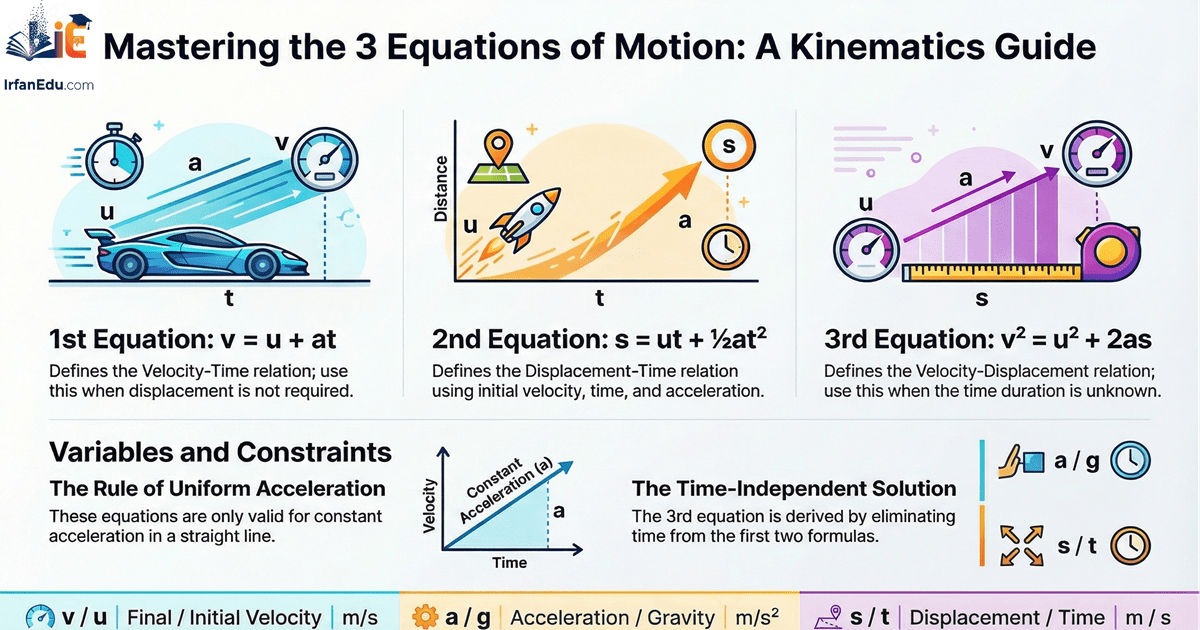
1st Equation: v = u + at
Solve for: final velocity, initial velocity, acceleration, or time
Solve For
⚠️ Please enter valid numbers in all required fields!
✅ Result
v = u + at
FINAL VELOCITY
—
m/s
Step-by-Step Solution
⚡
1st Equation of Motion
Relates final velocity to initial velocity, acceleration and time. Used when displacement is not required.
v = u + at
📐
2nd Equation of Motion
Gives displacement in terms of initial velocity, time and acceleration. Derived by integrating velocity.
s = ut + ½at²
🔮
3rd Equation of Motion
Connects velocity and displacement without time. Most useful in projectile & free-fall problems.
v² = u² + 2as
📌
Derivation Summary
How each equation is derived
1
From definition of acceleration: a = (v−u)/t → rearranging gives v = u + at
2
Average velocity = (u+v)/2. Displacement = avg velocity × time → s = ut + ½at²
3
Eliminate t from 1st & 2nd equations → v² = u² + 2as (time-independent equation)
⚠️
All three equations are valid only for uniform acceleration (constant a) in a straight line.
🔢
Variables & Symbols
All symbols used in equations of motion
| Symbol | Quantity | SI Unit | Type | Notes |
|---|---|---|---|---|
| v | Final Velocity | m/s | Vector | Velocity at end of motion |
| u | Initial Velocity | m/s | Vector | Velocity at start of motion |
| a | Acceleration | m/s² | Vector | Must be constant (uniform) |
| t | Time | s | Scalar | Duration of motion |
| s | Displacement | m | Vector | Straight-line distance |
| g | Gravity | 9.81 m/s² | Vector | Use 10 m/s² for NCERT |
Leave a Reply