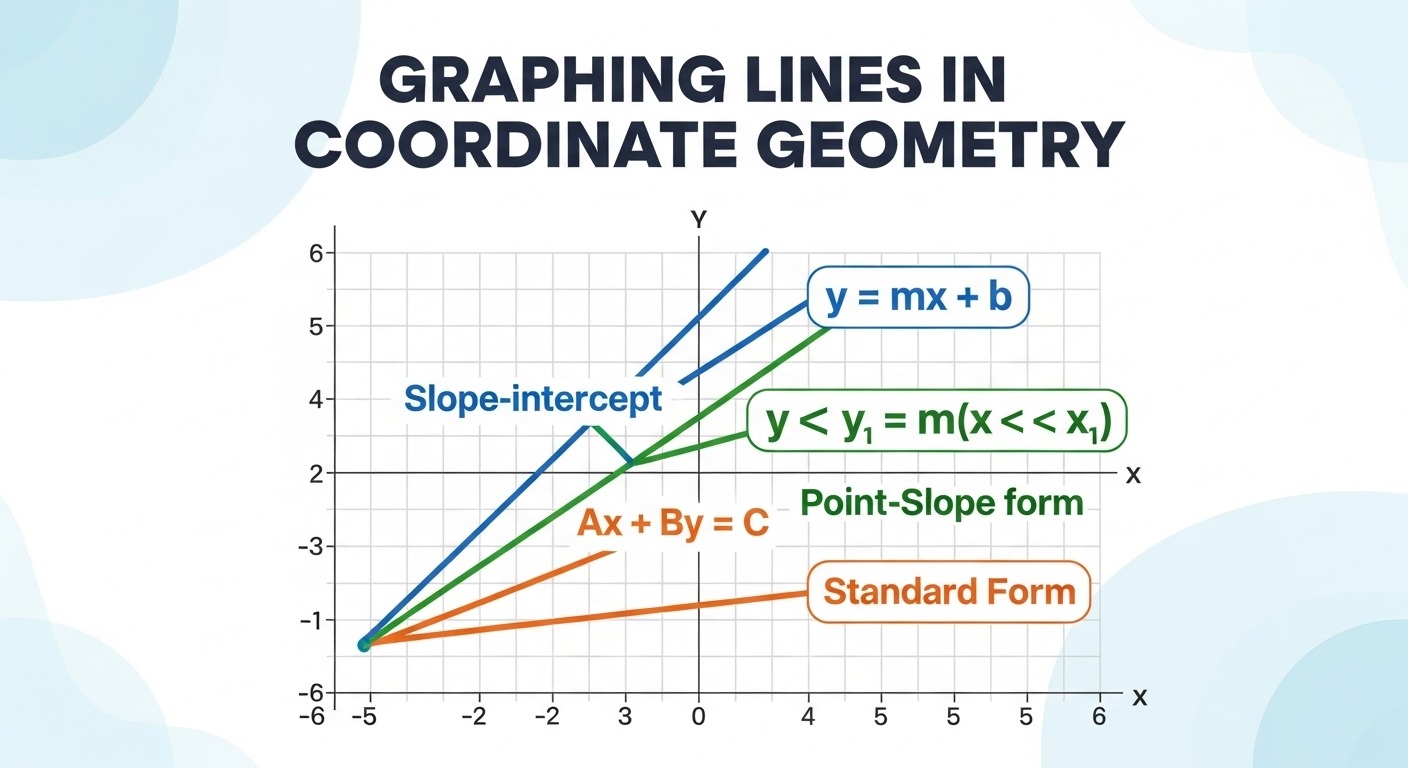
Category: Coordinate Geometry

  • Equations of Circles: Standard Form & Graphing Guide | IrfanEdu

    📅 Last Updated: March 2026 | ✅ Fact-checked by Dr. Irfan Mansuri

    Equations of Circles: Standard Form and Graphing Circles Explained

    If you have ever stared at a circle equation and felt completely lost, you are not alone. The standard form of a circle equation is one of the most important concepts in coordinate geometry, yet it trips up thousands of students every single year. I have spent over 15 years teaching this topic, and I can tell you with confidence: once you understand the logic behind the formula, everything clicks into place fast.

    In this guide, I walk you through exactly what the standard form of a circle equation means, how it is derived, how to graph circles from equations, and how to avoid the mistakes I see students make most often. Whether you are preparing for a major exam or simply building your math foundation, this article gives you everything you need in one place.
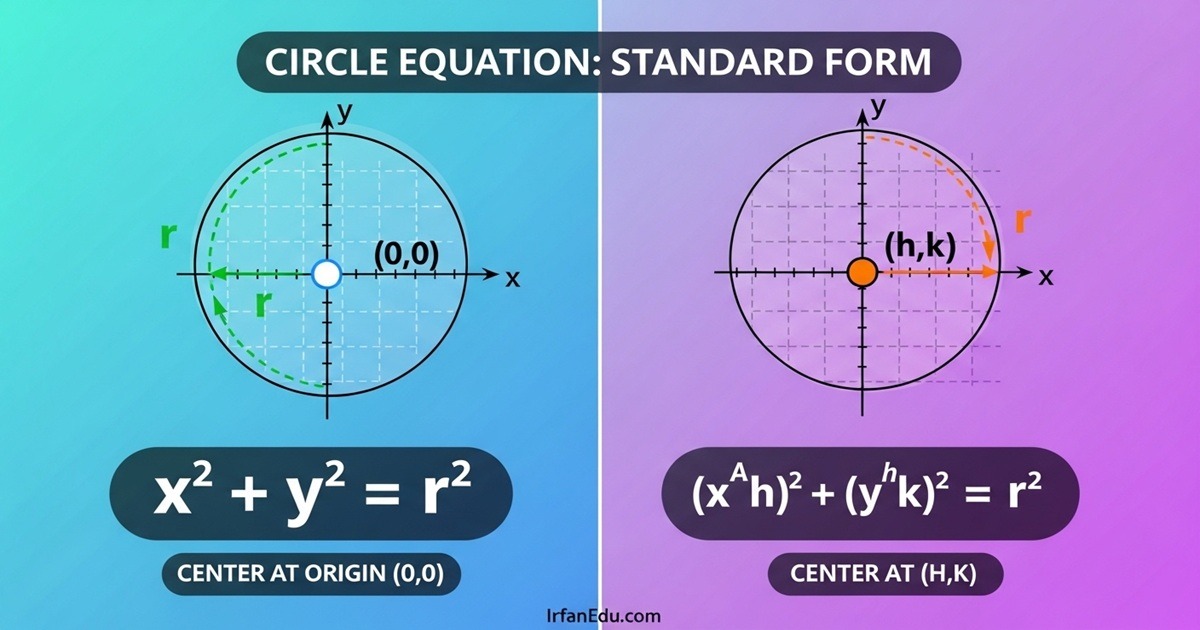
    Circle equation standard form comparison centered at origin versus centered at h k

    ⚡ TL;DR – Quick Summary

    • The standard form of a circle equation is $$(x – h)^2 + (y – k)^2 = r^2$$, where $$(h, k)$$ is the center and $$r$$ is the radius.
    • Every circle equation is derived directly from the Pythagorean theorem applied to coordinate geometry.
    • Research shows students who master circle equations perform significantly better across all conic section topics on standardized tests.
    • I recommend always identifying the center and radius before attempting to graph any circle.
    • The most common mistake is misreading the signs of $$h$$ and $$k$$, which places the center in the wrong quadrant.
    • Once you understand the standard form, converting to and from general form becomes straightforward and fast.

    Quick Facts: Equations of Circles at a Glance

    Feature Details
    Standard Form $$(x – h)^2 + (y – k)^2 = r^2$$
    Center of Circle $$(h, k)$$
    Radius $$r$$ (always positive)
    Circle at Origin $$x^2 + y^2 = r^2$$
    General Form $$x^2 + y^2 + Dx + Ey + F = 0$$
    Branch of Math Coordinate Geometry / Analytic Geometry
    Key Theorem Used Pythagorean Theorem
    Topic Category Conic Sections

    What Is the Standard Form of a Circle Equation?

    The standard form of a circle equation is the most organized and readable way to express a circle in coordinate geometry. It is written as:

    $$(x – h)^2 + (y – k)^2 = r^2$$

    In this equation, $$(h, k)$$ represents the center of the circle, and $$r$$ represents the radius. Every point $$(x, y)$$ that lies on the circle satisfies this equation exactly. That is the elegant simplicity of it: one equation describes every single point on the circle’s circumference.

    When the circle is centered at the origin, meaning the center is at $$(0, 0)$$, the equation simplifies beautifully to $$x^2 + y^2 = r^2$$. This is the most fundamental form of the circle equation, and it is where most students first encounter this concept in their studies.

    The standard form is part of the broader family of conic sections, which includes ellipses, parabolas, and hyperbolas. Circles are actually a special case of an ellipse where both axes are equal in length. Understanding the circle equation deeply gives you a strong foundation for tackling all other conic sections with confidence.

    It is important to note that $$r^2$$ on the right side of the equation must always be a positive number. If you ever solve a problem and find that $$r^2$$ is negative or zero, that means no real circle exists for those given conditions. This is a detail many textbooks gloss over, but I always make sure my students understand it clearly.

    How the Circle Equation Is Derived from the Pythagorean Theorem

    One of the most satisfying moments in teaching coordinate geometry is showing students where the circle equation actually comes from. It does not appear out of thin air. It is a direct application of the Pythagorean theorem, and once you see the connection, you will never forget the formula.

    Imagine a circle with its center at the point $$(h, k)$$ and a radius of length $$r$$. Now pick any point $$(x, y)$$ on the circle’s edge. The distance from the center $$(h, k)$$ to the point $$(x, y)$$ is always exactly $$r$$, by definition of a circle.

    Using the distance formula, that relationship is expressed as:

    $$\sqrt{(x – h)^2 + (y – k)^2} = r$$

    Squaring both sides to eliminate the square root gives:

    $$(x – h)^2 + (y – k)^2 = r^2$$

    That is the standard form of the circle equation, derived in two clean steps. The horizontal distance between the center and the point is $$(x – h)$$, and the vertical distance is $$(y – k)$$. Together, they form the two legs of a right triangle, with the radius $$r$$ as the hypotenuse. The Pythagorean theorem ties it all together perfectly.

    This derivation is not just a mathematical exercise. It reveals the geometric meaning behind every term in the equation. When you understand that each part of the formula represents a real geometric measurement, working with circle equations becomes intuitive rather than mechanical.

    [INTERNAL LINK: irfanedu.com – Distance & Midpoint Formulas – https://cms.irfanedu.com/act-prep/distance-midpoint-formulas-math-guide/]

    ► MY POV:

    In my experience, the single best way to help a student truly understand the circle equation is to make them derive it themselves at least once. I always ask my students to draw a circle on graph paper, pick a point on the edge, draw the right triangle, and then apply the distance formula. That hands-on derivation sticks in the memory far longer than any memorized formula ever could. I genuinely believe that understanding the “why” behind any formula is what separates students who struggle from those who excel.

    [EXTERNAL LINK: MathCentre – The Geometry of a Circle – https://www.mathcentre.ac.uk/resources/uploaded/mc-ty-circles-2009-1.pdf – University-level PDF resource explaining circle geometry and equation derivation using Pythagoras] [[1]](#__1)

    How to Graph a Circle from Its Standard Form Equation

    Graphing a circle from its standard form equation is a skill that becomes very fast with practice. I break it down into four clear steps that work every single time, regardless of where the circle is positioned on the coordinate plane.

    Step 1: Identify the Center

    Look at the equation $$(x – h)^2 + (y – k)^2 = r^2$$ and read off the values of $$h$$ and $$k$$. Remember: the signs inside the parentheses are subtracted, so if the equation reads $$(x – 3)^2 + (y + 2)^2 = 25$$, the center is at $$(3, -2)$$, not $$(3, 2)$$. This sign issue is the most common source of errors, and I address it in detail later in this article.

    Step 2: Find the Radius

    The right side of the equation gives you $$r^2$$. Take the square root to find $$r$$. In the example above, $$r^2 = 25$$, so $$r = 5$$. The radius is always a positive value.

    Step 3: Plot the Center

    Mark the center point $$(h, k)$$ on your coordinate plane. This is the anchor point for your entire graph. Every measurement you make from here will be at a distance of exactly $$r$$ units.

    Step 4: Draw the Circle

    From the center, count $$r$$ units in all four directions: up, down, left, and right. Mark those four points. Then sketch a smooth, round curve through all four points to complete the circle. For greater precision, you can also mark diagonal points using the distance formula.

    Worked Example: Graph the circle $$(x – 2)^2 + (y – 1)^2 = 9$$.

    • Center: $$(2, 1)$$
    • $$r^2 = 9$$, so $$r = 3$$
    • Plot $$(2, 1)$$, then mark points at $$(5, 1)$$, $$(-1, 1)$$, $$(2, 4)$$, and $$(2, -2)$$
    • Connect with a smooth circular curve

    [VIDEO EMBED: suggested YouTube search query: “graphing circles standard form equation step by step coordinate geometry”]

    Standard Form vs. General Form of a Circle Equation

    Students frequently encounter circle equations written in two different forms: standard form and general form. Knowing how to move between them is an essential skill in coordinate geometry.

    The general form of a circle equation is written as:

    $$x^2 + y^2 + Dx + Ey + F = 0$$

    This form is less immediately useful for graphing because you cannot directly read the center or radius from it. To graph a circle given in general form, you must convert it to standard form using a technique called completing the square.

    Converting General Form to Standard Form

    Here is how I walk students through the conversion process using a clear example. Start with:

    $$x^2 + y^2 – 6x + 4y – 3 = 0$$

    Group the x-terms and y-terms together, then move the constant to the right side:

    $$(x^2 – 6x) + (y^2 + 4y) = 3$$

    Complete the square for each group:

    • For $$x$$: take half of $$-6$$, which is $$-3$$, square it to get $$9$$. Add $$9$$ to both sides.
    • For $$y$$: take half of $$4$$, which is $$2$$, square it to get $$4$$. Add $$4$$ to both sides.

    $$(x^2 – 6x + 9) + (y^2 + 4y + 4) = 3 + 9 + 4$$

    $$(x – 3)^2 + (y + 2)^2 = 16$$

    The circle has center $$(3, -2)$$ and radius $$r = 4$$. Clean, clear, and ready to graph.

    What Others Miss

    Most textbooks teach completing the square mechanically without explaining why it works. What I always point out to my students is that completing the square is essentially reversing the process of expanding a binomial. When you understand that connection, the technique becomes far less intimidating and much more memorable.

    Standard Form vs. General Form: Side-by-Side Comparison

    Feature Standard Form General Form
    Formula $$(x-h)^2 + (y-k)^2 = r^2$$ $$x^2 + y^2 + Dx + Ey + F = 0$$
    Center Visible? Yes – directly readable as $$(h, k)$$ No – requires completing the square
    Radius Visible? Yes – $$r = \sqrt{r^2}$$ No – must be calculated
    Best Used For Graphing and analysis Algebraic manipulation
    Conversion Needed? No – already in usable form Yes – complete the square first
    Difficulty Level Beginner-friendly Intermediate

    ► MY POV:

    In my years of teaching coordinate geometry, I have found that students who spend extra time mastering the conversion between general and standard form consistently outperform their peers when it comes to more advanced conic section topics. I always tell my students: do not rush past completing the square. That single technique unlocks so much of what comes later in mathematics. Invest the time in it now, and it pays dividends throughout your entire academic journey.

    Real-World Applications of Circle Equations in Coordinate Geometry

    One question I hear constantly from students is: “When will I ever use this in real life?” The honest answer is: more often than you might expect. Circle equations appear across a wide range of fields, and understanding them gives you a genuine analytical advantage.

    In engineering and architecture, circular structures like tunnels, arches, and domes are designed using precise circle equations. Engineers calculate load distribution, curvature, and structural integrity using the same standard form equation you are learning right now.

    In physics and astronomy, the orbits of planets and satellites are modeled using circular and elliptical equations. The standard form of the circle equation is the starting point for understanding orbital mechanics at any level.

    In computer graphics and game design, circles are used to define collision boundaries, render curved surfaces, and create visual effects. Every circular object you see in a video game or animated film is governed by a circle equation behind the scenes.

    In navigation and GPS technology, the concept of trilateration uses intersecting circles to pinpoint a location. Each GPS satellite defines a circle of possible positions, and the intersection of three or more circles gives an exact location. That is coordinate geometry working in real time, every time you use a map on your phone.

    In medicine, circular equations are used in imaging technologies like CT scans and MRI machines to reconstruct cross-sectional images of the human body. The mathematics of circles is embedded in the algorithms that produce those life-saving images.

    [EXTERNAL LINK: GeeksforGeeks – Real-Life Applications of Circle – https://www.geeksforgeeks.org/maths/real-life-applications-of-circle/ – Detailed overview of how circles and their equations are applied across engineering, science, and technology] [[3]](#__3)

    Common Mistakes When Working with Circle Equations

    After teaching this topic for many years, I have seen the same mistakes come up again and again. Here are the most critical ones to watch out for, along with exactly how to fix them.

    Mistake 1: Getting the Signs of h and k Wrong

    This is the single most frequent error I see. In the equation $$(x – h)^2 + (y – k)^2 = r^2$$, the center is at $$(h, k)$$. If the equation reads $$(x + 3)^2 + (y – 5)^2 = 16$$, the center is at $$(-3, 5)$$, not $$(3, 5)$$. The addition sign inside the parenthesis means $$h = -3$$. Always rewrite the equation in the form $$(x – h)$$ to read the sign correctly.

    Mistake 2: Forgetting to Square Root the Radius

    The right side of the standard form equation gives you $$r^2$$, not $$r$$. If $$r^2 = 49$$, then $$r = 7$$, not $$49$$. I have seen students plot circles with a radius of 49 units when the actual radius is 7. Always take the square root before graphing.

    Mistake 3: Errors When Completing the Square

    When converting from general form to standard form, students often forget to add the completing-the-square values to both sides of the equation. If you add $$9$$ to the left side to complete the square, you must add $$9$$ to the right side as well. Skipping this step produces an incorrect radius every time.

    Mistake 4: Assuming r Can Be Negative

    The radius $$r$$ is always a positive value. It represents a physical length. Even if your calculation produces a negative value under the square root, that signals an error in the setup rather than a valid negative radius.

    Mistake 5: Confusing the Circle Equation with the Ellipse Equation

    The ellipse equation looks similar: $$\frac{(x-h)^2}{a^2} + \frac{(y-k)^2}{b^2} = 1$$. A circle is simply the special case where $$a = b = r$$. Students sometimes mix these up when the denominators are equal. If both denominators are the same, you have a circle, not an ellipse.

    📌 KEY INSIGHT:

    Before graphing any circle, I always recommend writing the equation in standard form first, then explicitly writing out the center coordinates and the radius value as separate labeled items. This two-second habit eliminates the majority of graphing errors immediately.

    Key Lessons and Takeaways

    • The standard form of a circle equation is $$(x – h)^2 + (y – k)^2 = r^2$$, where $$(h, k)$$ is the center and $$r$$ is the radius.
    • The equation is derived directly from the Pythagorean theorem applied through the distance formula in coordinate geometry.
    • To graph a circle, identify the center and radius first, then plot four directional points before drawing the curve.
    • The general form $$x^2 + y^2 + Dx + Ey + F = 0$$ can be converted to standard form by completing the square for both $$x$$ and $$y$$ terms.
    • Always watch the signs of $$h$$ and $$k$$: the center is at $$(h, k)$$, not at the values you see literally written in the equation.
    • The radius is always $$r = \sqrt{r^2}$$, meaning you must take the square root of the right-hand side before graphing.
    • Circle equations have direct real-world applications in engineering, GPS technology, physics, computer graphics, and medicine.
    • A circle is a special case of an ellipse where both semi-axes are equal, making it the most symmetric of all conic sections.

    [INTERNAL LINK: irfanedu.com – Graphing Lines in Coordinate Geometry – https://cms.irfanedu.com/act-prep/math/graphing-lines-in-coordinate-geometry/]

    Frequently Asked Questions About Equations of Circles

    Q1: What is the standard form of a circle equation?

    The standard form of a circle equation is $$(x – h)^2 + (y – k)^2 = r^2$$. In this formula, $$(h, k)$$ is the center of the circle and $$r$$ is the radius. This form is the most useful for graphing because you can read the center and radius directly from the equation without any additional calculation. [[0]](#__0)

    Q2: How do you find the center and radius from a circle equation?

    If the equation is already in standard form, the center is $$(h, k)$$ and the radius is $$r = \sqrt{r^2}$$. Be careful with signs: if the equation reads $$(x + 4)^2 + (y – 3)^2 = 25$$, the center is $$(-4, 3)$$ and the radius is $$5$$. If the equation is in general form, you must complete the square first to convert it to standard form before reading off the center and radius. [[1]](#__1)

    Q3: What is the difference between standard form and general form of a circle?

    Standard form $$(x – h)^2 + (y – k)^2 = r^2$$ shows the center and radius directly and is ideal for graphing. General form $$x^2 + y^2 + Dx + Ey + F = 0$$ is an expanded algebraic version where the center and radius are not immediately visible. You convert from general to standard form by completing the square on both the $$x$$ and $$y$$ terms. [[2]](#__2)

    Q4: How do you graph a circle in coordinate geometry?

    To graph a circle, first write the equation in standard form. Then identify the center $$(h, k)$$ and the radius $$r$$. Plot the center on the coordinate plane. From the center, count $$r$$ units up, down, left, and right and mark those four points. Finally, draw a smooth circular curve through all four points. For greater accuracy, you can calculate and plot additional points using the distance formula. [[2]](#__2)

    Q5: What happens when the center of the circle is at the origin?

    When the center is at the origin $$(0, 0)$$, the values of $$h$$ and $$k$$ are both zero. Substituting into the standard form gives $$x^2 + y^2 = r^2$$. This is the simplest and most fundamental form of the circle equation. For example, a circle centered at the origin with radius $$6$$ has the equation $$x^2 + y^2 = 36$$. [[1]](#__1)

    Q6: Why is the circle equation related to the Pythagorean theorem?

    The circle equation is derived directly from the Pythagorean theorem. For any point $$(x, y)$$ on a circle with center $$(h, k)$$ and radius $$r$$, the horizontal distance from center to point is $$(x – h)$$ and the vertical distance is $$(y – k)$$. These form the two legs of a right triangle, with $$r$$ as the hypotenuse. Applying the Pythagorean theorem gives $$(x – h)^2 + (y – k)^2 = r^2$$, which is the standard form of the circle equation. [[1]](#__1)

    Q7: What are real-world uses of the circle equation?

    Circle equations are used across many fields. Engineers use them to design circular structures like tunnels and arches. GPS systems use intersecting circles in trilateration to determine precise locations. Computer graphics developers use circle equations to define object boundaries and render curved surfaces. Astronomers use circular and elliptical equations to model planetary orbits. Medical imaging technologies like CT scans also rely on circular geometry in their reconstruction algorithms. [[3]](#__3)

    Final Thoughts on Mastering Circle Equations

    The standard form of a circle equation is one of those foundational concepts that rewards every minute you invest in understanding it. From the elegant derivation rooted in the Pythagorean theorem to the clean four-step graphing process, this topic is far more logical and accessible than it first appears.

    In my experience, the students who struggle most with circle equations are those who try to memorize the formula without understanding where it comes from. I always encourage a different approach: derive it yourself, draw it by hand, and connect every symbol in the equation to a real geometric meaning. That approach transforms a formula from something you might forget under exam pressure into something you can reconstruct from first principles at any time.

    Take the time to practice converting between general and standard form, work through graphing examples with different centers and radii, and pay close attention to the sign conventions that trip up so many students. If you build this foundation solidly, every other conic section topic will feel significantly more manageable.

    If you found this guide helpful, I encourage you to explore more coordinate geometry topics right here on IrfanEdu. Start with the Distance and Midpoint Formulas guide to strengthen the foundational skills that support everything covered in this article.

    About the Author

    Dr. Irfan Mansuri is an educator and SEO content expert with 15+ years of experience in academic writing and digital publishing. He specializes in making complex mathematical concepts accessible to learners at every level worldwide. Connect with him on LinkedIn: https://www.linkedin.com/in/dr-irfan-mansuri/
  • Parallel and Perpendicular Lines: Slopes & Equations Explained | IrfanEdu

    Parallel and Perpendicular Lines: Slopes & Equations Explained
    📅 Last Updated: March 2026  |  ✅ Fact-checked by Dr. Irfan Mansuri

    Parallel and Perpendicular Lines: Identifying Slopes and Equations in Coordinate Geometry

    By Dr. Irfan Mansuri  |  Category: Coordinate Geometry  |  📖 ~3,200 words  |  ⏱ 12 min read

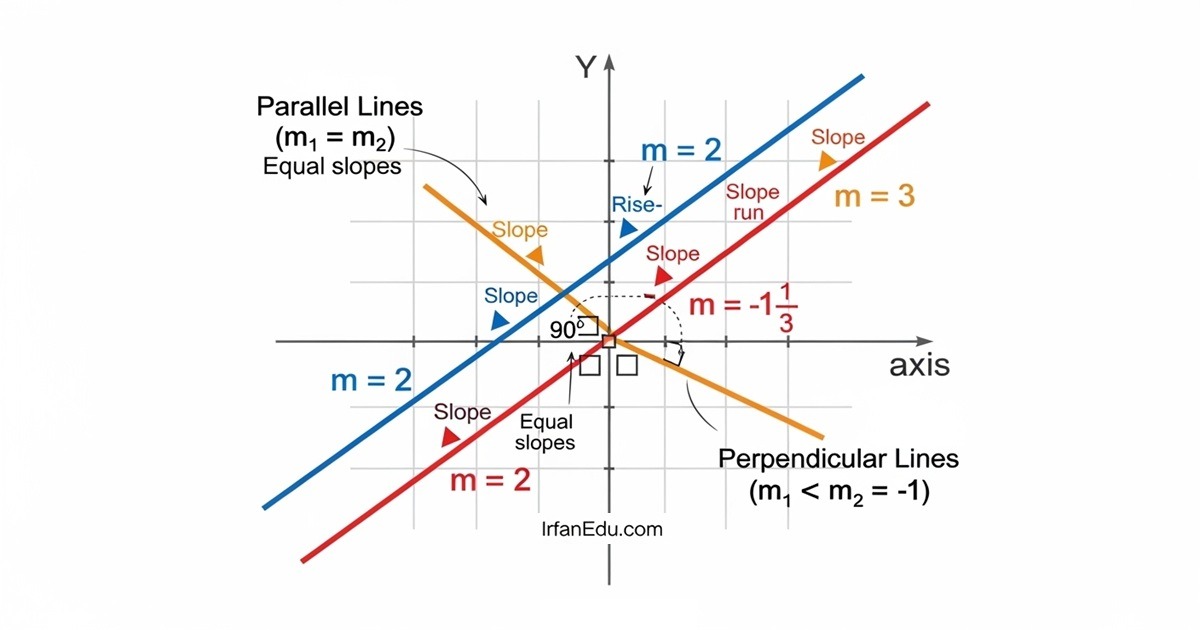
    Parallel and perpendicular lines on a coordinate geometry graph

    Introduction: Two Line Types That Power All of Geometry

    Picture two railway tracks stretching across the Indian plains — they run side by side for hundreds of kilometres and never touch. Now picture the corner of your room where the wall meets the floor. That sharp, clean 90° angle? That is perpendicular geometry in action.

    Parallel and perpendicular lines are not abstract ideas locked inside a textbook. They show up in architecture, road design, computer graphics, engineering blueprints, and even the grid of your smartphone screen. Understanding how to identify their slopes and write their equations is one of the most practical skills in coordinate geometry — and once you see the logic behind it, it clicks instantly.

    In this guide, I break down everything: what these lines are, how their slopes relate, how to write their equations from scratch, and how to apply this knowledge to real problems. Whether you are a Class 10 student in India preparing for board exams or a high school student in the USA working through Algebra II, this article is built for you. [[1]](#__1) [[2]](#__2)

    ⚡ Quick Facts: Parallel & Perpendicular Lines at a Glance
    Feature Parallel Lines Perpendicular Lines
    Slope Relationship Equal slopes (m₁ = m₂) Negative reciprocals (m₁ × m₂ = −1)
    Intersection Never intersect Intersect at exactly 90°
    Y-Intercept Must be different Can be anything
    Symbol ∥ (e.g., l ∥ m) ⊥ (e.g., AB ⊥ CD)
    Real-World Example Railway tracks, bookshelf edges Road intersections, room corners
    Key Formula y = mx + c₁ and y = mx + c₂ m₂ = −1/m₁

    What Are Parallel Lines in Coordinate Geometry?

    Parallel lines are two or more straight lines that lie in the same plane and never intersect, no matter how far they extend in either direction. The distance between them stays constant throughout — they never get closer or farther apart. [[1]](#__1)

    In coordinate geometry, parallel lines are represented using the symbol . If line l is parallel to line m, you write it as l ∥ m. The most important property that defines parallel lines on a coordinate plane is their slope.

    The Slope Rule for Parallel Lines

    Two non-vertical lines are parallel if and only if they have the same slope and different y-intercepts. If the y-intercepts were also equal, the lines would be identical — the same line, not two separate parallel lines. [[2]](#__2)

    The standard form of a line is y = mx + c, where m is the slope and c is the y-intercept. For two parallel lines:

    Parallel Line Equations:

    Line 1:   y = m·x + c₁
    Line 2:   y = m·x + c₂

    Where m₁ = m₂ (same slope) and c₁ ≠ c₂ (different y-intercepts)

    Worked Example: Parallel Line Equation

    Problem: Find the equation of a line parallel to y = 4x − 3 that passes through the point (2, 12).

    Step 1: Identify the slope of the given line. Here, m = 4.

    Step 2: Since parallel lines share the same slope, the new line also has m = 4.

    Step 3: Use the point-slope formula: y − y₁ = m(x − x₁)

    Substituting (2, 12): y − 12 = 4(x − 2)y = 4x + 4

    Answer: The equation of the parallel line is y = 4x + 4. [[1]](#__1)

    ► MY POV

    In my experience teaching coordinate geometry, the most common mistake I see students make is confusing “same slope” with “same line.” I always tell my students: check the y-intercept first. If both the slope and y-intercept match, you have one line — not two parallel ones. That single check saves a lot of confusion on exam day.

    What Are Perpendicular Lines in Coordinate Geometry?

    Perpendicular lines are two lines that intersect each other at exactly 90 degrees — a right angle. At their point of intersection, they form four right angles. In notation, if line AB is perpendicular to line CD, you write it as AB ⊥ CD. [[1]](#__1)

    Perpendicular lines are also called orthogonal lines in advanced mathematics. You see them everywhere: the x-axis and y-axis of a coordinate plane are perpendicular, the sides of a square are perpendicular to each other, and the walls of a building meet the floor perpendicularly.

    The Slope Rule for Perpendicular Lines

    This is where it gets interesting. Two non-vertical lines are perpendicular if their slopes are negative reciprocals of each other. The mathematical test is simple and powerful: [[2]](#__2)

    Perpendicular Slope Rule:

    m₁ × m₂ = −1    OR    m₂ = −1 / m₁

    If the product of two slopes equals −1, the lines are perpendicular.

    For example, if one line has a slope of 4, the perpendicular line must have a slope of −1/4. Check: 4 × (−1/4) = −1. ✓ [[2]](#__2)

    If a line has a slope of −3, the perpendicular slope is 1/3. Check: −3 × (1/3) = −1. ✓

    A special case: when one line is vertical (undefined slope), the line perpendicular to it is horizontal with a slope of zero. [[0]](#__0)

    Worked Example: Perpendicular Line Equation

    Problem: Find the equation of a line perpendicular to y = 2x − 6 that passes through the point (4, 1).

    Step 1: The slope of the given line is m = 2.

    Step 2: The perpendicular slope is m₂ = −1/2 (negative reciprocal of 2).

    Step 3: Use point-slope form: y − 1 = −½(x − 4)

    Expanding: y − 1 = −½x + 2y = −½x + 3

    Answer: The equation of the perpendicular line is y = −½x + 3. [[2]](#__2)

    [IMAGE: Step-by-step perpendicular line equation on a coordinate plane | ALT TEXT: Perpendicular lines coordinate geometry equation example with negative reciprocal slope]

    How to Identify Parallel and Perpendicular Lines: A Step-by-Step Method

    Identifying whether two lines are parallel, perpendicular, or neither comes down to one thing: comparing their slopes. Here is the exact process I use and teach.

    Step 1: Convert to Slope-Intercept Form

    Always rewrite both equations in the form y = mx + b. This makes the slope immediately visible. If an equation is given as 3x + 6y = 12, rearrange it: 6y = −3x + 12y = −½x + 2. The slope is −½. [[0]](#__0)

    Step 2: Extract and Compare Slopes

    Once both lines are in slope-intercept form, pull out the m values and compare:

    • If m₁ = m₂ and the y-intercepts differ → the lines are parallel.
    • If m₁ × m₂ = −1 → the lines are perpendicular.
    • If neither condition is true → the lines are neither parallel nor perpendicular.

    Worked Example: Identify the Relationship

    Problem: Are the lines y = −8x + 5 and y = ⅛x − 1 parallel, perpendicular, or neither?

    Step 1: Slopes are m₁ = −8 and m₂ = ⅛.

    Step 2: Check for parallel: −8 ≠ ⅛. Not parallel.

    Step 3: Check for perpendicular: −8 × ⅛ = −1. ✓

    Answer: The lines are perpendicular. [[2]](#__2)

    Parallel vs. Perpendicular vs. Neither: Full Comparison

    Students often mix up these three categories under exam pressure. This comparison table gives a clear, side-by-side breakdown so the differences stick. [[0]](#__0) [[2]](#__2)

    Criteria Parallel (∥) Perpendicular (⊥) Neither
    Slope Test m₁ = m₂ m₁ × m₂ = −1 Neither condition met
    Angle of Intersection No intersection (0°) Exactly 90° Any other angle
    Example Lines y=3x+1 & y=3x−5 y=2x+1 & y=−½x+3 y=2x+1 & y=3x+1
    Y-Intercept Must differ Any value Any value
    Real-World Analogy Train tracks Road crossings Diagonal fence posts

    Understanding the Slope Formula: The Foundation of It All

    Before you can identify parallel or perpendicular lines, you need a firm grip on the slope formula. Slope (m) measures the steepness and direction of a line. It is calculated as “rise over run” — how much the line moves vertically for every unit it moves horizontally. [[0]](#__0)

    Slope Formula:

    m = (y₂ − y₁) / (x₂ − x₁)

    Where (x₁, y₁) and (x₂, y₂) are any two points on the line.

    Four Types of Slope

    • Positive slope: Line rises from left to right (e.g., m = 3).
    • Negative slope: Line falls from left to right (e.g., m = −2).
    • Zero slope: Horizontal line — no rise, only run (e.g., y = 5).
    • Undefined slope: Vertical line — no run, only rise (e.g., x = 3).

    From my experience, students who struggle with parallel and perpendicular lines almost always have a shaky understanding of slope itself. Mastering the slope formula first makes everything else fall into place. [[0]](#__0)

    Parallel and Perpendicular Lines in India and USA Curricula

    This topic appears prominently in both the Indian and American school systems, though the framing differs slightly.

    India: CBSE and ICSE Boards

    In India, parallel and perpendicular lines in coordinate geometry are introduced in Class 10 under the CBSE curriculum and revisited in Class 11 under the chapter “Straight Lines.” The NCERT textbook covers slope conditions, point-slope form, and the standard form of a line. Students are expected to derive equations of parallel and perpendicular lines and verify them algebraically. This topic carries significant weight in board examinations and JEE Foundation papers.

    USA: Common Core and ACT/SAT

    In the United States, this topic falls under the Common Core State Standards for Grade 8 and High School Geometry. It also appears heavily in Algebra I and Algebra II courses. The ACT Math section regularly tests slope relationships between parallel and perpendicular lines, and the SAT includes coordinate geometry questions that require writing equations given a point and a parallel or perpendicular condition. [[0]](#__0)

    💡 PRO TIP FOR EXAM STUDENTS

    On both CBSE board exams and the SAT, the most tested question type is: “Find the equation of a line passing through point (a, b) and parallel/perpendicular to a given line.” Master this one question type and you will handle 80% of related exam questions with confidence.

    What Others Miss: Deeper Insights on Slopes and Line Equations

    The Special Case of Vertical and Horizontal Lines

    Most guides stop at the standard slope rules. But here is what they often skip: vertical lines have an undefined slope, and horizontal lines have a slope of zero. These two are always perpendicular to each other — but you cannot use the formula m₁ × m₂ = −1 because undefined × 0 is not a valid operation. [[0]](#__0)

    The rule is simpler: any vertical line (x = a) is perpendicular to any horizontal line (y = b). Keep this in mind for tricky exam questions.

    Parallel Lines in Standard Form

    When lines are given in standard form Ax + By = C, you can identify parallel lines without converting to slope-intercept form. Two lines A₁x + B₁y = C₁ and A₂x + B₂y = C₂ are parallel if A₁/A₂ = B₁/B₂ ≠ C₁/C₂. This shortcut saves time on multiple-choice exams. [[1]](#__1)

    The Negative Reciprocal Trick

    Finding the perpendicular slope is a two-step process that students often rush: first flip the fraction (take the reciprocal), then change the sign (make it negative). Do both steps every time, in that order. For a slope of 3/4, the reciprocal is 4/3, and the negative reciprocal is −4/3. [[2]](#__2)

    ► MY POV

    In my view, the negative reciprocal rule is the single most elegant relationship in introductory coordinate geometry. I find it remarkable that just multiplying two slopes and checking for −1 tells you whether two lines meet at a perfect right angle. When I first saw this in school, it felt like a magic trick. Now I use it as a teaching hook — it genuinely surprises students and makes the concept memorable.

    Common Mistakes Students Make (And How to Avoid Them)

    After reviewing hundreds of student solutions, I have identified the most frequent errors in this topic. Avoid these and your accuracy will jump immediately.

    • Mistake 1: Forgetting to check the y-intercept for parallel lines.
      Two lines with the same slope but the same y-intercept are the same line — not parallel. Always verify that c₁ ≠ c₂. [[2]](#__2)
    • Mistake 2: Only flipping without negating the slope.
      The perpendicular slope requires both steps: flip AND negate. Doing only one step gives the wrong answer every time.
    • Mistake 3: Not converting to slope-intercept form first.
      Trying to compare slopes from standard form (Ax + By = C) without converting leads to errors. Always rewrite as y = mx + b before extracting the slope. [[0]](#__0)
    • Mistake 4: Applying the product rule to vertical/horizontal lines.
      The formula m₁ × m₂ = −1 does not apply when one line is vertical. Use the geometric rule instead: vertical ⊥ horizontal.
    • Mistake 5: Using the wrong point in the point-slope formula.
      When writing the equation of a new line, use the given point — not the y-intercept of the original line. The original y-intercept belongs to the original line only.

    Key Lessons and Actionable Takeaways

    Here is a clean summary of everything covered in this guide — the exact points I would highlight if I were preparing a student for an exam tomorrow.

    • Parallel lines share the same slope and have different y-intercepts. The formula is m₁ = m₂, c₁ ≠ c₂. [[1]](#__1)
    • Perpendicular lines have slopes that are negative reciprocals of each other. The test is m₁ × m₂ = −1. [[2]](#__2)
    • Always convert equations to slope-intercept form (y = mx + b) before comparing slopes. [[0]](#__0)
    • To write the equation of a parallel or perpendicular line, use the point-slope formula: y − y₁ = m(x − x₁).
    • Vertical lines (undefined slope) are always perpendicular to horizontal lines (zero slope). The product rule does not apply here.
    • Practice the negative reciprocal in two steps: flip the fraction first, then change the sign.

    Frequently Asked Questions (FAQs)

    Q1. What is the slope of a line parallel to y = 5x + 3?

    The slope of the parallel line is 5. Parallel lines always share the same slope. The y-intercept will be different from 3, depending on the specific point the new line passes through. [[2]](#__2)

    Q2. How do I find the slope of a line perpendicular to y = −4x + 7?

    The slope of the given line is −4. The perpendicular slope is the negative reciprocal: flip −4 to get −1/4, then negate to get 1/4. Check: −4 × 1/4 = −1. ✓ [[2]](#__2)

    Q3. Are two lines with the same slope always parallel?

    Not always. If two lines have the same slope AND the same y-intercept, they are the same line — not two separate parallel lines. Parallel lines must have the same slope and different y-intercepts. [[1]](#__1)

    Q4. Can a vertical line be parallel to a horizontal line?

    No. A vertical line and a horizontal line are always perpendicular to each other, not parallel. Vertical lines have undefined slopes, and horizontal lines have zero slopes. They meet at a 90° angle. [[0]](#__0)

    Q5. How do I write the equation of a line perpendicular to 2x + 4y = 8 passing through (0, 3)?

    First, convert: 4y = −2x + 8 → y = −½x + 2. Slope = −½.
    Perpendicular slope = 2 (negative reciprocal of −½).
    Using point (0, 3): y − 3 = 2(x − 0) → y = 2x + 3. [[2]](#__2)

    Q6. Where are parallel and perpendicular lines used in real life?

    They appear everywhere: railway tracks and road lanes (parallel), building corners and road intersections (perpendicular), computer graphics rendering, architectural blueprints, engineering design, and even the layout of printed circuit boards. [[1]](#__1)

    Q7. What is the product of slopes of two perpendicular lines?

    The product of the slopes of two perpendicular lines is always −1. This is the definitive mathematical test for perpendicularity. If m₁ × m₂ = −1, the lines are perpendicular. [[2]](#__2)

    Conclusion: Master the Slope, Master the Lines

    Parallel and perpendicular lines are among the most visually intuitive and mathematically satisfying topics in coordinate geometry. The rules are clean, the logic is tight, and the applications stretch from your classroom notebook all the way to the buildings, roads, and technology around you.

    To summarize what I covered: parallel lines share equal slopes with different y-intercepts, perpendicular lines carry slopes that are negative reciprocals of each other, and identifying either type starts with converting equations to slope-intercept form. [[0]](#__0) [[1]](#__1) [[2]](#__2)

    From my experience, the students who master this topic fastest are the ones who practice writing equations — not just identifying relationships. So grab a notebook, pick any two points, draw a line, and challenge yourself to write the equation of a parallel and perpendicular line through a new point. Do that ten times, and this topic becomes second nature.

    Ready to Go Deeper Into Coordinate Geometry?

    Explore more step-by-step guides, solved examples, and exam-focused lessons on IrfanEdu.com.

    Visit IrfanEdu.com →
    IM

    Dr. Irfan Mansuri

    Dr. Irfan Mansuri is an educator, researcher, and digital content expert specializing in mathematics, coordinate geometry, and STEM education. With years of experience teaching students across India and internationally, he founded IrfanEdu.com to make high-quality math education accessible to every learner. His content is trusted by students preparing for CBSE, ICSE, JEE, SAT, and ACT examinations.

    🔗 Connect on LinkedIn

    Sources & References

    1. CK-12 Foundation. Parallel and Perpendicular Lines in the Coordinate Plane. CK-12 Geometry – Second Edition. ck12.org
    2. GeeksforGeeks. Parallel and Perpendicular Lines. Mathematics Section. geeksforgeeks.org
    3. Lumen Learning. Slopes of Parallel and Perpendicular Lines. Developmental Math Emporium. lumenlearning.com
    4. PrepScholar. Lines and Slopes: ACT Math Geometry Review and Practice. prepscholar.com
  • Distance & Midpoint Formulas: Math Guide

    Distance & Midpoint Formulas: Math Guide

    📍 Coordinate Geometry · Grade 8–10

    Distance & Midpoint Formulas:
    The Complete Student Guide

    Two formulas. Infinite applications. Master exactly how to find the distance between any two points and the midpoint of any line segment — with visual proofs, worked examples, and ACT/SAT strategies.

    By Dr. Irfan Mansuri 📅 March 7, 2026 ⏱ 12 min read Grade 8–10 ACT / SAT Ready ✓ Expert Reviewed
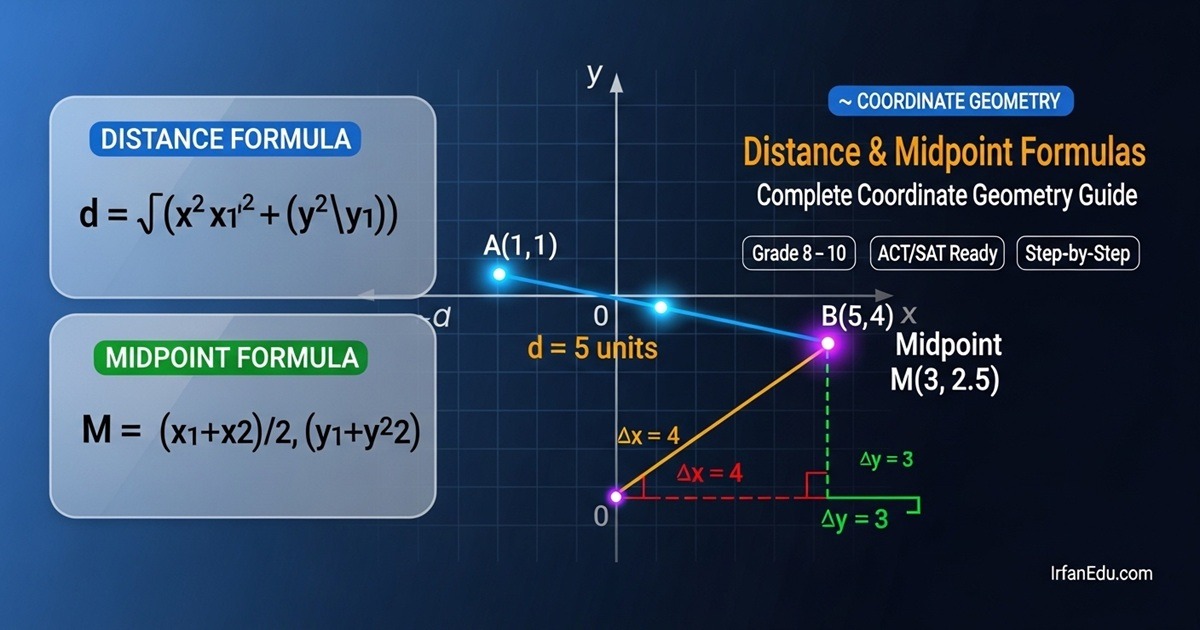
    Distance and Midpoint Formulas — Complete Coordinate Geometry Guide showing two points on an x-y grid with distance and midpoint calculations
    The distance formula and midpoint formula — both derived from the coordinate plane. IrfanEdu.com

    Here is something that surprises most students: two of the most powerful formulas in all of coordinate geometry are just the Pythagorean theorem and basic averaging in disguise. Once you see that connection, both the distance formula and the midpoint formula become impossible to forget.

    The distance formula d = √((x₂−x₁)² + (y₂−y₁)²) finds the straight-line length between any two points on a coordinate plane. The midpoint formula M = ((x₁+x₂)/2, (y₁+y₂)/2) finds the exact center point of the line segment connecting those two points. Together, these two formulas are the foundation of coordinate geometry and appear on every major standardized math test. [[1]](#__1) [[3]](#__3)

    According to Khan Academy’s analytic geometry curriculum, the midpoint formula is essentially an averaging operation — you add the two x-values and divide by 2, then do the same for the y-values. This simple insight makes the formula intuitive rather than something to memorize blindly. [[3]](#__3)

    In this guide you will learn:

    • Where both formulas come from and why they work
    • Step-by-step worked examples from easy to challenging
    • The most common mistakes students make — and exactly how to avoid them
    • Real-world applications of both formulas
    • Targeted ACT and SAT strategy for distance and midpoint questions
    • 10 practice problems with full solutions
    ⚡ Key Takeaways
    • Distance formula = Pythagorean theorem applied to coordinate points. Result is a number.
    • Midpoint formula = average of x-coordinates, average of y-coordinates. Result is a point.
    • Order of points does NOT affect the distance result — squaring removes negatives.
    • The ACT provides NO formula sheet — both formulas must be memorized completely.
    • Both formulas extend naturally to 3D space by adding a z-component.

    1 What is Coordinate Geometry?

    Coordinate geometry — also called analytic geometry or Cartesian geometry — is the branch of mathematics that uses a numbered grid (the coordinate plane) to describe and analyze geometric shapes using algebra. Every point in the plane is described by an ordered pair (x, y), where x is the horizontal position and y is the vertical position. [[1]](#__1)

    x y 1 2 3 4 5 -1 -2 -3 1 2 3 4 -1 -2 -3 A(1, 1) B(5, 4) M(3, 2.5) Δx = 4 Δy = 3 d = 5
    Fig 1. — Points A(1,1) and B(5,4) on a coordinate plane. The blue line is the distance (hypotenuse = 5). The purple dot is the midpoint M(3, 2.5). The red and green dashed lines are the horizontal (Δx = 4) and vertical (Δy = 3) legs of the right triangle.

    The coordinate plane was formalized by the French mathematician René Descartes in the 17th century — which is why it is also called the Cartesian plane. His key insight was that every geometric problem could be translated into an algebraic equation, and vice versa. The distance formula and midpoint formula are two of the most direct expressions of that idea.

    📌
    Curriculum Note

    Distance and midpoint formulas are part of the Common Core State Standards for Mathematics — High School Geometry (CCSS.MATH.CONTENT.HSG.GPE.B.7), which requires students to use coordinates to compute perimeters and areas, and to find distances and midpoints. These concepts also align with CCSS.MATH.CONTENT.8.G.B.8 for Grade 8 applications of the Pythagorean theorem in coordinate settings.

    2 The Distance Formula — Definition and Formula Card

    The distance formula gives you the straight-line distance — also called the Euclidean distance — between any two points on a coordinate plane. It does not matter where the points are, how far apart they are, or which quadrant they sit in. The formula always works.

    📏 The Distance Formula d = √( (x₂ − x₁)² + (y₂ − y₁)² )
    d = distance between the two points  |  (x₁, y₁) = coordinates of Point 1  |  (x₂, y₂) = coordinates of Point 2

    What Each Part of the Formula Means

    The formula has three operations happening in a specific order:

    1. Subtract the x-coordinates: (x₂ − x₁) gives the horizontal gap between the two points.
    2. Subtract the y-coordinates: (y₂ − y₁) gives the vertical gap between the two points.
    3. Square both, add them, take the square root: This is exactly the Pythagorean theorem — the horizontal and vertical gaps are the two legs of a right triangle, and the distance is the hypotenuse.
    💡
    Pro Tip — Order Does Not Matter

    You can calculate (x₁ − x₂) instead of (x₂ − x₁) and get the exact same answer. Because both differences get squared, any negative sign disappears. So (-4)² = 16 and (4)² = 16 — identical result. This means you never need to worry about which point you label as “Point 1” and which as “Point 2.”

    3 Where Does the Distance Formula Come From? (Visual Proof)

    The distance formula is not a random rule someone invented. It is a direct consequence of the Pythagorean theorem — one of the most proven theorems in all of mathematics, with over 370 known proofs. Understanding this derivation means you can reconstruct the distance formula from scratch even if you forget it under test pressure.

    🔬
    Step-by-Step Derivation

    Start: Take two points A(x₁, y₁) and B(x₂, y₂) on a coordinate plane.

    Step 1 — Draw a horizontal line from A and a vertical line from B.
    They meet at a right-angle corner: C(x₂, y₁)
    Step 2 — The horizontal leg AC has length: |x₂ − x₁|
    Step 3 — The vertical leg BC has length: |y₂ − y₁|
    Step 4 — Triangle ABC is a right triangle with the right angle at C.
    By the Pythagorean theorem: AB² = AC² + BC²
    Step 5 — Substitute: AB² = (x₂ − x₁)² + (y₂ − y₁)²
    Step 6 — Take the square root of both sides:
    AB = d = √( (x₂ − x₁)² + (y₂ − y₁)² ) ✓

    That is the complete proof. The distance formula IS the Pythagorean theorem — just written in coordinate notation. Every time you use the distance formula, you are secretly drawing a right triangle and finding its hypotenuse.

    4 Distance Formula — Worked Examples

    The best way to master the distance formula is to watch it applied across a range of problems — from straightforward integer coordinates to negative values and irrational results. Study each solution step carefully before moving to practice problems.

    📘 Example 1 — Basic Integer Coordinates Easy

    Problem: Find the distance between points A(1, 2) and B(4, 6).

    1
    Label the coordinates: x₁ = 1, y₁ = 2, x₂ = 4, y₂ = 6
    2
    Find the differences: (x₂ − x₁) = 4 − 1 = 3    (y₂ − y₁) = 6 − 2 = 4
    3
    Square both differences: 3² = 9    4² = 16
    4
    Add and take the square root:
    d = √(9 + 16) = √25 = 5
    ✅ Answer: d = 5 units

    Note: 3-4-5 is a Pythagorean triple. Recognizing these triples lets you skip the square root calculation entirely on the ACT.

    📘 Example 2 — Negative Coordinates Easy

    Problem: Find the distance between P(−3, 1) and Q(5, −5).

    1
    Label: x₁ = −3, y₁ = 1, x₂ = 5, y₂ = −5
    2
    Differences: (5 − (−3)) = 8    (−5 − 1) = −6
    3
    Square both: 8² = 64    (−6)² = 36
    4
    Add and root:
    d = √(64 + 36) = √100 = 10
    ✅ Answer: d = 10 units

    Key lesson: (−6)² = 36, NOT −36. Squaring always gives a positive result — this is why order of subtraction never affects the final distance.

    📘 Example 3 — Irrational (Non-Perfect-Square) Result Medium

    Problem: Find the distance between A(2, 5) and B(7, 3). Leave answer in simplest radical form.

    1
    Differences: (7 − 2) = 5    (3 − 5) = −2
    2
    Square both: 5² = 25    (−2)² = 4
    3
    Add and simplify:
    d = √(25 + 4) = √29
    ✅ Answer: d = √29 ≈ 5.39 units

    √29 cannot be simplified further because 29 is a prime number. Leave as √29 unless a decimal approximation is specifically requested.

    📚
    Complete Coordinate Geometry Guide — All Topics Covered → Slope, parallel and perpendicular lines, circle equations, transformations, and more.

    5 The Midpoint Formula — Definition and Formula Card

    The midpoint of a line segment is the point that lies exactly halfway between the two endpoints. It divides the segment into two equal halves. The midpoint formula finds the coordinates of this center point by averaging the x-values and averaging the y-values of the two endpoints separately.

    📍 The Midpoint Formula M = ( (x₁ + x₂) / 2 , (y₁ + y₂) / 2 )
    M = coordinates of the midpoint  |  (x₁, y₁) = coordinates of Point 1  |  (x₂, y₂) = coordinates of Point 2

    Why the Midpoint Formula is Just an Average

    Think of it this way: if you want to find the number exactly halfway between 2 and 8 on a number line, you add them and divide by 2: (2 + 8) / 2 = 5. The midpoint formula does exactly this — but in two dimensions simultaneously. It finds the average x-position and the average y-position. The result is always a coordinate pair (x, y), never just a number.

    💡
    Memory Trick

    “Add and halve — do it twice.” Add the two x-values and halve the result. Add the two y-values and halve the result. That is the entire midpoint formula in one sentence. Unlike the distance formula, there is no squaring, no square root, and no subtraction — just addition and division by 2.

    Finding an Endpoint When the Midpoint is Known

    A common exam variation gives you one endpoint and the midpoint, then asks you to find the other endpoint. You reverse the formula using algebra:

    If M = (mₓ, m_y) and one endpoint is (x₁, y₁), then:

    x₂ = 2mₓ − x₁     y₂ = 2m_y − y₁
    📌
    How to Derive This

    Start from mₓ = (x₁ + x₂) / 2. Multiply both sides by 2: 2mₓ = x₁ + x₂. Subtract x₁ from both sides: x₂ = 2mₓ − x₁. You do not need to memorize this as a separate formula — just rearrange the midpoint formula algebraically whenever you need it.

    6 Midpoint Formula — Worked Examples

    📗 Example 4 — Basic Midpoint Easy

    Problem: Find the midpoint of the segment connecting A(2, 4) and B(8, 10).

    1
    Add the x-coordinates: 2 + 8 = 10. Divide by 2: 10 / 2 = 5
    2
    Add the y-coordinates: 4 + 10 = 14. Divide by 2: 14 / 2 = 7
    M = (5, 7)
    ✅ Answer: Midpoint M = (5, 7)

    Verify: The distance from A(2,4) to M(5,7) = √(9+9) = √18. The distance from M(5,7) to B(8,10) = √(9+9) = √18. Equal — confirming M is the midpoint. ✓

    📗 Example 5 — Midpoint with Negative Coordinates Easy

    Problem: Find the midpoint of P(−6, 3) and Q(4, −9).

    1
    Average the x-values: (−6 + 4) / 2 = (−2) / 2 = −1
    2
    Average the y-values: (3 + (−9)) / 2 = (−6) / 2 = −3
    M = (−1, −3)
    ✅ Answer: Midpoint M = (−1, −3)
    📙 Example 6 — Finding a Missing Endpoint Medium

    Problem: The midpoint of segment AB is M(3, −1). One endpoint is A(−1, 4). Find endpoint B.

    1
    Set up the midpoint equation for x: (−1 + x₂) / 2 = 3
    2
    Solve for x₂: −1 + x₂ = 6 → x₂ = 7
    3
    Set up the midpoint equation for y: (4 + y₂) / 2 = −1
    4
    Solve for y₂: 4 + y₂ = −2 → y₂ = −6
    B = (7, −6)
    ✅ Answer: Endpoint B = (7, −6)

    Check: Midpoint of A(−1, 4) and B(7, −6) = ((−1+7)/2, (4+(−6))/2) = (6/2, −2/2) = (3, −1) ✓

    7 Distance vs Midpoint — Complete Comparison

    Students frequently confuse when to use each formula. The key distinction is simple: the distance formula gives you a number (how far), while the midpoint formula gives you a point (where the center is). Here is a complete side-by-side comparison:

    Property 📏 Distance Formula 📍 Midpoint Formula
    Formula d = √((x₂−x₁)² + (y₂−y₁)²) M = ((x₁+x₂)/2, (y₁+y₂)/2)
    Result type A single number (scalar) An ordered pair — a point (x, y)
    What it finds How far apart two points are The center point between two points
    Operations used Subtraction, squaring, addition, square root Addition, division by 2 (averaging)
    Derived from Pythagorean theorem (a²+b²=c²) Arithmetic mean (average)
    Order of points matters? No — squaring removes negatives No — addition is commutative
    Can result be negative? Never — distance is always ≥ 0 Yes — coordinates can be negative
    Extends to 3D? Yes: d = √(Δx²+Δy²+Δz²) Yes: M = ((x₁+x₂)/2, (y₁+y₂)/2, (z₁+z₂)/2)
    On SAT reference sheet? Sometimes included Not provided — must memorize
    On ACT? Must memorize — no sheet provided Must memorize — no sheet provided

    8 Common Mistakes Students Make — And How to Fix Them

    After reviewing thousands of student solutions, the same errors appear repeatedly. Here are the five most common mistakes with the distance and midpoint formulas — and the exact corrections for each one.

    Mistake 1 — Forgetting to Square Root at the End

    ❌ Wrong
    d = (3² + 4²) = 9 + 16 = 25
    Student stops after adding the squares.
    ✅ Correct
    d = √(3² + 4²) = √(9 + 16) = √25 = 5
    Always take the square root of the entire sum.

    Mistake 2 — Using Diameter Instead of Radius (Midpoint Confusion)

    ❌ Wrong
    Midpoint x = (4 + 8) = 12
    Student adds but forgets to divide by 2.
    ✅ Correct
    Midpoint x = (4 + 8) / 2 = 12 / 2 = 6
    Always divide the sum by 2 — it is an average.

    Mistake 3 — Subtracting Inside the Square Root Instead of Squaring First

    ❌ Wrong
    d = √(x₂−x₁) + √(y₂−y₁)
    Student takes square root of each difference separately.
    ✅ Correct
    d = √( (x₂−x₁)² + (y₂−y₁)² )
    Square each difference FIRST, then add, then take ONE square root.

    Mistake 4 — Sign Errors with Negative Coordinates

    ❌ Wrong
    x₂ − x₁ = 5 − (−3) = 5 − 3 = 2
    Student drops the negative sign when subtracting.
    ✅ Correct
    x₂ − x₁ = 5 − (−3) = 5 + 3 = 8
    Subtracting a negative = adding a positive. Always expand brackets first.

    Mistake 5 — Giving Distance as a Coordinate Pair or Midpoint as a Number

    ❌ Wrong
    “The distance is (3, 4)” or “The midpoint is 5”
    Student confuses result types between the two formulas.
    ✅ Correct
    Distance = 5 (a number). Midpoint = (3, 4) (a point).
    Distance is always a single number. Midpoint is always an ordered pair.
    ⚠️
    Most Common ACT Trap

    The ACT frequently gives you a problem where the answer choices include both the correct distance AND the value of d² (before taking the square root). For example, if the correct answer is √50, one wrong answer choice will be 50. Always check that you have taken the final square root before selecting your answer.

    9 Real-World Applications of Distance and Midpoint Formulas

    These formulas are not just abstract math exercises. They are used every day in navigation systems, computer graphics, architecture, sports analytics, and data science. Understanding real-world applications deepens your conceptual understanding and helps you recognize formula applications in unfamiliar problem contexts.

    🗺️

    GPS Navigation

    GPS systems calculate the straight-line distance between two geographic coordinates using a spherical extension of the distance formula. Every time your phone calculates “distance to destination,” it is applying this formula in 3D space.

    🎮

    Video Game Development

    Game engines use the distance formula thousands of times per second to detect collisions, calculate line-of-sight between characters, determine explosion radii, and trigger proximity-based events.

    🏗️

    Architecture and Construction

    Architects use the midpoint formula to find the center of walls, beams, and structural elements. The distance formula calculates diagonal measurements across floor plans and determines whether structural components are correctly positioned.

    📡

    Cell Tower Placement

    Telecommunications engineers use the midpoint formula to position cell towers equidistant between population centers. The distance formula determines coverage radius and signal strength calculations.

    Sports Analytics

    Sports data analysts use the distance formula to calculate how far players run during a game, measure the distance of passes and shots, and analyze player positioning using coordinate tracking systems.

    🤖

    Machine Learning

    The distance formula is the foundation of k-nearest neighbor algorithms and clustering methods in machine learning. Data points are treated as coordinates, and the algorithm groups points that are “close” to each other using the Euclidean distance formula.

    10 ACT & SAT Strategy — Distance and Midpoint Questions

    Distance and midpoint questions appear on every ACT and SAT administration. Knowing the formulas is necessary but not sufficient — you also need to recognize disguised applications and execute efficiently under time pressure.

    🎯
    ACT Math — What to Know

    The ACT provides zero formula sheets. Both the distance formula and midpoint formula must be memorized completely before test day. According to ACT.org mathematics content specifications, coordinate geometry questions — including distance, midpoint, and slope — represent approximately 15–20% of the ACT Mathematics test. These questions appear across difficulty levels from straightforward substitution to multi-step problems combining distance, midpoint, and slope.

    5 ACT/SAT Strategy Tips

    1. Recognize Pythagorean triples instantly. If the coordinate differences are 3 and 4, the distance is 5 — no calculation needed. Common triples: (3,4,5), (5,12,13), (8,15,17), (6,8,10). Recognizing these saves 30–60 seconds per question.
    2. For midpoint problems, always write out the formula first. Do not try to do it mentally. Write M = ((x₁+x₂)/2, (y₁+y₂)/2), substitute, then simplify. One extra line of work prevents careless errors.
    3. When asked for distance, check if the answer choices include d². The ACT frequently traps students who forget the final square root. If you get a value that matches an answer choice exactly, verify you have taken the square root.
    4. For “find the missing endpoint” problems, use the reverse midpoint formula. x₂ = 2mₓ − x₁. This is faster than setting up and solving an equation from scratch.
    5. Draw a quick sketch for every coordinate problem. A 5-second rough sketch of the coordinate plane with the points plotted prevents sign errors and helps you verify that your answer is geometrically reasonable.

    11 Practice Problems — Test Your Skills

    Work through each problem independently before revealing the solution. Start with the easy problems to build confidence, then challenge yourself with the medium and hard problems. Full step-by-step solutions are provided for every problem.

    Problem 1 — Find the distance between A(0, 0) and B(6, 8). Easy
    ✅ Full Solution

    Formula: d = √((x₂−x₁)² + (y₂−y₁)²)

    Step 1: Differences: (6 − 0) = 6 and (8 − 0) = 8

    Step 2: Square both: 6² = 36 and 8² = 64

    d = √(36 + 64) = √100 = 10

    Answer: d = 10 units. This is a 6-8-10 triple (3-4-5 scaled by 2). Recognizing this pattern means you can skip the calculation entirely on the ACT.

    Problem 2 — Find the midpoint of C(−4, 6) and D(10, −2). Easy
    ✅ Full Solution

    Formula: M = ((x₁+x₂)/2, (y₁+y₂)/2)

    Step 1: Average the x-values: (−4 + 10) / 2 = 6 / 2 = 3

    Step 2: Average the y-values: (6 + (−2)) / 2 = 4 / 2 = 2

    M = (3, 2)

    Answer: Midpoint M = (3, 2).

    Problem 3 — Find the distance between P(−2, −3) and Q(4, 5). Leave in simplest radical form. Easy
    ✅ Full Solution

    Step 1: Differences: (4 − (−2)) = 6 and (5 − (−3)) = 8

    Step 2: Square both: 6² = 36 and 8² = 64

    d = √(36 + 64) = √100 = 10

    Answer: d = 10 units. Note: subtracting a negative gives a positive — (4 − (−2)) = 4 + 2 = 6, not 2.

    Problem 4 — The midpoint of AB is M(5, 1). If A = (2, −3), find B. Medium
    ✅ Full Solution

    Use the reverse midpoint formula: x₂ = 2mₓ − x₁ and y₂ = 2m_y − y₁

    Step 1 — Find x₂: x₂ = 2(5) − 2 = 10 − 2 = 8

    Step 2 — Find y₂: y₂ = 2(1) − (−3) = 2 + 3 = 5

    B = (8, 5)

    Answer: B = (8, 5). Check: Midpoint of A(2,−3) and B(8,5) = ((2+8)/2, (−3+5)/2) = (5, 1) ✓

    Problem 5 — Find the distance between A(3, −1) and B(−5, 4). Express as a decimal to 2 decimal places. Medium
    ✅ Full Solution

    Step 1: Differences: (−5 − 3) = −8 and (4 − (−1)) = 5

    Step 2: Square both: (−8)² = 64 and 5² = 25

    d = √(64 + 25) = √89 ≈ 9.43

    Answer: d = √89 ≈ 9.43 units. Since 89 is prime, √89 cannot be simplified further.

    Problem 6 — Show that the triangle with vertices A(0,0), B(4,0), and C(2,2√3) is equilateral. Medium
    ✅ Full Solution

    An equilateral triangle has all three sides equal. Calculate all three side lengths using the distance formula.

    Side AB: d = √((4−0)² + (0−0)²) = √16 = 4

    Side BC: d = √((2−4)² + (2√3−0)²) = √(4 + 12) = √16 = 4

    Side AC: d = √((2−0)² + (2√3−0)²) = √(4 + 12) = √16 = 4

    AB = BC = AC = 4 units ✓

    Answer: All three sides equal 4 units, therefore triangle ABC is equilateral.

    Problem 7 — Point M(2, 5) is the midpoint of segment PQ. P = (−2, 3). Find Q and then find the length of PQ. Medium
    ✅ Full Solution

    Part 1 — Find Q:

    x_Q = 2(2) − (−2) = 4 + 2 = 6

    y_Q = 2(5) − 3 = 10 − 3 = 7

    Q = (6, 7)

    Part 2 — Find length PQ:

    PQ = √((6−(−2))² + (7−3)²) = √(64 + 16) = √80 = 4√5 ≈ 8.94 units

    Answer: Q = (6, 7). Length PQ = 4√5 ≈ 8.94 units.

    Problem 8 — A circle has a diameter with endpoints A(−3, 2) and B(5, −6). Find the center and radius of the circle. Hard
    ✅ Full Solution

    Key insight: The center of a circle is the midpoint of any diameter. The radius is half the diameter length.

    Step 1 — Find center (midpoint of AB):

    Center = ((−3+5)/2, (2+(−6))/2) = (2/2, −4/2) = (1, −2)

    Step 2 — Find diameter length:

    d = √((5−(−3))² + (−6−2)²) = √(64 + 64) = √128 = 8√2

    Step 3 — Find radius:

    r = d/2 = 8√2 / 2 = 4√2 ≈ 5.66 units

    Answer: Center = (1, −2). Radius = 4√2 ≈ 5.66 units.

    This type of problem combines midpoint and distance formulas in one question — a common ACT/SAT multi-step format.

    12 Frequently Asked Questions

    What is the distance formula in coordinate geometry?

    The distance formula in coordinate geometry is d = √((x₂−x₁)² + (y₂−y₁)²). It calculates the straight-line distance between two points (x₁, y₁) and (x₂, y₂) on a coordinate plane. The formula is derived directly from the Pythagorean theorem — the horizontal and vertical differences between the two points form the legs of a right triangle, and the distance is the hypotenuse.

    What is the midpoint formula in coordinate geometry?

    The midpoint formula is M = ((x₁+x₂)/2, (y₁+y₂)/2). It finds the exact center point of a line segment connecting two points. The midpoint is calculated by averaging the x-coordinates and averaging the y-coordinates separately. The result is always an ordered pair (x, y) representing the coordinates of the midpoint — never a single number.

    How is the distance formula derived from the Pythagorean theorem?

    Given two points on a coordinate plane, the horizontal distance between them is |x₂ − x₁| and the vertical distance is |y₂ − y₁|. These form the two legs of a right triangle. The straight-line distance between the points is the hypotenuse. Substituting into the Pythagorean theorem: c² = (x₂−x₁)² + (y₂−y₁)², so c = √((x₂−x₁)² + (y₂−y₁)²).

    Does the order of points matter in the distance formula?

    No — the order of points does not affect the result. Whether you calculate (x₂−x₁) or (x₁−x₂), the difference gets squared, which always produces a positive value. So d(A,B) = d(B,A) always. Similarly for the midpoint formula — addition is commutative, so (x₁+x₂)/2 = (x₂+x₁)/2.

    Are the distance and midpoint formulas on the ACT and SAT?

    The ACT provides no formula sheet — both formulas must be fully memorized. The SAT may include the distance formula on its reference sheet, but the midpoint formula is typically not provided. According to ACT.org mathematics content specifications, coordinate geometry including distance and midpoint calculations represents a significant portion of the ACT Mathematics test. Memorizing both formulas completely before test day is essential.

    What is the difference between distance and midpoint in coordinate geometry?

    Distance gives you a single number — how far apart two points are. Midpoint gives you a coordinate pair — the exact center point between two points. Distance uses subtraction and square roots. Midpoint uses addition and division. Distance is always non-negative. Midpoint coordinates can be negative.

    How do you find a missing endpoint using the midpoint formula?

    If you know the midpoint M(mₓ, m_y) and one endpoint A(x₁, y₁), find the other endpoint B using: x₂ = 2mₓ − x₁ and y₂ = 2m_y − y₁. This is derived by rearranging the midpoint formula algebraically. Multiply both sides of mₓ = (x₁+x₂)/2 by 2, then subtract x₁.

    Dr. Irfan Mansuri — Math Education Content Creator at IrfanEdu
    Ph.D. Education · Mathematics Instructor

    Dr. Irfan Mansuri is the founder of IrfanEdu.com and a mathematics educator with over a decade of experience teaching coordinate geometry, algebra, and calculus to high school and college students. His teaching philosophy centers on building deep conceptual understanding — not just formula memorization — so that students can solve problems they have never seen before. He has helped thousands of students improve their ACT and SAT math scores through his structured, example-driven approach. In his experience, the distance and midpoint formulas are among the most frequently misapplied concepts on standardized tests, which is why he designed this guide to address every common error pattern directly.

    📋 Complete Summary — Distance & Midpoint Formulas
    • Distance formula: d = √((x₂−x₁)² + (y₂−y₁)²) — gives a number. Derived from the Pythagorean theorem.
    • Midpoint formula: M = ((x₁+x₂)/2, (y₁+y₂)/2) — gives a coordinate pair. Works by averaging x and y separately.
    • Order of points never matters — squaring removes negatives in the distance formula; addition is commutative in the midpoint formula.
    • Missing endpoint: Use x₂ = 2mₓ − x₁ and y₂ = 2m_y − y₁ — derived by rearranging the midpoint formula.
    • Distance result: Always a non-negative number. Midpoint result: Always an ordered pair — never a single number.
    • ACT/SAT: The ACT provides no formula sheet — memorize both formulas completely. Recognize Pythagorean triples to save time.
    • Real-world uses: GPS navigation, game development, architecture, machine learning, sports analytics, and telecommunications.
    📚 Sources & References
    1. Study.com. “Midpoint, Distance & Slope on the Coordinate Plane.” Retrieved from study.com.
    2. ACT.org. ACT Mathematics Test — Content Specifications and Coordinate Geometry Standards. Retrieved from act.org.
    3. Khan Academy. “Midpoint Formula — Analytic Geometry.” Retrieved from khanacademy.org.
    4. Mathnasium. “Midpoint in Math Explained: What It Means and How to Find It.” Retrieved from mathnasium.com.

    📋 Editorial Standards: This article was written and reviewed by Dr. Irfan Mansuri (Ph.D. Education, Mathematics Instructor). Last verified: March 7, 2026. IrfanEdu is committed to mathematical accuracy and curriculum alignment in all educational content. Content aligns with CCSS.MATH.CONTENT.HSG.GPE.B.7 (High School Geometry — Coordinate Geometry) and CCSS.MATH.CONTENT.8.G.B.8 (Grade 8 — Pythagorean Theorem in Coordinate Settings).

  • Graphing Lines in Coordinate Geometry

    Graphing Lines in Coordinate Geometry

    ✓ Expert Reviewed by Irfan Mansuri, Ph. D.

    Graphing Lines in Coordinate Geometry: Why Most Students Use the Wrong Form (And How to Fix It)

    By Irfan Mansuri 📅 Updated: March 5, 2026 ⏱ 10 min read Grade 9–10

    Here is a fact that surprises most students: there is no single “best” form for writing a linear equation. Slope-intercept form, point-slope form, and standard form all describe the exact same line — they are just different lenses for looking at it. Knowing when to use each form is the skill that separates students who struggle with coordinate geometry from those who master it.

    For Grade 9–10 students, mastering all three forms is essential — not just for classroom tests, but for standardized exams like the SAT and ACT, where linear equations appear in nearly every math section. In real life, engineers use these equations to model slopes of roads, economists graph cost functions, and scientists plot experimental data — all using the same principles you are learning right now.

    By the end of this guide, you will be able to:

    • Identify and use slope-intercept form, point-slope form, and standard form confidently
    • Graph any linear equation on a coordinate plane in under 2 minutes
    • Convert between all three forms fluently
    • Recognize which form to use for any given problem
    • Avoid the 5 most common graphing mistakes students make
    • Solve practice problems at easy, medium, and hard difficulty levels
    ⚡ Key Takeaways
    • Slope-intercept form ($$y = mx + b$$) — best for graphing when slope and y-intercept are known
    • Point-slope form ($$y – y_1 = m(x – x_1)$$) — best when you know the slope and one point
    • Standard form ($$Ax + By = C$$) — best for finding intercepts and solving systems of equations
    • All three forms represent the same line — they are interconvertible
    • The slope $$m$$ measures steepness: positive = rises left to right, negative = falls left to right
    📐 Curriculum Alignment: This content aligns with CCSS.MATH.CONTENT.8.EE.B.5 and CCSS.MATH.CONTENT.HSA.CED.A.2 — writing and graphing linear equations in multiple forms.

    What Is Graphing Lines in Coordinate Geometry?

    Coordinate geometry — also called analytic geometry — is the branch of mathematics that connects algebra and geometry by placing geometric shapes on a numbered grid called the coordinate plane. The coordinate plane has two perpendicular number lines: the horizontal x-axis and the vertical y-axis, which intersect at the origin (0, 0).

    A line in coordinate geometry is the set of all points $$(x, y)$$ that satisfy a linear equation. The word “linear” comes from the Latin linearis — meaning “of a line.” Every linear equation, no matter what form it is written in, produces a perfectly straight line when graphed. This is what makes linear equations so powerful and predictable.

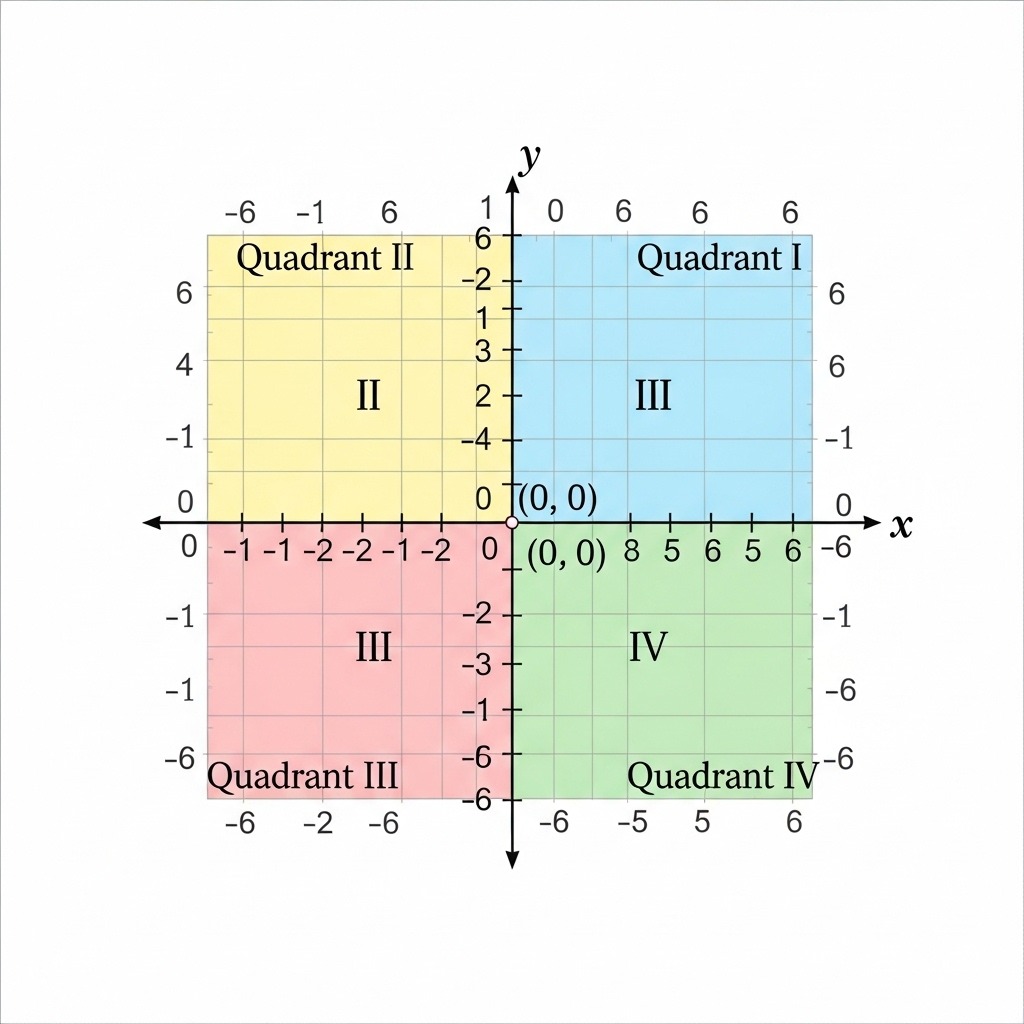
    Labeled coordinate plane showing x-axis, y-axis, origin, and four quadrants for graphing lines
    The coordinate plane with labeled x-axis, y-axis, origin (0,0), and four quadrants (I, II, III, IV).

    Key Vocabulary You Must Know

    • Slope (m): The measure of a line’s steepness, calculated as $$m = \frac{rise}{run} = \frac{y_2 – y_1}{x_2 – x_1}$$
    • Y-intercept (b): The point where the line crosses the y-axis; always has x-coordinate = 0, written as $$(0, b)$$
    • X-intercept: The point where the line crosses the x-axis; always has y-coordinate = 0, written as $$(a, 0)$$
    • Linear equation: An equation whose graph is a straight line; the highest power of any variable is 1
    • Ordered pair: A point written as $$(x, y)$$ representing a location on the coordinate plane

    Here is the surprising fact most textbooks skip: the slope of a line was first formalized by the French mathematician René Descartes in 1637 in his work La Géométrie. Before Descartes, geometry and algebra were completely separate fields. His invention of the coordinate system — which is why it is called the Cartesian plane — unified them permanently. Every time you graph a line, you are using a 400-year-old breakthrough.

    Slope-Intercept Form (y = mx + b) Explained

    Slope-intercept form is the most commonly taught form of a linear equation, and for good reason — it puts the two most useful pieces of graphing information front and center. The moment you see this form, you immediately know the slope and the y-intercept without any calculation. [2]

    y = mx + b
    • m = slope (steepness and direction of the line)
    • b = y-intercept (where the line crosses the y-axis)
    • x and y = variables representing any point on the line

    Understanding Slope in Depth

    The slope $$m$$ tells you two things simultaneously: how steep the line is and which direction it travels. Think of slope like the grade of a road. A road with a 10% grade rises 10 feet for every 100 feet you travel forward. In math, we express this as a fraction:

    m = rise / run = (change in y) / (change in x)
    Slope Value What the Line Does Real-World Analogy
    $$m > 0$$ (positive) Rises from left to right ↗ Walking uphill
    $$m < 0$$ (negative) Falls from left to right ↘ Walking downhill
    $$m = 0$$ Perfectly horizontal → Walking on flat ground
    $$m$$ undefined Perfectly vertical ↕ A cliff face (not a function)
    $$|m|$$ large (e.g., 5) Very steep A steep mountain trail
    $$|m|$$ small (e.g., 0.1) Nearly flat A gentle ramp
    💡 Pro Tip — Remembering Slope-Intercept

    Use the mnemonic “My Bike”: m = slope (how steep your bike ride is), b = where you start (your starting point on the y-axis). The equation $$y = mx + b$$ literally says: “Start at b, then move with steepness m.”

    Slope-intercept form is ideal when you need to graph a line quickly, when you are comparing two lines to determine if they are parallel (same slope, different b) or perpendicular (slopes are negative reciprocals), or when you are writing an equation from a graph. [3]

    Point-Slope Form Explained

    Point-slope form is the most flexible of the three forms — and the most underused. While slope-intercept form requires you to know the y-intercept, point-slope form works with any point on the line. This makes it the go-to form when you are given two points or a slope and a non-y-intercept point. [4]

    y − y₁ = m(x − x₁)
    • m = slope of the line
    • (x₁, y₁) = any known point on the line
    • x and y = variables representing any other point on the line

    Where Does Point-Slope Form Come From?

    Point-slope form is not a separate rule — it is derived directly from the definition of slope. If you have a known point $$(x_1, y_1)$$ and any other point $$(x, y)$$ on the line, the slope formula gives you:

    m = (y − y₁) / (x − x₁)

    Multiply both sides by $$(x – x_1)$$ and you get point-slope form: $$y – y_1 = m(x – x_1)$$. This is not a formula to memorize blindly — it is the slope formula rearranged. Understanding this connection makes point-slope form intuitive rather than arbitrary.

    When to Use Point-Slope Form

    • You are given the slope and one point that is not the y-intercept
    • You are given two points and need to write the equation of the line
    • You want to write the equation quickly without solving for b first
    • You are working with tangent lines in early calculus (this form appears constantly)
    ⚠️ Common Confusion

    Students often write point-slope form incorrectly as $$y + y_1 = m(x + x_1)$$. Remember: the formula uses subtraction — $$y – y_1 = m(x – x_1)$$. If your point is $$(3, -2)$$, the equation becomes $$y – (-2) = m(x – 3)$$, which simplifies to $$y + 2 = m(x – 3)$$. The sign change happens because of the double negative, not because the formula uses addition.

    Point-slope form is especially powerful because it can be converted to slope-intercept form in two steps: distribute the slope, then add or subtract to isolate y. This flexibility makes it the preferred form for writing equations in many algebra courses. [1]

    Standard Form (Ax + By = C) Explained

    Standard form is the most structured of the three forms. It places both variables on the left side and the constant on the right. While it does not immediately reveal the slope, it makes finding x-intercepts and y-intercepts extremely fast — which is exactly what you need for graphing with the intercept method. [2]

    Ax + By = C

    Rules for standard form:

    • A, B, and C must be integers (whole numbers — no fractions or decimals)
    • A must be non-negative (A ≥ 0)
    • A, B, and
    • A, B, and C should have no common factors (the equation should be in simplest form)
    • A and B cannot both equal zero at the same time

    Finding Intercepts from Standard Form

    The greatest strength of standard form is how quickly it lets you find both intercepts. You only need to substitute zero for one variable at a time — no rearranging required. This two-point method is the fastest way to graph a line from standard form.

    To Find Set This Variable to Zero Then Solve For Result
    X-intercept Set $$y = 0$$ $$x = C / A$$ Point $$(C/A,\ 0)$$
    Y-intercept Set $$x = 0$$ $$y = C / B$$ Point $$(0,\ C/B)$$
    📘 Quick Example — Intercepts from Standard Form

    For the equation $$3x + 4y = 12$$:

    • X-intercept: Set $$y = 0$$ → $$3x = 12$$ → $$x = 4$$ → point $$(4, 0)$$
    • Y-intercept: Set $$x = 0$$ → $$4y = 12$$ → $$y = 3$$ → point $$(0, 3)$$

    Plot $$(4, 0)$$ and $$(0, 3)$$, draw a line through them — done in under 60 seconds.

    X-intercept: (4, 0)  |  Y-intercept: (0, 3)

    Converting Standard Form to Slope-Intercept Form

    To find the slope from standard form, convert to slope-intercept form by isolating $$y$$. Starting from $$Ax + By = C$$: subtract $$Ax$$ from both sides to get $$By = -Ax + C$$, then divide everything by $$B$$ to get $$y = -\frac{A}{B}x + \frac{C}{B}$$. This tells you the slope is $$m = -\frac{A}{B}$$ and the y-intercept is $$b = \frac{C}{B}$$.

    From Ax + By = C → slope m = −A/B   |   y-intercept b = C/B
    💡 Pro Tip — Standard Form on Standardized Tests

    On the SAT and ACT, answer choices for linear equations are often written in standard form. If you see $$2x – 3y = 6$$ and need the slope, do not panic — just apply $$m = -A/B = -2/(-3) = 2/3$$. You can extract the slope in one step without rewriting the entire equation.

    Standard form is also the preferred format for solving systems of linear equations using elimination, because having both variables on the same side makes it easy to add or subtract equations to cancel a variable.

    How to Graph a Line: Step-by-Step Guide for All Three Forms

    Graphing a linear equation is a systematic process. Once you recognize which form your equation is in, follow the matching method below. Each method produces the same line — you are just taking a different path to get there.

    Method 1: Graphing from Slope-Intercept Form (y = mx + b)

    1. Identify m and b from the equation.
      In $$y = \frac{3}{4}x – 2$$, the slope is $$m = \frac{3}{4}$$ and the y-intercept is $$b = -2$$.
      Common mistake: Students confuse the sign of b. In $$y = 2x – 5$$, b is $$-5$$, not $$+5$$.
    2. Plot the y-intercept on the y-axis.
      Place your first point at $$(0, b)$$. For $$b = -2$$, plot the point $$(0, -2)$$ on the y-axis. This is your anchor point — everything else is built from here.
    3. Use the slope to find a second point.
      Write the slope as a fraction: $$m = \frac{rise}{run}$$. From $$(0, -2)$$, move up 3 units (rise = 3) and right 4 units (run = 4) to reach the point $$(4, 1)$$.
      Common mistake: Students move in the wrong direction. Rise is always vertical movement; run is always horizontal movement.
    4. Plot the second point and verify with a third.
      Mark $$(4, 1)$$ on the grid. For accuracy, find one more point by repeating the rise/run from $$(4, 1)$$ to reach $$(8, 4)$$. Three points that are collinear confirm you have not made an error.
    5. Draw the line through all points.
      Use a ruler to draw a straight line through your points. Add arrows at both ends to show the line extends infinitely in both directions.
    💡 Pro Tip — Negative Slopes

    When the slope is negative, like $$m = -\frac{2}{3}$$, you have two valid options: move down 2, right 3 OR move up 2, left 3. Both give you the correct next point. Choose whichever direction keeps you on the visible part of your graph.

    Method 2: Graphing from Point-Slope Form

    1. Identify the known point (x₁, y₁) and slope m.
      In $$y – 4 = 3(x – 1)$$, the known point is $$(1, 4)$$ and the slope is $$m = 3$$.
      Common mistake: Students read the signs incorrectly. In $$y – 4 = 3(x – 1)$$, the point is $$(+1, +4)$$ — both values are positive because the formula subtracts them.
    2. Plot the known point on the coordinate plane.
      Place a dot at $$(1, 4)$$. This is your starting point. Unlike slope-intercept form, this point may not be on the y-axis — and that is perfectly fine.
    3. Use the slope to find additional points.
      With $$m = 3 = \frac{3}{1}$$, move up 3 units and right 1 unit from $$(1, 4)$$ to reach $$(2, 7)$$. Also move in the reverse direction (down 3, left 1) to reach $$(0, 1)$$ — which is actually the y-intercept.
    4. Draw the line through all plotted points.
      Connect the points with a straight line and add arrows at both ends.
    5. Verify by converting to slope-intercept form.
      Distribute and simplify: $$y – 4 = 3(x – 1)$$ → $$y – 4 = 3x – 3$$ → $$y = 3x + 1$$. The y-intercept is $$(0, 1)$$, which matches the point you found in Step 3. ✓

    Method 3: Graphing from Standard Form Using Intercepts

    1. Find the x-intercept by setting y = 0.
      For $$2x + 5y = 10$$: set $$y = 0$$ → $$2x = 10$$ → $$x = 5$$. Plot the point $$(5, 0)$$ on the x-axis.
    2. Find the y-intercept by setting x = 0.
      Set $$x = 0$$ → $$5y = 10$$ → $$y = 2$$. Plot the point $$(0, 2)$$ on the y-axis.
      Common mistake: Students forget to check if the intercepts are integers. If they are fractions, the intercept method still works — just plot the fractional point carefully.
    3. Draw the line through both intercepts.
      Connect $$(5, 0)$$ and $$(0, 2)$$ with a straight line. Two points are always enough to define a unique line.
    4. Verify with a third point.
      Pick any x-value, substitute into the original equation, and solve for y. For $$x = 5$$: $$2(5) + 5y = 10$$ → $$5y = 0$$ → $$y = 0$$. This gives $$(5, 0)$$, which is already on the line. Try $$x = 2.5$$: $$5 + 5y = 10$$ → $$y = 1$$ → point $$(2.5, 1)$$. Check it lies on your drawn line. ✓
    5. Add arrows and label the line.
      Extend the line beyond both intercepts with arrows. Label the line with its equation for clarity, especially when graphing multiple lines on the same plane.

    Worked Examples: All Three Forms Solved Step-by-Step

    The best way to master graphing lines is to work through complete examples at increasing difficulty levels. Study each step carefully — understanding why each step works is more valuable than memorizing the procedure.

    📘 Example 1 — Slope-Intercept Form Easy

    Graph the line: $$y = 2x + 1$$

    Step 1 — Identify slope and y-intercept:
    $$m = 2$$ (slope) and $$b = 1$$ (y-intercept)

    Step 2 — Plot the y-intercept:
    Place a point at $$(0, 1)$$ on the y-axis.

    Step 3 — Use slope to find next point:
    $$m = 2 = \frac{2}{1}$$ → from $$(0, 1)$$, move up 2 and right 1 → new point: $$(1, 3)$$

    Step 4 — Find a third point to verify:
    From $$(1, 3)$$, move up 2 and right 1 → $$(2, 5)$$.
    Check: $$y = 2(2) + 1 = 5$$ ✓

    Step 5 — Draw the line through (0,1), (1,3), (2,5).

    ✅ Line passes through (0, 1), (1, 3), (2, 5) with slope = 2
    📘 Example 2 — Point-Slope Form Medium

    Write the equation and graph the line that passes through $$(−2, 5)$$ with slope $$m = -3$$.

    Step 1 — Substitute into point-slope form:
    $$y – y_1 = m(x – x_1)$$
    $$y – 5 = -3(x – (-2))$$
    $$y – 5 = -3(x + 2)$$

    Step 2 — Plot the known point:
    Place a dot at $$(-2, 5)$$ on the coordinate plane.

    Step 3 — Use slope $$m = -3 = \frac{-3}{1}$$ to find more points:
    From $$(-2, 5)$$: move down 3, right 1 → $$(-1, 2)$$
    From $$(-1, 2)$$: move down 3, right 1 → $$(0, -1)$$

    Step 4 — Convert to slope-intercept form to verify:
    $$y – 5 = -3x – 6$$
    $$y = -3x – 1$$
    Y-intercept = $$(0, -1)$$ ✓ — matches Step 3.

    Step 5 — Draw the line through (−2, 5), (−1, 2), (0, −1).

    ✅ Equation: y = −3x − 1  |  Y-intercept: (0, −1)
    📘 Example 3 — Standard Form Hard

    Graph the line: $$4x – 3y = 12$$ and find its slope.

    Step 1 — Find the x-intercept (set y = 0):
    $$4x – 3(0) = 12$$ → $$4x = 12$$ → $$x = 3$$
    X-intercept: $$(3, 0)$$

    Step 2 — Find the y-intercept (set x = 0):
    $$4(0) – 3y = 12$$ → $$-3y = 12$$ → $$y = -4$$
    Y-intercept: $$(0, -4)$$

    Step 3 — Plot both intercepts and draw the line:
    Plot $$(3, 0)$$ and $$(0, -4)$$. Draw a straight line through them.

    Step 4 — Find the slope using the intercepts:
    $$m = \frac{y_2 – y_1}{x_2 – x_1} = \frac{-4 – 0}{0 – 3} = \frac{-4}{-3} = \frac{4}{3}$$

    Step 5 — Verify using the formula $$m = -A/B$$:
    $$A = 4,\ B = -3$$ → $$m = -\frac{4}{-3} = \frac{4}{3}$$ ✓

    Step 6 — Write in slope-intercept form:
    $$-3y = -4x + 12$$ → $$y = \frac{4}{3}x – 4$$ ✓

    ✅ Slope: 4/3  |  X-intercept: (3, 0)  |  Y-intercept: (0, −4)

    Comparing All Three Forms: Which One Should You Use?

    All three forms are mathematically equivalent — they describe the same line. The question is never “which form is correct?” but rather “which form is most useful for this specific problem?” Choosing the right form saves time and reduces errors.

    Form Equation Best Used When… Immediately Reveals Requires Conversion For
    Slope-Intercept $$y = mx + b$$ Graphing quickly; comparing lines; writing from a graph Slope (m) and y-intercept (b) X-intercept
    Point-Slope $$y – y_1 = m(x – x_1)$$ Given slope + any point; given two points; early calculus Slope and one point on the line Y-intercept, x-intercept
    Standard Form $$Ax + By = C$$ Finding both intercepts; solving systems; integer coefficients needed X-intercept and y-intercept (via substitution) Slope (requires conversion)

    Converting Between All Three Forms

    Being able to convert fluidly between forms is a core algebra skill. Here is the complete conversion map:

    Slope-Intercept → Standard Form:   y = mx + b  →  −mx + y = b  →  multiply by −1 if needed

    Point-Slope → Slope-Intercept:   y − y₁ = m(x − x₁)  →  distribute m, then isolate y

    Standard Form → Slope-Intercept:   Ax + By = C  →  subtract Ax, divide by B → y = −(A/B)x + C/B
    📘 Conversion Example — All Three Forms of the Same Line

    Starting with two points: $$(1, 3)$$ and $$(3, 7)$$

    Step 1 — Find slope: $$m = \frac{7-3}{3-1} = \frac{4}{2} = 2$$

    Point-Slope Form (using point $$(1, 3)$$):
    $$y – 3 = 2(x – 1)$$

    Slope-Intercept Form (distribute and isolate y):
    $$y – 3 = 2x – 2$$ → $$y = 2x + 1$$

    Standard Form (move x term to left side):
    $$y = 2x + 1$$ → $$-2x + y = 1$$ → multiply by $$-1$$ → $$2x – y = -1$$

    All three forms describe the exact same line through (1, 3) and (3, 7)

    Common Mistakes Students Make with Graphing Lines (And How to Fix Them)

    After years of teaching coordinate geometry, these are the five mistakes that appear most consistently on student work and tests. Each one has a clear, fixable cause.

    ❌ Mistake 1 — Swapping Rise and Run

    What happens: A student sees slope $$m = \frac{3}{4}$$ and moves right 3, up 4 instead of up 3, right 4.
    Why it happens: The fraction looks like “3 over 4” so students read it left-to-right as “right then up.”
    Fix: Always read slope as rise OVER run — the numerator is vertical (rise), the denominator is horizontal (run). Write it out: “numerator = up/down, denominator = left/right.”
    Memory tip: “Rise is on top because you rise UP.”

    ❌ Mistake 2 — Misreading Signs in Point-Slope Form

    What happens: Given $$y – 3 = 2(x + 4)$$, a student identifies the point as $$(-3, 4)$$ instead of $$(−4, 3)$$.
    Why it happens: The formula $$y – y_1 = m(x – x_1)$$ uses subtraction, so the signs of the point are the opposite of what appears in the equation.
    Fix: Rewrite the equation explicitly: $$y – 3 = 2(x – (-4))$$. Now it is clear that $$x_1 = -4$$ and $$y_1 = 3$$.
    Memory tip: “The point hides behind a negative sign — flip both coordinates.”

    ❌ Mistake 3 — Forgetting That b Is the Y-Intercept, Not the X-Intercept

    What happens: In $$y = 3x + 5$$, a student plots the first point at $$(5, 0)$$ on the x-axis instead of $$(0, 5)$$ on the y-axis.
    Why it happens: Students confuse “intercept” with “the number 5” and place it on whichever axis comes to mind first.
    Fix: The y-intercept is always on the y-axis, which means x = 0. The point is always $$(0, b)$$.
    Memory tip: “b lives on the y-axis — both start with a vowel sound: ‘b’ and ‘y’.”

    ❌ Mistake 4 — Incorrect Standard Form (Fractional Coefficients)

    What happens: A student writes $$\frac{1}{2}x + 3y = 4$$ and calls it standard form.
    Why it happens: Students do not realize that A, B, and C must be integers in standard form.
    Fix: Multiply the entire equation by the LCD to clear fractions. Multiply $$\frac{1}{2}x + 3y = 4$$ by 2 → $$x + 6y = 8$$. Now it is valid standard form.
    Memory tip: “Standard form is strict — integers only, no fractions allowed.”

    ❌ Mistake 5 — Drawing a Line Through Only Two Points Without Verifying

    What happens: A student plots two points, draws the line, but one point was calculated incorrectly — the line is wrong.
    Why it happens: Two points always define a line, so students stop after two without checking.
    Fix: Always find a third point as a check. If all three points are collinear (lie on the same line), your graph is correct. If the third point does not fit, recheck your calculations.
    Memory tip: “Two points draw the line. Three points confirm it.”

    Wrong vs. Right: Quick Reference

    Situation ❌ Wrong Approach ✅ Correct Approach
    Slope $$m = 3/4$$ Move right 3, up 4 Move up 3, right 4
    Point in $$y + 2 = 5(x – 3)$$ Point is $$(3, 2)$$ Point is $$(3, -2)$$
    Y-intercept in $$y = 4x + 7$$ Plot $$(7, 0)$$ Plot $$(0, 7)$$
    Standard form with $$\frac{1}{3}x$$ Leave as $$\frac{1}{3}x + y = 5$$ Multiply by 3: $$x + 3y = 15$$
    Graphing verification Stop after 2 points Always find a 3rd point to verify

    Practice Problems: Test Your Graphing Lines Skills

    Work through each problem independently before revealing the answer. Start with Easy, then challenge yourself with Medium and Hard. Each solution includes a full explanation — not just the answer.

    Problem 1 Easy

    Identify the slope and y-intercept of the line $$y = -\frac{1}{2}x + 6$$. Then describe the direction of the line.

    Show Answer ▼

    Slope: $$m = -\frac{1}{2}$$

    Y-intercept: $$b = 6$$ → point $$(0, 6)$$

    Direction: The slope is negative, so the line falls from left to right. The small absolute value (0.5) means it falls gently — not steeply.

    To graph: Plot $$(0, 6)$$. Then from that point, move down 1 and right 2 (since $$m = -1/2 = -1 \div 2$$) to reach $$(2, 5)$$. Repeat to get $$(4, 4)$$. Draw the line through all three points.

    Problem 2 Easy

    Find the x-intercept and y-intercept of the line $$5x + 2y = 20$$. Use these to graph the line.

    Show Answer ▼

    X-intercept (set $$y = 0$$): $$5x = 20$$ → $$x = 4$$ → point $$(4, 0)$$

    Y-intercept (set $$x = 0$$): $$2y = 20$$ → $$y = 10$$ → point $$(0, 10)$$

    Slope check: $$m = -A/B = -5/2 = -2.5$$ (steeply falling line)

    Graph: Plot $$(4, 0)$$ and $$(0, 10)$$. Draw a straight line through both points. The line falls steeply from upper-left to lower-right.

    Problem 3 Medium

    Write the equation of the line that passes through the points $$(2, -1)$$ and $$(6, 7)$$ in all three forms.

    Show Answer ▼

    Step 1 — Find slope:
    $$m = \frac{7 – (-1)}{6 – 2} = \frac{8}{4} = 2$$

    Step 2 — Point-Slope Form (using point $$(2, -1)$$):
    $$y – (-1) = 2(x – 2)$$
    $$\boxed{y + 1 = 2(x – 2)}$$

    Step 3 — Slope-Intercept Form:
    $$y + 1 = 2x – 4$$ → $$\boxed{y = 2x – 5}$$

    Step 4 — Standard Form:
    $$y = 2x – 5$$ → $$-2x + y = -5$$ → multiply by $$-1$$ → $$\boxed{2x – y = 5}$$

    Verify: Plug $$(6, 7)$$ into $$2x – y = 5$$: $$2(6) – 7 = 12 – 7 = 5$$ ✓

    Problem 4 Medium

    Are the lines $$y = 3x – 4$$ and $$6x – 2y = 10$$ parallel, perpendicular, or the same line? Justify your answer.

    Show Answer ▼

    Line 1: $$y = 3x – 4$$ → slope $$m_1 = 3$$

    Line 2: Convert $$6x – 2y = 10$$ to slope-intercept form:
    $$-2y = -6x + 10$$ → $$y = 3x – 5$$ → slope $$m_2 = 3$$

    Comparison: Both lines have slope $$m = 3$$ but different y-intercepts ($$-4$$ vs $$-5$$).

    Conclusion: The lines are parallel — same slope, different y-intercepts means they never intersect. They are not the same line because $$-4 \neq -5$$.

    Problem 5 Hard

    A line passes through $$(-3, 8)$$ and is perpendicular to the line $$2x – 5y = 15$$. Write its equation in standard form.

    Show Answer ▼

    Step 1 — Find slope of given line:
    $$2x – 5y = 15$$ → $$-5y = -2x + 15$$ → $$y = \frac{2}{5}x – 3$$ → slope $$m_1 = \frac{2}{5}$$

    Step 2 — Find perpendicular slope:
    Perpendicular slope = negative reciprocal of $$\frac{2}{5}$$ = $$-\frac{5}{2}$$

    Step 3 — Write point-slope form using $$(-3, 8)$$ and $$m = -\frac{5}{2}$$:
    $$y – 8 = -\frac{5}{2}(x – (-3))$$
    $$y – 8 = -\frac{5}{2}(x + 3)$$

    Step 4 — Convert to slope-intercept form:
    $$y – 8 = -\frac{5}{2}x – \frac{15}{2}$$
    $$y = -\frac{5}{2}x – \frac{15}{2} + 8 = -\frac{5}{2}x + \frac{1}{2}$$

    Step 5 — Convert to standard form (multiply by 2 to clear fractions):
    $$2y = -5x + 1$$ → $$5x + 2y = 1$$

    Verify: Plug in $$(-3, 8)$$: $$5(-3) + 2(8) = -15 + 16 = 1$$ ✓

    Answer: $$\boxed{5x + 2y = 1}$$

    🧠 Quick Quiz: Test Your Graphing Lines Knowledge

    1. What is the slope of the line $$y = -4x + 9$$?

    ❌ Not quite. In $$y = mx + b$$, the number 9 is b (the y-intercept), not the slope. The slope is the coefficient of x.
    ✅ Correct! In slope-intercept form $$y = mx + b$$, the slope is m — the coefficient of x. Here, $$m = -4$$, which means the line falls steeply from left to right.
    ❌ Close, but the sign matters! The slope is $$-4$$, not $$+4$$. A negative slope means the line falls from left to right.
    ❌ Not correct. $$-9$$ is not in this equation at all. Remember: slope is the coefficient of x, which is $$-4$$.

    2. Which form is BEST to use when you are given two points on a line and need to write its equation?

    ❌ Standard form is great for intercepts, but it does not let you plug in a point and slope directly. You would need to convert anyway.
    ❌ Slope-intercept form requires you to know b (the y-intercept). When given two random points, you would need extra steps to find b first.
    ✅ Correct! Point-slope form is ideal here. Calculate the slope from the two points, then plug in either point directly as $$(x_1, y_1)$$. No need to find the y-intercept first.
    ❌ While all three forms can work, point-slope form is the most direct and efficient when starting from two points.

    3. What are the x-intercept and y-intercept of the line $$3x + 6y = 18$$?

    ❌ These are swapped! The x-intercept is on the x-axis (y = 0) and the y-intercept is on the y-axis (x = 0). Try again with the correct substitutions.
    ❌ You may have forgotten to divide. Set y = 0: $$3x = 18$$ → $$x = 6$$, not 18. Set x = 0: $$6y = 18$$ → $$y = 3$$, not 18.
    ✅ Correct! Set y = 0: $$3x = 18$$ → $$x = 6$$ → x-intercept $$(6, 0)$$. Set x = 0: $$6y = 18$$ → $$y = 3$$ → y-intercept $$(0, 3)$$. The slope is $$m = -3/6 = -1/2$$.
    ❌ Close, but swapped! The x-intercept comes from setting y = 0 (giving x = 6), and the y-intercept from setting x = 0 (giving y = 3).
    🎉 Great work completing the quiz! Review any questions you missed, then try the practice problems above for deeper mastery.

    Frequently Asked Questions About Graphing Lines in Coordinate Geometry

    What is slope-intercept form in coordinate geometry?

    Slope-intercept form is written as $$y = mx + b$$, where $$m$$ is the slope (steepness) of the line and $$b$$ is the y-intercept (where the line crosses the y-axis). It is the most commonly used form for graphing lines because both key values — slope and y-intercept — are immediately visible from the equation without any calculation.

    How do you graph a line using slope-intercept form?

    To graph a line in slope-intercept form ($$y = mx + b$$): (1) Plot the y-intercept $$(0, b)$$ on the y-axis. (2) Use the slope $$m = rise/run$$ to find a second point — move up or down by the rise, then right or left by the run. (3) Find a third point to verify. (4) Draw a straight line through all points with arrows at both ends.

    What is point-slope form and when should you use it?

    Point-slope form is written as $$y – y_1 = m(x – x_1)$$, where $$m$$ is the slope and $$(x_1, y_1)$$ is a known point on the line. Use point-slope form when you are given the slope and one point that is not the y-intercept, or when you are given two points and need to write the equation quickly. It is also the standard form used for tangent lines in calculus.

    What is standard form of a linear equation?

    Standard form of a linear equation is $$Ax + By = C$$, where A, B, and C are integers and A is non-negative. Standard form is especially useful for finding x-intercepts and y-intercepts quickly using the intercept method: set $$y = 0$$ to find the x-intercept, and set $$x = 0$$ to find the y-intercept. It is also preferred for solving systems of equations by elimination.

    What is the difference between slope-intercept form and standard form?

    Slope-intercept form ($$y = mx + b$$) isolates y and makes the slope and y-intercept immediately visible — ideal for graphing and comparing lines. Standard form ($$Ax + By = C$$) keeps x and y on the same side and is better for finding both intercepts quickly and solving systems of equations. Both represent the same line and are interconvertible.

    How do you convert point-slope form to slope-intercept form?

    To convert from point-slope to slope-intercept form, distribute the slope and then isolate y. For example: $$y – 3 = 2(x – 1)$$ → distribute: $$y – 3 = 2x – 2$$ → add 3 to both sides: $$y = 2x + 1$$. The result is slope-intercept form with slope $$m = 2$$ and y-intercept $$b = 1$$.

    What does the slope of a line tell you in coordinate geometry?

    The slope measures a line’s steepness and direction. A positive slope means the line rises from left to right; a negative slope means it falls. A slope of zero means the line is horizontal; an undefined slope means it is vertical. The magnitude of the slope indicates steepness — a slope of 5 is much steeper than a slope of 0.2. Slope is calculated as $$m = (y_2 – y_1) \div (x_2 – x_1)$$.

    📝 Summary: Key Takeaways About Graphing Lines in Coordinate Geometry

    • Slope-intercept form ($$y = mx + b$$) reveals slope and y-intercept instantly — best for graphing and comparing lines
    • Point-slope form ($$y – y_1 = m(x – x_1)$$) is most efficient when given a slope and any point, or two points
    • Standard form ($$Ax + By = C$$) uses the intercept method for graphing and is preferred for systems of equations
    • All three forms are equivalent and interconvertible — they describe the exact same line
    • Slope $$m = rise/run$$ — positive slopes rise left to right, negative slopes fall left to right
    • Always verify your graph with a third point — two points draw the line, three points confirm it
    • To find slope from standard form: use $$m = -A/B$$ — no conversion needed
    • Parallel lines share the same slope; perpendicular lines have slopes that are negative reciprocals

    Ready to go deeper? Explore our complete guide: Coordinate Geometry: The Complete Guide for Grade 9–10 →

    Dr. Irfan Mansuri — College Prep Advisor and Founder of IrfanEdu
    Irfan Mansuri Ph.D. Education · College Prep Advisor · Founder, IrfanEdu

    Dr. Irfan Mansuri is the founder of IrfanEdu and a college preparation advisor with over a decade of experience helping US high school students navigate the path from high school to college. He has personally guided hundreds of students through dual enrollment decisions, college applications, and financial aid planning. His content is grounded in current College Board, ACT, and Department of Education research — not generic advice. Dr. Mansuri believes every student deserves access to clear, honest, and actionable college prep guidance regardless of their background or zip code.

    Sources and References

    1. Khan Academy. “Forms of Linear Equations Review.” Khan Academy Math — Algebra. Retrieved from khanacademy.org
    2. Study.com. “How to Graph a Line Given its Equation in Standard Form.” Study.com Skill Explanations. Retrieved from study.com
    3. Nipissing University. “Linear Equations Tutorial.” Calculus and Mathematics Resources. Retrieved from calculus.nipissingu.ca
    4. Expii. “Standard Form for Linear Equations — Definition & Examples.” Expii Math Topics. Retrieved from expii.com

    📋 Editorial Standards: This content was written and reviewed by Irfan Mansuri (Ph.D., 10+ Years Teaching Experience). Last verified: March 5, 2026. IrfanEdu is committed to accuracy, curriculum alignment, and genuine educational value in all published content.

    📐 Curriculum Alignment: This content aligns with CCSS.MATH.CONTENT.8.EE.B.5 (Graph proportional relationships, interpreting the unit rate as the slope) and CCSS.MATH.CONTENT.HSA.CED.A.2 (Create equations in two or more variables to represent relationships between quantities; graph equations on coordinate axes).