Category: Physics Calculator

  • Circular Motion Calculator: Circular Velocity and Centripetal Acceleration

    Circular Motion Calculator: Circular Velocity and Centripetal Acceleration

    Physics Calculator

    Circular Motion
    Calculator

    Calculate Circular Velocity and Centripetal Acceleration easily. Enter your values and get instant step-by-step solutions.

    🔵 Circular Velocity (v) ⚡ Centripetal Acceleration (a) 📋 Step-by-Step
    🔵

    Circular Velocity

    Find the speed of an object moving in a circular path

    ✅ Result
    Step-by-Step Solution
    🔵

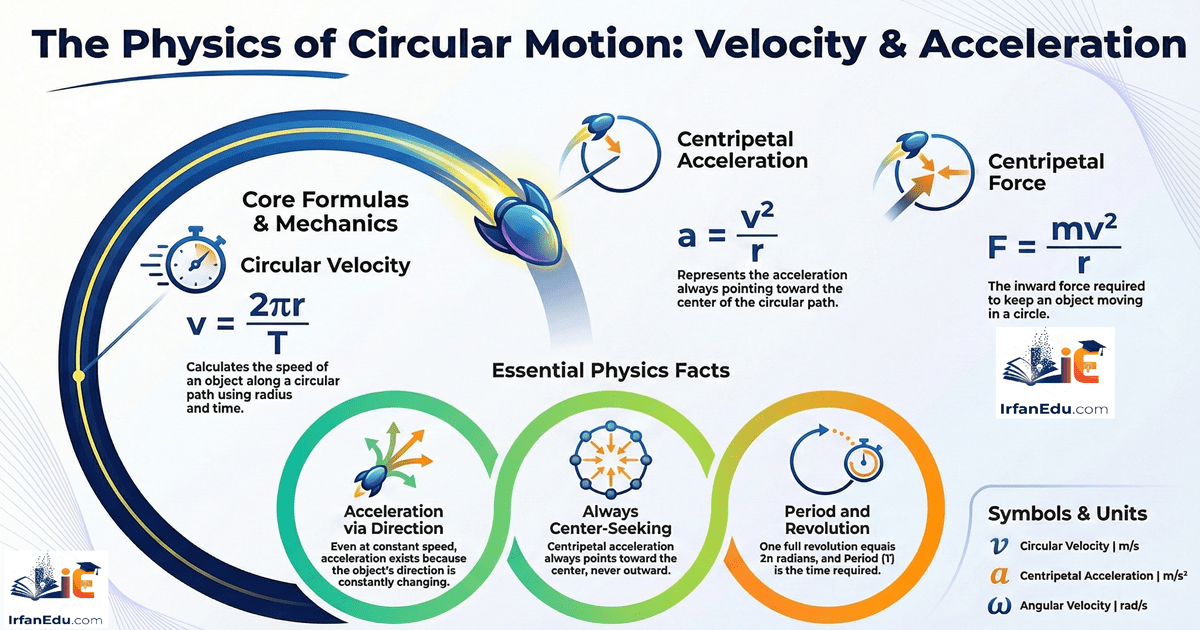
    Circular Velocity (v)

    The speed of an object moving along a circular path. It depends on the radius and the time taken to complete one full revolution.

    v = 2πr / T
    Also written as: v = ωr

    Centripetal Acceleration (a)

    The acceleration always pointing toward the center of the circle. It keeps the object moving in a circular path instead of a straight line.

    a = v² / r
    Also written as: a = ω²r
    📌

    Key Facts

    Important things to remember about circular motion

    1
    Even at constant speed, circular motion has acceleration — because direction keeps changing.
    2
    Centripetal acceleration always points toward the center of the circle — never outward.
    3
    The force causing centripetal acceleration is called Centripetal Force: F = mv²/r
    4
    Angular velocity: ω = 2π/T — relates to how fast the angle changes per second.
    5
    One full revolution = 2π radians. Period T is the time for one complete circle.
    🔢

    Variables & Symbols

    All symbols used in circular motion formulas

    SymbolMeaningUnitDescription
    vCircular Velocitym/sSpeed along the circular path
    rRadiusmDistance from center to object
    TTime PeriodsTime for one full revolution
    aCentripetal Accelerationm/s²Acceleration toward center
    ωAngular Velocityrad/sRate of change of angle
    fFrequencyHzRevolutions per second (f = 1/T)
    πPi≈ 3.14159
    FCentripetal ForceNF = mv²/r (needs mass m)

  • Projectile Motion Calculator : Projectile range, Projectile Max height and Time of flight

    Projectile Motion Calculator : Projectile range, Projectile Max height and Time of flight

    AI-Powered Physics Engine

    Projectile Motion
    Calculator

    Calculate Range, Maximum Height & Time of Flight instantly. Enter launch velocity and angle — get all three results with step-by-step solutions.

    🎯 Range (R) 📐 Max Height (H) ⏱️ Time of Flight (T) 📋 Step-by-Step 📚 NCERT Based
    🚀
    Complete Analysis
    R, H & T Together
    Calculate all three values
    at once from u and θ
    🔍
    Find Unknown
    Solve for u or θ
    Given R, H or T —
    find velocity or angle
    📐
    Angle Optimizer
    Max Range Angle
    Find optimal angle
    for maximum range
    🚀

    Complete Projectile Analysis

    Enter initial velocity and launch angle to get R, H and T

    ✅ Results
    Projectile Motion
    Step-by-Step Solution
    🎯

    Range (R)

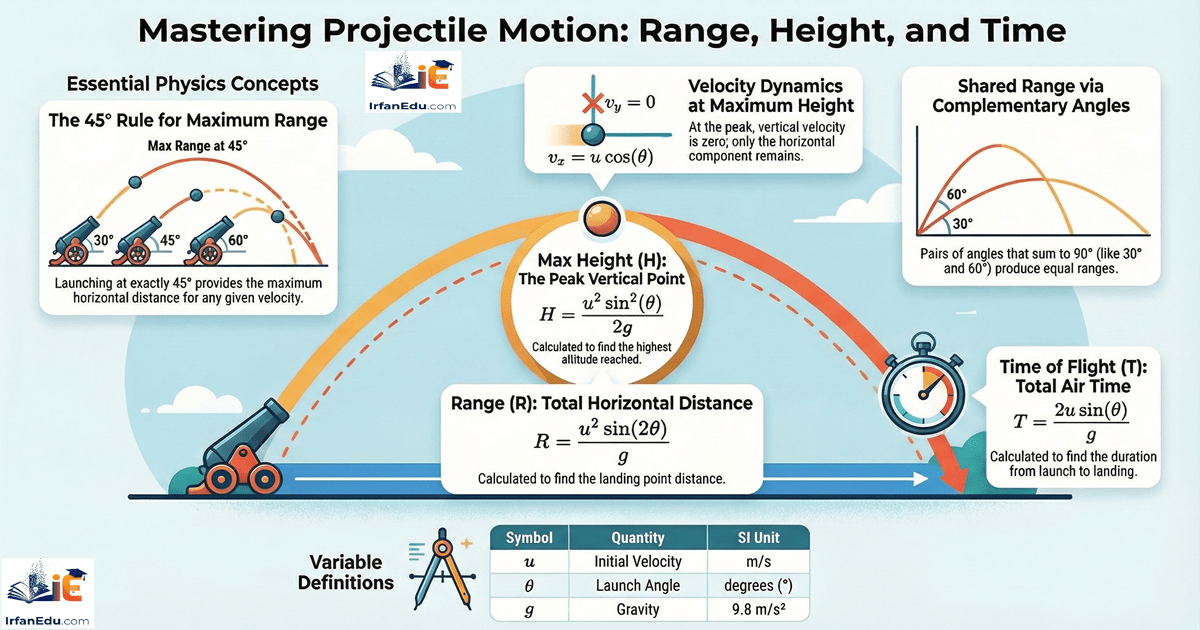
    Horizontal distance covered by the projectile from launch to landing point on same level.

    R = u²sin(2θ) / g
    📐

    Maximum Height (H)

    The highest vertical point reached by the projectile above the launch point.

    H = u²sin²(θ) / 2g
    ⏱️

    Time of Flight (T)

    Total time the projectile remains in the air from launch until it returns to same height.

    T = 2u·sin(θ) / g
    📌

    Key Concepts

    Important facts about projectile motion

    1
    Projectile motion = horizontal (uniform) + vertical (uniformly accelerated) motion combined.
    2
    Maximum range occurs at θ = 45°. At this angle, sin(2θ) = sin(90°) = 1 (maximum).
    3
    Complementary angles give the same range: e.g., 30° and 60° produce equal R.
    4
    At maximum height, vertical velocity = 0. Only horizontal component remains.
    5
    Air resistance is neglected. Gravity g = 9.8 m/s² (use 10 for NCERT approximation).
    🔢

    Variables & Symbols

    All symbols used in projectile motion

    SymbolQuantitySI UnitFormula Role
    uInitial Velocitym/sLaunch speed
    θLaunch Angledegrees (°)Angle with horizontal
    gGravity9.8 m/s²Downward acceleration
    RRangemHorizontal distance
    HMax HeightmPeak vertical height
    TTime of FlightsTotal air time
    uxHorizontal Componentm/su·cos(θ)
    uyVertical Componentm/su·sin(θ)

  • Equation of Motion Calculator – 1st, 2nd & 3rd Equation Solver

    Equation of Motion Calculator – 1st, 2nd & 3rd Equation Solver

    AI-Powered Physics Engine

    Equations of Motion
    Calculator

    Solve all three equations of motion with step-by-step AI solutions. Enter any known values and instantly find the unknown.

    ⚡ 1st Equation 📐 2nd Equation 🔮 3rd Equation 📋 Step-by-Step 📚 NCERT Based
    🎯

    1st Equation: v = u + at

    Solve for: final velocity, initial velocity, acceleration, or time

    Solve For
    ⚠️ Please enter valid numbers in all required fields!
    ✅ Result
    v = u + at
    FINAL VELOCITY
    m/s
    Step-by-Step Solution

    1st Equation of Motion

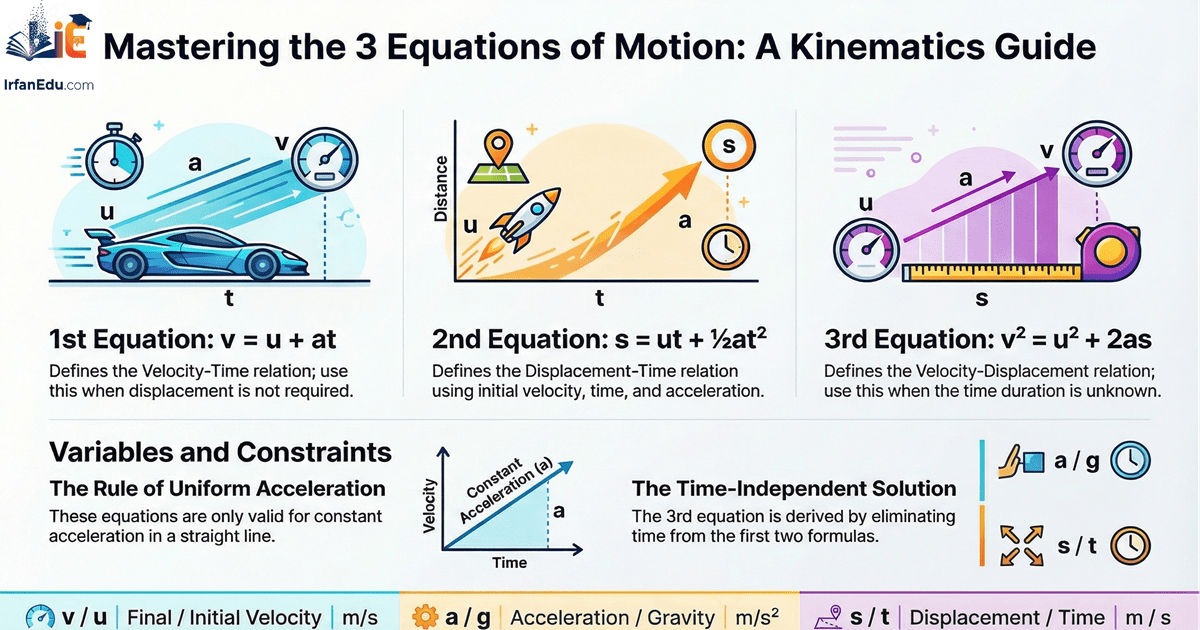
    Relates final velocity to initial velocity, acceleration and time. Used when displacement is not required.

    v = u + at
    📐

    2nd Equation of Motion

    Gives displacement in terms of initial velocity, time and acceleration. Derived by integrating velocity.

    s = ut + ½at²
    🔮

    3rd Equation of Motion

    Connects velocity and displacement without time. Most useful in projectile & free-fall problems.

    v² = u² + 2as
    📌

    Derivation Summary

    How each equation is derived

    1
    From definition of acceleration: a = (v−u)/t → rearranging gives v = u + at
    2
    Average velocity = (u+v)/2. Displacement = avg velocity × time → s = ut + ½at²
    3
    Eliminate t from 1st & 2nd equations → v² = u² + 2as (time-independent equation)
    ⚠️
    All three equations are valid only for uniform acceleration (constant a) in a straight line.
    🔢

    Variables & Symbols

    All symbols used in equations of motion

    SymbolQuantitySI UnitTypeNotes
    vFinal Velocitym/sVectorVelocity at end of motion
    uInitial Velocitym/sVectorVelocity at start of motion
    aAccelerationm/s²VectorMust be constant (uniform)
    tTimesScalarDuration of motion
    sDisplacementmVectorStraight-line distance
    gGravity9.81 m/s²VectorUse 10 m/s² for NCERT

  • Acceleration Calculator – Solve All Equations of Motion Instantly

    Acceleration Calculator – Solve All Equations of Motion Instantly

    🚀

    Acceleration Calculator

    Master Newton’s Laws with our interactive acceleration calculator. Solve for acceleration, velocity change, or time instantly with step-by-step solutions!

    📐 Kinematics ⚡ Instant Results 📋 Step-by-Step 📚 NCERT Based
    📌 Core Formula
    a = (v − u) ÷ t
    FIND ACCELERATION
    a = (v − u) / t
    FIND FINAL VELOCITY
    v = u + at
    FIND INITIAL VELOCITY
    u = v − at
    FIND TIME
    t = (v − u) / a
    🎯

    Choose What to Solve

    Select a mode and enter your known values

    m/s
    🔙 m/s
    ⏱️ s
    🔙 m/s
    🚀 m/s²
    ⏱️ s
    m/s
    🚀 m/s²
    ⏱️ s
    m/s
    🔙 m/s
    🚀 m/s²
    ⚖️ kg
    🚀 m/s²
    🔙 m/s
    🚀 m/s²
    ⏱️ s
    ⚠️ Please enter valid numbers in all fields!
    ✅ Result
    📋 Step-by-Step Solution
    🚀

    What is Acceleration?

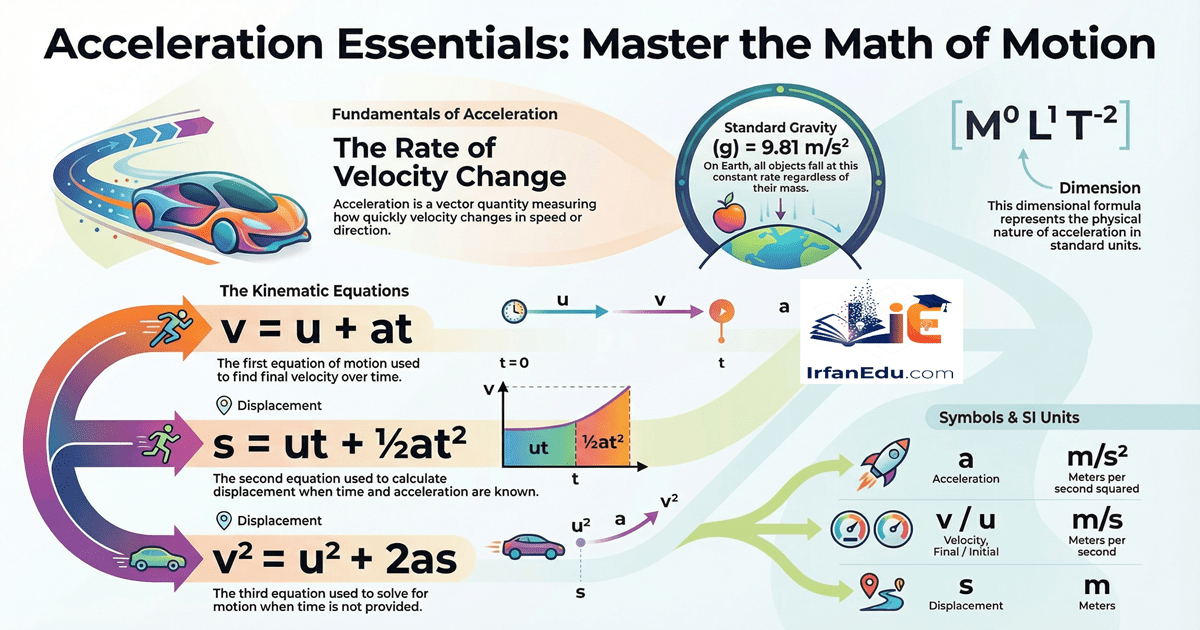
    Acceleration is a vector quantity that describes the rate of change of velocity with respect to time. It can be a change in speed, direction, or both.

    a = (v − u) / t
    📊

    Average Acceleration

    Average acceleration is the total change in velocity divided by total time. It tells us how fast velocity changed over an interval.

    a_avg = Δv / Δt

    Instantaneous Acceleration

    Acceleration at a specific instant in time. It is the second derivative of position or the first derivative of velocity with respect to time.

    a = dv/dt = d²x/dt²
    📐

    SI Unit & Dimensions

    The standard unit of acceleration is metre per second squared (m/s²). Its dimensional formula is [M⁰ L¹ T⁻²].

    [M⁰ L¹ T⁻²]
    💡

    Newton’s Second Law

    Force equals mass times acceleration: F = ma. A net force on an object causes it to accelerate in the direction of the force. More mass = less acceleration for same force.

    F = m × a
    🌍

    Gravitational Acceleration

    On Earth’s surface, all objects fall with the same acceleration due to gravity: g = 9.81 m/s² (approx. 10 m/s² in NCERT). This is independent of mass.

    g = 9.81 m/s²
    🗂️

    Types of Acceleration

    UniformConstant acceleration in a straight line
    Non-UniformChanging rate of velocity change
    PositiveVelocity increasing with time
    Negative (Decel.)Velocity decreasing (retardation)
    CentripetalDirected toward center of circular path
    GravitationalDue to Earth’s gravity (9.81 m/s²)
    🔢

    Variables & Symbols

    All mathematical symbols used in acceleration formulas

    SymbolQuantitySI UnitType
    aAccelerationm/s²Vector
    vFinal Velocitym/sVector
    uInitial Velocitym/sVector
    tTimeseconds (s)Scalar
    sDisplacementmVector
    FForceNewton (N)Vector
    mMasskilogram (kg)Scalar
    gGravitational Accel.9.81 m/s²Vector
    📌

    Key Acceleration Equations

    All important formulas — Equations of Motion

    Basic Acceleration
    a = (v−u) / t
    1st Equation of Motion
    v = u + at
    2nd Equation of Motion
    s = ut + ½at²
    3rd Equation of Motion
    v² = u² + 2as
    Newton’s 2nd Law
    F = m × a
    Centripetal Accel.
    a = v² / r
    Free Fall
    a = g = 9.81 m/s²
    Average Accel.
    a = Δv / Δt

    Free Physics Calculators for Students & Educators
    irfanedu.com · Physics Calculator Series · Unit 02: Acceleration

  • Velocity Calculator – Instantly Solve Speed, Distance & Time with Formulas

    Velocity Calculator – Instantly Solve Speed, Distance & Time with Formulas

    🚀

    Velocity Calculator

    Master kinematics with our interactive velocity calculator. Solve for velocity, distance, or time instantly with unit conversions!

    📐 Kinematics ⚡ Instant Results 🔄 Unit Conversion 📚 NCERT Based
    📌 Core Formula
    v = d ÷ t
    FIND VELOCITY
    v = d / t
    FIND DISTANCE
    d = v × t
    FIND TIME
    t = d / v
    WITH ACCELERATION
    v = u + at
    🎯

    Choose What to Solve

    Select a mode and enter your known values

    📏 m
    ⏱️ s
    m/s
    ⏱️ s
    📏 m
    m/s
    ⚠️ Please enter valid positive numbers!
    ✅ Result
    🌍

    What is Velocity?

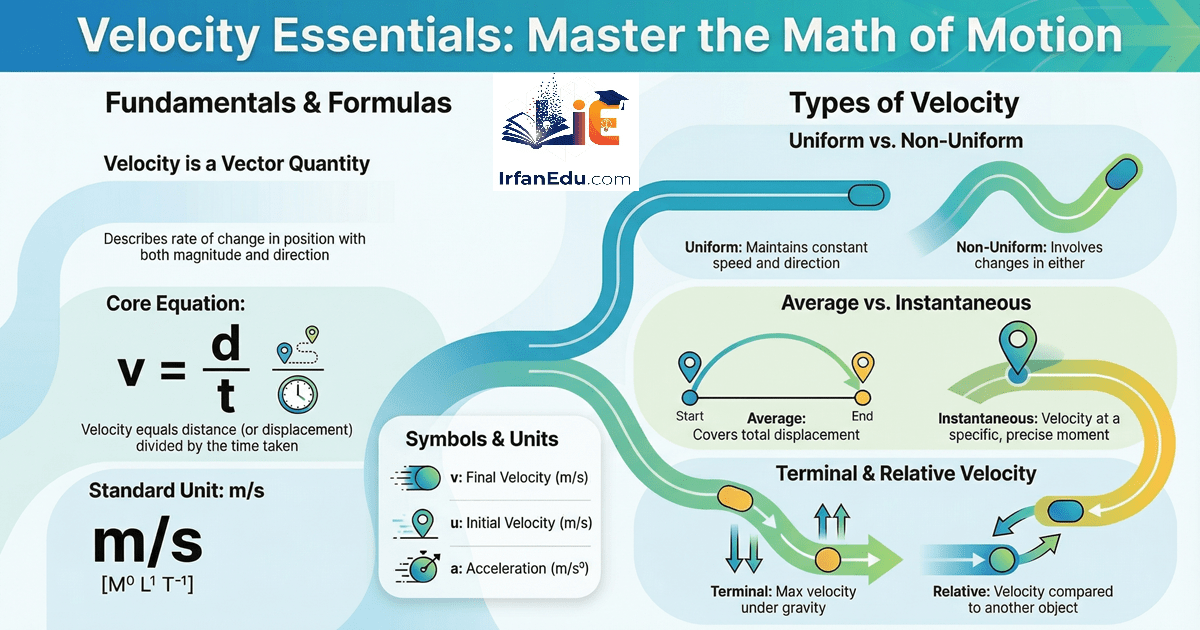
    Velocity is a vector quantity describing the rate of change of position with respect to time. It has both magnitude and direction.

    v = Δx / Δt
    📊

    Average Velocity

    Average velocity is the total displacement divided by total time. It considers only the straight-line start-to-end distance.

    v = (x₂−x₁)/(t₂−t₁)

    Instantaneous Velocity

    Velocity at a specific instant in time. It is the derivative of position with respect to time — limit of average velocity as Δt → 0.

    v = dx/dt
    📐

    SI Unit & Dimensions

    The standard unit of velocity is metre per second (m/s). Its dimensional formula is [M⁰ L¹ T⁻¹].

    [M⁰ L¹ T⁻¹]
    🗂️

    Types of Velocity

    UniformConstant speed in a straight line
    Non-UniformChanging speed or direction
    AverageTotal displacement ÷ total time
    InstantaneousVelocity at a precise moment
    RelativeVelocity w.r.t. another object
    TerminalMax velocity under gravity + drag
    🔢

    Variables & Symbols

    All mathematical symbols used in velocity formulas

    SymbolQuantitySI UnitType
    vFinal Velocitym/sVector
    uInitial Velocitym/sVector
    d / sDistance / DisplacementmScalar / Vector
    tTimeseconds (s)Scalar
    aAccelerationm/s²Vector
    gGravitational Accel.9.81 m/s²Vector
    ΔxChange in PositionmVector
    ΔtChange in TimesScalar
    📌

    Key Velocity Equations

    Most important formulas for velocity problems

    Basic Velocity
    v = d / t
    1st Equation of Motion
    v = u + at
    3rd Equation of Motion
    v² = u² + 2as
    Average Velocity
    v = (u+v) / 2
    Escape Velocity
    v = √(2gR)
    Relative Velocity
    v_rel = v₁ − v₂

    Free Physics Calculators for Students & Educators
    irfanedu.com · Physics Calculator Series · Unit 01: Velocity