Category: ACT Prep

  • Ratios and Proportions: Solving Direct and Inverse Proportion Problems | ACT Math Guide

    Ratios and Proportions: Solving Direct and Inverse Proportion Problems | ACT Math Guide

    Ratios and Proportions: Solving Direct and Inverse Proportion Problems | ACT Math Guide

    Understanding ratios and proportions is absolutely essential for success on the ACT Math section. Whether you’re comparing quantities, scaling recipes, or solving real-world problems, the ability to work with direct and inverse proportions will serve you well not just on test day, but throughout your academic journey. This comprehensive guide breaks down everything you need to know about solving proportion problems with confidence and speed. For more ACT prep resources, explore our complete collection of study guides and practice materials.

    ๐ŸŽฏ

    ACT SCORE BOOSTER: Master This Topic for 3-4 Extra Points!

    Ratio and proportion problems appear in 5-8 questions on every ACT Math section. Understanding direct and inverse proportions thoroughly can add 3-4 points to your composite score. Let’s break it down with proven strategies that work!

    ๐Ÿš€ Jump to ACT Strategy โ†’

    ๐Ÿ“š What Are Ratios and Proportions?

    A ratio is a comparison between two quantities, showing how many times one value contains another. For example, if a recipe calls for 2 cups of flour and 1 cup of sugar, the ratio of flour to sugar is 2:1 (read as “2 to 1”).

    A proportion is an equation stating that two ratios are equal. When we say $$\frac{a}{b} = \frac{c}{d}$$, we’re expressing a proportion. This concept becomes incredibly powerful when solving real-world problems.

    There are two main types of proportional relationships you’ll encounter on the ACT:

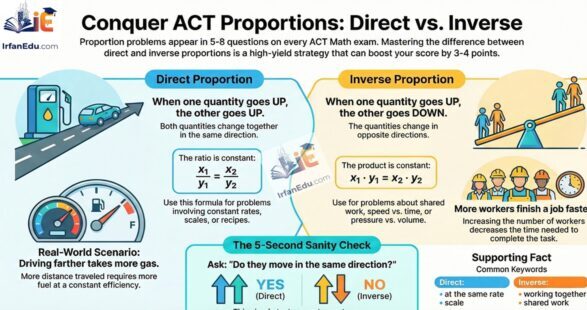
    • Direct Proportion: When one quantity increases, the other increases proportionally (e.g., more hours worked = more money earned)
    • Inverse Proportion: When one quantity increases, the other decreases proportionally (e.g., more workers = less time to complete a job)

    ๐Ÿ’ก Why This Matters for ACT: Proportion problems appear in various contexts on the ACTโ€”from geometry (similar triangles) to word problems (rates and conversions). According to the official ACT website, mastering this topic gives you a versatile tool for tackling multiple question types quickly and accurately.

    ๐Ÿ“ Key Formulas & Rules

    Direct Proportion

    When two quantities are directly proportional, their ratio remains constant:

    $$\frac{x_1}{y_1} = \frac{x_2}{y_2}$$

    Or equivalently: $$x_1 \cdot y_2 = x_2 \cdot y_1$$ (cross-multiplication)

    When to use: Distance and time at constant speed, cost and quantity, scaling recipes, similar figures in geometry


    Inverse Proportion

    When two quantities are inversely proportional, their product remains constant:

    $$x_1 \cdot y_1 = x_2 \cdot y_2$$

    Or equivalently: $$\frac{x_1}{x_2} = \frac{y_2}{y_1}$$ (note the flip!)

    When to use: Speed and time for fixed distance, workers and time to complete a job, pressure and volume (Boyle’s Law)


    Quick Recognition Guide

    Type Relationship Formula
    Direct Both increase/decrease together $$\frac{x_1}{y_1} = \frac{x_2}{y_2}$$
    Inverse One increases, other decreases $$x_1 \cdot y_1 = x_2 \cdot y_2$$

    ๐ŸŽจ Visual Understanding: Direct vs. Inverse Proportion

    Direct Proportion

        y
        |     /
        |    /
        |   /
        |  /
        | /
        |/_________ x
        
        As x increases โ†’
        y increases โ†’
        
        Example:
        Distance โˆ Time
        (at constant speed)
          

    Inverse Proportion

        y
        |\
        | \
        |  \
        |   \___
        |       ----___
        |______________x
        
        As x increases โ†’
        y decreases โ†
        
        Example:
        Speed โˆ 1/Time
        (for fixed distance)
          

    โœ… Step-by-Step Solved Examples

    Example 1: Direct Proportion Problem

    Problem: If 5 pounds of apples cost $8.75, how much will 12 pounds of apples cost at the same rate?

    Step 1: Identify the relationship

    More pounds = more cost. This is a direct proportion. As the quantity increases, the cost increases proportionally.

    Step 2: Set up the proportion

    Let $$x$$ = cost of 12 pounds

    $$\frac{\text{pounds}_1}{\text{cost}_1} = \frac{\text{pounds}_2}{\text{cost}_2}$$

    $$\frac{5}{8.75} = \frac{12}{x}$$

    Step 3: Cross-multiply

    $$5 \cdot x = 8.75 \cdot 12$$

    $$5x = 105$$

    Step 4: Solve for x

    $$x = \frac{105}{5} = 21$$

    Step 5: Verify and answer

    Check: $$\frac{5}{8.75} = 0.571$$ and $$\frac{12}{21} = 0.571$$ โœ“

    Answer: 12 pounds of apples will cost $21.00

    โฑ๏ธ ACT Time Estimate: 45-60 seconds with practice

    Example 2: Inverse Proportion Problem

    Problem: It takes 6 workers 8 hours to build a fence. How long would it take 4 workers to build the same fence, working at the same rate?

    Step 1: Identify the relationship

    Fewer workers = more time needed. This is an inverse proportion. As the number of workers decreases, the time increases.

    Step 2: Use the inverse proportion formula

    Let $$t$$ = time for 4 workers

    $$\text{workers}_1 \times \text{time}_1 = \text{workers}_2 \times \text{time}_2$$

    $$6 \times 8 = 4 \times t$$

    Step 3: Solve for t

    $$48 = 4t$$

    $$t = \frac{48}{4} = 12$$

    Step 4: Verify the logic

    Fewer workers (6โ†’4) should mean more time (8โ†’12). โœ“ This makes sense!

    Answer: It will take 4 workers 12 hours to build the fence

    โฑ๏ธ ACT Time Estimate: 50-70 seconds with practice

    Example 3: ACT-Style Challenge Problem

    Problem: The scale on a map is 1 inch : 25 miles. If two cities are 3.5 inches apart on the map, what is the actual distance between them?

    Step 1: Recognize the direct proportion

    Map distance and actual distance are directly proportional (more map inches = more actual miles).

    Step 2: Set up the proportion

    $$\frac{\text{map inches}}{\text{actual miles}} = \frac{\text{map inches}}{\text{actual miles}}$$

    $$\frac{1}{25} = \frac{3.5}{x}$$

    Step 3: Cross-multiply and solve

    $$1 \cdot x = 25 \cdot 3.5$$

    $$x = 87.5$$

    Answer: The actual distance is 87.5 miles

    ๐Ÿ’ก ACT Pro Tip: Scale problems always use direct proportion. The ratio stays constant!

    ๐Ÿ“

    Ready to Test Your Knowledge?

    Take our full-length ACT practice test and see how well you’ve mastered this topic. Get instant scoring, detailed explanations, and personalized recommendations!

    ๐Ÿš€ Start ACT Practice Test Now โ†’
    โœ“ Full-Length Tests
    โœ“ Instant Scoring
    โœ“ Detailed Solutions

    โš ๏ธ Common Mistakes to Avoid

    โŒ Mistake #1: Confusing Direct and Inverse Proportions

    Wrong: Using $$\frac{x_1}{y_1} = \frac{x_2}{y_2}$$ when the relationship is inverse
    Right: Ask yourself: “Do both quantities move in the same direction?” If no, it’s inverse!

    โŒ Mistake #2: Setting Up the Proportion Incorrectly

    Wrong: Mixing units or putting corresponding values in wrong positions
    Right: Keep the same units in numerator and denominator. Write it out: “5 pounds is to $8.75 as 12 pounds is to $x”

    โŒ Mistake #3: Forgetting to Check Your Answer

    Wrong: Moving to the next question without verification
    Right: Quick logic check: Does the answer make sense? If workers decrease, should time increase?

    โŒ Mistake #4: Arithmetic Errors in Cross-Multiplication

    Wrong: Rushing through multiplication and division
    Right: Use your calculator strategically. Double-check decimal placement!

    ๐Ÿ“ Practice Questions with Solutions

    Test your understanding with these ACT-style practice problems. Try solving them on your own before checking the solutions!

    Practice Question 1 (Basic)

    A car travels 180 miles in 3 hours at a constant speed. How far will it travel in 5 hours at the same speed?

    A) 270 miles
    B) 300 miles
    C) 320 miles
    D) 360 miles
    E) 400 miles
    Show Solution

    Solution: This is a direct proportion (more time = more distance at constant speed).

    $$\frac{180}{3} = \frac{x}{5}$$

    $$3x = 180 \times 5 = 900$$

    $$x = 300$$

    Answer: B) 300 miles

    โฑ๏ธ Target time: 40 seconds | ๐ŸŽฏ Difficulty: Basic

    Practice Question 2 (Intermediate)

    A factory has 8 machines that can produce 240 units in 6 hours. If 2 machines break down, how long will it take the remaining machines to produce the same 240 units?

    A) 6 hours
    B) 7 hours
    C) 8 hours
    D) 9 hours
    E) 10 hours
    Show Solution

    Solution: This is an inverse proportion (fewer machines = more time needed).

    Remaining machines: 8 – 2 = 6 machines

    $$\text{machines}_1 \times \text{time}_1 = \text{machines}_2 \times \text{time}_2$$

    $$8 \times 6 = 6 \times t$$

    $$48 = 6t$$

    $$t = 8$$

    Answer: C) 8 hours

    โฑ๏ธ Target time: 60 seconds | ๐ŸŽฏ Difficulty: Intermediate

    Practice Question 3 (Advanced)

    On a blueprint, the scale is 2 cm : 5 meters. If a room measures 7.5 cm by 6 cm on the blueprint, what is the actual area of the room in square meters?

    A) 140.625 mยฒ
    B) 168.75 mยฒ
    C) 225 mยฒ
    D) 281.25 mยฒ
    E) 337.5 mยฒ
    Show Solution

    Solution: First, find actual dimensions using direct proportion, then calculate area.

    For length (7.5 cm):

    $$\frac{2}{5} = \frac{7.5}{L}$$

    $$2L = 37.5$$

    $$L = 18.75 \text{ meters}$$

    For width (6 cm):

    $$\frac{2}{5} = \frac{6}{W}$$

    $$2W = 30$$

    $$W = 15 \text{ meters}$$

    Area:

    $$\text{Area} = 18.75 \times 15 = 281.25 \text{ m}^2$$

    Answer: D) 281.25 mยฒ

    โฑ๏ธ Target time: 90 seconds | ๐ŸŽฏ Difficulty: Advanced

    Practice Question 4 (Challenge)

    A water tank can be filled by Pipe A in 12 hours. If Pipes A and B together can fill the tank in 8 hours, how long would it take Pipe B alone to fill the tank?

    A) 18 hours
    B) 20 hours
    C) 24 hours
    D) 28 hours
    E) 32 hours
    Show Solution

    Solution: Use work rates (portion of job per hour).

    Pipe A’s rate: $$\frac{1}{12}$$ tank per hour
    Combined rate: $$\frac{1}{8}$$ tank per hour
    Pipe B’s rate: $$\frac{1}{8} – \frac{1}{12}$$

    $$\frac{1}{8} – \frac{1}{12} = \frac{3}{24} – \frac{2}{24} = \frac{1}{24}$$

    If Pipe B fills $$\frac{1}{24}$$ per hour, it takes 24 hours to fill the entire tank.

    Answer: C) 24 hours

    โฑ๏ธ Target time: 90-120 seconds | ๐ŸŽฏ Difficulty: Challenge

    ๐Ÿ’ก ACT Pro Tips & Tricks

    ๐ŸŽฏ Tip #1: The “Direction Test”

    Ask: “If I increase one quantity, does the other increase or decrease?” Same direction = direct proportion. Opposite direction = inverse proportion. This simple test works every time!

    โšก Tip #2: The “Multiply or Divide” Shortcut

    For direct proportion: If one quantity is multiplied by a factor, multiply the other by the same factor. Example: 5 pounds โ†’ 12 pounds (ร—2.4), so cost also multiplies by 2.4. Faster than cross-multiplication!

    ๐Ÿ“ Tip #3: Write It Out in Words First

    Before setting up equations, write: “5 pounds is to $8.75 as 12 pounds is to $x.” This prevents setup errors and keeps your ratios organized correctly.

    ๐Ÿงฎ Tip #4: Calculator Strategy

    For ACT, you can use a calculator! Instead of cross-multiplying, find the unit rate first. Example: $8.75 รท 5 = $1.75 per pound, then 1.75 ร— 12 = $21. Often faster and less error-prone.

    โœ… Tip #5: The “Reasonableness Check”

    Always do a quick sanity check. If 5 pounds cost $8.75, should 12 pounds cost more or less? If your answer is $3, you know something went wrong. This catches 90% of errors!

    ๐ŸŽจ Tip #6: Look for Keywords

    Direct proportion keywords: “at the same rate,” “constant speed,” “per unit,” “scale.” Inverse proportion keywords: “working together,” “shared work,” “speed vs. time for fixed distance.”

    ๐ŸŽฅ Video Explanation: Ratios and Proportions

    Watch this detailed video explanation to understand ratios and proportions better with visual demonstrations and step-by-step guidance.
    Ratios and Proportions Video Tutorial
    Click to Load Video

    ๐ŸŽฏ ACT Test-Taking Strategy for Ratios and Proportions

    Time Allocation

    Target time: 45-75 seconds per proportion problem. These are typically faster than algebra problems, so use them to bank time for harder questions.

    When to Skip and Return

    Skip if: (1) The problem involves complex multi-step proportions with 3+ variables, or (2) You can’t immediately identify if it’s direct or inverse. Mark it and return after completing easier questions.

    Guessing Strategy

    If you must guess: (1) Eliminate answers that don’t make logical sense (too big/small), (2) For direct proportion, the answer should be proportionally larger/smaller, (3) Avoid extreme valuesโ€”ACT rarely uses them for proportion problems.

    Quick Check Method

    After solving, plug your answer back into the original ratio. If $$\frac{5}{8.75} = \frac{12}{21}$$, both should equal approximately 0.571. Takes 5 seconds and prevents careless errors.

    Common Trap Answers

    Watch out for:

    • Answers that use direct proportion when it should be inverse (or vice versa)
    • Answers that forget to convert units (inches to feet, hours to minutes)
    • Answers from adding instead of multiplying in inverse proportions
    • Answers that represent intermediate steps rather than the final answer

    Strategic Approach

    1. Read carefully and identify the type (direct or inverse)
    2. Set up the equation correctly based on the type
    3. Solve efficiently using calculator or mental math
    4. Check reasonableness in 5 seconds
    5. Mark your answer and move on confidently

    ๐ŸŒ Real-World Applications

    Understanding ratios and proportions isn’t just about acing the ACTโ€”these concepts appear everywhere in real life and professional fields:

    ๐Ÿ—๏ธ Architecture & Engineering

    Architects use scale drawings and proportions to design buildings. Engineers calculate load distributions and material ratios for construction projects.

    ๐Ÿณ Cooking & Nutrition

    Scaling recipes up or down requires direct proportion. Nutritionists use ratios to calculate macronutrient distributions and portion sizes.

    ๐Ÿ’ฐ Finance & Business

    Financial analysts use proportions for currency conversion, profit margins, and investment returns. Business owners calculate cost-to-revenue ratios.

    ๐Ÿ”ฌ Science & Medicine

    Pharmacists calculate medication dosages based on body weight. Scientists use proportions in chemical solutions and experimental scaling.

    ๐Ÿš— Transportation & Logistics

    GPS systems calculate travel times using speed-distance-time relationships. Logistics companies optimize delivery routes using inverse proportions.

    ๐ŸŽจ Art & Design

    Graphic designers maintain aspect ratios when resizing images. Artists use proportions to create realistic perspectives and scale in their work.

    ๐Ÿ’ก College Connection: Proportion concepts are foundational for college courses in mathematics, physics, chemistry, economics, statistics, and virtually all STEM fields. Mastering them now gives you a significant advantage in higher education.

    โ“ Frequently Asked Questions

    Q1: How do I quickly tell if a problem is direct or inverse proportion?

    Answer: Use the “direction test.” Ask yourself: “If one quantity increases, does the other increase or decrease?” If both move in the same direction (both increase or both decrease), it’s direct proportion. If they move in opposite directions (one increases while the other decreases), it’s inverse proportion. For example, more workers completing a job means less time neededโ€”that’s inverse. More miles driven means more gas usedโ€”that’s direct.

    Q2: Can I use my calculator for proportion problems on the ACT?

    Answer: Absolutely! The ACT Math section allows calculators, and using them strategically can save time and reduce errors. Instead of cross-multiplying manually, you can find the unit rate first (divide to get the rate per one unit), then multiply. For example, if 5 pounds cost $8.75, calculate $8.75 รท 5 = $1.75 per pound, then multiply $1.75 ร— 12 = $21 for 12 pounds. This method is often faster and more intuitive.

    Q3: What’s the most common mistake students make with proportions?

    Answer: The most common mistake is confusing direct and inverse proportions, which leads to using the wrong formula. The second most common error is setting up the proportion incorrectlyโ€”mixing up which values go in the numerator and denominator. To avoid this, always write out the relationship in words first: “5 pounds is to $8.75 as 12 pounds is to $x.” This ensures you maintain the correct correspondence between quantities.

    Q4: How many proportion problems typically appear on the ACT Math section?

    Answer: Proportion problems appear in approximately 5-8 questions on every ACT Math section, though they may be disguised in different contexts. You’ll see them in word problems, geometry (similar triangles and scale drawings), rate problems, and conversion questions. Some are straightforward proportion setups, while others require you to recognize the proportional relationship within a more complex problem. This makes proportions one of the highest-yield topics to master for the ACT.

    Q5: Are there any memory tricks for remembering proportion formulas?

    Answer: Yes! For direct proportion, remember “SAME direction = SAME side” (both variables on the same side of the equation: $$\frac{x_1}{y_1} = \frac{x_2}{y_2}$$). For inverse proportion, remember “OPPOSITE direction = OPPOSITE sides” (variables multiply across: $$x_1 \cdot y_1 = x_2 \cdot y_2$$). Another helpful trick: Direct proportion looks like a fraction equals a fraction, while inverse proportion looks like a product equals a product. Visual learners can remember the graphs: direct proportion is a straight line through the origin, inverse proportion is a curve (hyperbola).

    ๐ŸŽ“ Key Takeaways

    • Direct proportion: Both quantities change in the same direction. Use $$\frac{x_1}{y_1} = \frac{x_2}{y_2}$$
    • Inverse proportion: Quantities change in opposite directions. Use $$x_1 \cdot y_1 = x_2 \cdot y_2$$
    • Quick identification: Ask “same direction or opposite?” to choose the right formula
    • Calculator strategy: Find unit rate first, then multiplyโ€”often faster than cross-multiplication
    • Always verify: Check if your answer makes logical sense before moving on
    • High-yield topic: Master this for 3-4 extra points on your ACT Math score
    Dr. Irfan Mansuri

    โœ๏ธ Written by Dr. Irfan Mansuri

    Educational Content Creator & Competitive Exam Specialist

    IrfanEdu.com โ€ข United States

    Dr. Irfan Mansuri is a distinguished educational content creator and competitive exam specialist with over 15 years of experience spanning high school, undergraduate, and postgraduate levels. As the founder of IrfanEdu.com, he has successfully guided thousands of students through various competitive examinations, helping them achieve exceptional results and gain admission to their dream institutions.

    15+ years in competitive exam preparation Certified Instructor LinkedIn Profile

    ๐Ÿ“š Related ACT Math Resources

    ๐Ÿ“ Solving Linear Equations

    Master the fundamentals of solving single and multi-step linear equations for ACT success.

    ๐Ÿ“Š Percentages and Percent Change

    Learn to calculate percentages, percent increase/decrease, and solve percent word problems.

    ๐Ÿ”บ Similar Triangles and Scale

    Apply proportion concepts to geometry problems involving similar figures and scale factors.

    โšก Rate, Time, and Distance

    Solve motion problems using the relationship between speed, time, and distance.

    ๐Ÿš€ Ready to Master ACT Math?

    Keep practicing these proportion problems, and you’ll see your confidenceโ€”and your scoreโ€”soar! Remember, consistent practice with strategic understanding is the key to ACT success.
    [pdf_viewer id=”69″]
    ACT Math ratios and proportions guide showing direct proportion formula (xโ‚/yโ‚ = xโ‚‚/yโ‚‚) and inverse proportion formula (xโ‚ยทyโ‚ = xโ‚‚ยทyโ‚‚) with purple and blue gradient background for grades 9-10 students
  • Master Factors & Multiples for ACT Math | Complete Guide

    Master Factors & Multiples for ACT Math | Complete Guide

    Factors and Multiples: Prime Factorization, LCM & GCD | ACT Math Guide

    Understanding factors, multiples, prime factorization, LCM (Least Common Multiple), and GCD (Greatest Common Divisor) is absolutely essential for ACT Math success. These foundational pre-algebra concepts appear frequently throughout the testโ€”not just in obvious number theory questions, but also in problems involving fractions, ratios, algebraic expressions, and even geometry. Mastering these concepts will save you valuable time and help you tackle complex problems with confidence. For more comprehensive strategies, explore our ACT prep resources.

    ๐ŸŽฏ

    ACT SCORE BOOSTER: Master This Topic for 2-3 Extra Points!

    This topic appears in 5-8 questions per ACT Math test. Understanding factors, multiples, LCM, and GCD thoroughly can add 2-3 points to your composite score. Let’s break it down with proven strategies that work!

    ๐Ÿš€ Jump to ACT Strategy โ†’

    ๐Ÿ“š Introduction to Factors and Multiples

    Factors and multiples are fundamental building blocks in mathematics that describe the relationships between numbers. A factor is a number that divides evenly into another number, while a multiple is the result of multiplying a number by an integer. These concepts are interconnected with prime factorization, which breaks numbers down into their prime components, and with LCM and GCD, which help us find common denominators and simplify fractions.

    Why is this crucial for the ACT? The ACT Math section tests your ability to work efficiently with numbers. Questions involving factors and multiples appear in various forms: simplifying fractions, finding common denominators, solving word problems about repeating events, and working with algebraic expressions. Students who master these concepts can solve problems in 30-45 seconds instead of 2-3 minutes.

    Test frequency: Expect 5-8 questions per test that directly or indirectly involve these concepts. That’s approximately 8-13% of the entire Math section! According to the official ACT website, number theory and pre-algebra questions make up a significant portion of the mathematics section, making this topic essential for score improvement.

    โšก Quick Answer Box (TL;DR)

    • Factors: Numbers that divide evenly into another number (e.g., factors of 12: 1, 2, 3, 4, 6, 12)
    • Multiples: Results of multiplying a number by integers (e.g., multiples of 5: 5, 10, 15, 20…)
    • Prime Factorization: Breaking a number into prime factors (e.g., $$60 = 2^2 \times 3 \times 5$$)
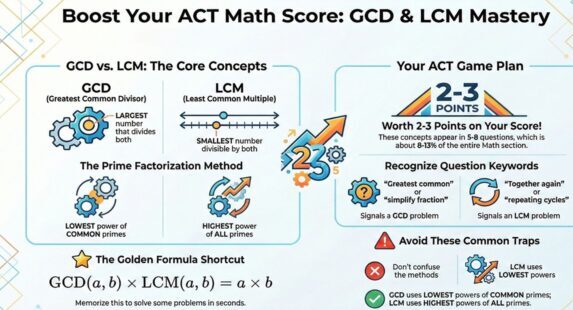
    • GCD (Greatest Common Divisor): Largest number that divides both numbers evenly
    • LCM (Least Common Multiple): Smallest number that both numbers divide into evenly
    • ACT Shortcut: Use prime factorization for quick LCM and GCD calculations

    ๐Ÿ“ Key Concepts & Definitions

    ๐Ÿ”‘ Essential Definitions & Formulas

    1. Factors

    A factor of a number $$n$$ is any integer that divides $$n$$ evenly (with no remainder).

    Example: Factors of 24 are: 1, 2, 3, 4, 6, 8, 12, 24

    2. Multiples

    A multiple of a number $$n$$ is the product of $$n$$ and any integer.

    Example: Multiples of 7 are: 7, 14, 21, 28, 35, 42…

    3. Prime Factorization

    Express a number as a product of prime numbers only.

    Example: $$72 = 2^3 \times 3^2 = 2 \times 2 \times 2 \times 3 \times 3$$

    4. GCD (Greatest Common Divisor)

    The largest positive integer that divides both numbers evenly.

    Method: Take the lowest power of each common prime factor.

    5. LCM (Least Common Multiple)

    The smallest positive integer that both numbers divide into evenly.

    Method: Take the highest power of each prime factor present.

    ๐Ÿ’ก Golden Formula:

    $$\text{GCD}(a,b) \times \text{LCM}(a,b) = a \times b$$

    ๐Ÿ“Š GCD vs LCM: Quick Comparison

    Aspect GCD (Greatest Common Divisor) LCM (Least Common Multiple)
    Definition Largest number that divides both Smallest number divisible by both
    Size Always โ‰ค smaller number Always โ‰ฅ larger number
    Prime Factor Method Take lowest powers of common primes Take highest powers of all primes
    Common Use Simplifying fractions Finding common denominators
    Example (12, 18) GCD = 6 LCM = 36

    โœ… Step-by-Step Examples

    Example 1: Prime Factorization

    Problem: Find the prime factorization of 180.

    Step 1: Start with the smallest prime number (2) and divide.

    $$180 \div 2 = 90$$

    Step 2: Continue dividing by 2 until you can’t anymore.

    $$90 \div 2 = 45$$

    Step 3: Move to the next prime (3).

    $$45 \div 3 = 15$$

    $$15 \div 3 = 5$$

    Step 4: 5 is prime, so we’re done!

    โœ… Final Answer:

    $$180 = 2^2 \times 3^2 \times 5$$

    โฑ๏ธ ACT Time: 30-45 seconds with practice

    Example 2: Finding GCD Using Prime Factorization

    Problem: Find the GCD of 48 and 72.

    Step 1: Find prime factorization of both numbers.

    $$48 = 2^4 \times 3^1$$

    $$72 = 2^3 \times 3^2$$

    Step 2: Identify common prime factors.

    Both have 2 and 3 as prime factors.

    Step 3: Take the lowest power of each common prime.

    For 2: lowest power is $$2^3$$ (from 72)

    For 3: lowest power is $$3^1$$ (from 48)

    Step 4: Multiply these together.

    $$\text{GCD} = 2^3 \times 3^1 = 8 \times 3 = 24$$

    โœ… Final Answer: GCD(48, 72) = 24

    โฑ๏ธ ACT Time: 45-60 seconds

    Example 3: Finding LCM Using Prime Factorization

    Problem: Find the LCM of 24 and 36.

    Step 1: Find prime factorization of both numbers.

    $$24 = 2^3 \times 3^1$$

    $$36 = 2^2 \times 3^2$$

    Step 2: Identify all prime factors from both numbers.

    Prime factors present: 2 and 3

    Step 3: Take the highest power of each prime factor.

    For 2: highest power is $$2^3$$ (from 24)

    For 3: highest power is $$3^2$$ (from 36)

    Step 4: Multiply these together.

    $$\text{LCM} = 2^3 \times 3^2 = 8 \times 9 = 72$$

    โœ… Final Answer: LCM(24, 36) = 72

    โฑ๏ธ ACT Time: 45-60 seconds

    ๐Ÿ’ก Verification Tip: Check using the golden formula: $$24 \times 36 = 864$$ and $$\text{GCD}(24,36) \times 72 = 12 \times 72 = 864$$ โœ“

    ๐ŸŽจ Visual Solution: Prime Factorization Tree

    Here’s a visual representation of finding the prime factorization of 60:

                        60
                       /  \
                      2    30
                          /  \
                         2    15
                             /  \
                            3    5
    
    Prime Factorization: 60 = 2 ร— 2 ร— 3 ร— 5 = 2ยฒ ร— 3 ร— 5
    

    ๐Ÿ’ก Pro Tip: On the ACT, you don’t need to draw the treeโ€”just divide systematically starting with 2, then 3, then 5, etc.

    ๐Ÿ“

    Ready to Test Your Knowledge?

    Take our full-length ACT practice test and see how well you’ve mastered factors, multiples, LCM, and GCD. Get instant scoring, detailed explanations, and personalized recommendations!

    ๐Ÿš€ Start ACT Practice Test Now โ†’
    โœ“ Full-Length Tests
    โœ“ Instant Scoring
    โœ“ Detailed Solutions

    ๐Ÿ“ ACT-Style Practice Questions

    Practice Question 1 MEDIUM

    What is the greatest common divisor (GCD) of 84 and 126?

    A) 6
    B) 12
    C) 21
    D) 42
    E) 84
    ๐Ÿ“– Show Detailed Solution

    Step 1: Prime factorization

    $$84 = 2^2 \times 3 \times 7$$

    $$126 = 2 \times 3^2 \times 7$$

    Step 2: Take lowest powers of common primes

    Common primes: 2, 3, 7

    $$\text{GCD} = 2^1 \times 3^1 \times 7^1 = 2 \times 3 \times 7 = 42$$

    โœ… Correct Answer: D) 42

    โฑ๏ธ Target Time: 45-60 seconds

    Practice Question 2 MEDIUM

    Two buses leave the station at the same time. One bus returns to the station every 18 minutes, and the other returns every 24 minutes. After how many minutes will both buses be at the station together again?

    A) 42 minutes
    B) 48 minutes
    C) 54 minutes
    D) 72 minutes
    E) 144 minutes
    ๐Ÿ“– Show Detailed Solution

    Key Insight: This is an LCM problem! We need the smallest time when both cycles align.

    Step 1: Prime factorization

    $$18 = 2 \times 3^2$$

    $$24 = 2^3 \times 3$$

    Step 2: Take highest powers of all primes

    $$\text{LCM} = 2^3 \times 3^2 = 8 \times 9 = 72$$

    โœ… Correct Answer: D) 72 minutes

    โฑ๏ธ Target Time: 60-75 seconds

    ๐ŸŽฏ ACT Tip: Word problems about repeating events almost always require LCM!

    Practice Question 3 HARD

    If the GCD of two numbers is 15 and their LCM is 180, what is the product of the two numbers?

    A) 195
    B) 900
    C) 1,350
    D) 2,700
    E) 3,600
    ๐Ÿ“– Show Detailed Solution

    Key Formula: This uses the golden relationship!

    $$\text{GCD}(a,b) \times \text{LCM}(a,b) = a \times b$$

    Step 1: Apply the formula directly

    $$15 \times 180 = a \times b$$

    Step 2: Calculate

    $$a \times b = 2,700$$

    โœ… Correct Answer: D) 2,700

    โฑ๏ธ Target Time: 20-30 seconds (if you know the formula!)

    ๐Ÿš€ Speed Tip: Memorize this formulaโ€”it appears on nearly every ACT and saves massive time!

    โš ๏ธ Common Mistakes to Avoid

    โŒ Mistake #1: Confusing GCD and LCM

    Wrong: Using highest powers for GCD or lowest powers for LCM.

    Remember: GCD = lowest powers (it divides both), LCM = highest powers (both divide into it).

    โŒ Mistake #2: Forgetting to Include All Prime Factors for LCM

    Wrong: Only using common prime factors for LCM.

    Correct: LCM includes ALL prime factors from BOTH numbers (take highest power of each).

    โŒ Mistake #3: Incomplete Prime Factorization

    Wrong: Stopping at composite factors like $$36 = 6 \times 6$$.

    Correct: Break down completely to primes: $$36 = 2^2 \times 3^2$$.

    โŒ Mistake #4: Calculation Errors with Exponents

    Wrong: Thinking $$2^3 = 6$$ instead of 8.

    Tip: Double-check exponent calculationsโ€”they’re easy to rush through!

    ๐Ÿง  Memory Tricks & Mnemonics

    ๐Ÿ’ก Trick #1: “GCD Goes Down, LCM Lifts Up”

    GCD uses lowest powers (goes down), LCM uses highest powers (lifts up).

    ๐Ÿ’ก Trick #2: “Common vs. All”

    GCD uses only common prime factors. LCM uses all prime factors from both numbers.

    ๐Ÿ’ก Trick #3: “Small Divides, Big Contains”

    GCD is small (divides both numbers). LCM is big (contains both numbers as factors).

    ๐Ÿ’ก Trick #4: The “2-3-5-7” Quick Check

    Always test divisibility by primes in order: 2, 3, 5, 7, 11… This systematic approach prevents missing factors.

    ๐Ÿ’ก ACT Pro Tips & Tricks

    ๐Ÿš€ Time-Saving Strategies

    Tip #1: Use the Golden Formula for Quick Calculations

    If you know GCD and LCM, you can find the product: $$a \times b = \text{GCD} \times \text{LCM}$$. This saves 30-45 seconds!

    Tip #2: Recognize LCM Word Problem Patterns

    Keywords like “together again,” “at the same time,” “repeating cycles” = LCM problem. Instantly know what to calculate!

    Tip #3: Small Numbers? List Them Out

    For numbers under 20, listing multiples or factors can be faster than prime factorization. Be flexible!

    Tip #4: Use Your Calculator Strategically

    Calculator can verify divisibility quickly. Test $$180 \div 2$$, $$90 \div 2$$, etc. But do the prime factorization logic yourself.

    Tip #5: Eliminate Obviously Wrong Answers

    GCD must be โ‰ค smaller number. LCM must be โ‰ฅ larger number. Use this to eliminate 2-3 answer choices immediately!

    Tip #6: Check if Numbers Share Obvious Factors

    Both even? Factor out 2. Both end in 0 or 5? Factor out 5. This simplifies calculations dramatically.

    ๐ŸŒ Real-World Applications

    Understanding factors and multiples isn’t just for testsโ€”these concepts appear everywhere in real life:

    • Scheduling & Planning: Finding when events align (LCM) like work shifts, bus schedules, or meeting times.
    • Music & Rhythm: Musicians use LCM to find when different rhythms sync up in a measure.
    • Construction & Design: Tiling floors, arranging objects in rowsโ€”GCD helps find the largest tile size that fits perfectly.
    • Cooking & Recipes: Scaling recipes up or down while maintaining proportions uses GCD and LCM.
    • Computer Science: Algorithms for data compression, cryptography, and memory allocation rely heavily on prime factorization.
    • Finance: Calculating payment cycles, interest compounding periods, and investment synchronization.

    The ACT tests these concepts because they’re genuinely useful in college-level math, engineering, computer science, and beyond!

    ๐ŸŽฅ Video Explanation

    Watch this detailed video explanation to understand factors, multiples, LCM, and GCD better with visual demonstrations and step-by-step guidance.

    Factors and Multiples Video Tutorial
    Click to Load Video

    ๐ŸŽฏ ACT Test-Taking Strategy for Factors & Multiples

    โฑ๏ธ Time Allocation

    Allocate 45-90 seconds per factors/multiples question. Simple GCD/LCM problems: 45-60 seconds. Word problems: 60-90 seconds.

    ๐ŸŽฏ Question Recognition

    Look for these keywords:

    • GCD/GCF problems: “greatest common,” “largest number that divides,” “simplify fraction”
    • LCM problems: “least common,” “smallest number divisible,” “together again,” “at the same time”
    • Prime factorization: “express as product of primes,” “prime factors”

    ๐Ÿšฆ When to Skip and Return

    Skip if you can’t find prime factorization within 30 seconds OR if the numbers are very large (over 200). Mark it and return after easier questions.

    ๐ŸŽฒ Guessing Strategy

    If you must guess:

    • For GCD: Eliminate answers larger than the smaller number
    • For LCM: Eliminate answers smaller than the larger number
    • Check if answer choices are factors/multiples of given numbers

    โœ… Quick Verification

    Always verify using the golden formula: $$\text{GCD} \times \text{LCM} = a \times b$$. Takes 5 seconds and catches calculation errors!

    โš ๏ธ Common Trap Answers

    • Product of the two numbers (often appears as distractor)
    • Sum of the two numbers
    • One of the original numbers
    • Swapped GCD/LCM answers (giving LCM when asking for GCD)

    โ“ Frequently Asked Questions (FAQs)

    ๐Ÿ” What’s the difference between GCD and GCF? +

    There’s no difference! GCD (Greatest Common Divisor) and GCF (Greatest Common Factor) are two names for the exact same concept. The ACT may use either term, so be familiar with both. They both refer to the largest number that divides evenly into two or more numbers.

    โšก Is there a faster way than prime factorization for finding GCD? +

    Yes! The Euclidean Algorithm is faster for large numbers, but it’s more complex. For ACT purposes, prime factorization is usually fastest because:

    • ACT numbers are typically small (under 200)
    • You often need prime factorization for other parts of the problem
    • It’s less prone to calculation errors under time pressure

    For very small numbers (under 20), listing factors can be quickest.

    ๐Ÿค” Can the LCM of two numbers ever equal one of the numbers? +

    Yes! This happens when one number is a multiple of the other. For example:

    • LCM(6, 12) = 12 (because 12 is a multiple of 6)
    • LCM(5, 15) = 15 (because 15 is a multiple of 5)
    • LCM(7, 7) = 7 (a number’s LCM with itself is itself)

    ACT Tip: If you see that one number divides evenly into the other, the larger number IS the LCM. This saves you 30+ seconds!

    ๐Ÿ“ฑ Can I use my calculator to find GCD or LCM on the ACT? +

    Most ACT-approved calculators don’t have built-in GCD/LCM functions. However, you can use your calculator to:

    • Test divisibility quickly (divide and check for remainders)
    • Calculate prime factorizations faster
    • Verify your final answer using the formula $$\text{GCD} \times \text{LCM} = a \times b$$

    Important: Some TI calculators have GCD/LCM in the MATH menu, but relying on finding it wastes time. Learn the prime factorization methodโ€”it’s faster!

    ๐ŸŽฏ How many questions about factors and multiples appear on each ACT? +

    Typically 5-8 questions per ACT Math test directly involve factors, multiples, GCD, or LCM. This represents about 8-13% of the 60 Math questions. Additionally, these concepts appear indirectly in:

    • Fraction simplification problems
    • Ratio and proportion questions
    • Algebraic factoring
    • Number pattern problems

    Mastering this topic can realistically add 2-3 points to your Math score, which translates to about 1 point on your composite score!

    Dr. Irfan Mansuri

    โœ๏ธ Written by Dr. Irfan Mansuri

    Educational Content Creator & Competitive Exam Specialist

    IrfanEdu.com โ€ข United States

    Dr. Irfan Mansuri is a distinguished educational content creator with over 15 years of experience spanning high school, undergraduate, and postgraduate levels. As the founder of IrfanEdu.com, he has successfully guided thousands of students through competitive examinations, helping them achieve exceptional results and gain admission to their dream institutions.

    15+ years in competitive exam preparation Certified Instructor LinkedIn Profile
    [pdf_viewer id=”50″]

  • Master Basic Operations with Integers, Fractions & Decimals | ACT Math

    Master Basic Operations with Integers, Fractions & Decimals | ACT Math

    How to Master Basic Operations with Integers, Fractions & Decimals | ACT Math

    How to Master Basic Operations with Integers, Fractions & Decimals | ACT Math Grade 9-10 Practice

    Welcome to IrfanEdu.com’s comprehensive ACT prep resources! If you’re preparing for the ACT Math section, understanding how to confidently work with integers, fractions, and decimals in mixed operation problems is absolutely essential. Today, we’re tackling a medium-difficulty practice problem that combines all these elements, and I’ll show you exactly how to approach it with the speed and accuracy needed for test day success. ๐ŸŽฏ

    ๐ŸŽฏ

    ACT SCORE BOOSTER: Master This Topic for 2-3 Extra Points!

    This topic appears in most tests (5-10 questions) on the ACT Math section. Understanding it thoroughly can add 2-3 points to your composite score. Let’s break it down with proven strategies that work!

    ๐Ÿš€ Jump to ACT Strategy โ†’

    โšก Quick Answer (TL;DR)

    Problem: Calculate: $$(-12) + 18 \div 3 – 2.5 \times 4 + \frac{3}{4} = ?$$

    Answer: $$-15.25$$ or $$-15\frac{1}{4}$$

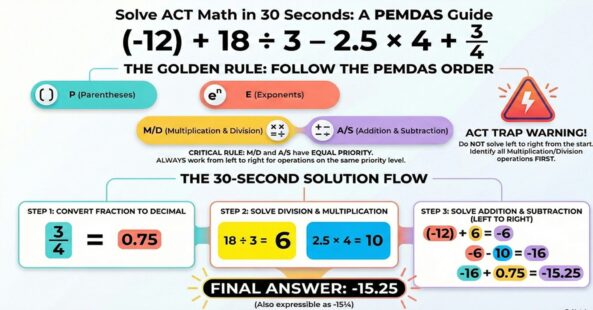
    ๐Ÿ’ก Key Strategy: Follow PEMDAS strictly! Division and multiplication first (left to right), then addition and subtraction (left to right). Convert the fraction to decimal for easier calculation.

    ๐Ÿ“‹ Practice Problem 1: Mixed Operations Challenge

    ACT Math | Pre-Algebra | Difficulty: Medium

    Calculate: $$(-12) + 18 \div 3 – 2.5 \times 4 + \frac{3}{4} = ?$$

    This problem tests your ability to handle multiple types of numbers (negative integers, positive integers, decimals, and fractions) while correctly applying the order of operations. It’s exactly the kind of question you’ll encounter in the early-to-middle section of the ACT Math test, where one small mistake can cost you valuable points. According to the official ACT website, basic operations questions like this form the foundation of the Pre-Algebra section. Let’s break it down together! ๐Ÿ“Š

    ๐ŸŽฏ ACT Strategy: The 30-Second Approach

    โฑ๏ธ Time Target: 30-45 seconds

    For ACT Math, you have an average of 60 seconds per question. Basic operation problems like this should take you half that time if you’re well-practiced. Here’s your game plan:

    1. Scan for PEMDAS violations (5 seconds) – Identify what operations need to happen first
    2. Convert fraction to decimal (5 seconds) – $$\frac{3}{4} = 0.75$$ (memorize common fractions!)
    3. Calculate multiplication/division (10 seconds) – Do these operations left to right
    4. Calculate addition/subtraction (10 seconds) – Work left to right with your results
    5. Double-check signs (5 seconds) – Negative number errors are the #1 mistake!

    ๐Ÿšจ ACT Trap Warning: The test makers LOVE to include problems where students forget order of operations and work strictly left to right. If you calculated $$(-12) + 18 = 6$$, then $$6 \div 3 = 2$$, you’ve fallen into the trap! Always identify multiplication and division first.

    ๐ŸŽฅ Video Explanation

    Watch this detailed video explanation to understand the concept better with visual demonstrations and step-by-step guidance.

    ACT Math Video Tutorial Thumbnail
    Click to Load Video

    ๐ŸŽจ Visual Solution Breakdown

    Let’s visualize the order of operations with a clear diagram showing exactly what happens at each step:

    ๐Ÿ“ ORIGINAL PROBLEM:
    (-12) + 18 รท 3 – 2.5 ร— 4 + 3/4
    ๐Ÿ”„ STEP 1: Convert Fraction to Decimal
    (-12) + 18 รท 3 – 2.5 ร— 4 + 0.75
    ๐Ÿ’ก Conversion: 3/4 = 0.75
    ๐ŸŽฏ STEP 2: Identify Operations by Priority
    Priority 1 (Mult/Div):
    18 รท 3 and 2.5 ร— 4
    Priority 2 (Add/Sub):
    Everything else (left to right)
    โž— STEP 3: Calculate Division
    (-12) + 6 – 2.5 ร— 4 + 0.75
    ๐Ÿ’ก Calculation: 18 รท 3 = 6
    โœ–๏ธ STEP 4: Calculate Multiplication
    (-12) + 6 – 10 + 0.75
    ๐Ÿ’ก Calculation: 2.5 ร— 4 = 10
    โž•โž– STEP 5: Work Left to Right (Addition/Subtraction)
    Step 5a:
    (-12) + 6 = -6
    Step 5b:
    -6 – 10 = -16
    Step 5c:
    -16 + 0.75 = -15.25
    ๐ŸŽ‰ FINAL ANSWER
    -15.25 or -15ยผ
    ๐Ÿ“

    Ready to Test Your Knowledge?

    Take our full-length ACT practice test and see how well you’ve mastered this topic. Get instant scoring, detailed explanations, and personalized recommendations!

    ๐Ÿš€ Start ACT Practice Test Now โ†’
    โœ“ Full-Length Tests
    โœ“ Instant Scoring
    โœ“ Detailed Solutions

    โœ… Complete Step-by-Step Solution

    Now let’s walk through this problem with detailed explanations for each step. This is the methodology you should internalize for test day:

    1 Write Down the Problem Clearly

    $$(-12) + 18 \div 3 – 2.5 \times 4 + \frac{3}{4}$$

    Why this matters: On the ACT, rushing leads to misreading. Take 2 seconds to ensure you’ve captured all numbers and operations correctly.

    2 Convert Fractions to Decimals (When Helpful)

    $$\frac{3}{4} = 0.75$$

    So our problem becomes: $$(-12) + 18 \div 3 – 2.5 \times 4 + 0.75$$

    Pro tip: Memorize these common fraction-to-decimal conversions: $$\frac{1}{4} = 0.25$$, $$\frac{1}{2} = 0.5$$, $$\frac{3}{4} = 0.75$$, $$\frac{1}{5} = 0.2$$, $$\frac{1}{8} = 0.125$$

    3 Apply PEMDAS: Division First

    Identify and calculate: $$18 \div 3 = 6$$

    Updated expression: $$(-12) + 6 – 2.5 \times 4 + 0.75$$

    Remember: In PEMDAS, Multiplication and Division have equal priority. Work left to right when you encounter them.

    4 Apply PEMDAS: Multiplication Next

    Calculate: $$2.5 \times 4 = 10$$

    Updated expression: $$(-12) + 6 – 10 + 0.75$$

    Calculator tip: For $$2.5 \times 4$$, think of it as $$\frac{5}{2} \times 4 = \frac{20}{2} = 10$$ or simply $$2.5 + 2.5 + 2.5 + 2.5 = 10$$

    5 Work Left to Right: Addition and Subtraction

    Step 5a: $$(-12) + 6 = -6$$

    Think: Start at -12 on the number line, move 6 units to the right โ†’ land at -6

    Step 5b: $$-6 – 10 = -16$$

    Think: Subtracting a positive is the same as adding a negative โ†’ $$-6 + (-10) = -16$$

    Step 5c: $$-16 + 0.75 = -15.25$$

    Think: Start at -16, move 0.75 units to the right โ†’ land at -15.25

    ๐ŸŽ‰ Final Answer

    $$-15.25$$ or $$-15\frac{1}{4}$$ or $$-\frac{61}{4}$$

    โš ๏ธ Common Mistakes to Avoid

    Let’s look at the most frequent errors students make on problems like thisโ€”and how to avoid them:

    โŒ Mistake Why It Happens โœ… How to Fix It
    Working strictly left to right Forgetting PEMDAS order Always identify mult/div operations first, mark them with circles
    Sign errors with negatives Rushing through negative number rules Use parentheses: treat $$(-12) + 6$$ as $$-12 + 6$$, not $$12 + 6$$
    Decimal point errors Misplacing decimal in $$2.5 \times 4$$ Double-check: $$2.5 \times 4 = 10$$, not 1.0 or 100
    Fraction conversion mistakes Not memorizing common fractions Create flashcards for $$\frac{1}{4}$$, $$\frac{1}{2}$$, $$\frac{3}{4}$$, $$\frac{1}{5}$$, $$\frac{1}{8}$$
    Calculator input errors Typing too fast, missing parentheses Input as: $$(-12) + (18 \div 3) – (2.5 \times 4) + 0.75$$

    โฑ๏ธ Time-Saving Tips for ACT Math

    ๐Ÿ’ก Tip #1: Memorize Common Conversions

    Don’t waste 10 seconds dividing $$3 \div 4$$ on your calculator. Know that $$\frac{3}{4} = 0.75$$ instantly. This saves 5-10 seconds per problem!

    ๐Ÿ’ก Tip #2: Use Calculator Parentheses

    Input the entire expression with parentheses: $$(-12)+(18\div3)-(2.5\times4)+0.75$$ and let your calculator handle PEMDAS.

    ๐Ÿ’ก Tip #3: Circle Mult/Div Operations

    Before calculating anything, physically circle or underline all multiplication and division operations. This prevents PEMDAS violations.

    ๐Ÿ’ก Tip #4: Practice Mental Math

    Simple operations like $$18 \div 3$$ or $$2.5 \times 4$$ should be instant. Practice 10 minutes daily to build speed and confidence.

    ๐Ÿ“ Practice Problems (Try These!)

    Ready to test your skills? Try these similar problems. Answers are at the bottomโ€”no peeking! ๐Ÿ˜Š

    ๐ŸŽฏ Challenge Yourself:

    Problem 1 (Easy): $$15 + 20 \div 4 – 3 \times 2 = ?$$

    Problem 2 (Medium): $$(-8) + 24 \div 6 – 1.5 \times 4 + \frac{1}{2} = ?$$

    Problem 3 (Hard): $$(-15) + 36 \div 4 – 3.25 \times 2 + \frac{3}{8} – 1 = ?$$

    ๐Ÿ” Click to Reveal Answers

    Problem 1: $$14$$

    Problem 2: $$-1.5$$ or $$-\frac{3}{2}$$

    Problem 3: $$-9.125$$ or $$-9\frac{1}{8}$$

    โ“ Frequently Asked Questions (FAQs)

    Q1: What is the order of operations for ACT Math problems?

    A: The order of operations follows PEMDAS: Parentheses, Exponents, Multiplication and Division (left to right), Addition and Subtraction (left to right). This is crucial for ACT Math success. Remember that multiplication and division have equal priority, as do addition and subtractionโ€”always work left to right within each priority level.

    Q2: How do I handle negative numbers in basic operations?

    A: When adding a negative number, subtract its absolute value (e.g., $$5 + (-3) = 5 – 3 = 2$$). When subtracting a negative, add its absolute value (e.g., $$5 – (-3) = 5 + 3 = 8$$). For multiplication/division: same signs give positive results, different signs give negative results. Always use parentheses around negative numbers to avoid confusion: $$(-12) + 6$$ is clearer than $$-12 + 6$$.

    Q3: Should I convert fractions to decimals or decimals to fractions?

    A: For ACT Math, converting fractions to decimals is usually faster and less error-prone. Use your calculator efficiently. However, keep fractions when they’re simple (like $$\frac{1}{2}$$, $$\frac{1}{4}$$) or when the problem requires exact answers. Memorize common conversions: $$\frac{1}{4} = 0.25$$, $$\frac{1}{2} = 0.5$$, $$\frac{3}{4} = 0.75$$, $$\frac{1}{5} = 0.2$$, $$\frac{1}{8} = 0.125$$. This saves valuable time!

    Q4: How much time should I spend on basic operation questions on the ACT?

    A: Basic operation questions should take 30-45 seconds maximum. You have 60 minutes for 60 questions on ACT Math (average 60 seconds per question), but simpler problems should be solved faster to give you more time for complex geometry and algebra questions. If you’re spending more than 1 minute on a basic operations problem, you may be overcomplicating it. Practice mental math and calculator efficiency to improve speed.

    Q5: What are the most common mistakes in mixed operation problems?

    A: The top mistakes are: 1) Ignoring order of operations and working left to right, 2) Sign errors with negative numbers (especially double negatives), 3) Decimal point placement errors, 4) Calculator input mistakes (forgetting parentheses), and 5) Rushing through parentheses. To avoid these, always circle multiplication/division operations first, use parentheses liberally in your calculator, and double-check your signs before finalizing your answer.

    ๐ŸŽ“ Wrapping Up: Your Path to ACT Math Success

    Congratulations! You’ve just mastered a critical ACT Math skill: solving mixed operation problems with integers, fractions, and decimals. While this might seem like a basic topic, it’s the foundation for more complex algebra, geometry, and trigonometry questions you’ll encounter on test day.

    Remember these key takeaways:

    • PEMDAS is non-negotiable โ€“ Always identify multiplication and division operations before doing anything else
    • Speed comes from practice โ€“ Aim for 30-45 seconds on basic operation problems
    • Negative numbers require extra attention โ€“ Use parentheses and double-check your signs
    • Memorize common conversions โ€“ Knowing $$\frac{3}{4} = 0.75$$ instantly saves precious seconds
    • Your calculator is your friend โ€“ But only if you input expressions correctly with parentheses
    • Visual learning helps โ€“ Use number lines and flowcharts to understand the process

    The path to a higher ACT Math score is built on mastering fundamentals like this, then applying them consistently under time pressure. Practice the three problems above, then find 10 more similar questions and time yourself. Your goal: solve each one correctly in under 45 seconds.

    For more comprehensive ACT preparation resources, visit our complete collection of practice problems, video tutorials, and test-taking strategies.

    ๐Ÿ’ช Keep practicing, stay confident, and remember: every point counts on the ACT!

    Visit IrfanEdu.com for more ACT Math practice problems and strategies

    Dr. Irfan Mansuri

    โœ๏ธ Written by Dr. Irfan Mansuri

    Educational Content Creator & Competitive Exam Specialist

    IrfanEdu.com โ€ข United States

    Dr. Irfan Mansuri is a distinguished educational content creator and competitive exam specialist with over 15 years of experience spanning high school, undergraduate, and postgraduate levels. As the founder of IrfanEdu.com, he has successfully guided thousands of students through competitive examinations, helping them achieve exceptional results and gain admission to their dream institutions.

    15+ years in competitive exam preparation Certified Instructor LinkedIn Profile

    ๐Ÿ“ข Found this helpful? Share it with your classmates preparing for the ACT!

    ๐Ÿš€ Ready to Boost Your ACT Math Score?

    Get access to hundreds more practice problems, video explanations, and personalized study plans at IrfanEdu.com

    ๐ŸŽฏ Start Practicing Now โ†’
    ๐Ÿ“„

    ๐Ÿ“š Complete Study Guide – Read Online or Download

    View the complete ACT Math: Basic Operations with Integers, Fractions & Decimals Guide right here, or download it for offline study. Includes all formulas, examples, practice questions, and strategies!

    ๐Ÿ“– Read the Guide Online

    ๐Ÿ“„

    Click to Load PDF Viewer

    (1.8 MB – Loads on demand to save bandwidth)

    ๐Ÿ’ก Tip: Use the toolbar to zoom, navigate pages, and print directly from the viewer

    โœจ What’s Inside This PDF:

    ๐Ÿ“ PEMDAS rules & formulas
    โœ… 10+ worked examples
    ๐Ÿ“ 20 practice questions
    ๐ŸŽฏ ACT timing strategies
    ๐Ÿ–จ๏ธ Printer-friendly format
    ๐Ÿ’ก Fraction conversion chart
    โš ๏ธ Common mistake warnings
    ๐Ÿ“Š Number line visuals
    ๐Ÿงฎ Calculator techniques
    โฌ‡๏ธ Download PDF for Offline Study (100% Free)

    ๐Ÿ“Š File Size: 1.8 MB | ๐Ÿ“„ 12 Pages | No signup required

    โœ… Read online or download | ๐Ÿ–จ๏ธ Print-ready | ๐Ÿ“ฑ Mobile-friendly | ๐Ÿ”„ Updated January 2025

    Published: January 30, 2026
    Category: ACT Math, Pre-Algebra
    Reading Time: 12 minutes
    Difficulty: Medium