Simplifying Radical Expressions | ACT Math Guide for Grades 9-12
Radical expressions appear frequently on the ACT Math section, and knowing how to simplify them quickly can save you valuable time during the test. Whether you’re dealing with square roots, cube roots, or higher-order radicals, mastering simplification techniques is essential for success. This comprehensive guide will walk you through everything you need to know about simplifying radical expressions, complete with step-by-step examples, proven strategies, and practice questions designed specifically for ACT prep resources.
ACT SCORE BOOSTER: Master This Topic for 2-3 Extra Points!
Radical expressions appear in 5-8 questions on the ACT Math section. Understanding simplification thoroughly can add 2-3 points to your composite score. Let’s break it down with proven strategies that work!
🚀 Jump to ACT Strategy →📚 Understanding Radical Expressions for ACT Success
A radical expression contains a root symbol ($$\sqrt{}$$) with a number or expression underneath called the radicand. Simplifying radicals means rewriting them in their most reduced form by removing perfect square factors (or perfect cube factors for cube roots). This skill is fundamental to Elementary Algebra on the ACT and appears in various contexts throughout the test.
The ACT Math section tests your ability to simplify radicals quickly and accurately. You’ll encounter these expressions in standalone questions, within algebraic equations, and as part of geometry problems. According to the official ACT website, Elementary Algebra comprises approximately 15-20% of the Math section, making radical simplification a high-value skill to master.
💡 Quick Answer: What Does “Simplifying” Mean?
Simplifying a radical means expressing it with the smallest possible radicand by factoring out perfect squares (or cubes, fourths, etc.). For example, $$\sqrt{50}$$ simplifies to $$5\sqrt{2}$$ because 50 = 25 × 2, and $$\sqrt{25} = 5$$.
📐 Essential Rules for Simplifying Radicals
Product Property of Radicals
$$\sqrt{a \cdot b} = \sqrt{a} \cdot \sqrt{b}$$
When to use: Breaking down radicands into smaller factors, especially when identifying perfect squares.
Quotient Property of Radicals
$$\sqrt{\frac{a}{b}} = \frac{\sqrt{a}}{\sqrt{b}}$$
When to use: Simplifying fractions under radical signs or rationalizing denominators.
Perfect Squares to Memorize
| $$1^2 = 1$$ | $$2^2 = 4$$ | $$3^2 = 9$$ | $$4^2 = 16$$ | $$5^2 = 25$$ |
| $$6^2 = 36$$ | $$7^2 = 49$$ | $$8^2 = 64$$ | $$9^2 = 81$$ | $$10^2 = 100$$ |
| $$11^2 = 121$$ | $$12^2 = 144$$ | $$13^2 = 169$$ | $$14^2 = 196$$ | $$15^2 = 225$$ |
Memory trick: Knowing perfect squares up to 15² will handle 95% of ACT radical questions!
Simplified Radical Form Requirements
- No perfect square factors remain under the radical
- No fractions appear under the radical
- No radicals appear in denominators (rationalized)
✅ Step-by-Step Examples with Visual Solutions
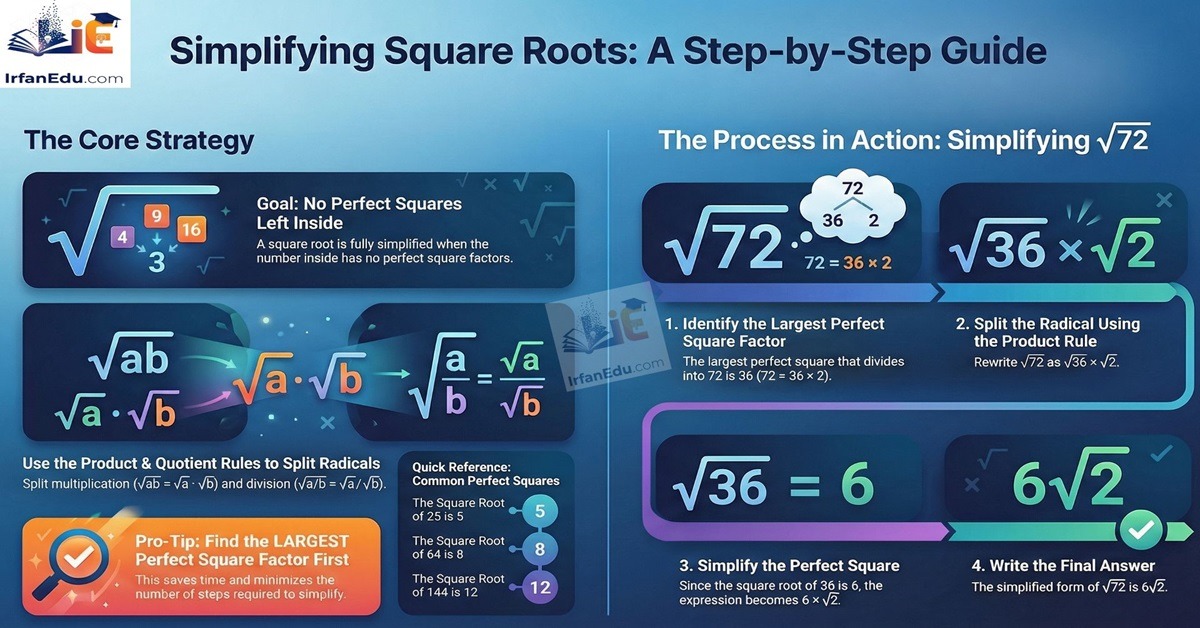
Example 1: Simplify $$\sqrt{72}$$
Step 1: Find the prime factorization
Break 72 into prime factors: $$72 = 2 \times 36 = 2 \times 6 \times 6 = 2 \times 2 \times 3 \times 2 \times 3 = 2^3 \times 3^2$$
Step 2: Identify perfect square factors
$$72 = 36 \times 2$$ (36 is a perfect square: $$6^2$$)
Step 3: Apply the product property
$$\sqrt{72} = \sqrt{36 \times 2} = \sqrt{36} \times \sqrt{2}$$
Step 4: Simplify the perfect square
$$\sqrt{36} \times \sqrt{2} = 6\sqrt{2}$$
✓ Final Answer: $$6\sqrt{2}$$
⏱️ ACT Time Estimate: 30-45 seconds
Example 2: Simplify $$\sqrt{98} + \sqrt{32}$$
Step 1: Simplify each radical separately
For $$\sqrt{98}$$: $$98 = 49 \times 2$$, so $$\sqrt{98} = \sqrt{49 \times 2} = 7\sqrt{2}$$
For $$\sqrt{32}$$: $$32 = 16 \times 2$$, so $$\sqrt{32} = \sqrt{16 \times 2} = 4\sqrt{2}$$
Step 2: Combine like radicals
$$7\sqrt{2} + 4\sqrt{2} = (7 + 4)\sqrt{2} = 11\sqrt{2}$$
✓ Final Answer: $$11\sqrt{2}$$
⏱️ ACT Time Estimate: 45-60 seconds
⚠️ Common Mistake: Students often try to add $$\sqrt{98} + \sqrt{32} = \sqrt{130}$$. This is WRONG! You can only combine radicals with the same radicand after simplification.
Example 3: Simplify $$\frac{6}{\sqrt{3}}$$ (Rationalizing the Denominator)
Step 1: Identify the problem
We have a radical in the denominator, which needs to be rationalized.
Step 2: Multiply by $$\frac{\sqrt{3}}{\sqrt{3}}$$
$$\frac{6}{\sqrt{3}} \times \frac{\sqrt{3}}{\sqrt{3}} = \frac{6\sqrt{3}}{3}$$
Step 3: Simplify the fraction
$$\frac{6\sqrt{3}}{3} = 2\sqrt{3}$$
✓ Final Answer: $$2\sqrt{3}$$
⏱️ ACT Time Estimate: 30-40 seconds
Ready to Test Your Radical Skills?
Take our full-length ACT Math practice test and see how well you’ve mastered radical simplification. Get instant scoring, detailed explanations, and personalized recommendations!
🚀 Start ACT Practice Test Now →📝 Practice Questions
Test your understanding with these ACT-style practice problems. Click “Show Solution” to see detailed explanations.
Practice Question 1 MEDIUM
Simplify: $$\sqrt{200}$$
Show Solution
Step 1: Factor 200 to find perfect squares: $$200 = 100 \times 2$$
Step 2: Apply product property: $$\sqrt{200} = \sqrt{100 \times 2} = \sqrt{100} \times \sqrt{2}$$
Step 3: Simplify: $$\sqrt{100} \times \sqrt{2} = 10\sqrt{2}$$
✓ Correct Answer: A) $$10\sqrt{2}$$
Practice Question 2 HARD
Simplify: $$3\sqrt{48} – 2\sqrt{75}$$
Show Solution
Step 1: Simplify $$\sqrt{48}$$: $$48 = 16 \times 3$$, so $$\sqrt{48} = 4\sqrt{3}$$
Step 2: Simplify $$\sqrt{75}$$: $$75 = 25 \times 3$$, so $$\sqrt{75} = 5\sqrt{3}$$
Step 3: Substitute: $$3(4\sqrt{3}) – 2(5\sqrt{3}) = 12\sqrt{3} – 10\sqrt{3}$$
Step 4: Combine like terms: $$12\sqrt{3} – 10\sqrt{3} = 2\sqrt{3}$$
✓ Correct Answer: D) $$2\sqrt{3}$$
Practice Question 3 EASY
Which of the following is equivalent to $$\sqrt{45}$$?
Show Solution
Step 1: Factor 45: $$45 = 9 \times 5$$
Step 2: Apply product property: $$\sqrt{45} = \sqrt{9 \times 5} = \sqrt{9} \times \sqrt{5}$$
Step 3: Simplify: $$\sqrt{9} \times \sqrt{5} = 3\sqrt{5}$$
✓ Correct Answer: C) $$3\sqrt{5}$$
🎥 Video Explanation: Simplifying Radical Expressions
Watch this comprehensive video explanation to master radical simplification with visual demonstrations and step-by-step guidance.
💡 ACT Pro Tips & Tricks
🎯 Memorize Perfect Squares Through 15
Knowing $$1^2$$ through $$15^2$$ instantly will save you 15-20 seconds per radical question. That’s huge on a timed test! Practice until these become automatic.
⚡ Look for the Largest Perfect Square First
Instead of breaking down to prime factors every time, scan for the largest perfect square factor. For $$\sqrt{72}$$, recognize 36 immediately rather than working through $$2 \times 2 \times 2 \times 3 \times 3$$.
🚫 Common Trap: Don’t Add Radicals Incorrectly
$$\sqrt{a} + \sqrt{b} \neq \sqrt{a+b}$$. The ACT loves to include wrong answers like $$\sqrt{50}$$ when the correct answer is $$\sqrt{32} + \sqrt{18} = 4\sqrt{2} + 3\sqrt{2} = 7\sqrt{2}$$.
🧮 Calculator Verification Trick
Calculate the decimal value of both your answer and the original expression. For example, $$\sqrt{72} \approx 8.485$$ and $$6\sqrt{2} \approx 8.485$$. They should match!
⏰ Time Management Strategy
Spend no more than 60 seconds on radical simplification questions. If you’re stuck after 45 seconds, use your calculator to check answer choices and move on.
📐 Rationalize Denominators Automatically
If you see a radical in the denominator, the ACT expects you to rationalize it. Answer choices will reflect this, so always complete this step.
🎯 ACT Test-Taking Strategy for Radical Expressions
Time Allocation
Allocate 45-60 seconds for straightforward simplification problems and up to 90 seconds for complex problems involving multiple radicals or algebraic expressions. These questions typically appear in the first 30 questions of the ACT Math section.
When to Skip and Return
If you don’t immediately recognize a perfect square factor within 15 seconds, mark the question and return to it. Don’t waste time on prime factorization if the pattern isn’t obvious—use your calculator to test answer choices instead.
Strategic Guessing
If you must guess, eliminate answers that aren’t in simplified form (still have perfect squares under the radical) or have radicals in denominators. The correct answer will always be fully simplified.
Quick Verification Method
Use your calculator to compute decimal approximations. Calculate $$\sqrt{72}$$ directly (8.485…), then verify your answer $$6\sqrt{2}$$ by computing $$6 \times \sqrt{2}$$ (8.485…). They should match exactly.
Common Trap Answers
- Answers that incorrectly add radicands: $$\sqrt{a} + \sqrt{b} = \sqrt{a+b}$$ (WRONG!)
- Answers with radicals still in denominators (not rationalized)
- Answers with remaining perfect square factors under the radical
- Answers that confuse coefficients with radicands
❓ Frequently Asked Questions
✍️ Written by Dr. Irfan Mansuri
Educational Content Creator & Competitive Exam Specialist
IrfanEdu.com • United States
Dr. Irfan Mansuri is a distinguished educational content creator with over 15 years of experience spanning high school, undergraduate, and postgraduate levels. As the founder of IrfanEdu.com, he has successfully guided thousands of students through competitive examinations, helping them achieve exceptional results and gain admission to their dream institutions.
📚 Related ACT Math Resources
Continue building your ACT Math skills with these related topics from our comprehensive ACT preparation collection:
- Exponent Rules: Master the laws of exponents for ACT success
- Solving Quadratic Equations: Learn multiple methods for solving quadratics
- Factoring Polynomials: Essential algebra skills for the ACT
- Rational Expressions: Simplifying and operating with fractions
- Linear Equations: Solving and graphing linear relationships
🎓 Ready to Ace the ACT Math Section?
You’ve learned the fundamentals of simplifying radical expressions. Now it’s time to put your skills to the test with our comprehensive ACT practice platform!
🚀 Start Your Free ACT Practice TestJoin thousands of students who have improved their ACT scores with IrfanEdu.com
Mastering Radical Simplification: A Complete Guide to Square Roots
Understanding how to work with radicals represents a fundamental skill in algebra. You’ve likely encountered square roots before—expressions like $$\sqrt{25} = 5$$ or $$\sqrt{2} \approx 1.414$$. Now, we’ll explore powerful techniques that help you simplify radical expressions efficiently. Throughout this guide, we focus exclusively on square roots, while higher-order roots (cube roots, fourth roots, etc.) appear in advanced algebra courses.
Essential Properties of Square Roots
Two fundamental properties govern how we manipulate radicals. These rules become your toolkit for simplification:
Property 1 (Product Rule): When you multiply two positive numbers under a square root, you can split them into separate radicals:
$$\sqrt{ab} = \sqrt{a} \times \sqrt{b}$$
Property 2 (Quotient Rule): When you divide two positive numbers under a square root, you can separate them into individual radicals:
$$\sqrt{\frac{a}{b}} = \frac{\sqrt{a}}{\sqrt{b}}$$
Understanding These Properties Through Examples
Let’s see how these properties work in practice. Consider the square root of 144. We can break this down using the product rule:
$$\sqrt{144} = \sqrt{36 \times 4} = \sqrt{36} \times \sqrt{4} = 6 \times 2 = 12$$
Similarly, the quotient rule helps us simplify fractions under radicals:
$$\sqrt{\frac{9}{25}} = \frac{\sqrt{9}}{\sqrt{25}} = \frac{3}{5}$$
The Key to Simplification: Finding Perfect Square Factors
When you simplify a radical expression, your goal involves identifying the largest perfect square factor within the radicand (the number under the radical symbol). Let’s explore this concept with $$\sqrt{450}$$:
You might initially factor 450 as $$25 \times 18$$:
$$\sqrt{450} = \sqrt{25 \times 18} = \sqrt{25} \times \sqrt{18} = 5\sqrt{18}$$
However, this doesn’t represent the simplest form! Notice that 18 still contains a perfect square factor (9). We need to simplify further:
$$\sqrt{18} = \sqrt{9 \times 2} = \sqrt{9} \times \sqrt{2} = 3\sqrt{2}$$
Therefore, the complete simplification becomes:
$$\sqrt{450} = 5 \times 3\sqrt{2} = 15\sqrt{2}$$
Pro Tip: You can save time by identifying the largest perfect square factor from the start. For 450, that’s 225, giving us: $$\sqrt{450} = \sqrt{225 \times 2} = 15\sqrt{2}$$
What Makes a Radical “Simplified”?
A radical expression reaches its simplest form when the radicand contains no perfect square factors. This means you’ve extracted all possible square roots from under the radical symbol.
Step-by-Step Examples: Simplifying Radicals
Let’s work through several examples to build your confidence with radical simplification:
Example 1: Simplify $$\sqrt{24}$$
Strategy: We need to factor 24 so that one factor represents a perfect square.
Since $$24 = 4 \times 6$$, and 4 is a perfect square, we can write:
$$\sqrt{24} = \sqrt{4 \times 6} = \sqrt{4} \times \sqrt{6} = 2\sqrt{6}$$
Answer: $$2\sqrt{6}$$
Example 2: Simplify $$\sqrt{72}$$
Strategy: Look for the largest perfect square factor to minimize your work.
The largest perfect square factor of 72 is 36:
$$\sqrt{72} = \sqrt{36 \times 2} = \sqrt{36} \times \sqrt{2} = 6\sqrt{2}$$
Alternatively, if you didn’t spot 36 immediately, you could factor using smaller squares:
$$\sqrt{72} = \sqrt{9 \times 8} = \sqrt{9} \times \sqrt{8} = 3\sqrt{8}$$
But we’re not finished! Since $$8 = 4 \times 2$$:
$$3\sqrt{8} = 3\sqrt{4 \times 2} = 3 \times \sqrt{4} \times \sqrt{2} = 3 \times 2 \times \sqrt{2} = 6\sqrt{2}$$
Answer: $$6\sqrt{2}$$
Example 3: Simplify $$-\sqrt{288}$$
Strategy: The negative sign stays outside the radical throughout the simplification process.
We identify 144 as the largest perfect square factor of 288:
$$-\sqrt{288} = -\sqrt{144 \times 2} = -\sqrt{144} \times \sqrt{2} = -12\sqrt{2}$$
Answer: $$-12\sqrt{2}$$
Example 4: Simplify $$\sqrt{\frac{75}{4}}$$
Strategy: Apply the quotient rule first, then simplify the numerator.
$$\sqrt{\frac{75}{4}} = \frac{\sqrt{75}}{\sqrt{4}} = \frac{\sqrt{25 \times 3}}{2} = \frac{\sqrt{25} \times \sqrt{3}}{2} = \frac{5\sqrt{3}}{2}$$
Answer: $$\frac{5\sqrt{3}}{2}$$
Example 5: Simplify $$\frac{3 + \sqrt{18}}{3}$$
Strategy: Simplify the radical first, then reduce the entire fraction.
First, we simplify $$\sqrt{18}$$:
$$\sqrt{18} = \sqrt{9 \times 2} = \sqrt{9} \times \sqrt{2} = 3\sqrt{2}$$
Now we substitute this back into our original expression:
$$\frac{3 + \sqrt{18}}{3} = \frac{3 + 3\sqrt{2}}{3}$$
We can factor out 3 from the numerator and simplify:
$$\frac{3 + 3\sqrt{2}}{3} = \frac{3(1 + \sqrt{2})}{3} = 1 + \sqrt{2}$$
Or, you can split the fraction into separate terms:
$$\frac{3 + 3\sqrt{2}}{3} = \frac{3}{3} + \frac{3\sqrt{2}}{3} = 1 + \sqrt{2}$$
Answer: $$1 + \sqrt{2}$$
Understanding the Relationship Between Powers and Roots
Radicals and exponents work as inverse operations—they undo each other. When you square a number and then take its square root, you return to your original value. Consider these relationships:
- Since $$2^2 = 4$$, we know that $$\sqrt{4} = 2$$
- Since $$3^2 = 9$$, we know that $$\sqrt{9} = 3$$
- Since $$12^2 = 144$$, we know that $$\sqrt{144} = 12$$
Important Note About Principal Square Roots
When you see the square root symbol, it always refers to the principal (positive) square root. Although both 2 and -2 square to give 4, the expression $$\sqrt{4}$$ specifically means the positive value, 2.
Key Distinction: Evaluating an expression like $$\sqrt{4}$$ gives one answer (2), while solving an equation like $$x^2 = 4$$ gives two solutions ($$x = 2$$ or $$x = -2$$).
Working With Non-Perfect Squares
Not every number under a radical can simplify to a whole number. For example, $$\sqrt{3}$$ has no perfect square factors, so it remains in radical form. When you need a decimal approximation for practical applications, you can use a calculator:
$$\sqrt{3} \approx 1.732$$
However, for mathematical exercises requiring exact answers, you should leave your answer as $$\sqrt{3}$$.
Quick Reference: Common Perfect Squares
Memorizing these perfect squares will significantly speed up your radical simplification:
- $$1^2 = 1$$
- $$2^2 = 4$$
- $$3^2 = 9$$
- $$4^2 = 16$$
- $$5^2 = 25$$
- $$6^2 = 36$$
- $$7^2 = 49$$
- $$8^2 = 64$$
- $$9^2 = 81$$
- $$10^2 = 100$$
- $$11^2 = 121$$
- $$12^2 = 144$$
- $$13^2 = 169$$
- $$14^2 = 196$$
- $$15^2 = 225$$
Practice Tips for Mastering Radical Simplification
- Memorize perfect squares up to at least 15² to recognize them quickly in problems
- Look for the largest perfect square factor first to minimize your steps
- Check your final answer by ensuring no perfect square factors remain under the radical
- Practice prime factorization to help identify all factors of a number
- Remember the properties: $$\sqrt{ab} = \sqrt{a} \times \sqrt{b}$$ and $$\sqrt{\frac{a}{b}} = \frac{\sqrt{a}}{\sqrt{b}}$$
Summary: Key Takeaways
- A radical reaches its simplest form when the radicand contains no perfect square factors
- You can split radicals using the product and quotient rules
- Finding the largest perfect square factor saves time and effort
- The square root symbol always refers to the principal (positive) root
- Radicals and exponents function as inverse operations
Mastering radical simplification builds a strong foundation for advanced algebra topics. With practice, you’ll quickly recognize perfect square factors and simplify expressions efficiently. Keep these properties and techniques in mind as you progress through more complex mathematical concepts.
[pdf_viewer id=”214″]
Leave a Reply