AI-Powered Physics Engine
Projectile Motion
Calculator
Calculate Range, Maximum Height & Time of Flight instantly. Enter launch velocity and angle — get all three results with step-by-step solutions.
🚀
Complete Analysis
R, H & T Together
Calculate all three values
at once from u and θ
at once from u and θ
🔍
Find Unknown
Solve for u or θ
Given R, H or T —
find velocity or angle
find velocity or angle
📐
Angle Optimizer
Max Range Angle
Find optimal angle
for maximum range
for maximum range
🚀
Complete Projectile Analysis
Enter initial velocity and launch angle to get R, H and T
✅ Results
Projectile Motion
Step-by-Step Solution
🎯
Range (R)
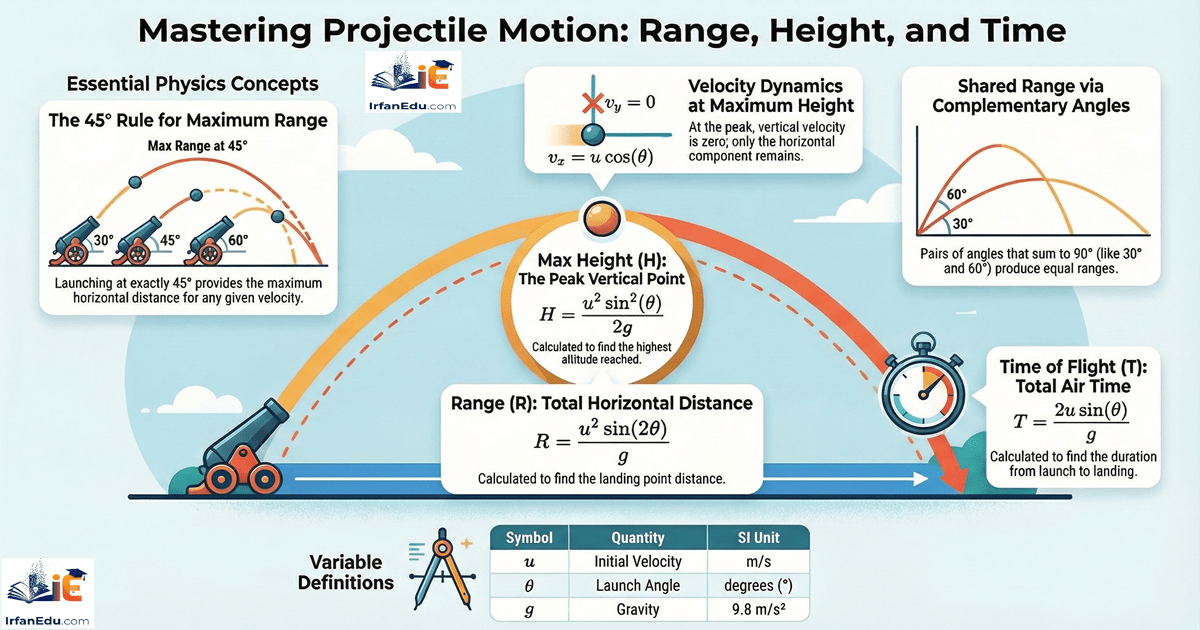
Horizontal distance covered by the projectile from launch to landing point on same level.
R = u²sin(2θ) / g
📐
Maximum Height (H)
The highest vertical point reached by the projectile above the launch point.
H = u²sin²(θ) / 2g
⏱️
Time of Flight (T)
Total time the projectile remains in the air from launch until it returns to same height.
T = 2u·sin(θ) / g
📌
Key Concepts
Important facts about projectile motion
1
Projectile motion = horizontal (uniform) + vertical (uniformly accelerated) motion combined.
2
Maximum range occurs at θ = 45°. At this angle, sin(2θ) = sin(90°) = 1 (maximum).
3
Complementary angles give the same range: e.g., 30° and 60° produce equal R.
4
At maximum height, vertical velocity = 0. Only horizontal component remains.
5
Air resistance is neglected. Gravity g = 9.8 m/s² (use 10 for NCERT approximation).
🔢
Variables & Symbols
All symbols used in projectile motion
| Symbol | Quantity | SI Unit | Formula Role |
|---|---|---|---|
| u | Initial Velocity | m/s | Launch speed |
| θ | Launch Angle | degrees (°) | Angle with horizontal |
| g | Gravity | 9.8 m/s² | Downward acceleration |
| R | Range | m | Horizontal distance |
| H | Max Height | m | Peak vertical height |
| T | Time of Flight | s | Total air time |
| ux | Horizontal Component | m/s | u·cos(θ) |
| uy | Vertical Component | m/s | u·sin(θ) |
Leave a Reply